These two get mixed up constantly at the parts counter, and the reason is understandable. They look like the same transmission, they shift the same way, they take the same fluid, and every technical article about the 10R family covers both in one breath. Then somebody orders a CDF cylinder off a 10R80 listing for a Bronco and finds out the hard way.
Here is the honest summary before you read another word. The 10R80 and the 10R60 are the same design at two different torque tiers. The architecture, the ratio set, the solenoid technology and the valve body layout are shared. The physical parts inside almost entirely are not. ATRA says so directly, and Ford's own bulletins prove it in the part numbering.
Related reading: our Ford 10R80 10-speed guide and the GM-side 10L80 vs 10L90 comparison.
Side by Side
Ford does not publish a public spec sheet for either unit, so the torque numbers and architecture below come out of ATRA's GEARS technical coverage of the 10R family, and the application list comes straight off Ford TSB 22-2428, which covers both transmissions in one bulletin.
| Spec | 10R80 | 10R60 |
|---|---|---|
| Max input torque | 590 lb-ft (800 Nm) | 443 lb-ft (600 Nm) |
| Introduced | 2017 F-150 | 2020 Explorer / Aviator, 2021 Bronco |
| Ratio set | Shared — 4.70 / 2.99 / 2.15 / 1.80 / 1.52 / 1.28 / 1.00 / 0.85 / 0.69 / 0.64, reverse 4.87 | |
| Ratio spread | 7.39, with three overdrive ratios | |
| Geartrain | Four planetary gearsets, six clutches (four rotating, two brake) | |
| Case | One-piece, both units | |
| Pump | Off-axis, driven by straight-cut transfer gears | |
| Solenoids | CIDAS, pressure control and TCC — same base OEM part number across the family | |
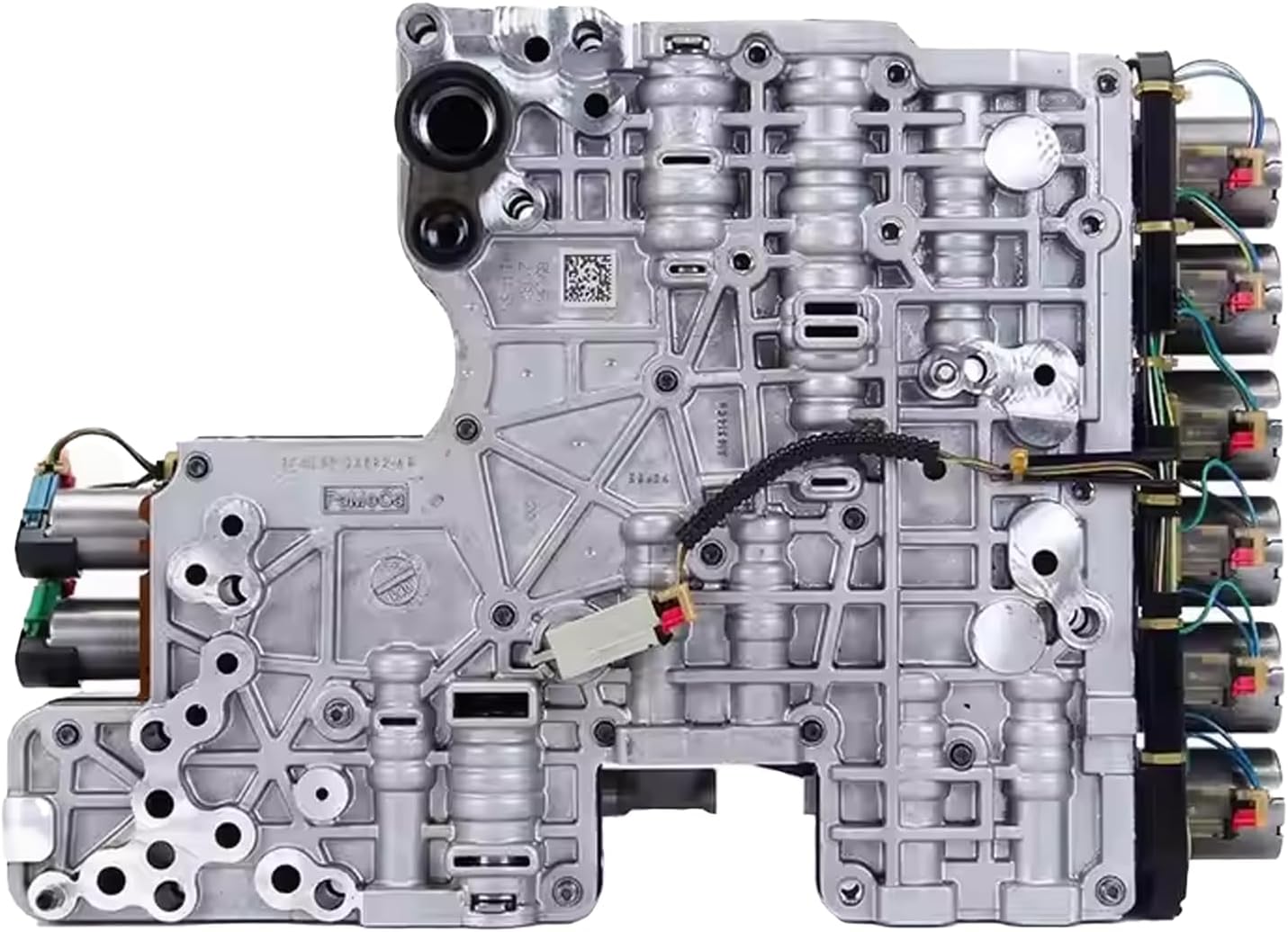
| Valve body | Same layout, not interchangeable between variants | |
| Fluid | Mercon ULV only | |
| Relative size | Larger, heavier | Lighter and physically smaller |
| Normal operating temp | 195°F to 215°F (90°C to 101°C) — this is correct, do not chase it | |
Count the merged cells. That is the whole point of this comparison.
Where Each One Lives
TSB 22-2428 lists the affected population for both units in one place, which makes it the cleanest public application list available. The 10R80 and its hybrid variant, the 10R80 MHT, went into 2017-2023 F-150, 2018-2023 Expedition and Navigator, 2018-2023 Mustang, 2019-2023 Ranger and 2020-2023 Transit. The 10R60 went into 2020-2023 Explorer and Aviator and 2021-2023 Bronco.
Two practical notes off that list. First, the Ranger runs a 10R80, not a 10R60, despite being the smaller truck in the lineup. The 10R60 simply did not exist yet when the Ranger was developed. Second, the 10R60 in hybrid Explorer and Aviator applications carries an auxiliary pump; the 10R60 parts list in TSB 22-2428 includes an auxiliary pump tube seal, HL3Z-7G199-A, flagged "if equipped." If you are quoting a job on one of those, do not assume the teardown matches a Bronco.
The Interchange Question, Answered With Part Numbers
GEARS puts it flatly: most of the parts inside these units are not interchangeable. That is easy to say and easy to ignore, so here is the proof in Ford's own numbering, pulled from the CDF cylinder replacement section of TSB 22-2428.
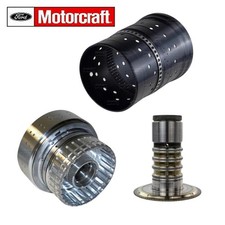
The CDF clutch cylinder, Ford component 7H351, sits at the center of the most common shift complaint on this family. Ford lists it as:
- 10R60: CDF cylinder LP5Z-7H351-B (2.7L / 3.0L applications)
- 10R80 and 10R80 MHT: JL3Z-7H351-B for Transit, 2017-2020 F-150 and 2018-2021 Expedition and Navigator; JR3Z-7H351-B for Ranger, Transit, 2.3L Mustang and 3.3L Explorer Police; ML3Z-7H351-B for 2021 F-150 and later applications
Three different 10R80 cylinders and a fourth for the 10R60. The seal kit tells the same story. The 10R60 CDF job calls for input shaft seals LP5Z-7G091-B, sun gear no. 3 shaft seals LP5Z-7B399-A and a front support to case seal LP5Z-7B031-A, all LP5Z prefix parts specific to that unit. About the only thing that crosses over in that parts list is the front support bolt, JL3Z-7N134-A, twelve of them, shared with the 10R80.
The rule that keeps you out of trouble: order hard parts by transmission code and application, never by "10-speed Ford." Order valve body repair parts by valve, because those genuinely do cross over.
Sonnax Zip Kit 10L80-G1-10R80-ZIP
This is the one part family that legitimately covers both units. Sonnax lists this Zip Kit for the Ford 10R60 and 10R80 as well as the Gen. 1 GM 10L60, 10L80 and 10L90, because they share the same valve body layout. It addresses the leak paths behind delayed engagement, TCC apply and release complaints, burnt clutches and lube failures. Sold through our sister store, CoreTransmissionParts.
View the Zip Kit →Latch valve stem repair kit 105740-47K or browse the full 10-speed collection.
The Failure Each One Is Known For
10R80: the CDF drum sleeve walks
GEARS reports binding, flared shifts and neutralizing as more common on 10R80 applications, caused by the inner sleeve of the C-D-F drum moving out of position. Gear ratio codes may or may not set. Sonnax describes the same failure from the bench side: the sleeve shifts rearward in the drum, exposing fluid ports from behind it, which produces bump slides, neutral shifts, slide shifts and loss of second gear. Ford's own wording in TSB 22-2428 is "axial movement of the CDF clutch cylinder (7H351) sleeve," which is three parties describing one defect.
Two diagnostic traps here, and both cost shops money. First, a drive relearn will not fix it, so do not keep cycling the adaptive procedure hoping it settles. Second, GEARS warns that changing the valve body will often make the issue worse. Sonnax makes the same point from the other direction: drum sleeve movement and sealing ring damage are caused by shift issues, not by the valve body, so a unit that came in the door with CDF drum failure plus shift flares is usually a candidate for reusing its original valve body. Replace the drum.
10R60: the A clutch return spring snap ring pops off
The signature 10R60 complaint is a harsh 7-6 downshift, and Ford TSB 22-2411 names the cause: the A clutch piston return spring retaining snap ring becomes dislodged. The bulletin covers 2022 Explorer, Aviator and Bronco built on or before 9-Aug-2022.
The confirmation test is refreshingly simple. Put the transmission in Selectshift and command a manual 7-6 downshift. If it is harsh, you have your answer. The correction is replacing the entire front support assembly, Ford part LP5Z-7A130-B, plus the A clutch components, and you only need to remove the torque converter, valve body and fluid pump to get at the front support. GEARS notes there is an updated housing assembly to correct this condition, which is what that part number represents.
What They Share on the Bench
Because the valve body layout is common, one diagnostic routine covers both units. Sonnax publishes a combined vacuum test guide for the Ford 10R60 and 10R80 alongside the Gen. 1 GM 10L60, 10L80 and 10L90, and the symptom mapping is worth memorizing:
- A clutch control valve — no forward or reverse, slips on take off, gear ratio codes
- B clutch control valve — 1-2 slip, no 2nd through 5th
- C clutch control valve — no reverse, reverse slip, no 8th through 10th
- D clutch control valve — slips 2nd through 4th, gear ratio codes
- E clutch control valve — no reverse, reverse slip, 3-4 slip, no 4th through 10th
- F clutch control valve — no drive engagement, slips in 1st and 2nd, no 5th through 9th
- TCC regulator valve — low TCC apply pressure in full lockup, converter shudder, TCC slip codes
- Main pressure regulator valve — low line pressure, delayed engagement, poor shift quality, burnt clutches
The latch valves deserve their own line. Sonnax notes they get beaten up by the retainer clip, and that when testing the A, B, C and F clutch latch valve locations you have to seal the bore with your thumb to get a valid reading. A leaking latch valve throws gear ratio codes and delayed or harsh reverse, and it will not show up on a scan tool as anything but a clutch complaint.
Two more shared items that get misdiagnosed. The CIDAS solenoids work directly on the clutch control valves and only produce clutch pressure with current, which is why one of these units will not move at all with the connector unplugged. And check battery condition before you condemn a valve body: Sonnax reports that on 10R80 work trucks in particular, a unit that will not adapt properly after repair, with harsh engagements and erratic up and downshifts that clean up as the vehicle warms, is frequently a failing battery rather than a hydraulic fault. Batteries in this era average about three years.
Fluid and Level, Which Kills More of These Than Anything
Both units take Mercon ULV and only Mercon ULV. GEARS states the wrong fluid produces shift quality concerns and unit failure, full stop.
Checking the level is not guesswork on these. The published procedure, with the vehicle on a hoist and a scan tool connected: move the selector through every range with the engine running, holding roughly six seconds in each, return to Park, remove the fill plug and use the level indicator that is part of the plug. The indicator has two bands, A and B, for different vehicle models. Read area B. The correct level is the center of the B band, and the fluid must be between 96°C and 101°C (206°F to 215°F) when you take the reading. Never drive one low; GEARS warns complete unit failure follows in a short period.
And do not chase the operating temperature. The 195°F to 215°F normal range is the OEM specification. Everything from the friction and steel plates to the fluid chemistry is designed around it, and spikes as high as 230°F while towing on a hot day are expected rather than alarming.
The Adaptive Learning Drive Cycle Is Not Optional
Both units require it after a rebuild or replacement, after TCM replacement or reprogramming, after major engine work, or after air and fuel adaptive values are reset. It is also worth performing before condemning a unit if you suspect prior repairs affected transmission operation. Performed on a level road:
- Record, then clear DTCs.
- Drive until engine and transmission reach normal operating temperature.
- Accelerate from a stop at light throttle, roughly 15 percent, so the 1st through 8th upshifts occur between 1300 and 1600 rpm.
- Keep accelerating, adding slight throttle after the 7-8 upshift at 32 to 38 mph, until you reach 55 mph and the 8-9 and 9-10 shifts complete.
- Brake gently to a full stop and hold the brake five seconds.
- Neutral, wait 1 second. Reverse, wait 2. Neutral, wait 1. Drive, wait 2.
- Repeat steps 3 through 6 six more times, then Park, key off, and wait three to five minutes before driving so the coding writes to the module.
Skipping this is the single most common reason a technically correct rebuild comes back with a shift quality complaint.
Need parts for this job?
CDF cylinders, front supports, valve bodies, solenoid kits, Mercon ULV, filters and full rebuild kits for the Ford 10R80, with the application splits called out so you order the right one.
Shop 10R80 parts →So Which Is Stronger, and Does It Matter?
The 10R80, by 147 lb-ft on paper. But the more useful way to think about it is that Ford built the 10R60 to fit the engines it fits. It is not a weakened 10R80; it is a right-sized member of the same family, lighter and smaller for the fuel economy a unibody SUV needs. In a 2.3L Bronco it is not the weak link.
Where the difference bites is in parts ordering and in power adders. If you are adding meaningful torque to a 2.7L Bronco or an Explorer ST, the 443 lb-ft ceiling is a real number, and the aftermarket extra-capacity clutch kits for the 10R60 exist for exactly that reason. If you are ordering a CDF cylinder, a front support or a valve body, the difference is absolute: nothing crosses over.
One last shared quirk worth telling a customer before they hear it as a complaint. The pump whine is normal. Both units drive an off-axis pump through straight-cut transfer gears, and straight-cut gears whine. GEARS is explicit that the noise does not affect durability. Do not attempt to correct it.
FAQ
Is the 10R80 stronger than the 10R60?
Yes, and unlike some transmission comparisons the gap here is real and published. ATRA's GEARS coverage of the 10R family lists the 10R80 at 590 lb-ft (800 Nm) of input torque and the 10R60 at 443 lb-ft (600 Nm). That is a 147 lb-ft difference on a shared architecture. Both units use four planetary gearsets, six clutches and the same ratio set, so the extra capacity comes from clutch and hard part sizing, not from a different design.
Can I swap a 10R80 into a vehicle that came with a 10R60?
Not as a bolt-in. The two are physically different sizes, the 10R60 being the lighter and smaller of the pair, and Ford's own bulletins list different CDF cylinder, front support and seal part numbers for each. Beyond the hardware, the TCM calibration is matched to the specific unit, and the 10R60 in hybrid applications carries an auxiliary pump. Treat it as a driveline fabrication project, not a bolt-in upgrade.
Do the 10R80 and 10R60 share valve body parts?
The valve body layout is shared but the castings are not. GEARS states plainly that the basic assembly is the same across the 10R family yet cannot interchange between variants, while the CIDAS, pressure control and TCC solenoids carry the same base OEM part number. Sonnax catalogs both units under the same 105740 valve part family and lists one Zip Kit, 10L80-G1-10R80-ZIP, covering the Ford 10R60 and 10R80 along with the Gen. 1 GM 10L60, 10L80 and 10L90. So the repair parts cross over; the housing does not.
What causes the harsh 7-6 downshift on a 10R60?
A dislodged A clutch piston return spring retaining snap ring. Ford TSB 22-2411 covers 2022 Explorer, Aviator and Bronco built on or before 9-Aug-2022 and names that snap ring as the cause. The correction is replacing the entire front support assembly, Ford part LP5Z-7A130-B, along with the A clutch components. You only have to pull the torque converter, valve body and fluid pump to reach the front support, so it is not a full teardown.
What fluid do the 10R80 and 10R60 take, and how do I check the level?
Both take Mercon ULV and nothing else. GEARS is direct about it: the wrong fluid causes shift quality complaints and unit failure. There is no conventional dipstick tube. Run the selector through every range holding roughly six seconds in each, return to Park, pull the fill plug and use the level indicator built into it, reading area B on the indicator. The fluid must be between 96 and 101 degrees C (206 to 215 degrees F) when you read it, and the level belongs at the center of the B band.
Related guides
- Ford 10R80 10-Speed Transmission Guide
- 10R80 Valve Body Problems and Testing
- 10R80 Harsh and Delayed Shifts
- 6R80 vs 10R80: F-150 Transmission Comparison
- 10L80 vs 10L90: Differences and Interchange
Sources
- ATRA / GEARS Magazine — "It's a Family Affair: 10R140, 10R80, and 10R60; The Same But Different," GEARS Staff. Backs the torque ratings (10R80 at 590 lb-ft / 800 Nm, 10R60 at 443 lb-ft / 600 Nm), the shared four-planetary six-clutch architecture and one-piece case, the "most of the parts inside these units are not interchangeable" statement, the shared CIDAS / pressure control / TCC solenoid base part numbers alongside non-interchangeable valve bodies, the Mercon ULV requirement, the fluid level procedure and the 96-101°C reading window at area B, the 195-215°F normal operating range with 230°F towing spikes, the straight-cut transfer gear pump whine as a normal condition, the full Adaptive Learning Drive Cycle, the 10R80 C-D-F drum inner sleeve failure with the warning that a valve body swap often makes it worse, and the 10R60 A-clutch return spring snap ring issue with an updated housing assembly. gearsmagazine.com
- Ford Motor Company — Technical Service Bulletin 22-2428, "10R60/10R80/10R80 MHT Automatic Transmission — Harsh/Delayed Engagement And/Or Harsh/Delayed Shift" (26 May 2023, NHTSA-hosted). Backs the full application list for both units, the build-date cutoffs (15-Aug-2022 for 10R80 and 10R80 MHT, 23-Dec-2022 for 10R60), the listed causes including axial movement of the CDF clutch cylinder (7H351) sleeve, sticking main control valves and the solenoid ID strategy, and every CDF cylinder and seal part number cited in the interchange section: LP5Z-7H351-B for the 10R60 against JL3Z-7H351-B, JR3Z-7H351-B and ML3Z-7H351-B for the 10R80, plus LP5Z-7G091-B, LP5Z-7B399-A, LP5Z-7B031-A, shared front support bolt JL3Z-7N134-A and auxiliary pump tube seal HL3Z-7G199-A. static.nhtsa.gov (PDF)
- Ford Motor Company — Technical Service Bulletin 22-2411, "10R60 Automatic Transmission — Harsh 7-6 Gear Downshift — Built On Or Before 9-Aug-2022" (02 March 2023, NHTSA-hosted). Backs the 10R60 harsh 7-6 downshift section: the 2022 Explorer, Aviator and Bronco population with the 9-Aug-2022 build cutoff, the A clutch piston return spring snap ring as the named cause, and front support assembly plus A clutch component replacement as the correction. static.nhtsa.gov (PDF)
- Transmission Digest — "How to fix Ford 10R60 harsh 7-6 downshift," Wayne Colonna (January 2025). Backs the Selectshift manual 7-6 confirmation test, the note that only the torque converter, valve body and fluid pump have to come off to reach the front support, and the 10R60 front support assembly part number LP5Z-7A130-B. transmissiondigest.com
- Sonnax — "Tackling Ford & GM 10-Speed Valve Body Problems, Failing Batteries & More!", Jim Mobley (March 2025). Backs the bench-side description of the CDF drum sleeve shifting rearward and exposing fluid ports (bump slides, neutral shifts, slide shifts, loss of 2nd), the guidance that drum sleeve and sealing ring damage are caused by shift issues rather than the valve body so the original valve body is often reusable, the CIDAS solenoids working directly on the clutch control valves with no movement when unplugged, the latch valves being damaged by the retainer clip, the wear list covering main pressure regulator, TCC priority, TCC regulator and boost valves, and the failing-battery symptom pattern on 10R80 work trucks with the roughly three-year battery life note. sonnax.com
- Sonnax — "Ford 10R60, 10R80 & GM 10L60/80/90 (Gen. 1) Vacuum Test Guide." Backs the complete valve-to-symptom mapping for the A through F clutch control valves, the TCC regulator, TCC priority and main pressure regulator valves, and the instruction to seal the bore with your thumb when testing the A, B, C and F clutch latch valve locations. sonnax.com
- Sonnax — "Ford 10R60/80/140, GM 10L60/80/90 (Gen. 1 & 2) & 10L1000 Identification Guide" (January 2023). Backs the shared Gen. 1 valve body architecture between the Ford 10R60/10R80 and the GM Gen. 1 units, the note that Ford valve bodies carry logos as an identification aid, and the single Zip Kit 10L80-G1-10R80-ZIP listed as covering both the 10R60 and the 10R80. sonnax.com