This is the comparison that trips up the most people, because the two units are far closer than the names imply. A 4L60E and a 4L80E are different transmissions. A 10L80 and a 10L90 are the same transmission with a deeper clutch stack in two places.
If you take one thing off this page, take this: on these units the generation matters more than the last digit. A Gen. 1 10L90 and a Gen. 2 10L90 differ from each other far more than a Gen. 2 10L80 differs from a Gen. 2 10L90. Get the generation wrong when you order a valve body or a Zip Kit and the parts will not fit. Get the 80 versus 90 wrong and, in the valve body at least, you will mostly be fine.
Related reading: our 8L90 vs 10L90 comparison and 10L80 problems and the valve body recall.
Side by Side
GM does not publish a public specification sheet for the 10L80 the way it does for the 8L90, so the ratio and capacity figures below come off Chevrolet Performance's own Supermatic 10L90 service literature (part no. 19420481), which the 10L80 shares. The RPO codes come straight out of GM bulletin PIP5477C.
| Spec | 10L80 | 10L90 |
|---|---|---|
| GM RPO code | MF6 | MGL |
| Forward speeds | 10 | 10 |
| Ratio set | Identical — 4.696 / 2.985 / 2.156 / 1.779 / 1.526 / 1.278 / 1.000 / 0.854 / 0.689 / 0.636 | |
| Overall ratio spread | 7.39 | 7.39 |
| Overdrive gears | 3 | 3 |
| Gearsets / clutches | 4 simple planetary gearsets, 6 multiple disc clutches (2 brake, 4 rotating) | |
| C clutch steels | 5 | 6 |
| D clutch steels | 6 | 7 |
| A / B / E / F packs | Identical — 2 A + 1 A bottom, 4 B + 1 B bottom, 4 E + 1 top + 1 bottom, 4 F | |
| Pump | Off-axis variable vane, located in the valve body | |
| Fluid | DEXRON ULV only (P/N 19352619 US) — not DEXRON VI or HP | |
| Valve body family | Shared — Sonnax 105740 series, one Zip Kit for Gen. 1 | |
Look at how much of that table is a merged cell. That is the honest answer to "which is stronger."
The Only Hardware Difference That Matters
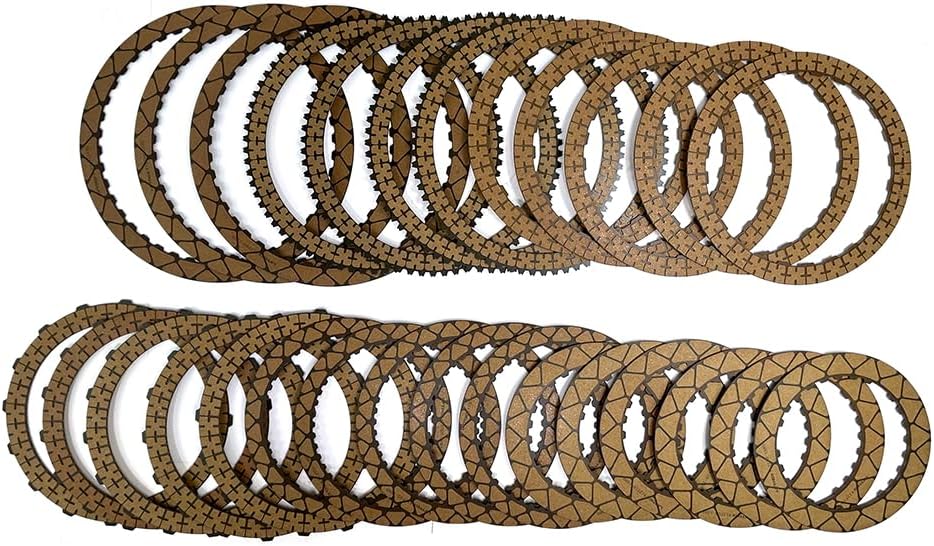
Raybestos Powertrain publishes the full factory steel counts for both service modules, and laying them next to each other settles the argument. The 10L80 module, part no. STMGM31, contains 2 A clutch, 1 A clutch bottom, 4 B clutch, 1 B clutch bottom, 4 E clutch with 1 E top and 1 E bottom, 5 C clutch, 6 D clutch and 4 F clutch steels. The 10L90 module, STMGM32, is the same list with one change: 6 C clutch and 7 D clutch.
One extra plate in C, one extra in D. That is the entire physical difference in the clutch stack, and it is why the 10L90 goes behind the LT4 and the 10L80 goes behind the L86. C and D are the packs carrying load in the gears where a supercharged engine puts torque through the unit, so GM deepened exactly those two and left the rest alone.
The practical consequence for a rebuilder: a 10L80 clutch kit will not correctly rebuild a 10L90. You will be two frictions and two steels short across C and D, and stacking a 10L80 kit into a 10L90 drum leaves you with clearance you cannot shim out honestly. Order by the RPO, not by the casting.
Feed Limit Low Valve Kit (Sonnax 105740-54K)
This is the valve behind the N242480630 recall, and it fits both the 10L80 and the 10L90. The GM remedy is monitoring software; this kit is the actual repair for the worn bore. Sold through our sister store, CoreTransmissionParts.
View the feed limit low valve kit →Generation Is the Split That Actually Costs You Money
Per Sonnax's 10-speed identification guide, GM's 10L60, 10L80 and 10L90 all started in 2017 alongside the Ford 10R60 and 10R80, sharing the Gen. 1 valve body. GM moved to Gen. 2 in 2019, adding a default disable solenoid and a lower valve body casting. Ford never followed; the 10R family kept the Gen. 1 architecture. So a Gen. 1 valve body article about a 10R80 applies to your 2018 10L80 and does not apply to your 2021 10L80.
Gen. 1: latch valves
Gen. 1 units regulate clutch apply with latch valves, four of them in the 10L60, 10L80 and 10L90. Transmission Digest's TASC Force coverage is blunt about these: they wear from constant back-and-forth motion, they side-load under high pressure, and the spring can buckle and hog out the bore. A stuck latch valve gives you extremely harsh shifts and dangerous bind-up; a leaking one gives you erratic shifts, delayed engagement, solenoid codes and burnt clutches. Vacuum test to 16 in-Hg or higher at all three locations on each valve, sealing the bore with your thumb, and inspect visually with a flashlight for spring-buckle damage that a vacuum test can miss.
Gen. 2: feed limit valves and boost balls
Late in 2019 GM deleted the latch valves entirely and replaced that strategy with two new valves, feed limit low and feed limit high, working against a set of checkballs Sonnax calls boost balls. The feed limit low output sits under the number 5 boost ball, seating it against the separator plate while line pressure is below roughly 120 psi and releasing above the 119 psi limit spec, which moves the clutch control regulating valve faster once pressure is up.
Gen. 3: the recall fix in hardware
A third-generation service valve body entered production June 19, 2025 under two part numbers, 24071206 for 3.0L diesel and 24071207 for 5.3L and 6.2L gas, both ETRS with electronic park control only. The quickest visual identification is the TCC solenoid, which moved to the case side of the valve body. The lower casting is gone and the default disable solenoid now mounts to the lower cover plate. Functionally, the feed limit high valve train has been eliminated along with the C and F boost balls, and the default valve oil circuit was redesigned specifically to prevent the wheel lockup condition. Verify fitment by VIN before ordering one.
The Recall Both Units Share
In March 2025 GM issued Safety Recall N242480630, filed with NHTSA as campaign 25V148000, covering the 10L1000 and Gen. 2 10L60, 10L80 and 10L90. The listed population is 2019-2020 Cadillac CT6, 2020-2021 CT4 and CT5, and 2020-2022 Chevrolet Camaro, with the defect described as internal damage causing the wheels to lock up.
The mechanism is worth understanding because the recall does not repair it. The feed limit low valve limits solenoid feed to the default disable solenoid, which is powered on at all times and only drops out during a default event. That solenoid positions the default enable and default select valves. When the feed limit low bore wears and feed pressure falls, those two valves can direct line pressure into the exhaust backfill circuit and apply the A, B, C and D clutches through their exhaust ports, which is second gear. Shifting into seventh or eighth, the vehicle drops straight to second, or the drive wheels momentarily lock.
Two things every tech should know about this one. First, it is heat dependent, so the unit usually behaves until it is hot, and the fault code to look for is P0747, reporting the E clutch on when it should be off. Second, GM's remedy is TCM monitoring software that commands fifth gear and lights the MIL when it detects the onset of bore wear. That gets the driver off the road. The worn valve is still worn. Sonnax has documented the feed limit low wearing out in as little as 35,000 miles on tow trucks and heavy-trailer vehicles, and continued driving in that condition will destroy clutch packs from intermittent bind-up.
Bench check: vacuum test the balance end of the feed limit low valve, which is where the wear concentrates. It should read 18 in-Hg or higher and should match the feed limit high, since the two are the same valve train with different springs.
Before You Condemn the Valve Body
GM bulletin PIP5792E covers 6L80, 6L90, 8L90, 10L80, 10L90 and 10L1000 vehicles with a harsh shift, shudder, surge, stall or high transmission fluid temperature, before or after an overhaul. Root cause on low-mileage vehicles is frequently a twisted cooler line, and on ETRS transmissions (RPO MHS, MQC) a twisted line can set P27EC in the TCM. You may have to drop the underbody panels to see the lines clearly. Disconnect the line at the auxiliary cooler, untwist it, reconnect and check fluid level. Replace the line if the rubber is misshapen.
It is a five-minute inspection that has saved a lot of shops from tearing into a unit that was never the problem.
Fluid
Both units take DEXRON ULV only. Chevrolet Performance's 10L90 literature states it in plain text: do not use DEXRON VI or DEXRON HP. There is no dipstick; level is set through a tube in the bottom pan with fluid temperature between 75 and 80 C (167 to 176 F), and the case plug torques to 22 N.m (16 lb-ft). One detail people skip: the quart bottles of ULV need to be shaken before pouring to put the additive package back into suspension.
So Which One Do You Want?
If a healthy 10L80 is already in the vehicle, there is no reason to chase a 10L90. Two extra clutch plates are not worth a calibration headache, and both units carry the identical feed limit low liability. If you are building behind an LT4 or anything supercharged, start with the 10L90 core so the C and D packs are already deep. If you are buying a used core for either, ask the generation and the RPO before you ask the price, then vacuum test the valve body before it goes in a car.
Need parts for this job?
Feed limit valve kits, Gen. 1 latch valve repair kits, clutch packs by RPO, filters and rebuild kits for the GM 10-speed family.
Shop 10-speed transmission parts →FAQ
Is the 10L90 stronger than the 10L80?
Yes, but by a narrower margin than the naming suggests, and the difference is entirely in the clutch stack. Raybestos publishes the factory steel counts for both units: the 10L80 module (STMGM31) carries 5 C-clutch and 6 D-clutch steels, while the 10L90 module (STMGM32) carries 6 C and 7 D. Every other pack is identical, 2 A, 1 A bottom, 4 B, 1 B bottom, 4 E with a top and bottom steel, and 4 F. Two extra plates across two packs is the whole hardware story. Gear ratios, case, pump and valve body family are shared.
How do I tell a 10L80 from a 10L90 in a salvage yard?
Read the RPO code, not the case. GM bulletin PIP5477C lists the 10L80 as RPO MF6 and the 10L90 as RPO MGL. In that bulletin's population the MGL 10L90 went into the 2017-2018 Camaro, while MF6 10L80 units went into 2018 Escalade and Yukon Denali models. The cases look the same from the outside, so the RPO tag and the broadcast code are the only reliable identification.
Do the 10L80 and 10L90 use the same valve body parts?
Largely yes, and that surprises people. Sonnax catalogs both units in one 105740 part family and lists a single Zip Kit, 10L80-G1-10R80-ZIP, covering Gen. 1 10L60, 10L80, 10L90 and the Ford 10R60/10R80. What actually splits the catalog is generation, not the last digit. One Gen. 2 exception worth knowing: the LPC signal damper piston kit 105740-05K is listed for Gen. 2 10L80 and 10L90 only, not the 10L60.
What is the feed limit low valve recall on these transmissions?
In March 2025 GM issued Safety Recall N242480630, filed with NHTSA as campaign 25V148000, covering Gen. 2 10L60, 10L80, 10L90 and 10L1000 units. The feed limit low valve wears in its bore and stops holding solenoid feed pressure to the default disable solenoid. That solenoid controls the default enable and default select valves, so when feed pressure drops those valves can apply clutches through the exhaust backfill circuit. The result is a drop from seventh or eighth straight to second, or a momentary rear wheel lock-up. The remedy is TCM monitoring software that commands fifth gear and lights the MIL, not a valve replacement.
Can I swap a 10L90 in place of a 10L80?
Mechanically it is close, but it is not a plug-in. The two share the ratio set, case family and bellhousing pattern, so hard fitment is not the obstacle. The TCM calibration is, because the controller is matched to the solenoid characteristics of a specific transmission, and the deeper C and D packs in the 10L90 shift on different clutch volumes. Dropping a 10L90 in without the matching calibration gives you shift quality complaints and adaptive faults, not a free upgrade.
Related guides
- GM 10L80 Problems and the Valve Body Recall
- 10L80 Shift Solenoid Symptoms
- 8L90 vs 10L90: Differences and Interchange
- Ford 10R80 10-Speed Transmission Guide
- 10R80 Valve Body Problems and Testing
Sources
- General Motors — Preliminary Information bulletin PIP5477C, "10L90 10L80 10 Speed Automatic Transmission Exchange Program" (NHTSA-hosted). Backs the RPO identification used throughout this article: 10L80 = RPO MF6, 10L90 = RPO MGL, plus the affected population (2018 Cadillac Escalade, 2017-2018 Chevrolet Camaro, 2018 GMC Yukon Denali) and the short list of components serviceable without a full unit exchange. static.nhtsa.gov (PDF)
- Raybestos Powertrain — GM 10L80 Steel Clutch Pack (STMGM31) and GM 10L90 Steel Clutch Pack (STMGM32) product data. Backs the exact factory steel counts that separate the two units: 5 C and 6 D in the 10L80 against 6 C and 7 D in the 10L90, with the A, B, E and F packs identical. STMGM31 • STMGM32
- Sonnax — "Ford 10R60/80/140, GM 10L60/80/90 (Gen. 1 & 2) & 10L1000 Identification Guide." Backs the generation timeline: GM 10L60/80/90 and Ford 10R60/10R80 both starting in 2017 on the Gen. 1 valve body, and GM moving to Gen. 2 in 2019 with a default disable solenoid and an added lower valve body. sonnax.com
- Sonnax — "Understanding '19-Later GM 10-Speed Clutch Regulating Changes," Jim Dial (May 2025). Backs the Gen. 1 to Gen. 2 hydraulic change: deletion of the latch valves in late 2019, introduction of the feed limit low and feed limit high valves with boost checkballs, and the number 5 boost ball seating below roughly 120 psi and unseating above the 119 psi limit spec. sonnax.com
- Sonnax — "GM Trucks Gen. 3 10L60/80/90 Service Valve Body: Changes & Identification," Jim Dial (March 2026). Backs the Gen. 3 details: June 19, 2025 production start, part numbers 24071206 (3.0L diesel) and 24071207 (5.3L / 6.2L gas), ETRS-with-electronic-park-control fitment, the TCC solenoid relocated to the case side as the quickest ID, elimination of the lower casting and the feed limit high valve train, and the redesigned default valve circuit that prevents the wheel lockup condition. sonnax.com
- Sonnax — "GM 10L60/80/90 (Gen. 2) Valve Body Layout." Backs the shared-parts claim and its one exception: the 105740 series covering all three units, the feed limit low valve kit 105740-54K tied to momentary wheel lockup, code P0747 and downshift-to-second, and the LPC signal damper piston kit 105740-05K listed for Gen. 2 10L80 and 10L90 only. sonnax.com
- Transmission Digest — "GM's new 10-speed safety recall: What you need to know," Jim Dial (TASC Force Tips, June 2025). Backs the recall mechanism and the bench numbers: recall N242480630 scope, the default disable / default enable / default select valve chain, the exhaust backfill second-gear default, the seventh-or-eighth-to-second and wheel lockup complaints, the heat dependence, DTC P0747 as the E-clutch indicator, wear as early as 35,000 miles on hard-worked units, the fifth-gear software remedy, and the 18 in-Hg vacuum test on the feed limit low balance end. transmissiondigest.com
- Transmission Digest — "Why Every 10-Speed Rebuild Needs Latch Valve Attention," Chris Leach (TASC Force Tips, July 2026). Backs the Gen. 1 latch valve section: four latch valves in the GM Gen. 1 10L60/80/90 and Ford 10R60/10R80, the side-loading and spring-buckle wear modes, the failure symptoms from erratic shifts to bind-up, and the 16 in-Hg minimum vacuum reading at all three locations per valve. transmissiondigest.com
- General Motors — Preliminary Information bulletin PIP5792E (published 07/29/2022, NHTSA-hosted). Backs the cooler line section: the 6L80 / 6L90 / 8L90 / 10L80 / 10L90 / 10L1000 population, the harsh shift, shudder, surge, stall and high fluid temperature complaints, twisted cooler line as root cause on low-mileage vehicles, and DTC P27EC setting in the TCM on ETRS transmissions (RPO MHS, MQC). static.nhtsa.gov (PDF)
- NHTSA — Part 573 Safety Recall Report, campaign 25V148000 (General Motors LLC). Backs the recall filing: GM recall number N242480630, the population across 2019-2020 Cadillac CT6, 2020-2021 CT4 and CT5, and 2020-2022 Chevrolet Camaro, the defect description, and the TCM monitoring software remedy. static.nhtsa.gov (PDF)
- Chevrolet Performance — Supermatic 10L90 Transmission Kit installation instructions, part no. 19420481. Backs the shared ratio set (4.696 through 0.636), the four planetary gearsets with two brake and four rotating clutches, the off-axis variable vane pump inside the valve body, DEXRON ULV only (P/N 19352619 US) with the explicit warning against DEXRON VI and HP, the 75-80 C fill window, the 22 N.m case plug torque, and the statement that controllers and transmissions are matched. chevrolet.com (PDF)
- General Motors — Chevrolet Performance SuperMatic 10L90-E product information. Backs the 7.39 overall gear ratio spread, the 4.70 first-gear ratio and the three overdrive gears shared by both units. gmspecialtyvehicles.com