The 200-4R showed up for the 1981 model year as GM's first 4-speed overdrive automatic, built with a multi-pattern bellhousing so it could go behind Chevrolet, Buick-Olds-Pontiac, and Cadillac engines in the same production run. It ended up behind everything from the diesel-powered G-bodies to the turbocharged Buick Grand National and Turbo T-type, and it is still the stock choice for anyone keeping a G-body or early Corvette period-correct. It is also a transmission with a short list of real, repeatable failure points, and almost none of them are the band or clutch itself. The band and clutch are usually just where the damage shows up after something upstream let them slip.
This is that list, in the order a bench tech should actually check them: the TV cable, the TV boost valve, the reverse boost valve, the 2-4 servo, and the sun shell. Each one has a distinct symptom set, and guessing wrong wastes a rebuild on parts that were never the problem.

The TV Cable Is the Root Cause More Often Than the Band Is
Start here on every 200-4R complaint, before you pull a pan or hook up a gauge. This transmission has no electronic pressure control. The throttle valve cable is the only thing telling the unit how hard the engine is working, and that signal sets line pressure for every shift. Sonnax's documentation on the TV cable corrector kit states plainly that in most GM and Ford cable-controlled units, including the TH200, 200-4R, TH200C, 4L60 (700-R4), AOD and AXOD, the throttle valve cable pulls itself out of adjustment at wide-open throttle. That is a design habit of the whole cable-controlled family, not a one-off defect in a bad cable.
Once the cable creeps loose, every hard-throttle shift happens at lower line pressure than the load calls for. A shift that should be firm turns into a slipping shift, and a slipping shift makes heat. That heat burns the 2-4 band first, then the 3-4 clutch, and by the time the car is in the shop for a flare or a burnt smell, the cable has usually been quietly wrong for weeks. Sonnax's AS1-01K corrector kit addresses this by adding a spring and stop to the cable linkage so excess pull is absorbed instead of dragging the adjuster out of position. If the car has had any carburetor swap, aftermarket throttle bracket, or engine swap, assume the cable geometry is wrong until you verify it, because none of those changes were engineered against the factory cable travel.
How to check it in ten minutes
- With the engine off, work the throttle by hand through its full travel and confirm the TV cable pulls and returns smoothly with no binding.
- Set the cable per factory procedure, then road test for a firm, complete kickdown at wide-open throttle. A soft or incomplete kickdown says the cable is still short of full travel.
- If the cable was recently adjusted and the car has seen hard use since, re-check it. A cable that pulls out of adjustment once will do it again under the same conditions.
A Leaking TV Boost Valve Burns Bands Even With a Perfect Cable
This is the failure that gets blamed on a bad cable even when the cable is fine, because the symptoms overlap. Inside the pump, the throttle valve boost valve and sleeve regulate how much throttle boost oil reaches the pressure circuit. Sonnax's part documentation for the TV boost valve kit identifies the failure directly: oil loss between the outside diameter of the TV sleeve and the pump body bore, which produces soft slide shifts, a burned 3-4 clutch, and reduced band life. That is the same damage pattern a bad cable produces, except the cable can be adjusted perfectly and the transmission will still cook a band because the pressure signal is leaking out internally before it ever reaches the clutch or band apply circuit.
Sonnax sells the fix as a ladder of bore sizes rather than one universal kit, because the pump bore wears to different diameters depending on how many miles and how much heat it has seen: a .423 in. kit, two kits at .471 in., and two at .500 in., each a hardened-steel sleeve and valve with O-rings separating the throttle pressure and reverse boost circuits to stop the cross-leak. A rebuilder has to measure the actual bore before ordering, not guess from the mileage.
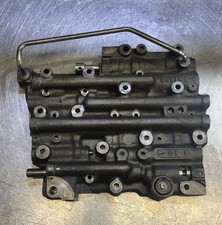
200-4R Valve Body
When the TV boost bore has worn past what a sleeve kit can seal, or when multiple valve body circuits are leaking at once, a remanufactured valve body resets every bore and valve to spec in one part instead of chasing leaks one sleeve at a time.
View on Gearbox Insider →Worn Reverse Boost Valve: Low, Delayed, or No Reverse
Reverse complaints on a 200-4R point at a different bore. Sonnax's documentation on the reverse boost valve kit explains the mechanism: the valve's sleeve and the aluminum pump body bore expand at different rates as the transmission heats up, and over time that differential thermal expansion lets the sleeve develop excess clearance and scrub the bore. The symptom list Sonnax attaches to this wear is specific and useful for diagnosis: low reverse boost, delayed reverse, low line pressure, and poor upshift in manual low. If a car backs up fine cold but reverse goes soft or delayed once the transmission is hot, that temperature-dependent pattern is the signature of this exact wear mode, because a cold, thicker fluid still seals a slightly worn bore that hot, thinner fluid will not.
The K77898 kit replaces the worn factory sleeve and valve with hardened steel components and adds O-rings to seal the circuit, which restores reverse boost pressure without requiring a full pump rebuild in cases where this is the only worn bore.
Weak or Burned 2-4 Band: Check the Servo Before You Blame the Band
A burned 2-4 band is frequently diagnosed as a bad band and replaced as a bad band, and then it burns again within a few thousand miles because the actual problem was never touched. Sonnax's documentation for the super hold servo kit identifies the real cause in a lot of these comebacks: the stock TH200/200-4R/TH200C servo has limited apply area, which does not generate enough clamping force on the band. Under load, the band slips instead of holding, and a slipping band burns exactly the same way a slipping clutch does, just at the 2-4 shift instead of the 3-4 shift.
Sonnax's fix increases apply area by 17% over the Grand National servo, which was already the factory's higher-apply-force unit for the turbocharged cars, and adds an O-ring seal between the piston and pin to stop cross-leakage between the apply and release sides of the piston, so the full apply pressure the pump is generating actually reaches the band instead of bleeding past the piston. If a 2-4 band has burned more than once on the same vehicle, replacing it a third time without upgrading the servo is just scheduling the fourth failure.
Sudden Loss of 2nd, 4th, and Reverse Together: Check the Sun Shell
Everything above is a hydraulic problem: a leak, a worn bore, or insufficient apply force. The sun shell failure is mechanical, and it presents differently. The sun gear splines that live inside the shell are shared by 2nd, 4th, and reverse, and builders who work on these units regularly report the shell's internal splines stripping under load as a recurring hard-parts failure independent of any pressure or cable issue. When that happens, the unit does not flare or slip its way into failure the way a burned band does. It simply stops having 2nd, 4th, and reverse, often within the same drive cycle, because all three ranges depend on a shell that has lost its grip on the sun gear.
The practical distinction for diagnosis: a slow onset with flare or slip before the gear disappears points at a hydraulic cause further up this list. An abrupt loss of multiple unrelated ranges with no preceding flare points at the sun shell, and that means pulling the pan and inspecting the splines rather than chasing a pressure test that will come back normal.
Lockup That Drops Out Hot or Comes On Too Early: The TCC Apply Valve Bore
The converter clutch on this unit is an on/off circuit: one solenoid and one apply valve that rides in a bore in the aluminum pump. That bore wears. Sonnax's documentation for its 200-4R TCC apply valve kit lists the symptoms as no lockup, lockup that falls out when hot, fluid blown out of the fill tube, and lockup immediately after second gear, caused by excessive valve-to-bore clearance letting signal oil leak past the spool while converter feed oil leaks into the signal circuit (Sonnax 77805-K). The same page warns that cross-leaks can float the valve to a midway position that restricts cooler flow and burns the converter, and that PWM and non-PWM valves must never be mixed. The 200-4R is non-PWM.
Before blaming the pump, rule out the wiring. B&M's 200-4R troubleshooting list for no converter clutch apply covers voltage not reaching the solenoid, a harness plug not fully seated, connectors on the wrong switches, pinched wires and a stuck converter clutch valve (B&M 35265 instructions). And do not let anyone wire lockup off in overdrive: B&M states GM four speeds should always be in lockup in fourth because of the increased chance of overheating the converter (B&M 80217 instructions). The full circuit and test sequence is in our 200-4R TCC lockup guide.
Fluid: The Factory Spec Is Gone, and That Is Fine
The 200-4R was built around Dexron II and was later serviced with Dexron III. GM no longer licenses either. Valvoline's official Dexron VI product information sheet states that its Dexron VI/Mercon LV full synthetic fluid is officially licensed and approved by GM, specifically recommended for Dexron VI, Dexron II, and Dexron III applications, and fully back-serviceable wherever Dexron II or Dexron III is called for. That means a current Dexron VI fill is the correct service fluid for this unit. There is no reason to hunt down discontinued Dexron II or III product, and doing so is a waste of money since the current fluid is formulated to cover the older specs.
| Item | Figure |
|---|---|
| Original factory fluid | Dexron II, later serviced with Dexron III |
| Current correct service fluid | Dexron VI (back-serviceable for Dexron II/III per Valvoline's licensed product spec) |
| Bellhousing patterns | Chevrolet, Buick-Olds-Pontiac (BOP), and Cadillac, built on one case |
| Production years | 1981 through 1990 |
Diagnosis in the Order That Actually Saves Time
- Check and set the TV cable first. It is free, fast, and the most common root cause on this unit. Do this before you open anything.
- Pressure test hot, including Reverse at idle. Reverse at a hot idle is the condition that exposes a worn reverse boost valve, and a general line pressure test across the ranges will flag a leaking TV boost valve before you pull the pump.
- Inspect the 2-4 servo bore and piston seal if the band has burned more than once. Repeat band failures on the same unit are a servo problem, not a band problem.
- Treat a sudden, multi-range loss as mechanical, not hydraulic. If 2nd, 4th, and reverse vanish together with no preceding flare, go straight to the sun shell instead of running a pressure test that will tell you nothing.
- Service the fluid with Dexron VI on a real interval, and do not assume a fluid-only service fixes a worn bore. It will not; it will just delay the symptom until the fluid is hot again.
The pattern across every failure here is the same: the 200-4R is not a transmission that wears out randomly. It fails at specific, well-documented points, and once you know which symptom maps to which bore or part, a repeat customer with a repeat complaint usually means the first repair fixed the symptom and missed the cause.
FAQ
What is the most common problem with a GM 200-4R transmission?
A throttle valve cable that has walked out of adjustment. Sonnax's technical documentation on the TV cable corrector kit states that in most GM and Ford cable-controlled units, including the 200-4R, the TV cable pulls itself out of adjustment at wide-open throttle. Because the TV cable sets line pressure on this unit, a cable that has crept loose starves every hard shift of pressure, and that slipping shift is what burns the 2-4 band and the 3-4 clutch.
Why does my 200-4R have weak, delayed, or no reverse?
Check the reverse boost valve and sleeve before anything else. Sonnax's part documentation for the reverse boost valve kit describes wear developing in the sleeve or pump body bore from differential thermal expansion between the steel sleeve and the aluminum pump body as the transmission heats up, which leaks reverse boost oil and produces low reverse boost, delayed reverse, low line pressure, and poor upshift in manual low.
Why does my 200-4R keep burning the 2-4 band or the 3-4 clutch?
Two separate things cause this and both need to be ruled out. Sonnax's TV boost valve kit documentation points to throttle boost oil leaking past the throttle valve sleeve, which produces soft slide shifts, a burned 3-4 clutch, and reduced band life. Separately, Sonnax's super hold servo kit page attributes band burning to the stock 2-4 servo's limited apply area, which does not clamp the band hard enough and lets it slip and cook under load.
What does it mean if a 200-4R suddenly loses 2nd, 4th, and reverse all at once?
That combination points at the sun shell, not the valve body. The sun gear splines inside the sun shell drive 2nd, 4th, and reverse, and builders who work on these units report the shell's splines stripping under load as a recurring mechanical failure separate from any hydraulic problem. If the unit drops multiple unrelated gears at once with no warning and no flare beforehand, pull the pan and inspect the shell before chasing a pressure problem.
What transmission fluid does a GM 200-4R use?
The 200-4R was factory filled with Dexron II and later serviced with Dexron III, both of which GM has discontinued licensing. Valvoline's official Dexron VI product information sheet states its Dexron VI/Mercon LV fluid is fully back-serviceable and specifically recommended wherever Dexron II or Dexron III is called for, so a current Dexron VI fill is the correct service fluid. There is no need to hunt down discontinued Dexron II or III product.
TV cables, valve bodies, pumps, sun shells, servos and rebuild kits for the 200-4R — shipped fast from the USA.
Shop 200-4R parts →Sources
- Sonnax — "Carburetor TV Linkage Corrector Kit" (TV cable corrector, part AS1-01K). Backs the claim that in most GM and Ford cable-controlled units, including the TH200, 200-4R, TH200C, 4L60 (700-R4), AOD and AXOD, the throttle valve cable pulls itself out of adjustment at wide-open throttle, and that the corrector kit adds a spring and stop to absorb excess cable pull. sonnax.com
- Sonnax — "TV Boost Valve Kit" (part 77917-471, .471 in. bore). Backs the TV boost valve failure mode: oil loss between the outside diameter of the TV sleeve and the pump body, producing soft slide shifts, a burned 3-4 clutch, and reduced band life; and the hardened-steel, O-ring-sealed design that stops the cross-leak between throttle pressure and reverse boost circuits. sonnax.com
- Sonnax — "Reverse Boost Valve Kit" (part K77898). Backs the reverse boost valve failure mechanism: differential thermal expansion between the steel sleeve and aluminum pump body causing the sleeve to develop excess clearance and scrub the bore, producing low reverse boost, delayed reverse, low line pressure, and poor upshift in manual low; and the hardened-steel, O-ring-sealed replacement design. sonnax.com
- Sonnax — "Super Hold Servo Kit" (part K65703-1, 2-4 servo). Backs the claim that the stock TH200/200-4R/TH200C servo has limited apply area that fails to adequately clamp the 2-4 band, the resulting band slip and burn, and the 17% greater apply area plus piston-to-pin O-ring seal of the Sonnax replacement that prevents apply-to-release cross-leakage. sonnax.com
- Valvoline — Dexron VI/Mercon LV (ATF) Product Information Sheet. Backs the fluid section: that Valvoline's Dexron VI/Mercon LV full synthetic ATF is officially licensed and approved by GM, is specifically recommended for Dexron-VI, Dexron-II and Dexron-III applications, and is fully back-serviceable wherever Dexron-II or Dexron-III is called for. valvoline product data (PDF)
- Sonnax — "TCC Apply Valve Kit" (part 77805-K, non-PWM 200-4R/4L60). Backs the lockup section: pump bore wear causing no lockup, hot drop-out, lockup right after second and fluid out the fill tube; the midway valve that restricts cooler flow; and the PWM vs non-PWM mismatch warning. sonnax.com
- B&M Racing & Performance — Shift Improver Kit 35265 for THM200-4R, installation instructions. Backs the no converter clutch apply / no release troubleshooting list. B&M instructions (PDF)
- B&M Racing & Performance — Power Switch 80217 for GM lockup converters, installation instructions. Backs the statement that GM four speeds, including the 1981-86 TH200-4R, should stay in lockup in fourth gear to avoid overheating the converter. B&M instructions (PDF)