Almost every 200-4R that comes in cooked gets blamed on the cooler. The customer says it needs a bigger cooler, the last shop bolted a tube-and-fin unit in front of the condenser, and it cooked again eight months later. The cooler is rarely the whole story. A 200-4R makes heat in three specific places, and two of them are hydraulic problems that no amount of cooler capacity will fix, because a cooler cannot cool fluid that never reaches it.
Heat in an automatic comes from slip. Slip in the converter, slip at a clutch or band that is supposed to be holding, and slip that gets worse because the fluid meant to carry the heat away is being restricted at the exact moment the unit needs it most. In the 200-4R all three run through one valve.


The Pressure Regulator Is a Priority Valve, and Line Pressure Wins
This is the single most important thing to understand about heat in this unit, and most techs never get told it. The main pressure regulator valve does not just regulate line pressure. In the majority of common transmissions, the PR valve also meters the volume of oil going to the torque converter, which means it controls converter charge, cooler flow and lube flow. Sonnax describes it as a priority valve: it gives priority to line pressure and less priority to converter and lube oil.
The PR valve regulates by balancing spring and boost forces on one end against balance oil pressure on the other, holding regulated line pressure in the 50-250 psi range typical of automatics. Sonnax calls it "in balance" when the valve sits in its regulating position with converter charge open, and "out of balance" when it strokes over and converter charge is restricted or cut off entirely. On a healthy unit that happens for an instant during every shift, which is that needle twitch you see on the pressure gauge; watch a flow meter at the same time and you will see cooler flow dip right along with it. That is normal. The problem is when the valve stays out of balance.
Sonnax lists the two ways it happens. Too much force on the spring or boost end: an over-adjusted or too-strong PR spring, or a worn boost valve cross-leaking and driving reverse line pressure up. Or not enough balance pressure on the other end, from bore wear, end plug leaks, or a weak pump. Their examples of worn PR bores name the TH400 and TH200C specifically, and the 200-4R pump shares that family's habits.
Here is what that means on the road. Picture the car lugging up a grade, RPM low, throttle valve calling for high pressure. If pump output cannot maintain line pressure, the PR valve moves out of balance. Because it prioritizes line pressure, you can have near-normal line pressure and near-normal clutch holding capacity while cooler and lube flow drop toward nothing. The gauge looks fine. The transmission is cooking. That is where melted planets, a black ring on the front of the converter, and burned paint peeling off the converter come from.
Sonnax addresses the 200-4R pump directly: oversized pressure regulator valve 77917-06 for erratic line pressure, low line rise, clutch slippage, excess pump noise and 3-4 clutch failure, reamed with the 77917-TL tooling. Low base line pressure on its own points at the main PR spring, 77917-08. Erratic pressure that comes and goes can be the pump spring spacer 77917-RV, and a worn pump slide pivot pin 65797 shows up under both low and high line pressure. On any 200-4R pump you have on the bench for a heat complaint, all four are worth looking at before you touch the cooler.
Tru-Cool LPD47391 40,000 GVW Stacked-Plate Transmission Cooler
Once the hydraulics are right, capacity is worth having. A stacked-plate cooler moves considerably more heat per square inch of frontal area than a tube-and-fin unit, which matters on a 200-4R behind a towing or heavy-vehicle application. Includes mounting hardware.
View on Gearbox Insider →A 200-4R That Will Not Hold Lockup Is Making Heat
Converter slip is heat, full stop. Unlocked at highway speed the converter is doing the heating while the cooler is doing the cooling, and on this unit the margin is not generous. Any lockup fault on a 200-4R is therefore a cooling fault.
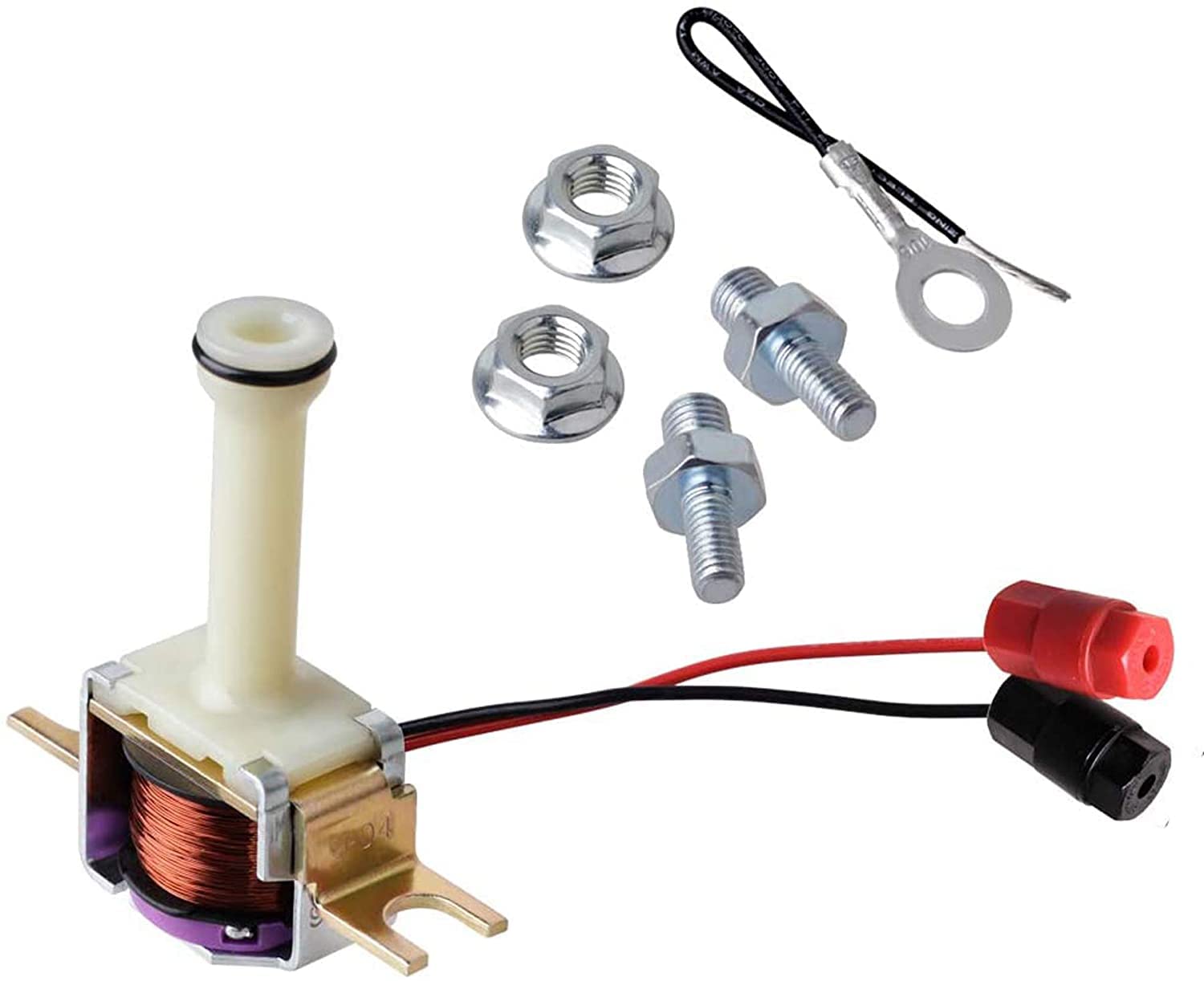
The lockup circuit has one electrical part and it is worth knowing exactly how it behaves. Per Sonnax, the TCC apply solenoid gets no oil in 1st or Reverse. Second-gear oil is fed to the solenoid through a small orifice, and the solenoid has to be able to exhaust that oil when it is not energized. If the solenoid is restricted, second-gear oil cannot exhaust, the TCC apply valve strokes, and the converter clutch applies. That is the mechanism behind the classic 200-4R complaint where lockup comes on immediately after the 1-2 shift and stays on until the car downshifts back to first, because the signal oil that strokes the TCC control valve is second-clutch oil.
The failures that actually cook converters are more subtle than a hard on or hard off. Bob Warnke of the Sonnax TASC Force, writing in Transmission Digest, describes the case that matters: when the TC control valve does not stroke all the way, the converter paths in and out are restricted by the partially stroked valve, and the result is a superheated converter. Same story with a clutch that will not fully release. Insufficient release lets the clutch drag, which shows up as rough idle and eventually friction overheat. On the two-path converter this unit uses, flow across the friction surface is minimal once the piston contacts the cover, so a partially applied clutch has neither the clamping force to stop slipping nor the flow to carry the heat away.
Bore wear is the usual culprit. Sonnax lists TCC apply valve kit 77805-K for non-PWM units and calls out exactly the symptom set a heat-driven bore problem produces: no lockup, falls out of lockup when hot, fluid blown out the fill tube, and lockup immediately after 2nd gear. "Falls out of lockup when hot" is the tell. Cold fluid is thick enough to seal a worn bore. Hot fluid is not.
How to check it without pulling anything apart
- Measure flow, not just pressure. A cooler flow meter (Sonnax makes the SonnaFlow, part FM-01KA) tees into the cooler return line. On a healthy lockup circuit you will see a clear interruption in flow as the TCC control valve strokes from release to apply: flow drops momentarily, then settles to a new level. No change means the valve is not moving.
- Check release oil in Reverse, at a hot idle. That is the position Warnke names as the best place to find a dragging clutch. Reverse line pressure is higher, so if the PR valve is going to stroke toward high pressure and limit charge and TCC release oil, this is where it shows.
- Compare flow hot versus cold, in every range. The whole series from pump through PR valve, converter, cooler and lube sits behind that one hose. Flow that is fine cold and falls off hot is telling you about a leak path that opens as the fluid thins.
- Put an infrared gun on the cooler. Shoot the inlet and outlet lines at the cooler. A cooler doing its job shows a real drop across it. A small drop with a hot inlet means the cooler is undersized or restricted. A small drop with a cool inlet means very little fluid is getting there at all, which sends you back to the PR valve.
- If flow is low, prove the lines and cooler before you open the pump. GM bulletin 17-NA-066 treats a cooler flow test as the way to diagnose units that may have overheated or run short of lube, and says that when flow comes in under the minimum, the fix is likely in the cooling circuit itself (cooler or line replacement), followed by a second flow test to confirm it. On a 35-year-old car with rusted, kinked or spliced lines, rule that out first; our 200-4R cooler line replacement guide walks through it.
The TV Cable Cooks 200-4Rs, and It Does It Slowly
The third heat source is a clutch or band slipping because line pressure never rose to meet the load. On a 200-4R that traces straight back to the throttle valve cable, because the cable is what tells the transmission how hard the engine is working. Too little TV, and every shift under load is a long slipping shift. Long slipping shifts burn the 3-4 clutch and the band, and burned friction material makes heat while contaminating the fluid that is supposed to be carrying heat away.
There is a design problem underneath it. Sonnax states that in most GM and Ford cable-controlled units, including the TH200, 200-4R, TH200C, 4L60 (700-R4), AOD and AXOD, the throttle valve cable pulls itself out of adjustment at wide-open throttle. Their TV cable corrector kit AS1-01K adds a spring and stop so excess cable pull is absorbed instead of yanking the adjuster. If the car has an aftermarket carb, an aftermarket throttle bracket or a swapped engine, assume the geometry is wrong until you prove otherwise, and set the cable before you chase anything else.
On the valve body side, Sonnax lists TV plunger spring 77968-01K for low throttle pressure and low line pressure, plus a ladder of TV boost valve kits sorted by bore diameter: 77917-02K at.423 in., 77917-471 and 77917-03K at.471 in., 77917-500 and 77917-04K at.500 in. All of them target the same three symptoms: soft slide shifts, burned 3-4 clutch, and reduced band life. That is a heat symptom list wearing a shift-quality costume.
One caution in the other direction. Raising line pressure is a legitimate build step and Sonnax sells the parts for it, but pressure fed into the TCC apply circuit has limits. Writing in Transmission Digest, Jim Dial of the Sonnax TASC Force walks through how excessive line pressure on units where TCC apply pressure tracks line pressure leads to converter ballooning, flex plate damage, and eventual damage to the pump assembly and bellhousing adapter. More pressure is not free cooling.
Fluid: What to Run, and Why Viscosity Matters Here
The 200-4R was released on DEXRON II and later serviced on DEXRON III. Both are gone. Per GEARS Magazine (ATRA), GM dropped the DEXRON III specification in 2005 and adopted DEXRON VI, and GM has stated that transmissions which originally used DEXRON II or III can now be serviced with DEXRON VI. Ford, Chrysler and Toyota do not make an equivalent claim for their fluids, so this is a GM-specific allowance, not a general rule you can carry to other units.
| Item | Figure |
|---|---|
| Original factory fluid | DEXRON II, later DEXRON III |
| Current service fluid | DEXRON VI (GM states DEXRON II/III units may be serviced with it) |
| Pre-2005 conventional ATF viscosity | 6.8 to 8.0 cSt at 100°C |
| DEXRON VI viscosity | 5.8 to 6.4 cSt at 100°C |
| Dry fill, stock pan and 298 mm converter | Roughly 10 to 11 quarts (shop figure, not a factory spec — varies with pan, cooler and converter) |
| Pan and filter service | Roughly 4 quarts (same caveat) |
Those viscosity numbers are not trivia. DEXRON VI is meaningfully thinner at operating temperature than the fluid this unit was designed around, and thinner fluid leaks past worn bores faster. In a 200-4R with a tired PR bore or a worn TCC apply valve bore, DEXRON VI can push a marginal circuit over the edge sooner once it is hot, which is exactly the "falls out of lockup when hot" complaint. That is not an argument for hunting down obsolete fluid. It is an argument for fixing the bores instead of blaming the fluid, and for being straight with a customer about what a fluid-only service will and will not do on a high-mileage unit.
Capacity deserves a word of caution too. There is no single right bottle count for a 200-4R, because the answer moves with the pan you have, the converter, the cooler and the length of the lines. The figures above are what shops generally see, not a factory number. Fill in stages: five or six quarts dry, start it, cycle through the ranges with your foot on the brake, then set the level on the dipstick hot, in Park, at idle. Overfilling aerates the fluid, and aerated fluid neither carries heat nor holds pressure.
Prevention, in the Order That Actually Matters
- Set the TV cable and verify it. Free, five minutes, and it is the most common root cause of a slowly cooked 200-4R. Confirm the cable pulls and returns smoothly through its full travel, and that you get a full-throttle 2-1 downshift. Replace a binding cable; you cannot adjust around one.
- Make lockup work, and keep it working. A converter that will not lock, or that drags partially applied, is a heater bolted to the back of the engine. Verify it with a flow meter, not by feel.
- Pressure test hot, in every range, including Reverse at idle. Hot idle in Reverse is the most demanding condition for the pump. If the PR valve is going to fall out of balance, that is where you catch it.
- Fix the pump before you upsize the cooler. PR bore, PR spring, spring spacer, slide pivot pin. A cooler cannot cool fluid the PR valve is not sending it.
- Flush or replace the cooler after any internal failure. Transmission Digest's "To Flush or Not to Flush" notes that contaminated radiator-mounted coolers are often the cause of premature failure in replacement transmissions, because debris from the old unit was never purged.
- Then size the cooler properly, and plumb it in series after the radiator so the fluid still reaches operating temperature in cold weather instead of running cold and sludging.
- Service the fluid on a real interval. On a towing or heavy-vehicle 200-4R that is far shorter than whatever the original owner's manual said, and what comes out of the pan tells you as much as any gauge.
The short version: on this transmission heat is a symptom of a circuit that is not doing its job, and the pressure regulator valve is usually the one holding the knife. Fix the hydraulics, prove it with flow and pressure, and then add cooling capacity because the vehicle needs it, not because you are hoping it covers something up.
Coolers and cooler lines, TCC lockup solenoids and lockup control kits, TV cables, pump and valve body components, filters and rebuild kits for the 200-4R — shipped fast from the USA.
Shop 200-4R parts →Sources
- Sonnax — "Anatomy of a Transmission: Oil Flow in the Pump-PR-Converter-Cooler Lube Circuits," Gregg Nader, September 30, 2005. Backs the core mechanism of this article: that the main pressure regulator valve also controls the volume of oil fed to the converter and acts as a priority valve giving priority to line pressure over converter and lube oil; the "in balance" and "out of balance" definitions; the 50-250 psi common regulated line pressure range; that a line pressure drop during a shift produces a corresponding dip in cooler flow; the listed causes of excessive spring or boost pressure and of low balance pressure, including worn PR bores on the TH400 and TH200C; the low-RPM-under-load scenario in which line pressure stays near normal while cooler and lube flow drop to nothing; the resulting melted planets, black ring on the front of the converter and burned converter paint; and the SonnaFlow FM-01KA as the tool for verifying cooler and lube flow. sonnax.com
- Sonnax — "Troubleshooting Lockup Issues." Backs the 200-4R lockup case in which lockup occurs immediately after the 1-2 shift and will not release until the vehicle downshifts to first, because the signal oil stroking the TCC control valve is 2nd clutch oil; the point that higher Reverse line pressure can stroke the PR valve toward high pressure and limit charge and TCC release oil; the description of the converter clutch as a one-way valve, with charge and release oil exiting the input shaft and returning through the cooler as lube oil; and the flow-meter method of verifying hydraulic function by watching flow drop momentarily and settle to a new level as the TCC control valve strokes. sonnax.com
- Sonnax — "200-4R TCC Apply on Top of 2nd Gear." Backs the specific hydraulic path described in the lockup section: that the TCC apply solenoid has no oil in 1st or Reverse, that 2nd gear oil is fed to the solenoid through a small orifice, that the solenoid must be able to exhaust that oil when de-energized, and that a restricted solenoid prevents 2nd gear oil from exhausting so the TCC apply valve strokes and the converter clutch applies. sonnax.com
- Sonnax — "GM 200-4R Transmission" unit catalog and valve body layout. Backs every part number and symptom mapping cited: oversized pressure regulator valve 77917-06 with 77917-TL tooling for erratic line pressure, low line rise, clutch slippage, excess pump noise and 3-4 clutch failure; main pressure regulator spring 77917-08 for low base line pressure; pump spring spacer 77917-RV; pump slide pivot pin 65797 for low and high line pressure; TCC apply valve kit 77805-K for non-PWM units, curing no lockup, falls out of lockup when hot, fluid blown out the fill tube and lockup immediately after 2nd gear; TV plunger spring 77968-01K for low throttle pressure and low line pressure; and the TV boost valve bore ladder 77917-02K (.423 in.), 77917-471 and 77917-03K (.471 in.), 77917-500 and 77917-04K (.500 in.) for soft slide shifts, burned 3-4 clutches and reduced band life. sonnax.com
- Transmission Digest — "Converter Clutch Control Part 2," Bob Warnke, Sonnax TASC Force, June 1, 2019. Backs the converter heat mechanism: that flow is required to charge the converter and dissipate heat while pressure applies the clutch; that on a two-path converter flow across the friction surface is minimal once the piston contacts the cover; that insufficient release lets the clutch drag, producing rough idle and eventually friction overheat; that a TC control valve which does not stroke all the way restricts the converter paths in and out and results in a superheated converter; and that the best position to check release oil, or find the cause of a dragging clutch, is in Reverse during a hot idle. transmissiondigest.com
- GEARS Magazine (ATRA) — "Viscosity and ATF." Backs the fluid section: pre-2005 conventional ATF viscosity of 6.8 to 8.0 cSt at 100°C; GM dropping the DEXRON III specification in 2005 in favor of DEXRON VI at 5.8 to 6.4 cSt at 100°C; and GM's stated position that transmissions originally using DEXRON II or III can now be serviced with DEXRON VI, while Ford, Chrysler and Toyota do not make the same claim. gearsmagazine.com
- General Motors — Service Bulletin 17-NA-066, "Automatic Transmission Oil Cooler Flush and Flow Test," December 2018 (hosted by NHTSA). Backs the J-45096 TransFlow flow test as GM's tool for diagnosing transmissions subject to potential overheating or lack of lubrication, and that below-minimum flow points to cooling system repairs such as cooler or line replacement, validated by a second flow test. static.nhtsa.gov (PDF)
- Transmission Digest — "To Flush or Not to Flush," Pat Barrow (Lubegard), June 1, 2019. Backs that contaminated radiator-mounted coolers are often the cause of premature failure of replacement transmissions when old fluid and debris are not purged. transmissiondigest.com