

A 200-4R dies under tow more often from heat than from a broken part. GM put this transmission behind a lot of G-, B-, C- and D-body cars that occasionally pulled a light trailer or boat, not behind a truck built for sustained pulling, and most of those cars left the factory with nothing more than the radiator-integrated cooler tank. That setup is fine for daily driving. It is not fine for ten miles of interstate grade with a loaded trailer behind it. Four things actually move the needle on heat and durability here: where the cooler lives, whether the converter stays locked, whether the line pressure is actually correct, and what fluid is in the pan. Everything else is secondary.
Why a 200-4R runs hotter than a similar-size truck transmission
The transmission itself generates most of its own heat at the torque converter, not from friction material wear. Whenever the converter is unlocked, the engine and transmission are coupled through a fluid shear, not a solid mechanical lock, and that slip turns directly into heat in the fluid. SAE's own research into automatic transmission clutch-plate temperatures found that the interface temperature rise during a lockup or apply event increases as the apply time gets longer relative to a fixed amount of energy input, meaning a converter that engages slowly or intermittently cooks the fluid harder than one that locks up cleanly and stays there. Under a sustained tow load, a 200-4R that is falling in and out of lockup, or never locking at all, is running its single biggest heat source constantly instead of only during the brief moment it should.
Add to that a factory cooling path sized for commuting, not towing, and the math is simple: more heat generated, less capacity to remove it. That gap is exactly what the four upgrades below are closing.
Add a dedicated cooler, in series with the factory one
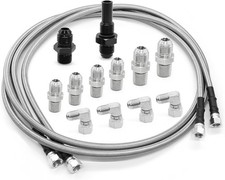
Don't pull the factory radiator-tank cooler out and replace it. Add a stacked-plate or tube-and-fin cooler in the line between the transmission and the radiator tank instead, so the radiator does the first-stage cooling and the aux cooler finishes the job before fluid goes back to the pan. That order matters in cold weather too, since the factory tank also helps bring the fluid up to operating temperature faster on startup, which a stand-alone aux cooler alone won't do. Our 200-4R transmission cooler is sized to drop into this spot without re-plumbing the whole system.
B&M's 200-4R troubleshooting chart lists three causes for overheating and fluid foaming out of the dipstick or breather: an oil cooler with insufficient capacity, a plugged cooler, and a high fluid level (B&M 35265 instructions). The last one is easy to miss on a towing rig. Check the level hot on level ground after any service, and do not top up to the full mark cold. If the transmission has already failed once, do not plumb a used cooler into the new unit without cleaning it. As Transmission Digest's “To Flush or Not to Flush” explains, a contaminated cooler and lines hold debris and old fluid that can cause premature failure of a replacement transmission, and some rebuilders require a new cooler to keep the warranty.
Keep the torque converter locked, and fix it if it won't stay locked
If your 200-4R intermittently loses lockup, especially once the fluid is fully warmed up, that is almost always a worn valve bore, not a bad converter. Sonnax's own parts data for this unit lists the 77805-K TCC apply valve kit as the fix for exactly this complaint set: no lockup at all, lockup immediately after 2nd gear, the converter falling out of lockup once hot, and fluid blown out the fill tube. The root cause is converter feed oil cross-leaking past a worn OE valve, and Sonnax's kit replaces it with a hardened steel valve and a PTFE seal that stops the leak path. This is a bench-level fix, not a full rebuild, and it directly targets the heat problem described above by letting the converter actually stay locked under load instead of hunting in and out.
On swapped or carbureted applications where the factory TCC control was never wired for reliable lockup to begin with, a manual lockup wiring kit like our 700R4 200-4R lockup wiring kit gives you a switch-controlled way to force the converter locked once you're at cruise speed with a load behind you, which is the single biggest heat reduction available on a tow run.
200-4R Torque Converter Lock-Up Kit at CoreTransmissionParts
For builds that need a more complete lockup control solution than a basic wiring kit, CoreTransmissionParts stocks the Painless Performance 60110 lock-up kit for the 200-4R, built to give you a clean, dedicated TCC control circuit rather than tapping into factory wiring that wasn't designed for the duty cycle of towing.
View the Painless Performance lock-up kit at CoreTransmissionParts →Get the TV cable right before you touch a boost valve
The throttle valve cable is the part most towing builds skip, and it is the part that causes the most failures. Transmission Digest's technical writeup on this exact cable system lays out why: the TV cable sets line pressure, shift points, shift feel, and both part-throttle and full-throttle downshift behavior, with the plunger's travel calibrated directly to throttle position. The article specifically flags the closed-throttle side of that adjustment as the one that matters most, because most real-world failures trace back to inadequate line pressure at low throttle openings, not at full throttle where people assume the risk is highest. Towing puts the engine at a sustained, moderate throttle opening for long stretches, exactly the range where a mis-adjusted cable leaves line pressure too low and lets the clutches and bands slip under load, generating more of the same heat problem from a different direction.
Once the cable is correctly adjusted and you are still seeing soft shifts or clutch slip under a loaded trailer, that's when a boost valve makes sense. TransGo's own product page for this transmission family lists four boost valve options for 1981-1993 GM TH200-4R, TH700-R4 and 4L60 units: the 7-300 for firmer manual 1-2 shifts, the 7-422 for light-duty use, the 7-472 built specifically for heavy-duty towing and off-road use, and the 7-500 for racing. TransGo describes the 7-472's .472-inch bore and bushing as delivering faster line pressure response and a higher maximum line pressure, which is the direct fix for clutch and band slippage once you've ruled out a bad cable adjustment as the cause.
Run DEXRON-VI, and watch an actual temperature number
The 200-4R was built entirely in the DEXRON-II era, but you don't need period-correct fluid to get this right. Valvoline's own DEXRON-VI product information sheet states the fluid is officially licensed with GM and fully back-serviceable anywhere DEXRON-II or DEXRON-III were originally specified, which covers every 200-4R built between 1981 and 1990. A quality DEXRON-VI fill is the correct modern choice, not a compromise, and it holds up better under the sustained heat a tow load produces than anything from this transmission's original era.
Pair that with a transmission temperature gauge if you're towing with any regularity. A dash warning light tells you after the fluid has already cooked; a gauge tells you while you still have the option to drop a gear, back off the throttle, or pull over and let it cool before any damage happens. Given that the converter is the main heat source described earlier, a gauge is also the fastest way to confirm whether your lockup fix actually worked: watch the temperature climb when the converter unlocks on a grade, and watch it level off once it locks back up.
A sensible order to do this in
- Adjust the TV cable correctly first. It's free, and it's the most common root cause of pressure-related slip under load.
- Fix lockup if it's not holding. The Sonnax 77805-K apply valve kit if it's a worn-bore cross-leak, or a manual lockup wiring kit if the application never had reliable electronic control.
- Add a dedicated cooler in series with the factory tank. Don't replace the factory cooler; stack this one after it.
- Add a boost valve only if slip persists after the cable and lockup are both confirmed correct.
- Run DEXRON-VI and watch a real temperature gauge instead of guessing from the dash light.
Any time the pan comes off for a cooler, lockup or boost valve job, torque the pan bolts to 10 ft-lb and the valve body bolts to 8 ft-lb, and keep the servo exhaust hole clear of gasket and sealer (B&M 35265). Our 200-4R pan bolt torque and service guide walks through it.
Need parts for this job?
Coolers, lockup wiring kits, TV cables and the rest of what's covered here, shipped from the USA.
Shop 200-4R parts →FAQ
Do I need an aftermarket cooler to tow with a 200-4R?
Yes, if the trip is longer than a few miles or involves any grade. These cars were fitted with a 200-4R as a passenger-car overdrive, not a tow-rated truck transmission, and most of them only have the radiator-integrated cooler tank as factory equipment. Add a stacked-plate cooler in series after the factory tank rather than replacing it, so the radiator still pre-cools the fluid before it hits the aux cooler.
What's the difference between the Sonnax TCC apply valve kit and a shift kit?
They fix different problems. Sonnax's 77805-K apply valve kit corrects a worn valve bore that lets converter signal and feed oil cross-leak, which causes no lockup, lockup falling out when hot, or fluid blown out the fill tube. A shift kit or boost valve changes line pressure and shift feel. If your converter won't stay locked, start with the apply valve, not a shift kit.
Will locking the torque converter more help a towing 200-4R run cooler?
Substantially, because the torque converter is the single biggest heat source in the transmission whenever it's unlocked and the fluid coupling is doing the work instead of a direct mechanical connection. Keeping the TCC locked in 3rd and 4th under steady tow load removes that slip-generated heat at the source, which is why both the Sonnax fix for a converter that won't stay locked and an aftermarket manual lockup kit matter for towing.
What TV cable mistake causes the most towing failures on a 200-4R?
An out-of-adjustment cable on the closed-throttle side, not the full-throttle side. The TV cable sets line pressure and shift feel at every throttle position, and Transmission Digest's own technical writeup on this system notes that most failures trace back to inadequate line pressure off idle, not at wide-open throttle. Get the cable adjusted correctly before adding a boost valve on top of it.
What fluid should I run in a 200-4R that tows regularly?
A quality DEXRON-VI fill. Valvoline's own DEXRON-VI product information sheet states it is officially licensed with GM and fully back-serviceable wherever DEXRON-II or DEXRON-III were originally specified, which covers every 200-4R built from 1981 to 1990. Towing shortens fluid life regardless of brand, so check it and change it more often than you would on a car that never pulls a trailer.
Related guides
- 200-4R overheating prevention
- 200-4R vs 700R4: differences, interchange and which is stronger
- 200-4R torque converter shudder
- 200-4R fluid change cost
- 200-4R rebuild cost
- 200-4R pan bolt torque spec and service
Shop the part for this fix
Full 200-4R catalog at CoreTransmissionParts: coolers, lockup kits, TV cables and hard parts.
Shop 200-4R parts at CoreTransmissionParts →Sources
- Sonnax, "GM 200-4R Transmission" unit/parts page — backs the 77805-K TCC apply valve kit and the specific symptom set it fixes (no lockup, falls out of lockup when hot, fluid blown out fill tube, lockup immediately after 2nd gear) caused by a worn valve bore cross-leak. sonnax.com/units/437-200-4r
- TransGo, "200-700 Boost Valves" product page — backs the four boost valve options for 1981-1993 GM TH200-4R/TH700-R4/4L60 (7-300, 7-422, 7-472, 7-500) and the 7-472's .472 in. bore specifically built for heavy-duty towing and off-road use. transgo.com/product-details/200-700-boost-valves
- Transmission Digest, "Adjusting Infamous THM700-R4 Throttle Valve Cable" by Paul Townsend — backs that the TV cable system shared by the 700R4 and 200-4R sets line pressure and shift feel at every throttle position, and that most real-world failures trace to inadequate closed-throttle pressure rather than full-throttle adjustment. transmissiondigest.com
- SAE International, "An Analysis of Automatic Transmission Clutch-Plate Temperatures" (SAE 720287) — backs that interface temperature rise during a converter/clutch apply event increases as apply time lengthens for a given energy input, the basis for why intermittent or unlocked converter operation generates more fluid heat than clean, sustained lockup. saemobilus.sae.org/papers/720287
- Valvoline, DEXRON-VI ATF product information sheet — backs that DEXRON-VI is officially licensed with GM, fully back-serviceable, and can be used wherever DEXRON-II or DEXRON-III were originally specified. Valvoline DEXRON-VI PI sheet (PDF)
- B&M Racing & Performance Products, Installation Instructions, Shift Improver Kit for 1981-90 THM200-4R (P/N 35265) — backs the troubleshooting causes of overheating and foaming (insufficient cooler capacity, plugged cooler, high fluid level), the 10 ft-lb pan and 8 ft-lb valve body torque, and the servo exhaust hole warning. B&M instructions (PDF)
- Transmission Digest, "To Flush or Not to Flush" by Pat Barrow (Lubegard) — backs that contaminated coolers and lines cause premature failure of replacement transmissions and that some rebuilders require cooler replacement for warranty. transmissiondigest.com