A 200-4R that will not move in any gear is a different animal from one that has lost a single range. When Drive, Overdrive and Reverse are all dead, you are looking for a failure in something every range shares: the fluid supply, the pump and line pressure, the drive path from the converter into the overdrive section, or the shift linkage itself. When only some ranges are dead, the range that still works tells you which clutch or roller clutch quit. This guide walks the diagnosis in the order that saves the most time and money, from a two-minute linkage check to the pressure test that decides whether the transmission has to come out.
How power gets through a 200-4R
You cannot diagnose a no-movement condition without knowing what has to hold for the car to move. The 200-4R is a THM200-based three-speed with an overdrive section bolted in behind the pump. Power comes off the converter turbine, through the turbine shaft, and into the overdrive planetary before it ever reaches the rear gear train. In 1st through 3rd, the overdrive section has to turn as a solid unit, and on this family of transmissions the part that makes that happen in the Overdrive range is the overdrive roller clutch.
Sonnax describes this exact arrangement in its write-up on 4L80-E overdrive roller clutch failure, which uses the same front-mounted overdrive layout: the overdrive roller clutch holds in 1st through 3rd and freewheels in 4th, and in the Overdrive range it is "holding by itself," while the overrun clutch is only on in the manual ranges. Selecting D, 2 or 1 applies the overrun clutch, which locks the same members the roller clutch locks and backs it up.
Behind the overdrive section, the rear gear train works like a THM200. The forward clutch is applied in every forward gear. First gear is held by the low roller clutch. Manual Low adds the low/reverse clutch, which holds the same member the low roller clutch holds, and Reverse uses the direct clutch together with the low/reverse clutch. Every range, forward or reverse, depends on the pump making line pressure and on the converter actually turning the turbine shaft.
| What still works | Where to look first |
|---|---|
| Nothing in any range, including Reverse | Linkage, fluid level, pump and line pressure, converter-to-pump drive, turbine shaft splines |
| D, 2 and 1 move, Overdrive range does not | Overdrive roller clutch (overrun clutch is covering for it) |
| Only Manual Low moves forward | Low roller clutch (low/reverse clutch is covering for it) |
| Reverse works, no forward range moves | Forward clutch: piston seals, feed sealing rings, cracked forward passage in the pump |
Step 1: Rule out the cheap stuff before you pick up a wrench
Start with the shift linkage. Have someone move the column or floor shifter through every position while you watch the manual shaft lever on the side of the case. If the lever does not move through its detents with the shifter, the cable or rod has come loose and the manual valve is still sitting in Neutral.
Next, raise the drive wheels safely, start the engine and put it in gear. Watch the driveshaft. If the driveshaft turns but the wheels do not, the transmission is fine and you are chasing a broken axle shaft, a stripped yoke or a rear axle failure. If the driveshaft does not turn, the problem is inside the transmission or the converter.
Then check the fluid, hot, engine running, in Park on level ground. A 200-4R that has puked fluid out of a cooler line or a front seal will simply run the pump dry, and a severely low level kills every range at once. Refill only with a fluid GM approves for the unit. GM Service Insights notes that DEXRON-VI is the correct fill for GM automatics where an earlier-generation DEXRON is specified, and warns that DEXRON ULV is not a substitute for DEXRON III or DEXRON VI. Do not put ULV or a universal multi-vehicle fluid in a 200-4R and expect clutch holding to be right.
Step 2: Listen and feel when you select a gear
The engine tells you a lot when you pull the lever into gear. On a healthy unit you feel the engine load up and RPM sag slightly as the forward clutch applies. If there is no load change at all, no engagement thump and the engine revs freely in gear, either nothing is applying because there is no pressure, or the drive is broken before the clutches. If you hear a grinding or ratcheting noise from the front of the transmission while in gear, suspect the converter-to-pump drive or a stripped turbine shaft spline before anything else.
A whine that rises with engine speed and gets worse in gear points at the pump. A pump that is cavitating because of a cracked filter neck seal, a missing pickup O-ring or a clogged filter will often show up as a whine first, then intermittent engagement, then no movement at all once it loses prime.
Step 3: Put a gauge on it
This step separates a pump-out repair from a full teardown. Tee a gauge into the line pressure tap on the case, run the engine and check pressure in Park, Neutral, Drive, Overdrive and Reverse. Compare your readings to the line pressure chart in the service manual for your application, since base and boosted pressures vary with TV cable position.
- Little or no pressure in every range: the pump is not making oil. Look at the filter, the filter neck seal and the pickup, then the pump itself.
- Low pressure that will not rise with throttle: the pressure regulator circuit is leaking or the pump slide is not moving. Sonnax's documentation for its oversized pressure regulator valve 77917-06 says bore wear in GM 4L60 and 200-4R pump covers lets oil leak past the valve and makes pump slide movement erratic, and that on a dyno a worn bore typically shows up as line pressure 50 to 100 psi below spec in Reverse.
- Normal pressure in every range but no movement: the hydraulics are fine. The problem is mechanical: the converter, the turbine shaft, the overdrive section or a clutch that is not sealing.
What to check when the pump is the problem
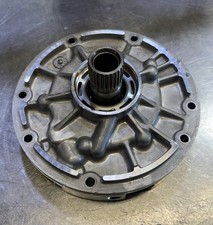
The 200-4R uses a variable-displacement vane pump with a pivoting slide, the same basic design as the 700-R4 and 4L60. Sonnax's 200-4R valve body layout lists the known wear points: the oversized pressure regulator valve for erratic line pressure, low line rise and clutch slippage, a pump slide pivot pin (65797) for erratic line pressure, and a main pressure regulator spring (77917-08) for low base line pressure.
When the pump is on the bench, do the slide shake test Sonnax describes in its 4L60-E 3-4 clutch guide. Assemble the clean, dry pump halves with only the slide inside and shake it. You should hear the slide move. A binding slide, in Sonnax's words, "can often be the cause of otherwise unexplained low line pressure." The same guide calls for vacuum or wet-air testing the 3-4 and forward oil passages in the pump, since those areas can develop hairline cracks. A crack in the forward passage is a classic cause of a unit that has Reverse but will not move in any forward range.
Also check the pump drive. The converter hub drives the pump rotor through two tangs. If those tangs or the pump rotor are chewed up, the pump makes no pressure at all even though the engine is turning the converter.
Step 4: Use the ranges to find the clutch that quit
If line pressure is good, the shift quadrant becomes your diagnostic tool. The Transmission Digest TASC Force article on troubleshooting one-way clutches lays out the principle: you can bypass a one-way clutch by applying a clutch or band that holds the same member. If the vehicle moves in a range where the backup clutch is applied but not in a range where the one-way clutch has to hold alone, the one-way clutch is the failure.
On a 200-4R that gives you two clean tests:
- Overdrive range dead, D, 2 and 1 move: the overdrive roller clutch is not holding. In D, 2 and 1 the overrun clutch is applied and carries the load for it. Sonnax notes that in an overheat the plastic cage of the overdrive roller clutch can melt, which causes a quick failure of the roller clutch.
- Only Manual Low moves forward: the low roller clutch is not holding. In Manual Low, the low/reverse clutch is applied and holds the member the low roller clutch is supposed to hold. The TASC Force article uses this exact manual-low test to isolate a low roller clutch on rear-drive units.
If no forward range moves, including Manual Low, but Reverse works, the forward clutch is the common element. That points to the forward clutch piston seals, a cracked or distorted forward piston, worn feed sealing rings, or the cracked forward passage in the pump mentioned above. That is a transmission-out repair.
If nothing moves in any range and pressure is normal, the break is ahead of all the clutches: the turbine shaft splines, the overdrive carrier, or the converter itself. Stripped turbine shaft splines are a known weak spot on high-output 200-4R builds, because the shaft carries full converter torque into the overdrive section.
No movement right after a rebuild or a swap
The most common cause of a freshly installed 200-4R that will not move is a converter that was not fully seated before the transmission was bolted to the engine. The converter has to drop through three engagements: the turbine shaft, the stator splines, and finally the pump drive tangs. If it is hanging on the tangs when the bellhousing bolts are drawn up, the converter pushes the pump rotor forward and can crack the pump or break the drive. Always measure converter depth before installation and make sure the converter turns freely by hand once the transmission is against the block.
Other post-rebuild no-movement causes are a pump that was not aligned and torqued with the proper tool, a forward clutch pack assembled with the wrong clearance, a pinched forward piston seal, and a roller clutch installed backwards.
Preventing a repeat
- Keep the fluid level right and the fluid fresh. The pump is the heart of every range, and it cannot make pressure on air.
- Tow in D, not Overdrive. Sonnax's snow-plow advice for the same overdrive layout applies here: driving in the manual ranges backs up the overdrive roller clutch with the overrun clutch and spreads the load.
- Watch temperature. Overheating is what melts roller clutch cages and hardens seals. An auxiliary cooler is cheap insurance on any 200-4R that tows or sees performance use.
- Fix the pump right the first time. If the pressure regulator bore or slide pivot is worn, repair it while the pump is apart instead of reusing a cover that will bleed off line pressure again.
FAQ
Why won't my 200-4R move in any gear?
When Drive, Overdrive and Reverse are all dead, the cause is something every range shares: a loose shift cable leaving the manual valve in Neutral, a fluid level too low for the pump to pick up, a pump that is not making line pressure, or a broken drive between the converter and the overdrive section. A line pressure gauge separates the hydraulic causes from the mechanical ones in a few minutes.
Can low fluid cause a 200-4R to not move at all?
Yes. If the level drops far enough that the pump pulls air, line pressure collapses and no clutch can apply, so every range goes dead at once. It often starts as a whine and intermittent engagement before it quits completely. Check the level hot with the engine running in Park, and refill with a DEXRON-VI approved fluid, not ULV.
Why does my 200-4R move in D but not in Overdrive?
In the Overdrive range the overdrive roller clutch has to hold the overdrive section by itself. In D, 2 and 1 the overrun clutch is applied and carries the load for it. If the car moves in D but not in Overdrive, the overdrive roller clutch is slipping, often because heat melted its plastic cage.
Why won't my 200-4R move after a rebuild?
The most common cause is a converter that was not fully seated through all three engagements before the bellhousing bolts were tightened. A converter hanging on the pump drive tangs can crack the pump or break the drive. Other causes include a misaligned pump, a pinched forward piston seal, and a roller clutch installed backwards.
200-4R Roller Clutch Sprag Set
If the range test points at a slipping overdrive or low roller clutch, this is the replacement set. The full 200-4R hard-parts catalog is at the CTP 200-4R collection.
View the roller clutch set →Sources
- TASC Force, "Troubleshooting One-Way Clutches," Transmission Digest. Backs the principle of bypassing a one-way clutch by applying a clutch or band that holds the same member, the manual-low test for isolating a low roller clutch, and the use of the D or 3 range (overrun clutch applied) to isolate an input one-way clutch on 700-series transmissions. transmissiondigest.com
- Jim Dial, "Understanding 4L80-E Overdrive Roller Clutch Failure," Sonnax. Backs the overdrive roller clutch holding in 1st through 3rd and freewheeling in 4th, holding by itself in the Overdrive range with the overrun clutch on only in the manual ranges, the advice to drive in the manual ranges under heavy load, and the melted plastic cage failure from overheating. sonnax.com
- Sonnax, "GM 200-4R Valve Body Layout." Backs the 200-4R pump and pressure wear points: oversized pressure regulator valve 77917-06 for erratic line pressure, low line rise and clutch slippage, pump slide pivot pin 65797 for erratic line pressure, and main pressure regulator spring 77917-08 for low base line pressure. sonnax.com
- Sonnax, "Oversized Pressure Regulator Valve" 77917-06, product technical documentation. Backs pressure regulator bore wear in GM 4L60 and 200-4R pump covers causing leakage and erratic pump slide movement, and the dyno finding of line pressure 50 to 100 psi below spec in Reverse. sonnax.com
- Brian Wing, "All Over the Map: Attacking 4L60-E Burnt 3-4 Clutches With Confidence," Sonnax. Backs the pump slide shake test, the statement that a binding slide can cause otherwise unexplained low line pressure, and the vacuum or wet-air test of the forward and 3-4 oil passages in the pump for hairline cracks. sonnax.com
- GM Service Insights (ACDelco), "Use the Right Transmission Fluid." Backs DEXRON-VI as the fill for GM automatics where an earlier-generation DEXRON is specified, and that DEXRON ULV is not a suitable replacement for DEXRON III or DEXRON VI. gmserviceinsights.com