Delayed engagement is a narrow, specific complaint on a 200-4R: you move the selector into Drive or Reverse, there's a noticeable pause with the engine just idling, and then the vehicle lurches into motion, sometimes with a clunk. That's a different animal from a transmission that engages instantly and then slips once you add throttle, and different again from one that won't make the 3-4 upshift into overdrive. This article is only about the pause before the clutch grabs in the first place, because that pause has its own short list of causes and its own diagnostic order — and on this particular transmission, one of those causes has a tell that most owners never notice: whether the delay only shows up after the car has sat for a while.
The 200-4R has no PCM and nothing to log a trouble code for any of this. Every signal that decides how fast the forward clutch or the low/reverse clutch fills and clamps is purely hydraulic — pump volume, regulated line pressure, and how well the torque converter holds the fluid it was charged with the last time the engine ran. Work through the causes below in the order given, because the first one costs nothing to rule out and the overnight-versus-every-time pattern narrows the rest down fast.
Rule Out Fluid, Level, and Filter First
Low fluid starves the pump of the volume it needs to fill the clutch circuit quickly, and that alone produces a pause before engagement that disappears the moment the level is corrected. Overfill causes the opposite flavor of the same problem: fluid gets churned past the vent, foams, and aerated fluid is compressible, so the pump can spin all day without ever building the firm pressure a piston needs to clamp. A cracked suction filter or a torn filter seal produces an identical symptom by letting the pump pull air on every cold start.
Fluid type matters here, and it's easy to get wrong on a unit this old. The 200-4R was factory-filled to a Dexron II/III specification, and a correct Dexron III-type product like Valvoline's ATF DX-3 remains backward-compatible with that original spec. Check the level with the engine warm and running, vehicle level, dipstick fully seated, and set it to the HOT mark before moving on to the hydraulic checks below.
Pressure Regulator Valve Bore Wear — the Most Common Mechanical Cause
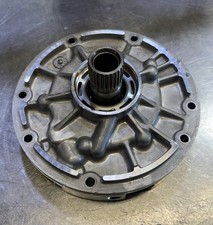
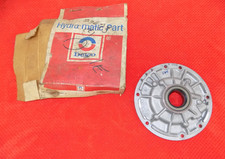
If fluid and filter check out clean, the pressure regulator valve bore in the pump cover is next up, and it's the single most common mechanical cause of this complaint. This valve sets and holds main line pressure, and both the forward clutch and the low/reverse clutch depend entirely on that regulated pressure to apply. Sonnax's technical documentation for its oversized pressure regulator valve names bore wear in the pump cover as a direct cause on GM 4L60 (700R4) and 200-4R units specifically, with a dynamometer test showing pressure running 50 to 100 psi below specification in Reverse on a worn example. A bore that has opened up from ordinary wear lets regulated fluid leak back toward exhaust instead of building toward the clutch circuit, which means the piston takes measurably longer to see enough pressure to clamp — the exact mechanism behind a pause before the vehicle moves.
This cause tends to get worse as the transmission warms up rather than better, since thinner hot fluid leaks past a worn bore more readily than cold, viscous fluid does. If the delay is mild on a cold start and stretches out after ten or fifteen minutes of driving, this bore is the leading suspect over fluid or filter issues, which usually show the opposite pattern. The fix is a pump cover rebuild: ream the worn bore and install an oversized regulator valve sized to the actual wear, which restores the original pressure seal without replacing the whole pump cover casting.
While the pump is apart, check the slide too. The 200-4R uses a variable-displacement vane pump with a pivoting slide, and Sonnax's guide to 4L60-E burnt 3-4 clutches, which covers the same pump family, gives a quick bench test: assemble the clean, dry pump halves with only the slide inside and shake the pump. You should hear the slide move. Per Sonnax, a binding slide "can often be the cause of otherwise unexplained low line pressure," and a worn slide pivot pin belongs on the same inspection. The same guide calls for vacuum or wet-air testing the forward and 3-4 oil passages in the pump, since hairline cracks there bleed off apply oil to the forward clutch.
Worn Front Pump Bushing — the Cause That Only Shows Up After Sitting
This is the cause most diagnostic checklists for other transmissions skip, and it's the one worth knowing specifically on a 200-4R because of its tell: a delay that only happens after the vehicle has sat for several hours or overnight, and that clears up on the next restart that same day. That pattern points at the torque converter draining itself back into the pan while parked, not at pump or regulator wear.
The converter stays full of fluid through a bushing and sealing-ring fit at the pump cover where the converter hub rides. Sonnax lists a dedicated front cover bushing, part number GM-B-3, as a service fit for the 200-4R's 298mm converter alongside the shared 4L60 (700-R4) and 4L60-E family, which confirms this is a documented wear point on this specific unit rather than a theoretical one. As that bushing and its sealing rings wear, clearance opens up and the converter slowly empties into the sump instead of staying charged. The next cold start has to refill the entire converter from empty before any clutch sees clamping pressure, which is a far bigger volume and a far longer pause than refilling a clutch circuit that was already primed.
General Motors documents the identical physics on its own newer automatics. GM service bulletin #16-NA-014 (November 2016 revision), covering 2015-2016 Corvette, Camaro, Silverado and Cadillac models with 8L45/8L90 transmissions, names "torque converter fluid drain back" as the cause of delayed engagement after the vehicle sits for several hours or overnight. GM's test is simple: with the engine started in Park, turbine (input) speed should match engine RPM within 2 seconds, and only units that take longer get the fix, an updated stator shaft support with an added check ball. GM handles the other cause, a clutch slow to fill, in a separate bulletin, 16-NA-364, which flags a Park-to-gear engagement taking more than 3 seconds. The 200-4R predates that electronic diagnosis path entirely — there's no Input Speed Sensor to time against engine RPM the way the bulletin describes — but the same three-element converter geometry and the same pump-cover sealing interface are susceptible to the same drain-back mechanism. On the 200-4R, the fix is a worn front pump bushing and seal replacement, or a full pump if the bore around the bushing has worn beyond a simple bushing swap.
Throttle Boost Circuit Leakage — a Secondary Contributor
The TV boost valve in the pump body raises line pressure above its base value in proportion to throttle signal, and a worn boost valve bore lets some of that boosted pressure bleed across circuits instead of staying isolated. Sonnax's documentation for its drop-in TV boost valve kit covers this directly for GM 200-4R and 4L60 (700R4) transmissions, and the complaint it's most often sold to fix is repeated burned bands and 3-4 clutches from throttle-boost oil leakage. That same worn bore lowers the ceiling on available line pressure overall, which compounds a marginal pressure regulator or an already-wearing front pump bushing rather than causing a garage-shift delay by itself on a transmission that's otherwise healthy. Treat it as a contributing factor to check once the regulator and converter-seal circuits are confirmed, not a first suspect on its own.
How to Test It, in the Order That Saves Money
- Note the pattern first, before you touch a tool. Does the pause happen every single time you shift into Drive or Reverse, at any temperature, after any length of sitting? Or does it only show up on the first start after the car has sat for hours or overnight, then disappear on every restart that same day? The first pattern points at the pump or regulator. The second points at converter drain-back through the front pump bushing.
- Check fluid level and condition. Confirm the correct Dexron II/III-type fluid is in it, warm, running, level, at the HOT mark. Dark or burnt-smelling fluid, or a low level, can mimic or mask everything below and costs nothing to rule out first.
- Hook a line pressure gauge to the case tap. Warm the transmission to operating temperature; a cold check reads as a pressure fault that isn't really there.
- Read pressure at idle and compare it against factory spec for your exact model year. Pressure that's low across the board at idle, regardless of how long the car sat beforehand, points at the pressure regulator valve bore or the pump itself — not the converter.
- If pressure tests fine but the overnight-only delay persists, suspect the front pump bushing. Pull the pump and inspect the bushing and sealing-ring fit at the converter hub for the excess clearance Sonnax's GM-B-3 kit is designed to correct.
- Verify the TV cable adjustment while the pump is apart. The 200-4R shares its TV cable design closely enough with the 700R4/4L60 that Transmission Digest's procedure for adjusting "the infamous THM700-R4 throttle valve cable" applies directly, and a cable that's out of adjustment compounds any pressure problem you've already found.
- Drop the pan and read the filter and magnet. Dark, charcoal-like debris confirms clutch damage already happened from repeated slipping during the delay. Clean fluid means you caught it before it did that damage.
| Symptom pattern | Most likely cause | How to confirm |
|---|---|---|
| Delay only after sitting hours/overnight, fine on same-day restarts | Worn front pump bushing — converter drain-back | Line pressure tests to spec; pull pump and check bushing/sealing-ring clearance at converter hub |
| Delay every time, worse as fluid warms up | Worn pressure regulator valve bore | Line pressure test vs. factory spec; compare to 50-100 psi low-in-Reverse pattern |
| Delay worst cold, gone once warm, fluid never serviced | Low fluid, overfill, or cracked filter | Set level to HOT mark warm/running, inspect filter, retest |
| Delay plus repeated 3-4 clutch or band burn-up | TV boost valve bore leakage compounding the above | Inspect/replace boost valve and sleeve in the pump body |
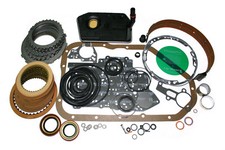
Pumps, pressure regulator valves, bushing kits and complete rebuild kits for the 200-4R — shipped fast from the USA.
Shop 200-4R parts →Fluid and filter cost nothing but ten minutes and rule out the two causes that mimic every hydraulic fault on this list. Noting whether the delay only happens after sitting is free, too, and it's the fastest way to send you straight at the front pump bushing instead of pulling a pump cover apart to chase a regulator bore that was never the problem.
FAQ
What causes a 200-4R to pause before engaging Drive or Reverse?
The forward or low/reverse clutch piston is taking too long to fill with fluid and build clamping pressure after you move the selector. On a 200-4R the usual causes, in order of likelihood, are low or worn-out fluid starving the pump, a worn pressure regulator valve bore in the pump cover letting line pressure bleed off before it reaches the clutch, a worn front pump bushing that lets the torque converter drain fluid back into the pan while the vehicle sits, and throttle-boost circuit leakage compounding any of the above. None of these set a code, because the 200-4R has no PCM to log one.
Why does my 200-4R only delay engagement after sitting overnight?
That pattern — fine all day, slow to engage on the first start after the vehicle has sat for several hours or overnight — is the signature of torque converter drain-back, not pump or clutch wear. A worn front pump bushing or seal lets the converter empty itself into the transmission pan while parked, so the pump has to refill the entire converter from empty before it can build clutch pressure on the next start. A pump or regulator wear problem, by contrast, shows up on every single engagement regardless of how long the vehicle sat.
Can a worn front pump bushing really cause delayed engagement on a 200-4R?
Yes. Sonnax lists a dedicated front cover bushing (GM-B-3) as a service part for the 200-4R's 298mm converter, and General Motors documents the identical failure physics — a worn bushing or seal at the converter-to-pump interface letting fluid drain back into the pan when parked — in its own service bulletins on later automatics. The 200-4R's three-element converter and non-return pump passages are susceptible to the same drain-back mechanism; it just has no electronic self-diagnosis path to flag it.
Is 200-4R delayed engagement the same problem as a worn TV boost valve?
Not usually by itself, but it can make an existing delay worse. The TV boost valve raises line pressure with throttle input, and Sonnax documents a worn boost valve bore leaking across circuits on GM 200-4R and 4L60/700R4 units, mainly as a cause of burned bands and 3-4 clutches. A leaking boost valve lowers the pressure ceiling available once the clutch does fill, which can stretch out an engagement delay that a worn regulator or pump already started, but it is rarely the sole cause of a pause before the vehicle moves. Our 200-4R valve body symptoms guide covers that boost valve failure in more depth.
Will a fluid and filter change fix 200-4R delayed engagement?
It fixes it when the cause is low fluid, old oxidized fluid, or a cracked filter pulling air into the pump, and that is always the cheapest thing to rule out first. GM Service Insights lists DEXRON-VI as the correct fill for GM automatics where an earlier-generation DEXRON is specified, and warns that DEXRON ULV is not a substitute for DEXRON III or DEXRON VI; a Dexron III-type product such as Valvoline's ATF DX-3 is also backward-compatible with the original spec. Running the wrong fluid or an incorrect level can produce the exact same symptom on its own. If a correct fluid and filter service does not resolve the pause, the cause is mechanical wear in the pump, regulator, or converter circuit, and a fluid change alone will not fix it.
Sources
- Sonnax — "2492 Oversized Pressure Regulator Valve" (77917-06), technical product documentation for GM 4L60 (700R4) and 200-4R. Backs the pressure regulator bore wear mechanism and the dynamometer-confirmed pattern of line pressure running 50-100 psi below spec in Reverse. sonnax.com
- Sonnax — "925 Front Cover Bushing" (GM-B-3), technical product documentation listing 4L60 (700-R4), 4L60-E and 200-4R (298mm NLU) compatibility. Backs the front pump bushing as a documented service wear point at the converter-to-pump sealing interface on this transmission family. sonnax.com
- General Motors — Service Bulletin #16-NA-014, "Delayed Engagement After Sitting With Engine Off - Torque Converter Fluid Drain Back," November 2016 (2015-2016 Corvette/Camaro/Silverado/Cadillac and others, 8L45/8L90). Backs torque converter drain-back as GM's documented cause of delayed engagement after sitting hours or overnight, the 2-second input speed versus engine RPM test, and the stator shaft support with added check ball. static.nhtsa.gov (PDF)
- General Motors — Service Bulletin #16-NA-364, "Delayed Engagement After Sitting With Engine Off - Clutch Slow to Fill," December 2016. Backs the separation of a slow-to-fill clutch from converter drain-back and the 3-second Park-to-gear engagement threshold. static.nhtsa.gov (PDF)
- Sonnax — "2497 TV Boost Valve Kit" (77917-500), technical product documentation for GM 200-4R and 4L60/700R4. Backs the throttle-boost circuit leakage mechanism and its secondary effect on available line pressure. sonnax.com
- Transmission Digest — "Adjusting the Infamous THM700-R4 Throttle Valve Cable." Backs the TV cable adjustment procedure applied here to the 200-4R's shared cable design. transmissiondigest.com
- Valvoline — ATF DX-3 Product Information Sheet. Backs the correct Dexron III-type fluid specification referenced when checking fluid condition as the first diagnostic step. valvoline product data sheet (PDF)
- Brian Wing, "All Over the Map: Attacking 4L60-E Burnt 3-4 Clutches With Confidence," Sonnax. Backs the pump slide shake test, the statement that a binding slide can cause otherwise unexplained low line pressure, the slide pivot pin inspection, and the vacuum or wet-air test of the forward and 3-4 passages in the pump. sonnax.com
- GM Service Insights (ACDelco), "Use the Right Transmission Fluid." Backs DEXRON-VI as the fill for GM automatics where an earlier-generation DEXRON is specified, and that DEXRON ULV is not a suitable replacement for DEXRON III or DEXRON VI. gmserviceinsights.com