A 2007 Liberty and a 2007 Caravan can sit side by side in the bays with what looks like two completely different transmissions. One is a transaxle hanging off the side of a transverse V6. The other bolts to the back of a 3.7L and feeds a transfer case. Open them up and you find the same clutches, the same gearset logic and close cousins of the same valve body. The 42RLE is the rear-wheel-drive version of the 41TE. Knowing exactly where they match and where they do not is what keeps you from ordering the wrong valve body, reaming the wrong switch valve bore or chasing a VLP code with the wrong pressure numbers.
This guide covers the shared design, the real hardware differences, the variable line pressure (VLP) split that catches a lot of shops, diagnosis numbers that apply to both, and which parts actually interchange. Sonnax, Transmission Digest and ATRA references are listed at the bottom.


Same Family, Different Layout
Sonnax groups Chrysler's clutch-to-clutch automatics into two branches. Branch one, the rectangular valve body casting, is the original Ultradrive group: 40TE, 40TES, 41AE, 41TE, 41TES, 42LE and 42RLE. Branch two, the L-shaped casting that began in 1999, is the 45RFE, 545RFE, 62TE and 68RFE. The whole family dates to the 1989 Ultradrive four-speed, and none of it uses bands. Every shift is one clutch releasing while another applies, timed by the controller.
Transmission Digest's TASC Force column puts it plainly: the 42RLE is the RWD configuration of the 41TE. The 42LE in between was the longitudinal front-drive version. The 42RLE lost the transaxle's final drive and exits through an output shaft and tailhousing instead, which is why you find it behind the 3.7L in the Liberty, Wrangler, Dakota, Nitro and Ram 1500 V6.
What stays the same
- Clutch layout. Underdrive (UD), overdrive (OD), reverse, 2/4 and low/reverse (L/R). Same names, same jobs, same CVI logic.
- Shift pattern. First is UD plus L/R. Second is UD plus 2/4. Third is UD plus OD, which locks the gearset for direct drive. Fourth releases UD and runs OD plus 2/4.
- Ratios. Chrysler's 2008 Liberty spec sheet lists the 42RLE at 2.84 first, 1.57 second, 1.00 third, 0.69 fourth and 2.21 reverse, the same four-speed spread the 41TE is known for.
- Fluid. Both are ATF+4 units. Do not put a universal multi-vehicle fluid in a clutch-to-clutch Chrysler and expect the adaptives to behave.
What changes
- Case and output. The 41TE carries its own differential. The 42RLE sends power out the back to a driveshaft or transfer case, so cases, output components and mounts never cross over.
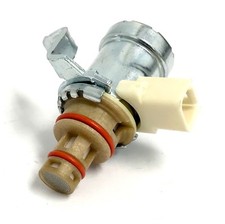
- Solenoid pack location. On a 41TE the solenoid and pressure switch assembly bolts to the outside of the case. On the 42RLE it lives inside the pan on the valve body, so a pack swap on a Jeep is a pan-drop job.
- Valve body casting. Same branch and same valve layout, but the castings are not identical. Sonnax lists separate reman valve bodies, for example CHR400 for the 41TE VLP and CHR402 for the 42LE and 42RLE VLP.
- Converter and pump details. The front pump and converter are close relatives, but order by the exact unit and year. Do not assume a FWD pump assembly drops into a Jeep.
The VLP Split: The Change That Actually Matters
The biggest difference you will run into is not FWD versus RWD. It is fixed line pressure versus variable line pressure. Both units went through it, and the VLP versions are separate builds.
Sonnax's VLP article says variable line pressure started with the 2007 Chrysler Sebring 2.4L and 2.7L, and that earlier 604, 606 and 42RLE units ran fixed line pressure. On the FWD side the VLP unit is the 41TES, also called the 41TE VLP. Chrysler calls the Jeep version the 42RLE-VLP. TransGo's VLP shift kit instructions list 2006-2017 for the 42RLE-VLP, so check the hardware rather than trusting the model year alone.
How to tell VLP from non-VLP in 30 seconds
- Second case connector. VLP units have an extra pass-through connector next to the range sensor connector. Early versions use 6 pins, later ones 5 (the unused pin 1 was dropped).
- Pinout. Three wires go to the line pressure sensor (5V reference, signal, ground) and two to the line pressure solenoid (12V feed and control). On the 6-pin version, pin 2 is 5V to the sensor, 3 is sensor signal, 4 is sensor ground, 5 is 12V to the solenoid and 6 is solenoid control.
- On the valve body. You cannot miss the solenoid and the transducer. Transmission Digest notes the line pressure solenoid looks almost identical to the governor pressure solenoid on the RE series, apart from the bracket.
The solenoid pack is still used on VLP units. The new solenoid and sensor are added, not swapped in place of the pack.
What does not interchange
Per Transmission Digest, the VLP valve body and transfer plate castings are different, the pressure regulator valve becomes a one-piece anodized valve, and the separator plate gains two extra holes. None of those parts interchange between VLP and non-VLP units. That applies to the 41TE and the 42RLE alike. If a customer's Liberty needs a valve body, the first question is whether it has the second connector.
The Solenoid Switch Valve Trap
Sonnax calls the solenoid switch valve (SSV) the most common wear point in this family. It routes oil between the L/R clutch and the TCC, and it feeds the 2nd and OD clutches through two shuttle plugs at the end of the bore. When the bore wears you get bind-up, no lockup, TCC apply and release complaints, engine stall when coming to a stop and failsafe, along with the codes Sonnax lists (P0841, P0868, P0871, P0988, P1775, P1776).
The trap is that the valve changed size at the same time VLP arrived. Sonnax lists the original valve with a 0.420 in large spool and the new design at 0.453 in, with both using a 0.453 in outer plug. On the 41TE branch, the new design came in around the 2006 model year. Transmission Digest's TASC Force article spells out the full change: the small spool is 0.003 in smaller, the large spool 0.033 in larger, the biggest land 0.040 in narrower, and the new valve has an identification groove.
That article started with a tech who could not ream a valve body he thought was a 41TE. It was a 41TES. The lesson is the same on a 42RLE: measure the valve before you pick tooling. Sonnax warns that the wrong reamer for the spool size wastes time and can ruin the casting. Their kits are split by spool size. For example, the 92835-21 oversized valve and the 92835-18K plug kit fit the original 0.420 in spool only, while the 92835-22K and 92835-31K are for the 0.453 in spool. Vacuum test the bore before you decide it needs work.
Line Pressure Numbers for Both
Wayne Colonna's VLP article in Transmission Digest gives the numbers that make diagnosis possible.
Non-VLP 41TE and 42RLE: fixed line pressure runs 120 to 145 psi in first and second. On the 2-3 shift, the overdrive solenoid applies the OD clutch, and that same oil goes to the pressure regulator valve to drop line pressure to about 85 psi for third and fourth.
41TES and 42RLE-VLP: the controller handles that drop through the solenoid instead.
- First and second: about 135 psi.
- About 5% duty cycle idling in drive with your foot on the brake (minimum effect).
- On the 2-3 shift, duty cycle ramps to about 25% and line pressure drops to about 85 psi.
- When the converter clutch applies in fourth, duty cycle climbs to about 30% and line pressure drops again.
- Maximum command is 62%.
On the scan tool, put desired line pressure next to actual line pressure. Desired is what the controller is commanding, and actual is what the transducer reports. With a good solenoid and sensor they track each other closely. A gap points you at the solenoid, the sensor, the wiring or the regulator side of the valve body.
P0869 on VLP units: check the computer before the parts
Transmission Digest calls P0869 (line pressure too high) right after the 2-3 shift a pattern failure caused by the TCM or PCM on both the 41TES and the 42RLE-VLP. It also lists five possible causes, which is why you test before you buy. If desired drops at the 2-3 shift, duty cycle actually reaches the solenoid on a meter, and actual line pressure still stays high, look at the hydraulics. If the duty cycle never changes, the controller is the suspect.
CVIs: The Health Check Both Units Share
Clutch volume index (CVI) is the learned volume of oil it takes to stroke each clutch piston to zero clearance. As frictions wear, the volume grows. ATRA's Technical Bulletin 1377 (41TE and 42LE) gives the normal ranges:
- L/R: 35-83, updated on a 2-1 or 3-1 coast downshift with fluid at 70-120°F.
- 2/4: 20-77, updated on the 1-2 upshift.
- OD: 48-150, updated on the 2-3 upshift.
- UD: 24-70, updated on a 4-3 or 4-2 downshift.
The upshift and UD updates need fluid above 80°F, or above 110°F on 1997 and later vehicles. The 42RLE uses the same clutch set, so start from the same ranges and check the service information for the exact vehicle. A high CVI on one clutch with clean shifts is wear you can plan around. A high CVI with a flare, a ratio code or burnt fluid means the unit is coming out.
Failures Worth Knowing on Each
Planetary noise on the 42RLE. Transmission Digest covered a 2009 Liberty 3.7L with 53,000 miles that moaned only on the shift into second. The captured bearing in the front carrier had come apart. That makes sense from the clutch chart. In first, L/R holds the front carrier and the load goes through the rear carrier. In second, 2/4 holds the front sun gear and the load moves to the front carrier, so the noise only shows up there. If the gears had stripped, the truck would have set P0732 (2nd gear ratio) and gone to failsafe second.
Front sun gear on early 41TEs. The same article recalls the early A604 front sun gear breaking away from its hub. The symptom was a first gear start, neutral on the 2-3 shift and no movement until the key was cycled. Both units share that gearset logic, so the same symptom tree applies when you see a 42RLE do it.
Shared valve body wear. The SSV bore, TCC regulator circuit and pressure regulator wear the same way on both. Sonnax lists the same family of fixes (TCC kits, accumulator kits and SSV kits) under both units.
42RLE Shift Kit 2006-2017
Listed for 2006-2017 Jeep and Dodge 42RLE units. Use it for valve body and accumulator work while the pan is off. Check the product fitment against the second case connector before ordering, because VLP and non-VLP units take different kits.
See the 42RLE shift kit →Need frictions, steels or an overhaul gasket and seal set instead? Browse all 42RLE parts at Core Transmission Parts →
What Interchanges and What Does Not
- Never interchange: cases, output and final drive parts, VLP with non-VLP valve bodies, transfer plates, separator plates and pressure regulator valves.
- Order by year and spool size: solenoid switch valve repair parts (0.420 in or 0.453 in large spool).
- Often common across the family: friction and steel designs, bushings and some accumulator parts. Sonnax lists several of these under both the 41TE and the 42RLE. Still confirm by part number, not by "it's a 41TE inside."
- Electrical: the VLP harness and the second connector exist only on VLP units. On a Jeep, the solenoid pack is under the pan. On a FWD unit, it is on the outside of the case.
After any valve body or pack work on either unit, clear the adaptives and run the quick learn procedure with a capable scan tool. Then road test until the CVIs relearn. A clutch-to-clutch Chrysler that has not learned will shift badly even with perfect hard parts.
Need parts for this job?
41TE and 42RLE master rebuild kits, valve bodies, solenoid packs, VLP pressure control solenoids and filters, all with secure checkout.
Shop 41TE and 42RLE parts →FAQ
Is the 42RLE the same as the 41TE?
Not the same, but closely related. Transmission Digest describes the 42RLE as the rear-wheel-drive configuration of the 41TE, and Sonnax puts both in the same valve body branch. They share the clutch layout, the shift logic and the four-speed ratios, but the case, output, valve body casting and solenoid pack location are different.
Will a 41TE valve body fit a 42RLE?
No. Sonnax lists separate reman valve bodies, such as CHR400 for the 41TE VLP and CHR402 for the 42LE and 42RLE VLP. On top of that, VLP and non-VLP valve bodies, transfer plates, separator plates and pressure regulator valves do not interchange on either unit. Match the valve body to the exact unit and to whether it has VLP.
How do I know if my 42RLE has VLP?
Look for a second electrical pass-through connector on the case next to the range sensor connector. VLP units have one, with 6 pins on early versions and 5 on later ones. With the pan off, you will also see the line pressure solenoid and pressure sensor on the valve body.
What line pressure should a 41TE or 42RLE have?
Non-VLP units run about 120 to 145 psi fixed in first and second, then about 85 psi in third and fourth. VLP units (41TES and 42RLE-VLP) run about 135 psi in first and second and about 85 psi after the 2-3 shift, then drop lower once the converter clutch applies. On a scan tool, desired and actual line pressure should track closely.
What fluid do the 41TE and 42RLE use?
Both take ATF+4. These are clutch-to-clutch units that rely on learned clutch volumes, so the correct fluid matters for shift quality. After any valve body or solenoid work, run the quick learn and let the CVIs relearn before you judge the shifts.
Sources
- Sonnax, "All in the Family: Identification & Repair of Chrysler Solenoid Switch Valve Problems." Backs the two-branch family (40TE, 40TES, 41AE, 41TE, 41TES, 42LE, 42RLE vs. 45RFE, 545RFE, 62TE, 68RFE), clutch-to-clutch design from 1989, SSV function, the 0.420 in vs. 0.453 in large spool, the new design around 2006 on the 41TE branch, symptoms and codes, and the 92835-series kit fitment. sonnax.com
- Sonnax, "42LE/42RLE Variable Line Pressure." Backs VLP starting with the 2007 Sebring 2.4L/2.7L, earlier units on fixed line pressure, the second case connector by the range sensor (6-pin early, 5-pin later), the pinout, the solenoid pack being retained, and the CHR400 (41TE VLP) and CHR402 (42LE/42RLE VLP) valve bodies. sonnax.com
- Transmission Digest, TASC Force Tips, "Know Your Patient" (Robert Moreau). Backs the 42RLE as the RWD configuration of the 41TE, 41TES = 41TE VLP, the 42RLE-VLP name, the non-interchangeable VLP valve body, transfer plate, anodized pressure regulator valve and separator plate, and the SSV dimension changes (0.003 in, 0.033 in, 0.040 in, ID groove). transmissiondigest.com
- Transmission Digest, Technically Speaking, "The Variable Line Pressure Solenoid" (Wayne Colonna). Backs the P0869 pattern TCM/PCM failure after the 2-3 shift, the 5%-62% duty cycle range, about 135 psi in 1st/2nd and 85 psi in 3rd/4th, 25% and 30% duty cycle points, and the fixed 120-145 psi non-VLP line pressure. transmissiondigest.com
- Transmission Digest, Shift Pointers, "42RLE with a Noise in Second Gear Shifts." Backs the 2009 Liberty 3.7L front carrier bearing failure at 53,000 miles, the clutch application chart by gear, P0732 failsafe behavior, and the early A604 front sun gear failure. transmissiondigest.com
- ATRA Technical Bulletin 1377, 41TE/42LE Clutch Volume Index (April 2011). Backs the CVI ranges (L/R 35-83, 2/4 20-77, OD 48-150, UD 24-70) and the update conditions and temperatures. atracom.blob.core.windows.net (PDF)
Shop the 42RLE shift kit →