A 41TE that slips under load is telling you one of two things: it is not making enough pressure, or the pressure it makes is leaking out on the way to a clutch. Almost everything else — the burnt frictions, the ratio codes, the CVI numbers walking up over months — is downstream of that fork. The good news is that this transaxle keeps a running record of its own clutch wear and hands it to you on a scan tool, which is more than most units from that era will do. The bad news is that most techs read those numbers without knowing what the units actually are, and a CVI you cannot interpret is just a number on a screen.
Start with what the unit is supposed to be doing hydraulically, because that sets the whole diagnosis.
The pressure a 41TE is supposed to make, and why it drops on purpose
On a standard non-VLP 41TE, line pressure is not one number. Wayne Colonna laid the architecture out in Transmission Digest: fixed line pressure in first and second runs between 120 and 145 psi. When the unit shifts into third, overdrive clutch oil is routed to the pressure-regulator valve to perform a cutback, and line pressure drops to roughly 85 psi for third and fourth.
Read that again with a slipping complaint in your head. The 41TE deliberately runs third and fourth at about 60 percent of the pressure it runs first and second at. A clutch pack that is marginal — worn frictions, a slightly leaking circuit, a fill volume that has crept up — will hold fine at 135 psi in second and let go the moment the unit cuts back to 85 psi and the driver leans on it. That is why so many of these come in described as "it slips going up a hill in overdrive but it feels fine around town." The transaxle is not being inconsistent. It is doing exactly what it was designed to do, and the cutback is exposing a weakness that first and second gear pressure was covering up.
The later 41TES and 42RLE units handle that same 2-3 cutback with a variable line pressure solenoid and a pressure transducer instead of overdrive oil. On those, Colonna documented the normal behavior: about 5 percent duty cycle idling in drive with the brake applied, duty cycle ramping to 25 percent on the 2-3 shift as line drops to approximately 85 psi, and around 30 percent once the converter clutch applies in fourth. Desired line pressure and actual line pressure both show on a scan tool, and when the solenoid and the sensor are both healthy those two numbers track close together. A wide split between desired and actual is a real finding, not scan tool noise.
Knowing which one you have matters before you order parts. Sonnax's identification rule is simple and visual: VLP units carry the line pressure solenoid and transducer mounted on the valve body. No solenoid and transducer up there means non-VLP.
CVI: what the number actually measures
Clutch Volume Index is the single most useful thing on a 41TE scan tool, and it gets misread constantly because people treat it as an arbitrary index. It is not. Per ATRA's Chrysler material, one CVI equals 1/64 of a cubic inch of transmission fluid, and the value represents the learned volume required to stroke that clutch piston to zero pack clearance without stroking the accumulator or picking up torque load.
That is a physical measurement of clutch pack clearance, updated as the clutch wears. A UD reading of 60 means the controller now has to push nearly an extra cubic inch of fluid to take up that pack compared to a unit reading 24. More clearance means more fill time, more fill time means a longer slip window on every apply, and a longer slip window means heat.
ATRA Technical Bulletin #1377 publishes the normal ranges and — more importantly for diagnosis — the conditions under which each one updates:
| Clutch | Normal CVI range | Updates on | Fluid temp required |
|---|---|---|---|
| Underdrive (UD) | 24 – 70 | 4-3 or 4-2 shift | Above 80°F (above 110°F from 1997 MY) |
| Overdrive (OD) | 48 – 150 | 2-3 shift | Above 80°F (above 110°F from 1997 MY) |
| 2-4 clutch | 20 – 77 | 1-2 shift | Above 80°F (above 110°F from 1997 MY) |
| Low/Reverse (L-R) | 35 – 83 | 2-1 or 3-1 coast downshift | Between 70°F and 120°F |
The update column is where people get burned. If you plug in cold, idle in the bay for two minutes, and read CVIs, you are looking at values learned during someone else's drive cycle, possibly weeks ago. The UD number will not move until you get the fluid above the temperature threshold and actually perform a 4-3 or 4-2 downshift. The L-R number is the awkward one, because its window is a band — between 70 and 120 degrees — so a fully hot unit will not update it at all. Get L-R data early in the road test and UD/OD/2-4 data after the unit is warm.
The other trap is the accumulator. ATRA's material notes each accumulator holds 64 CVIs of its own, but the scan data reports only the applying clutch volume, not the accumulator volume. So a number that reads plausible is not automatically proof the circuit is healthy — it is proof the clutch fill volume is in range.
Cause 1: the input clutch hub bushing is leaking the underdrive circuit
This is the one that turns a good rebuild into a comeback, and it is invisible unless you know to measure it. The input clutch hub bushing in the 41TE is not just a support bushing — it is an oil control surface for the underdrive clutch. Sonnax states the mechanism plainly: excess clearance between that bushing and the stator support allows leakage in the underdrive circuit, which causes low underdrive clutch pressure and clutch failure.
Follow the chain. The bushing wears. Clearance opens up. Underdrive apply oil bleeds off across that clearance instead of holding the piston. Apply pressure at the UD clutch falls below what it needs to carry torque. The clutch slips under load, glazes, then burns. Meanwhile the controller sees a longer fill and walks the UD CVI up, so you get a rising CVI, a ratio code, and burnt underdrive frictions all from a worn bushing.
Sonnax's replacement bushing for the job is 92003-01K, a steel-backed bimetal precision bushing at 0.575 inch width, 1.781 inch shaft diameter and 1.904 inch housing bore, installed with the 92003-TL removal and installation tool. The reason it matters that it is precision and steel-backed rather than whatever came in the kit is that shaft-to-bushing clearance is what controls the leak. A bushing a few thousandths loose in a sealing application is a leak path by definition.
Practical version for the bench: if you are in a 41TE for burnt underdrive frictions, replacing the frictions without addressing the input clutch hub bushing is rebuilding the symptom. Check that clearance every time, on every unit, regardless of mileage.
Cause 2: pressure regulator bore wear that starves everything
The second mechanism is upstream of all four clutches. The pressure regulator valve oscillates continuously in service, and over tens of thousands of miles that oscillation wears the aluminum bore it lives in. Sonnax's description of the failure is specific about where the wear does the damage: wear at the spring end of the bore allows line pressure to exhaust, producing low line pressure, soft shifts and burnt clutches, and wear in that area also affects converter flow and the lube circuit.
That is the whole slipping-under-load complaint in one sentence, and it does not require a bad pump, a bad solenoid pack, or a bad computer. The pump can be making plenty of volume and the regulator simply cannot hold the pressure against a worn bore. Because the same wear hurts lube flow, you also get accelerated bushing and clutch wear on top of the slip, which is how these units end up needing everything at once.
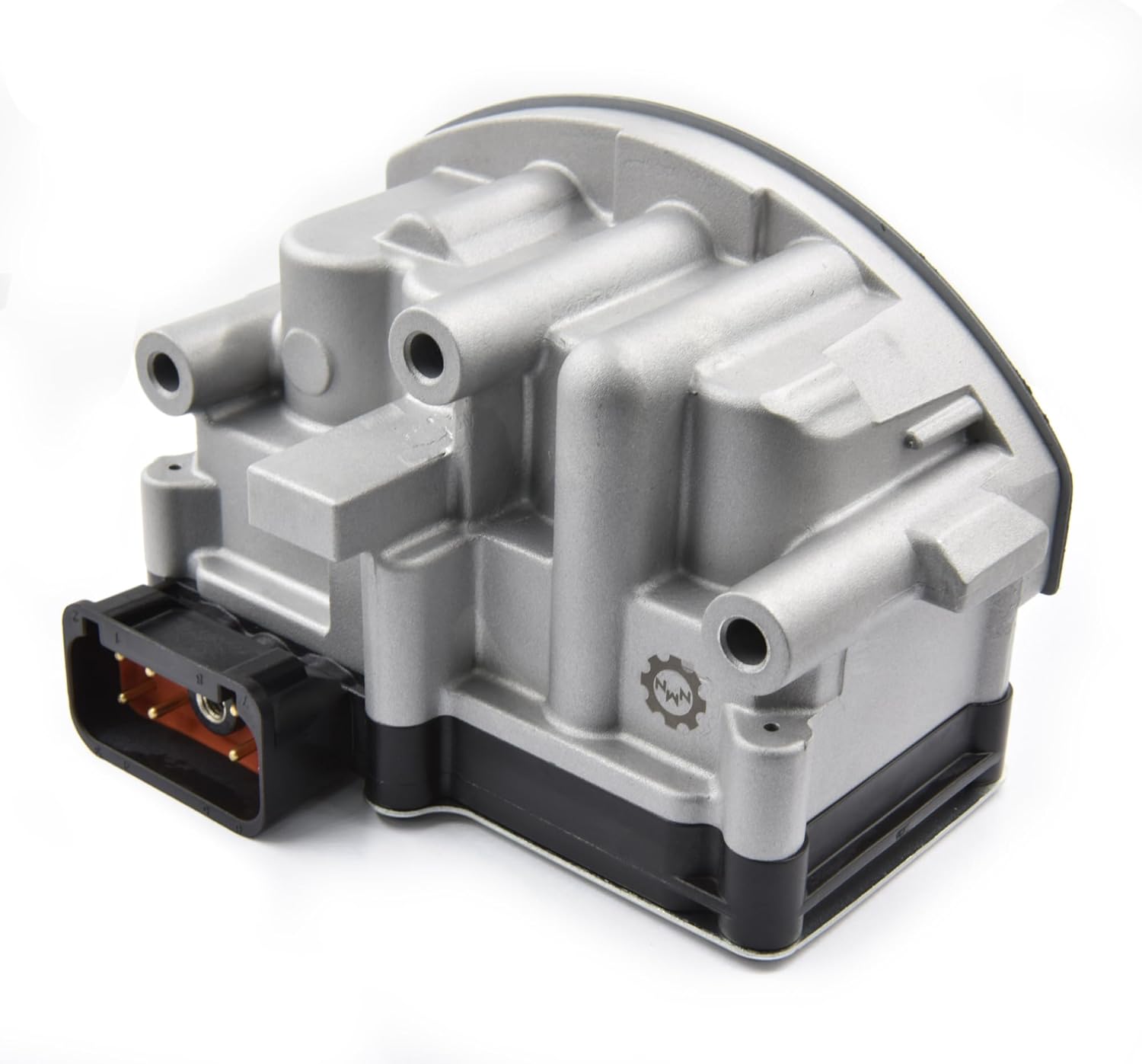
The repair splits by unit type. Sonnax's oversized pressure regulator valve 92835-24 fits non-VLP 40TE, 41AE, 41TE, 42LE and 42RLE units; 92835-29 is the VLP version for 40TES, 41AE, 41TES, 42RLE and 62TE. Both are hard-coat anodized aluminum and both require reaming the bore with the matching tool — you are restoring valve-to-bore clearance in a worn casting, not dropping in a new valve and hoping. If the bore fails a vacuum test at the indicated port, a stock replacement valve will not fix it.
Cause 3: it is electrical, and there are only four kinds
Before you take anything apart, rule out the electrical side, and do it with a framework rather than a parts cannon. Dave Skora's 41TE troubleshooting guide in ATRA's Gears magazine sorts every electrical or computer problem on this unit into four types:
- Type 1: the TCM itself — TCM codes, no codes at all, or no communication with the module.
- Type 2: codes indicating an electrical problem with a TCM input.
- Type 3: codes indicating an electrical problem with a TCM output.
- Type 4: a code indicating an incorrect gear ratio, with CVI numbers out of range or a clutch slipping.
A slipping-under-load complaint that also sets a ratio code lands in Type 4, and Type 4 is the one that is usually not electrical at all. That is the point of the sort: it stops you from ohming out a solenoid pack when the transaxle is telling you a clutch is not holding.
Skora's other instruction is one people skip because it feels too basic. Before any electrical diagnosis on this unit, confirm the battery is in good condition and fully charged, 12.45 volts minimum resting, and check the connections and grounds. Chrysler transmission controllers of this generation behave badly on marginal voltage, and a weak battery or a corroded ground will produce codes and symptoms that look like a failing transaxle.
The order I work a 41TE slipping complaint
- Fluid level and condition, hot and in gear. Low or aerated fluid drops pressure and produces a genuine slip with nothing wrong internally. Burnt fluid tells you which direction this is already going.
- Battery and grounds. 12.45 volts minimum at rest before anything else gets diagnosed.
- Pull codes, then classify by Skora's four types. A ratio code with no other electrical codes is Type 4 and points you at pressure or a clutch, not wiring.
- Read CVIs correctly. Get L-R while the fluid is between 70 and 120 degrees, then warm the unit and force a 1-2, a 2-3, and a 4-3 or 4-2 downshift to update 2-4, OD and UD. Compare against 20-77, 48-150 and 24-70.
- Gauge on the line pressure port. You want 120 to 145 psi in first and second, and roughly 85 psi after the 2-3 cutback. Flat-low across the board is a regulator or pump problem. Correct in first and second but slipping only in third and fourth is the cutback exposing a marginal clutch.
- On VLP units, compare desired versus actual line pressure and watch duty cycle ramp to about 25 percent on the 2-3. If the command is there and the pressure does not follow, the solenoid or the regulator is the problem, not the computer.
- If it is coming apart, vacuum test the valve body and measure the input clutch hub bushing. Those two checks are the difference between a rebuild and a comeback.
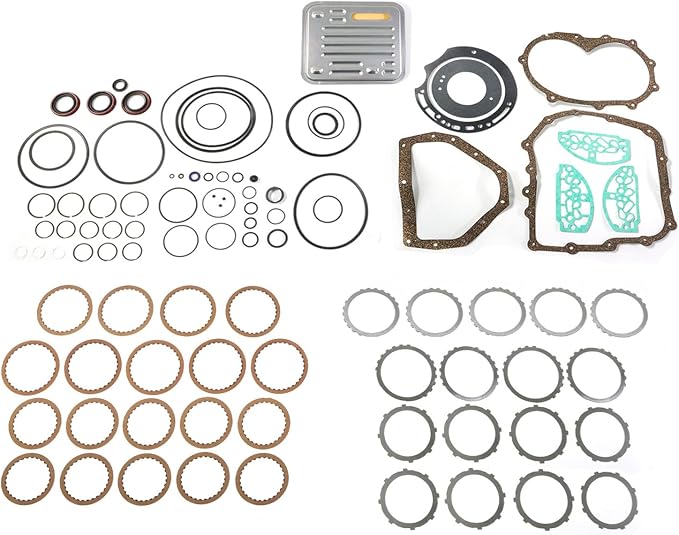
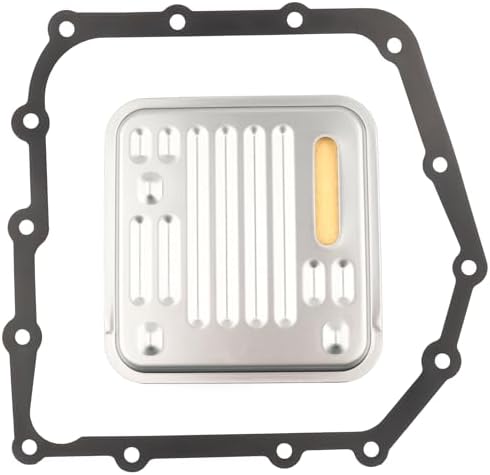
41TE and A604 master rebuild kits with frictions and steels, solenoid block packs, filter kits, ATF+4 and the pressure-testing gear to prove the diagnosis before you open the case — shipped from the USA.
Shop 41TE parts →Keeping one from slipping in the first place
Three things account for most of the 41TE slip complaints that come across the bench. Fluid that stayed in too long, which cooks the valve body bores and accelerates the regulator wear that starves line pressure. A rebuild that reused a worn input clutch hub bushing, which leaks the underdrive circuit no matter how good the new frictions are. And a pressure regulator bore that was never vacuum tested because the valve looked acceptable to the eye.
Service the fluid on a real interval with ATF+4, not a universal fluid that claims coverage on the back label — the frictional properties are what set the apply characteristics these controllers are calibrated around. Vacuum test the valve body every time it is on the bench. Measure the bushing clearance rather than eyeballing it. And once a unit is back together, drive it warm and confirm the CVIs land in range before it leaves, because a UD number sitting at 68 on a fresh rebuild is telling you something now that you would rather not learn from a tow bill later.
Related reading: our 41TE and A604 Ultradrive problem guide, how to check transmission line pressure, reading transmission live data, and 62TE valve body and solenoid problems.
Sources
- Transmission Digest — "The Variable Line Pressure Solenoid," Wayne Colonna, Technically Speaking, July 1, 2018. Backs the fixed non-VLP line pressure of 120 to 145 psi in first and second, overdrive clutch oil routed to the pressure-regulator valve to cut line pressure to approximately 85 psi for third and fourth, the VLPS duty cycle range of 5 to 62 percent, roughly 5 percent at idle in drive with the brake applied, the ramp to 25 percent on the 2-3 shift and about 30 percent at converter clutch apply, and the desired-versus-actual line pressure scan tool parameters tracking together when solenoid and sensor are healthy. transmissiondigest.com
- ATRA Technical Bulletin #1377, "41TE, 42LE Clutch Volume Index (CVI's)," April 2011. Backs the full CVI table used in this article: L-R 35 to 83 updated on a 2-1 or 3-1 coast downshift with fluid between 70 and 120°F; 2-4 clutch 20 to 77 updated on a 1-2 shift; OD 48 to 150 updated on a 2-3 shift; UD 24 to 70 updated on a 4-3 or 4-2 shift, all three with fluid above 80°F (above 110°F beginning with 1997 model year), plus the definition of learned clutch fill volume as the volume required to stroke the piston to zero pack clearance without stroking the accumulator or picking up torque load. atracom.blob.core.windows.net
- ATRA Chrysler technical manual, "Understanding Clutch Volume Index (CVI)," 2009. Backs the unit definition that one CVI equals 1/64 of a cubic inch of transmission fluid, that CVI values are derived by the controller comparing input and output speed sensor signals to time gear changes, and that each accumulator holds 64 CVIs which are not included in the clutch volume shown in scan data. atracom.blob.core.windows.net
- Sonnax — Input Clutch Hub Bushing 92003-01K product and technical page. Backs the input clutch hub bushing being an oil control surface for the underdrive clutch, excess clearance between the bushing and the stator support allowing leakage in the underdrive circuit, the resulting low underdrive clutch pressure and clutch failure, and the bushing specifications: steel-backed bimetal precision bushing, 0.575 inch width, 1.781 inch shaft diameter, 1.904 inch housing bore, installed with tool 92003-TL. sonnax.com
- Sonnax — Oversized Pressure Regulator Valve 92835-24 product and technical page. Backs worn pressure regulator bore as the cause of low line pressure, burnt clutches and poor lube oil control, wear at the spring end of the bore allowing line pressure to exhaust and producing low line pressure and soft shifts, the effect of that wear on converter flow and the lube circuit, the non-VLP application list (40TE, 41AE, 41TE, 42LE, 42RLE), the VLP identification rule based on the line pressure solenoid and transducer mounted on the valve body, and 92835-29 as the VLP-unit equivalent. sonnax.com
- Gears Magazine (ATRA) — "Troubleshooting the 604 (41TE)," Dave Skora, October 2005, page 20. Backs the four-type classification of 41TE electrical and computer problems, with Type 4 defined as a code indicating incorrect gear ratio accompanied by incorrect Clutch Volume Index numbers or a slipping clutch, and the pre-diagnosis requirement to start with basic connection and ground checks and confirm a good, fully charged battery at 12.45 volts minimum resting. atracom.blob.core.windows.net