The Ram 3500 with the 5.9L Cummins and an automatic used the same 48RE as the 2500 from 2003 through 2007. Chrysler's 2006 Ram Body Builder technical specifications list the automatic for the 3500 diesel as the "Auto 4-Speed HD 48RE," the same unit offered behind the Cummins in the 2500, with the NV5600 and G56 six-speed manuals as the alternatives.[1] There is no special 3500 version of the transmission. What changes is the load behind it.
The same spec sheet rates the 3500 4x4 rear axle at 6,500 lb on single rear wheels and 9,350 lb on dual rear wheels, against 6,200 lb for the 2500 with the standard engine, with 3.73 or 4.10 gears.[1] A one-ton dually gets bought to pull a heavy fifth-wheel or a gooseneck, and every pound of that extra capacity goes through a four-speed whose clutch packs and band were designed for a broader range of trucks. So the problem list on a 3500 looks like the 2500 list, but the order of likelihood shifts toward heat, converter clutch slip and overdrive clutch burn. This post covers what I see on 3500s specifically and how I sort them out.
Why the 48RE Has to Clamp Harder Than the 47RE
You cannot diagnose a burned 3500 without understanding what Chrysler changed in the 48RE's pressure curve. Jim Dial's Sonnax article on 48RE hydraulics explains it.[2] The TorqueFlite pressure regulator works backwards compared to most designs: it has reducing points that push the regulator toward lower line pressure, and throttle pressure works against them. When the converter clutch applies in 3rd or the unit shifts to 4th, apply oil moves a boost valve that exhausts some of those reducing points so line pressure can climb.
- 46/47RE: one reducing point (D) exhausts in lockup or 4th, raising line about 10-15 psi.
- 48RE: two reducing points (A and D) exhaust, raising line about 22-28 psi, and with point A gone the throttle pressure plug can raise line faster.[2]
Sonnax ties that extra rise directly to clamping force on the converter clutch and the overdrive clutch, and calls it "a requirement in these heavy-duty applications, especially when towing."[2] On a 3500 that is the whole story. The overdrive clutch and converter clutch carry full engine torque at highway speed with the trailer on. Anything that takes away that line rise (a worn boost valve bore, a 47RE valve body swapped in, a tired pressure regulator spring) shows up first as lockup slip and OD clutch heat, and on a dually pulling a big fifth-wheel it shows up fast.
Problem 1: Overdrive Clutch and Converter Clutch Burn Under Load
This is the most common reason a 48RE comes out of a 3500. The pattern is consistent: the truck tows fine for a while, then the customer notices the tach flaring on hills in 4th, or a shudder when lockup applies, and the fluid comes out dark with a burned smell.
TransGo, whose 48RE-HD2 reprogramming kit is engineered for 2003-2008 48RE trucks that tow or haul, lists the common complaints on this transmission as TCC slip or shudder, 2nd gear band failure, direct clutch failure and torque converter drain-back.[5] Those match what comes across my bench from one-tons. The HD2 kit raises maximum line pressure to 145 psi in 1st through 3rd and up to 180 psi in 4th or lockup, and adds a line-to-converter feed that TransGo says helps the unit run cooler and promotes TCC clutch life.[5] Those numbers tell you where the factory calibration runs out of margin on a working truck.
Before you rebuild the clutch pack, confirm the valve body. Sonnax warns that a 46/47RE valve body installed in a 48RE "seems to work ok at the start," then the vehicle comes back with a failed converter clutch or overdrive clutch, because it never delivers the 48RE pressure rise.[2] Used 48RE valve body cores are scarce, so a lot of 3500s have had a 47RE unit put in at some point. If the truck has a history of repeat overdrive failures, pull the pan and identify the valve body before you order friction material.
Use the converter in manual ranges on grades
The 48RE has a feature most owners never use. Chrysler changed the channel plate and spacer plates and deleted the No. 2 checkball so the TCC solenoid is fed with forward-clutch oil instead of 2nd-gear oil. Per Wayne Colonna of ATSG, that allows converter clutch engagement in manual 2 and manual 1 "for better pulling capacity at lower engine speed," under specific conditions such as the truck moving under load in a manual range.[3] On a loaded 3500, pulling a long grade in a lower manual range with the converter able to lock beats letting it hunt between 3rd and 4th with an unlocked converter making heat. Tell the customer that, and some of these units will live a lot longer.
Problem 2: Stalls When Shifted Into Gear, Hot
The same forward-clutch TCC feed that helps a 3500 pull creates a stall failure older RE units cannot have. Colonna's article lays it out: on a 48RE, a restricted TCC solenoid can fully apply the converter clutch as soon as Drive is selected and stall the engine. A partially dragging solenoid can instead load the engine enough that the computer raises idle on its own, so the driver is on the brakes with a diesel pushing against a half-locked converter.[3]
The split test is which range stalls. A stall in Reverse when hot is the classic RE pump problem (pump halves out of flat) or a restricted cooler, and can come with recurring P0740 or P1740. A stall in Drive but not Reverse points at the TCC solenoid. A stall in both can be pump plus solenoid, a restricted cooler, the converter, or a stuck TCC switch valve.[3] On a 3500 that has spent its life towing, I check cooler flow early in that list, because one-tons are the trucks that get aftermarket coolers, longer lines and replaced lines after a hitch strike.
Problem 3: Second Band, Direct Clutch and Delayed Engagement
The other two TransGo complaints, 2nd band failure and direct clutch failure, are load-driven too.[5] The 2nd (kickdown) band holds second gear and every kickdown from 3rd on a grade. A heavy 3500 that gets floored to pass with a trailer puts that band and its servo through a hard apply every time. The HD2 kit addresses it with servo components and valve body changes that increase flow to the direct clutch and band release circuit to reduce 2-3 shift overlap.[5] Overlap is time when the band and direct clutch are both slipping; less overlap means less heat in both.
Delayed engagement on a cold morning is the other complaint I hear from one-ton owners. TransGo lists torque converter drain-back among the common 48RE complaints and uses a manual valve with converter charge in Park to reduce overnight forward and reverse delayed engagement.[5] If a 3500 engages slowly only after sitting overnight but is fine once warm, think converter drain-back and cooler circuit before you condemn the forward clutch.
One related item for trucks that park on a slope hooked to a trailer: TransGo's kit includes a detent ball bore repair because a worn detent bore contributes to difficult Park disengagement.[5] A truck that is hard to pull out of Park with a load on it deserves a look at the park pawl and detent, not just a note on the repair order.
Problem 4: TTVA Codes on 2005-2007 3500s
Starting in 2005, Dodge replaced the TV cable on the 48RE in diesel 2500 and 3500 Rams with a transmission throttle valve actuator (TTVA): two potentiometers for position feedback and a DC motor that strokes the TV shaft through a D-shaped socket.[4] There is no adjustment. The engine computer recalibrates zero at every key-on, and after the actuator is replaced or reinstalled the key must be held on for at least 30 seconds to initialize. During calibration it needs at least 48 degrees of travel.[4]
The trap per Jeff Parlee of Sonnax: the throttle shaft adjustment bolt on the pressure regulator spring bracket should measure 0.905 inch from the bracket to the inside of the bolt head. Cable-type brackets can measure as little as 0.820 inch, and installing one without resetting the bolt sets P1751 and/or P1752 on a healthy unit.[4] On a 3500 that has had a used or 2003-2004 valve body installed, measure that bolt before you buy an actuator. The full code set is P1749 through P1755 (sensor circuit low/high, minimum range, span, mechanical performance, actuator stuck, control circuit).[4] Remember that the TV system sets shift timing and line pressure, so a TTVA problem on a loaded one-ton is also a line pressure problem.
Problem 5: Fluid Level and Cooling
Chrysler's 2006 Ram Body Builder fluid chart lists the 48RE service fill at 3.8 liters (8 pints) and the overhaul dry fill at 14-16 liters (29-33 pints), with a footnote that dry fill varies with the internal cooler, the length and inside diameter of the cooler lines, and any auxiliary cooler.[1] That footnote applies to 3500s more than any other Ram, because so many have added coolers or deep pans. Fill with ATF+4 and set the final level on the dipstick at operating temperature. A one-ton that is a quart low under a heavy trailer is starving the pump at the worst possible time.
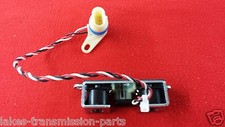
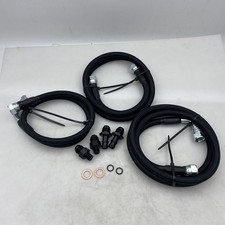
If the truck has an auxiliary cooler, confirm flow through it, not just that it is plumbed. A restricted cooler is on Colonna's short list for stalling, and low cooler flow is exactly the heat path that kills the converter clutch on a towing truck.[3]
Check Campaign Status Before You Chase a Chime
NHTSA campaign 05V462000 (DaimlerChrysler E17) covers 2003-2005 Ram 2500 and 3500 diesels with automatics. The summary says a driver exiting quickly without shutting off the engine could leave the shifter in indicated Reverse; the remedy was a software change that adds an out-of-park alarm.[6] If a 3500 owner complains about a warning chime when the door opens, check the campaign and confirm the lever is fully in Park before chasing a switch.
Triage Order for a 2003-2007 Ram 3500 Cummins 48RE
- Record model year (cable or TTVA), SRW or DRW, axle ratio, tune, and the heaviest trailer it pulls.
- Check level and condition hot with ATF+4. Look for added coolers and verify cooler flow.
- If it stalls, note which range before touching the pump.
- Pull codes. P1749-P1755 on a 2005+ truck points at the TTVA circuit and the 0.905 in. bolt dimension.
- Confirm the valve body is a true 48RE unit. A 47RE valve body explains repeat OD and TCC burns.
- Road test loaded if you can. Watch for flare in 4th, lockup slip and 2-3 overlap.
- Decide between valve body correction, a heavy-duty recalibration, or a full rebuild with upgraded clutch capacity.
For the full capacity and filter rundown, see our 48RE fluid type and capacity guide, and keep the transmission fluid spec chart on the bench for everything else in the shop.
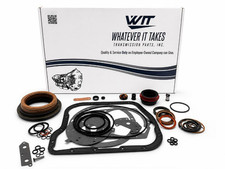
48RE master rebuild kits, TCC solenoids, coolers and valve bodies for the 2003-2007 Ram 3500 Cummins — shipped fast from the USA.
Shop 48RE parts →Shop the 48RE Level 2 kit → All 48RE parts
FAQ
Is the 48RE in a Ram 3500 different from the one in a 2500?
No. Chrysler's 2006 Ram Body Builder specifications list the same Auto 4-Speed HD 48RE for both the 2500 and 3500 with the 5.9L Cummins. The 3500 carries more weight, with a 4x4 rear axle rated 6,500 lb on single wheels and 9,350 lb on duals, so the same transmission works harder.
Why does the overdrive clutch keep burning up in my 3500 48RE?
The overdrive and converter clutches carry full torque at highway speed with a trailer, and they depend on the 48RE's 22-28 psi line rise in lockup and 4th. A 46/47RE valve body, a worn boost valve bore or low fluid takes that rise away, and Sonnax notes a 47RE valve body in a 48RE can come back with a failed converter or overdrive clutch.
Should I tow in overdrive with a 48RE Ram 3500?
On grades and with heavy trailers, use a lower range rather than letting it hunt between 3rd and 4th. The 48RE was designed to allow converter lockup in manual 2 and manual 1 for pulling at lower engine speed, which keeps converter slip and heat down.
What fluid and how much does a 3500 48RE take?
Use ATF+4. Chrysler lists a 3.8 liter (8 pint) service fill and a 14 to 16 liter (29 to 33 pint) dry fill after overhaul, and notes dry fill changes with coolers and line length. Set the final level on the dipstick at operating temperature.
What causes a 48RE Ram 3500 to stall when shifted into Drive?
On the 48RE the TCC solenoid is fed with forward-clutch oil, so a restricted solenoid can lock the converter as soon as Drive is selected. A stall in Reverse only usually points at the pump or a restricted cooler instead.
Related 48RE guides
Sources
- Chrysler / Ram Body Builder Guide 2006 — Technical Specifications and Fluid Capacities. Backs the "Auto 4-Speed HD 48RE" listing for the 3500 Cummins, the NV5600/G56 manual alternatives, 3500 4x4 rear axle ratings of 6,500 lb SRW and 9,350 lb DRW versus 6,200 lb for the 2500, the 3.73/4.10 ratios, and the 48RE 3.8 L service fill and 14-16 L dry fill with its cooler footnote. Technical specifications (PDF) · Fluid capacities (PDF)
- Sonnax Tech Resources — "Dodge 48RE Hydraulic Features Revealed," Jim Dial, October 27, 2015. Backs the reducing-point comparison, the 10-15 psi (46/47RE) versus 22-28 psi (48RE) line rise in lockup and 4th, the heavy-duty towing rationale, and the warning about 46/47RE valve bodies in 48RE units. sonnax.com
- Transmission Digest — "A Significant Departure: The 48RE Transmission," Wayne Colonna (ATSG), August 1, 2012. Backs the forward-clutch-fed TCC solenoid, manual 2/manual 1 lockup for pulling, the No. 2 checkball deletion, and the stall-in-Drive versus stall-in-Reverse diagnosis including pump flatness and restricted coolers. transmissiondigest.com
- Transmission Digest — "Preventing 48RE Transmission Throttle-Valve-Actuator Codes," Jeff Parlee (Sonnax TASC Force), June 1, 2010. Backs the 2005 TTVA introduction on diesel 2500/3500 Rams, the 30-second initialization and 48-degree span, the 0.905 in. versus 0.820 in. bolt dimension, and codes P1749-P1755. transmissiondigest.com
- TransGo — 48RE-HD2 Reprogramming Kit product details. Backs the list of common 48RE complaints (TCC slip/shudder, 2nd band, direct clutch failure, converter drain-back), the 145 psi / 180 psi line pressure targets, line-to-converter feed, converter charge in Park, detent bore repair and 2-3 overlap reduction. transgo.com
- NHTSA — Recall 05V462000 (DaimlerChrysler campaign E17). Backs the 2003-2005 Ram 2500/3500 diesel automatic out-of-park alarm software remedy. NHTSA recall data