A 48RE behind a Cummins will pull a gooseneck all day as long as the fluid stays cool. Let it cook and the fluid breaks down, the converter clutch starts to slip, and the slip makes even more heat. Most of the 48REs we tear down after towing duty did not break from torque. Heat wore them out, one long grade at a time.
This guide covers what the factory already does to protect a 48RE when it gets hot, how to tell whether your cooling circuit is really moving oil, and which upgrades are worth the money for a truck that tows. The temperature logic comes from the Chrysler 48RE service manual, the valve body wear points come from Sonnax, and the overheating diagnosis comes from ATRA's Gears Magazine. Sources are listed at the bottom.


Why Heat Is What Kills a Towing 48RE
Gears Magazine puts the ideal maximum transmission temperature at 200°F and gives the rule of thumb every builder knows: for every 20 degrees above that, expected life is cut in half. At 220°F you get half the life, at 240°F a quarter, and at 260°F one-eighth. A truck that sits at 240°F every time it climbs a grade with a trailer is using up its transmission four times as fast as one held at 200°F.
Most of that heat comes from the torque converter. With the converter clutch released, the turbine is turning slower than the impeller and the difference turns into heat in the fluid. Once the clutch is applied, that slip goes away. The 48RE was built with this in mind. Sonnax's "Dodge 48RE Hydraulic Features Revealed" explains that when the converter clutch is applied in 3rd or when the transmission is in 4th, the lockup boost valve raises line pressure about 22-28 psi. The 46/47RE only raises it about 10-15 psi. The extra pressure gives the converter clutch and the overdrive clutch more clamping force, and Sonnax says that is a requirement in these heavy-duty trucks, especially when towing. Any worn valve that bleeds off that pressure lets the clutch slip, and slip is heat.
What the Factory Already Does When It Gets Hot
The 48RE has a thermistor built into the governor pressure sensor assembly. It sits in transmission fluid at all times and reads about 1000 ohms at room temperature, per the Chrysler service manual [1]. The PCM uses that reading to decide when to allow overdrive, converter lockup and governor pressure changes. The 1998 Ram service manual spells out what it does at each temperature, and the 48RE kept the same RE-family strategy [1]:
- Below about 50°F (10°C): the PCM does not allow the converter clutch or the overdrive clutch to apply.
- Above 260°F (126°C): the PCM commands a 4-3 downshift and applies the converter clutch. The overdrive OFF lamp (the Tow/Haul lamp on later trucks) comes on during this downshift [1].
- Back to about 230°F (110°C): fourth gear is allowed again.
The torque converter section adds that the converter clutch applies in 4th and in 3rd under various conditions, such as with the O/D switch off. It can also apply in manual 2nd when the PCM sees high transmission temperature.
This matters for two reasons. First, if your truck drops out of overdrive on a long pull and the Tow/Haul light comes on without you pressing anything, do not assume the transmission is failing. It may be the overheat strategy doing its job, and it is telling you the fluid just went past 260°F. Second, by the time that strategy kicks in, the fluid is already in the one-eighth-life zone Gears describes. The factory protection is a last line of defense. It is not a cooling system.
Use the Tow/Haul switch the way it was meant to be used
Per the Chrysler service manual, overdrive is allowed at key-on [1]. Pressing the Tow/Haul overdrive switch once enters the OFF mode, which stops the 3-4 upshift, and the indicator lights to show it. The switch goes back to overdrive ON every time the ignition is cycled. On a grade or in rolling hills with a heavy trailer, locking out 4th keeps the truck in 3rd, where the converter clutch can stay applied, instead of hunting between 3rd and 4th and unlocking the converter with each shift. On flat highway with a light load, overdrive with the converter locked is fine. Remember that it resets at every key cycle, so press it again after every fuel stop.
Watch the Number, Not the Gauge Needle
Most 2003-2007 Rams do not have a transmission temperature gauge. A scan tool or plug-in monitor that reads the PCM's transmission temperature value will show you exactly what the thermistor sees. Here are the targets we use:
- About 180°F: normal hot operating temperature. It is also the temperature the service manual uses for checking fluid level.
- 200°F: the ideal maximum. Cruising while towing should stay at or below this.
- 220-240°F: short climbs can hit this. If the truck lives here, it needs more cooling or a cooling repair.
- 260°F: the PCM forces the 4-3 downshift. Back out of the throttle, go to a lower gear and let it cool.
If the temperature stays high on flat ground at steady speed, the problem is not the grade. Something in the cooling circuit is not working, and bolting on a bigger cooler will not fix it.
Step One: Prove the Cooling Circuit Flows
Before you buy anything, check that oil is actually moving through the cooler. Gears lists six main causes of overheating: plugged cooler lines, a plugged cooler, a plugged transmission filter, overloading, engine overheating, and a bad engine fan clutch. It also says cooler line flow should be at least a gallon per minute, measured with a flow meter or by timing flow into a bucket.
Then check the parts that choke flow on these trucks:
- Drainback valve. According to the service manual, this is a one-way check valve in the cooler outlet (pressure) line. Its spring-loaded check ball opens at about 2 psi and keeps the converter from draining into the cooler when the truck sits. The manual warns that if it is restricted, installed backwards, or in the wrong line, it will cause overheating and possible transmission failure. It cannot be repaired. Replace it with a new one after any failure that put debris through the cooler.
- Cooler thermostatic bypass. The Ram cooler circuits have a thermostatic bypass valve that sends fluid around the cooler until it warms up. In their overheating case study on a 2008 Ram 3500 with the 6.7L, Gears found the bypass valve on the top right side of the transmission cooler, and getting to it meant pulling the grille, intercooler and A/C condenser. If it sticks, the fluid keeps bypassing the cooler even after it is hot. Owners of 2003-2007 trucks report the same problem with debris holding the bypass open.
- Fan clutch. The transmission cooler sits in front of the radiator and depends on airflow. Gears' test is to watch fan speed on a scan tool at 2000 engine rpm. Fan speed should reach 1850 rpm or higher. A lazy fan clutch looks fine on the highway and overheats everything at low speed on a grade.
- Filter and fluid. A plugged filter starves the pump, and cooked fluid has already lost its friction properties. Service manual contamination causes include the wrong fluid, engine coolant getting in, debris from internal failure, and sludge from overheating.
Step Two: Add Cooling Capacity
Once the circuit is proven clear, capacity upgrades pay off. These are listed in the order we would spend the money:
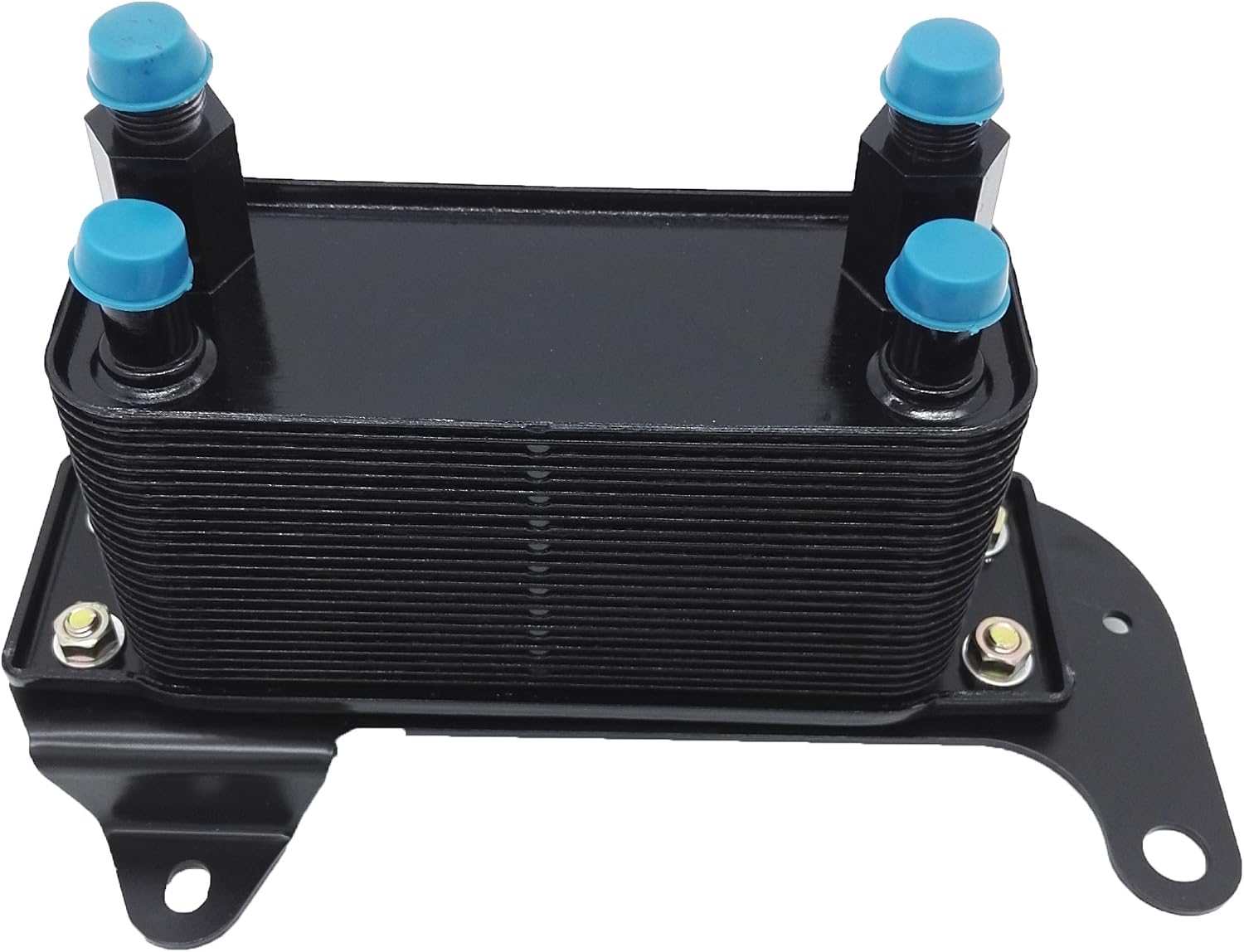
- A fresh factory cooler. An old cooler with bent fins, bugs packed between it and the intercooler, or a restricted core loses capacity before it ever leaks. Replacing it with a direct-fit unit brings you back to the factory baseline.
- An auxiliary cooler. A plate-and-fin auxiliary cooler plumbed in series after the factory cooler adds capacity where it counts, and mounting it where it gets clean air matters more than its size. Keep the drainback valve in the correct line with the flow arrow pointing the right way when you re-plumb, and do not create new restrictions with small fittings or kinked hose.
- A deep, finned pan. A deep cast aluminum pan adds fluid volume and surface area, which slows how fast the temperature climbs on a long pull and gives the filter a better pickup. It does not fix a cooling circuit with low flow, so do this after step one, not in place of it.
Step Three: Fix the Valve Body Wear That Makes Heat
A 48RE can have a clean cooler and still run hot because worn valves are leaking the pressure that feeds the converter and cooler. The Sonnax 48RE unit page lists the parts and the complaints each one fixes:
- Lockup boost valve. The oversized lockup boost valve kit (22771-19K) is listed for TCC slip under load, no line rise during TCC apply in 4th, converter overheating and loss of lube oil. When this valve wears, the 22-28 psi line rise goes away, and that line rise is what the 48RE depends on under a trailer.
- Switch valve. The 4-spool switch valve (22771A-01) is listed for lockup shudder, overheated converter, low cooler flow, soft TCC apply and release pressure building up during lockup.
- Pressure regulator valve. The lube-regulated pressure regulator valve kit (22771A-02K) is listed for converter drainback, lube failures and converter bushing failure. The line pressure plug and sleeve kit (22771A-19K) is listed for poor cooler charge at idle.
Sonnax's Sure Cure kit (SC-48RE) puts most of this in one box: an oversized throttle valve kit, an oversized 4-spool switch valve, and the oversized lube-regulated pressure regulator valve with the line/TV pressure plug kit, along with accumulator seals, turbine shaft seals and an output pilot bushing. The complaints Sonnax lists for it include poor cooler charge at idle, low cooler flow, overheated converter, converter bushing failure and lockup shudder. On a towing truck that is getting rebuilt anyway, it costs very little compared with what it protects.
One warning Sonnax makes clear: never put a 46/47RE valve body in a 48RE. The 48RE's boost circuit and TCC solenoid feed are different. A 47RE valve body seems fine at first, then comes back with a failed converter clutch or overdrive clutch, which is exactly the kind of failure a towing truck exposes quickly. Our 48RE valve body testing guide covers how to check what you have.
Hard-Part Upgrades for Heavy or Frequent Towing
If the truck tows near its rating on a regular basis, or has more power than stock, the rebuild is the time to add the hard parts Sonnax lists for this unit:
- Smart-Tech input shaft and piston kit (22121B-02K). The input shaft is the known weak link behind a Cummins under load.
- 2nd gear super hold servo kit (22301B-01K). More holding power on the front band for 2nd gear, which matters when a loaded truck starts out on a hill.
- Pump gear set (22530-D). Listed for low line pressure. Worn pump gears take away the pressure the boost circuit is trying to add.
- Extreme duty output shaft (22173D-01). For builds with serious power going through them.
Pair these with a converter built for the use and the power level. A converter that slips under load will overheat any cooling system you put in front of it.
2005-and-Later Diesels: Get the TTVA Right
On 2005-later 2500 and 3500 diesels, a transmission throttle valve actuator (TTVA) replaced the TV cable. Transmission Digest reports that the throttle shaft adjustment bolt on the pressure regulator spring bracket must measure 0.905 in. between the bracket and the bolt head. A cable-type bracket can measure as little as 0.820 in., which leaves the actuator without enough travel. The ECM needs at least 48 degrees of movement, and the initialization is a key-on hold of at least 30 seconds. Get this wrong and you get codes P1751/P1752 and poor shift quality. Soft, slipping shifts under a trailer make heat too, so check the bracket and the initialization on any 48RE that tows after a rebuild or valve body swap.
A Towing Checklist for the 48RE
- Run Mopar ATF+4 only. Chrysler warns that the wrong fluid can cause poor shift quality and converter shudder [2]. Check the level hot, at about 180°F, idling in Neutral.
- Get a real transmission temperature reading from a scan tool or monitor, and learn what your truck reads loaded and unloaded.
- Prove at least a gallon per minute of cooler flow, and check the drainback valve direction and the cooler bypass.
- Test the fan clutch: 1850 rpm or more fan speed at 2000 engine rpm.
- Use Tow/Haul on grades, and press it again after every key cycle.
- Service fluid and filter on your owner's manual severe-service schedule. Towing counts as severe service. If the fluid smells burnt or has turned dark, change it now.
- At rebuild time, fix the lockup boost valve, switch valve and pressure regulator wear points, and install the input shaft upgrade if the truck tows heavy.
For fluid capacity and the full fill procedure, see our 48RE fluid type and capacity guide. If you already have lockup shudder, start with the 48RE converter shudder guide.
Sonnax Sure Cure Kit for the 48RE
Oversized switch valve, lube-regulated pressure regulator valve and throttle valve in one kit. It targets the low cooler flow, poor cooler charge at idle and overheated converter complaints that towing brings out.
View the 48RE Sure Cure kit →Shop 48RE transmission parts →
Frequently Asked Questions
What temperature is too hot for a 48RE transmission?
About 200 degrees F is the ideal maximum. Gears Magazine notes that every 20 degrees above that cuts expected life in half, so 240 degrees F is a quarter of normal life. The PCM forces a 4-3 downshift and applies the converter clutch at 260 degrees F, which means the fluid is already far too hot.
Should I tow in overdrive with a 48RE?
On flat highway with a moderate load, overdrive with the converter locked is fine. On grades, rolling hills or with a heavy trailer, press the Tow/Haul switch to lock out 4th so the truck holds 3rd with the converter clutch applied instead of hunting between gears. The switch resets to overdrive ON every time the key is cycled.
Why does my 48RE drop out of overdrive and turn on the Tow/Haul light while towing?
If you did not press the switch, the PCM may have seen fluid temperature above 260 degrees F. The service manual says it then commands a 4-3 downshift, applies the converter clutch and lights the Tow/Haul lamp, and it will not allow 4th again until the fluid cools to about 230 degrees F. Treat it as an overheating warning and check cooler flow, the fan clutch and the fluid.
Does a bigger transmission cooler help a 48RE?
Only if the cooling circuit is already flowing. Gears says cooler flow should be at least a gallon per minute. A restricted or backwards drainback valve, a stuck cooler bypass, plugged lines or a bad fan clutch will keep a 48RE hot no matter how big the cooler is. Prove flow first, then add an auxiliary cooler in series after the factory cooler.
What fluid should a towing 48RE use?
Mopar ATF+4 only, per Chrysler’s 2007 Ram owner’s manual, which warns that a non-specified fluid can cause poor shift quality and torque converter shudder [2]. Towing is severe service, so change the fluid and filter on the severe-service schedule in your owner's manual, and sooner if the fluid smells burnt or looks dark.
Sources
- Chrysler, 1998 Dodge Ram Truck Service Manual — Group 21, RE automatic transmission: transmission fluid temperature thermistor and overdrive OFF switch. Backs the thermistor inside the governor pressure sensor assembly (about 1000 ohms at room temperature), no converter clutch or overdrive clutch engagement below about 10°C (50°F), the forced 4-3 downshift with converter clutch engagement above 126°C (260°F) with the overdrive OFF lamp lit, 4th gear withheld until fluid drops to about 110°C (230°F), and the momentary overdrive OFF switch that locks out the 3-4 upshift and resets to overdrive ON at every key cycle. The 48RE carries this RE-family control strategy. archive.org (1998 Ram FSM)
- Chrysler, 2007 Dodge Ram 2500/3500 Owner’s Manual — Maintaining Your Vehicle and Fluids, Lubricants and Genuine Parts. Backs Mopar ATF+4 as the specified 48RE-era automatic transmission fluid and the caution that non-specified fluid can cause poor shift quality and torque converter shudder. archive.org (2007 Ram 2500 owner’s manual)
- Gears Magazine (ATRA) — "48RE/68RFE/AS68RC Transmission Overheating." Backs the 200°F ideal maximum and the half-life-per-20°F rule, the six overheating causes, the one-gallon-per-minute minimum cooler flow, the fan clutch test (1850 rpm fan speed at 2000 engine rpm), and the stuck cooler thermostatic bypass valve. gearsmagazine.com
- Sonnax — "Dodge 48RE Hydraulic Features Revealed." Backs the 22-28 psi line rise at lockup and in 4th vs 10-15 psi on the 46/47RE, the need for that clamping force when towing, the 48RE's ability to apply torque converter clutch in manual 2nd gear (a capability the 46/47RE valve body does not share), and the warning against 46/47RE valve bodies in a 48RE. sonnax.com
- Sonnax — Chrysler 48RE unit page. Backs the lockup boost valve kit (22771-19K), 4-spool switch valve (22771A-01), lube-regulated pressure regulator valve kit (22771A-02K), line pressure plug and sleeve kit (22771A-19K), input shaft and piston kit (22121B-02K), 2nd gear super hold servo kit (22301B-01K), pump gear set (22530-D), extreme duty output shaft (22173D-01), and the complaints each is listed for. sonnax.com
- Sonnax — The Sure Cure Kit (SC-48RE). Backs the kit contents and the listed complaints including poor cooler charge at idle, low cooler flow, overheated converter and converter bushing failure. sonnax.com
- Transmission Digest — "Preventing 48RE Transmission Throttle-Valve-Actuator Codes." Backs the 2005-later diesel TTVA, the 0.905 in. vs 0.820 in. bracket measurement, the 48-degree span and the 30-second initialization. transmissiondigest.com