A 4L80E filter and pan service is a ninety-minute job that shops charge an hour and a half for and still manage to get wrong. Not because it is hard — because there are four places on this particular transmission where a small mistake turns routine maintenance into a comeback: the wrong filter height, a filter seal that never seated, a case rail that got pried on, and a second filter almost nobody knows is in there.
This is the bench version of the procedure, with the actual GM fastener numbers, the pressure specs to verify the job afterward, and the AFL filter that lives in the valve body and does not get touched by a normal service.


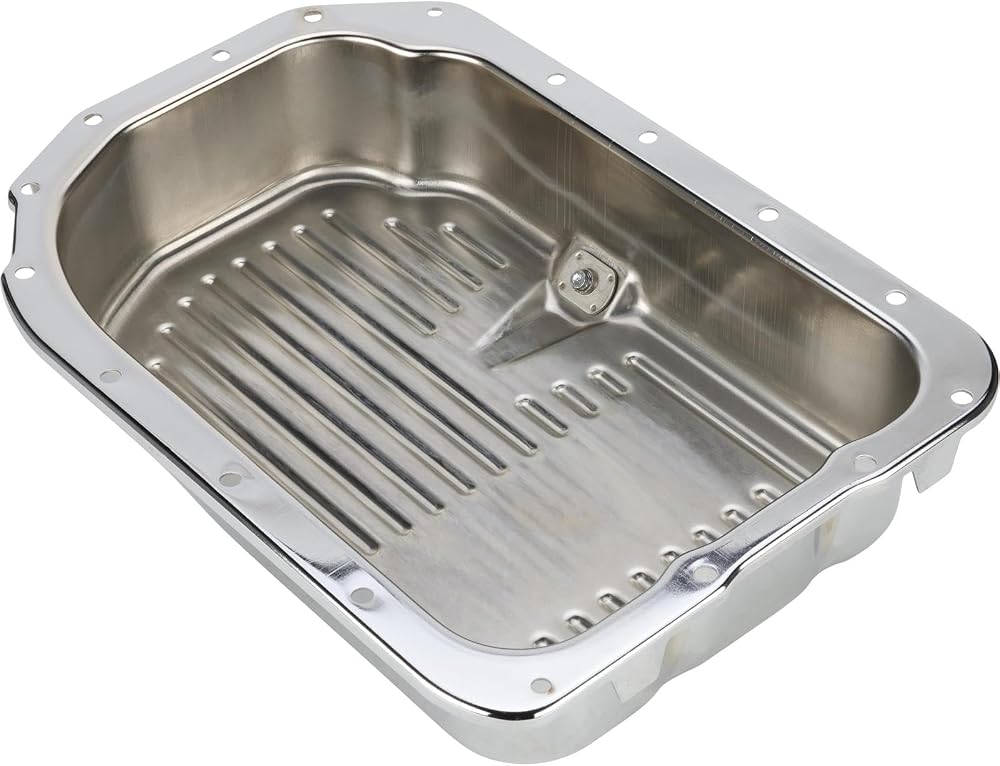
First: which filter does your truck take?
The 4L80E ran from 1991 to 2013 across a very wide range of trucks, vans, motorhomes and the Hummer H1, and the pan depth is not consistent. There are two families of service filter, and they are not interchangeable:
- Shallow-sump filter. Shorter overall height, flat bottom. Used on the earlier stock pan.
- Deep-sump filter. Taller, with raised dimples pressed into the bottom face. Those dimples are not decoration — they bottom against the pan floor and hold the filter body down so it cannot float off the pump pickup neck.
The failure mode when you get this wrong is ugly and fast. Put a shallow filter in a deep pan and the pickup is sitting in an air gap above the fluid; put a deep filter in a shallow pan and you crush the filter body against the floor and restrict flow. Either way the pump starves, line pressure drops, and the clutches that were fine an hour ago start slipping.
Do not order off a model year. Measure the pan. Pull the old filter, set it next to the new one on the bench, and confirm both the overall height and the length of the neck that goes up into the pump. Two seconds on the bench beats a transmission on the floor.
What you need on the cart before the pan comes down
- A big drain pan. Mag-Hytec's own 4L80E pan instructions call for a minimum 20-quart capacity drain pan, and that is not an exaggeration. A big-case GM unit holds 12.8 liters (13.5 quarts) total.
- Two gallons of licensed DEXRON VI. GM's service fill for pan removal is 7.3 liters (about 7.7 quarts). You want the extra on hand for the hot level check.
- Two torque wrenches. A lb-ft wrench for the pan, and an inch-pound wrench if you are going into the valve body. The valve body and solenoid fasteners on this unit are inch-pound specs and a 3/8 ft-lb wrench will not read them meaningfully.
- A mill-smooth file, 8 to 12 inches. For dressing the case rail, covered below.
- Filter, pan gasket, and a magnet you are willing to actually clean.
Getting the pan off without ruining the sealing surface
The stock 4L80E pan is a 17-bolt steel pan and it will be stuck. The temptation is a screwdriver in the corner. Every dent you put in the case rail with a screwdriver is a leak path that no amount of gasket will seal.
Work the front bolts loose, leave two rear bolts in finger-tight, and break the pan free at the seam with a putty knife or a dull chisel driven flat along the gasket line, not levered against the case. Let it drain into the corner by tipping it, then pull the last two bolts.
Then inspect the case rail. Mag-Hytec's install sheet spells out the right method for this: scrape the old gasket off, then check the rail for raised dents around the bolt holes and dress them down with a long mill-smooth file laid flat, being careful not to round off the flat gasket surface. Holes that have been overtorqued pull the metal up into a volcano around the hole, and a flat pan cannot seal against a volcano.
Read the pan before you do anything else
This is the diagnostic half of the job, and it is free. What is on the magnet and the pan floor tells you whether you are performing maintenance or documenting a failure:
- Grey fuzz on the magnet, fluid dark but not burnt. Normal. Clean it, service it, drive it.
- Black fibrous material coating the floor. Clutch lining. Something is slipping and fresh fluid will not stop it.
- Hard metal chips you can feel between your fingers. Gear, sprag or bushing material. Stop and diagnose before you spend money on fluid.
- Bronze or copper-colored powder. Bushing wear. On a 4L80E this usually means the unit has been running with marginal lube flow for a while.
- Aluminum glitter. Often the pump or a hard part making contact. Not a fluid-change conversation.
Take a photo of the pan floor before you wipe it. If the truck comes back in three months, that photo is the only record of what the unit looked like when you had it open.
The filter seal is where this job actually goes wrong
The 4L80E filter seals to the pump with a lip seal on the filter neck. Two things kill it:
The old seal stayed in the bore. The most common single cause of a post-service comeback on any GM unit. The filter comes out, the seal stays up in the pump, and the new filter gets pushed into a bore that already has a seal in it. It feels like it went in. It did not. The pump now pulls air past a doubled seal, and you get foaming fluid, erratic line pressure, and a whine at idle. Always look up into the bore with a light after the old filter is out. If the seal is up there, hook it out.
The filter never got pushed home. Seat the new filter by hand, firmly, until it stops, then look at how far the filter body hangs below the case. It should match the old one. If the filter is riding low, the seal is not fully in the bore and the pan will push it crooked when you bolt it up.
The second filter: the AFL filter in the valve body
Here is the part that separates a real 4L80E service from a fluid swap. Inside the valve body there is a small actuator feed limit filter that screens the oil going to the shift solenoid circuit, retained by an end plug with an O-ring. Nothing about a normal pan-and-filter service touches it.
The AFL circuit exists because you cannot feed a shift solenoid full line pressure. Per Sonnax's hydraulics writeup, in GM 4L60-E and 4L80-E transmissions line pressure is regulated down to approximately 115 psi and fed to the shift solenoids. The AFL valve does that regulating, and the AFL filter keeps trash out of it.
When that filter breaks up or the end plug leaks, the solenoid feed circuit loses pressure and the transmission behaves as if the solenoids failed. Sonnax lists the exact complaint set that its AFL filter end plug and O-ring kit (part 34994-17K) addresses: broken AFL filters, 2nd gear starts, leaking AFL end plug, code 68, 85, 86, 87, no upshifts.
TransGo attacks the same circuit from the other side — bore wear. Its AFL repair covers 1991 to 2013 GM vehicles with 4L80E and 4L85E transmissions where the actuator feed limit valve bore wears out, producing what it describes as inadequate pressure rise and shift solenoid feed oil loss, with wrong gear starts, falls out of gear and clutch plate burn-up and codes P0731, P0732, P0734, P0751 and P0756.
Practical rule: if the truck came in with a shift complaint — starts in 2nd, will not upshift, a shift solenoid code that came back after a new solenoid — the pan being off is your cheapest opportunity to address the AFL circuit. If it came in for plain maintenance and shifts correctly, replace the pan filter and leave the valve body alone. We cover the bore-wear side of this in more detail in our 4L80E valve body problems and testing guide, and the specific code path in 4L80E P0751 diagnosis and fix.
If you do pull the valve body, bench-test the bores before you put it back. Sonnax publishes a vacuum test guide for the 4L80-E and 4L85-E valve body that gives you a pass/fail on each bore instead of a guess.
The numbers: GM fastener torque for a 4L80E
These come off GM's fastener application table for this transmission, reproduced in the ATSG THM 4L80-E technical manual. Assembly torque first, recheck minimum in parentheses:
- Pan to case screw — 24 N·m / 18 lb-ft (recheck minimum 15 N·m, 133 lb-in)
- Control valve assembly to case screw — 11 N·m / 97 lb-in (recheck minimum 8 N·m, 71 lb-in)
- Solenoid to valve body screw — 8 N·m / 71 lb-in (recheck minimum 5 N·m, 44 lb-in)
- Accumulator housing to valve body screw — 11 N·m / 97 lb-in
- Temperature sensor to valve body — 4 N·m / 35 lb-in
- Oil test hole plug — 11 N·m / 97 lb-in
- Cooler pipe connector nut, at case and at radiator — 38 N·m / 28 lb-ft
Two notes. First, 18 lb-ft is more than most techs expect on a transmission pan, and it is correct for the stock steel pan. Aftermarket pans are different hardware entirely: Mag-Hytec specs its 8 mm allen cap screws at 12 to 16 lb-ft. Use the number that matches the pan in your hands. Second, run them criss-cross from the center of each long side outward, in two passes, and do not go around the perimeter in a circle.
Fill, then check it hot
Add about six quarts down the fill tube before you start the engine, then start it, hold the brake, and cycle the selector slowly through every range with a pause in each. That fills the circuits and the accumulators. Shut it off, recheck, add more.
The 4L80E level is a hot check — engine running, transmission in Park, vehicle level, fluid at operating temperature. Watch the transmission fluid temperature PID on a scan tool and do the check with TFT in the 160°F to 200°F band. Checking a 4L80E cold and calling it full is how trucks leave a shop two quarts down, which is also how you get a converter-charge complaint a week later.
Prove the job with a pressure check
This is the step that separates a service from a hope. The 4L80E has a line pressure tap, and GM publishes the range:
- Drive, Park or Neutral: 35 to 171 psi
- Reverse: 67 to 324 psi
The spread exists because line pressure is commanded electronically through the force motor. GM's procedure uses a scan tool override-force-motor test, raising force motor current in 0.1 amp increments and letting pressure stabilize about five seconds at each step, then comparing against the published chart — roughly 157 to 177 psi at 0.02 amps falling to 35 to 55 psi at 0.98 amps. The whole test is capped at two minutes of running time in GM's own notice, so do not sit there sweeping it.
For context on what normal looks like under load, GEARS Magazine's 400/4L80 rebuild article puts typical 4L80E converter charge pressure during high load at around 100 psi with a maximum line pressure of 180 psi.
What you are looking for after a filter service is simple: pressure that is in range, stable, and that tracks force motor current the way the chart says. Low, wandering, or non-responsive pressure right after a pan job points straight back at the filter seal, not at the pump. If you are chasing a genuine pressure problem, work through our 4L80E low line pressure diagnosis instead of replacing parts.
How often, realistically
The 4L80E lives behind big-block gas engines, diesels and motorhomes, which means most of them are in severe service whether the owner admits it or not. Any towing puts it there. In the field, 30,000 to 50,000 miles between pan-and-filter services keeps these units alive; stretch that on a truck that tows and the additive package is exhausted long before the fluid looks bad.
The other half of the interval is heat. A 4L80E that runs hot will use up fluid faster than the odometer suggests, and the single best thing you can do for one that tows is add cooling capacity and a deep pan with a drain plug — which also makes every service after this one a drain instead of a pry.
FAQ
Does a 4L80E have more than one filter?
Yes. Every 4L80E has the main pan filter that everyone replaces, and it also has a small actuator feed limit (AFL) filter inside the valve body that feeds the shift solenoid circuit. Sonnax sells a repair kit for it specifically because broken AFL filters and leaking AFL end plugs cause 2nd gear starts and no upshifts. A routine pan service does not touch it, which is why a truck can get a fresh filter and still shift badly.
Which 4L80E filter do I need, shallow or deep?
It is decided by the pan, not the model year badge on the truck. Measure the pan depth before you order. The later deep-sump applications use a filter with raised dimples on the bottom that hold the filter down against the pan floor; a shallow filter in a deep pan leaves the pickup sitting in air and starves the pump. Pull the old filter, set it next to the new one on the bench, and confirm the neck length and the overall height match before the pan goes back up.
What torque do 4L80E pan bolts take?
GM's fastener table for this transmission calls out 24 N·m, which is 18 lb-ft, for the pan-to-case screws, with a recheck minimum of 15 N·m (133 lb-in). Run them in a criss-cross pattern from the middle outward. Note that aftermarket aluminum and cast pans do not use that number — Mag-Hytec specs 12 to 16 lb-ft for its 8 mm allen cap screws, and torquing an aluminum pan to the steel-pan figure warps the flange.
How do I know the new filter is actually sealing?
Check line pressure after the job. GM's line pressure range for the 4L80E is 35 to 171 psi in Drive, Park or Neutral and 67 to 324 psi in Reverse. A filter seal that did not seat lets the pump pull air, and you will see pressure that is low, unstable, or that will not climb with force motor current. Foam on the dipstick and a whining pump point the same direction.
How much fluid does a 4L80E pan service take?
GM's published service fill after pan removal is 7.3 liters, about 7.7 quarts, against 12.8 liters (13.5 quarts) for a full overhaul fill. Buy two gallons so you have enough to fill and still top off on the hot level check. A deep aftermarket pan adds several quarts on top of that and requires the deep filter.