A 4L80E makes all four forward gears with exactly two on/off shift solenoids. Get that straight before you order anything, because it explains most of the symptom list below: one failed shift solenoid never costs you one gear. It costs you two, and it leaves the truck in a gear pair that looks random until you read the state chart.
Per the 4L80-E shift solenoid chart, the 1-2 solenoid (A) is energized in 1st and 4th and de-energized in 2nd and 3rd. The 2-3 solenoid (B) is de-energized in 1st and 2nd and energized in 3rd and 4th:
- 1st — 1-2 solenoid ON, 2-3 solenoid OFF
- 2nd — 1-2 OFF, 2-3 OFF
- 3rd — 1-2 OFF, 2-3 ON
- 4th — 1-2 ON, 2-3 ON
Both solenoids off is 2nd gear, not 1st. That is the hydraulic default with no solenoid feed, and it is why a 4L80E that loses the power supply to its solenoids pulls away in 2nd.


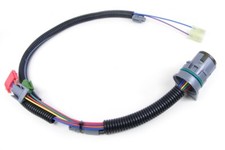
Symptoms, sorted by which solenoid failed and which direction it failed
Stop thinking in symptoms and start thinking in gear pairs. Work backward from the chart and the complaint tells you which solenoid you are chasing before you plug anything in.
1-2 solenoid (A) failed
- Stuck off: you get 2nd and 3rd only. The truck pulls away soft in 2nd, feels gutless from a stop, then has one usable shift.
- Stuck on: you get 1st and 4th only. This is the one that confuses people — a hard launch, then what feels like a jump straight into overdrive with nothing in between.
2-3 solenoid (B) failed
- Stuck off: 1st and 2nd only, revving out with no 3rd or 4th and no converter lockup. Owners describe this as the engine screaming on the highway.
- Stuck on: 3rd and 4th only. It leaves from a stop in 3rd, slips the life out of the converter, and feels like a slipping transmission rather than an electrical fault.
What the module does on its own
The failsafe is part of the symptom. On a 2-3 shift solenoid circuit fault the controller defaults to maximum line pressure, no TCC, and 2nd or 3rd gear only. On a 1-2 shift solenoid circuit fault it commands maximum line pressure and holds either 2nd and 3rd or 1st and 4th. So the customer complaint is almost always two things at once: wrong gears and a harsh, slamming truck, because line pressure is pinned high. That combination is a clue, not a second problem.
Both circuit codes set fast. The controller flags the fault when it commands the solenoid on and voltage stays high, or commands it off and voltage stays low, with the condition present for 2 seconds. There is no long filter to wait out, which is why an intermittent connection can drop a truck into failsafe at one stoplight and clear on the next key cycle.
Codes: circuit versus performance, and why the difference decides the job
Two different families of codes point at these solenoids, and they mean opposite things:
- P0753 and P0758 (GM codes 82 and 81 on the earlier controllers) are electrical. The module did not see the voltage change it expected on the control circuit. Something in the feed, the wiring, the connector, the coil or the driver is wrong.
- P0751 and P0756 are performance codes. The circuit worked, but the input-to-output speed ratio came back as the wrong gear. Those point at hydraulics as often as electronics.
- Ratio codes (low ratio, high ratio and undefined ratio — codes 86, 87 and 85 on the earlier controllers) are the same idea with tighter gates. The low-ratio test only runs with no TP sensor, speed sensor or range switch codes present, out of P/R/N, engine above 300 RPM, throttle above 25 percent and vehicle speed above 7 mph, and it sets when the calculated ratio drops below 1.06 with 1st or 2nd commanded.
Sonnax lists "repeated solenoid B code 86" and "code 87" among the documented recurring complaints on this unit, and that phrasing is the tell: on a 4L80E, a repeating ratio code usually is not a repeating solenoid. It is feed pressure or a worn bore.
Diagnosis in the order that actually saves time
1. Command the solenoids and listen
Ignition on, engine off. Command each shift solenoid on and off three times with a scan tool while listening at the bottom of the pan, stethoscope on the case if the shop is loud. Listen for two sounds, not one: the click going on and the clack coming off. A solenoid that clicks on and never clacks off is a real finding, and it does not always mean the solenoid — one documented case of exactly that symptom ended up being a slow controller driver.
2. Prove the shared feed before you blame a solenoid
Both shift solenoids and the TCC solenoid share one ignition feed that is spliced internally to terminal E of the case pass-through connector. Install a jumper harness or probe kit at the connector, put a test light from cavity E to ground with the key on, and confirm there is power at all. Then move the test light from E to A for the 1-2 solenoid and command it on and off. The light should follow the command. If it does not, you are chasing the control circuit or the driver, not the solenoid.
This is the step that saves the most parts. One shop chased P0753 and P0758 on a 2007 Express 3500 after already replacing the transmission, the harness and the solenoids — and the codes came back sooner the warmer the truck got. Back-probing the control wires at the PCM showed voltage sagging as the circuit heated, and the fault traced back through the shared supply to IGN O fuse 6, fed from terminal E of the ignition switch. The ignition switch was the failed part. A single weak shared feed is the clean explanation for solenoid codes on both solenoids at once, and that is a pattern worth recognizing before the pan comes down.
3. Resistance at the case connector
With the harness disconnected at the pass-through connector, the published windows are:
- 1-2 shift solenoid: 18-24 ohms, terminals A to E (internal circuit 1222)
- 2-3 shift solenoid: 18-24 ohms, terminals B to E (internal circuit 1223)
- Pressure control (EPC) solenoid: 3.5-5.2 ohms
- TCC solenoid: 10-14 ohms
GM's later diagnosis charts for this same style of on/off shift solenoid list a wider 19-31 ohm range, so do not condemn a coil that reads 26 ohms warm. Check each leg to the case for a short to ground while you are in there. What matters more than the exact number is that the two shift solenoids should read close to each other; a 10-ohm spread between two solenoids in the same pan is the finding.
4. When resistance looks fine and the code keeps coming back
A static resistance check tests a coil at rest. It does not test the circuit under load, and it does not test the controller's low-side driver at all. Two techniques close that gap. First, put an ammeter inline to ground on one control circuit and convert with Ohm's law: 0.49 amps on a 13 volt circuit works out to 26.5 ohms of real circuit resistance with the load included. Second, back-probe the control circuit and scope it. A healthy low-side driver snaps between source voltage and 0 volts with a crisp square edge. In the documented case above, the bad driver still swung the full 13 volts to 0 — it just took 15 to 27 seconds to turn off, which matched a shift the driver felt arrive 20 to 25 seconds after it was commanded. No ohmmeter finds that.
The two things that fake a bad 4L80E shift solenoid
Broken connector retention tabs
The case pass-through connector is held by three plastic retention tabs, and Sonnax notes that it is common for one of them to break on 4L80-E and 4L85-E units, which lets the connector back out or get pushed down into the pan area. The symptom is an intermittent that moves with vibration and temperature, and the usual fix sold for it is a complete internal wiring harness. Sonnax bracket 34998-01K clamps the connector from inside the pan using existing hardware instead. Identify which connector you have before ordering anything: the early style has exposed terminals with a red rubber gasket, the late style has a gray plastic enclosure around the terminals.
Actuator feed limit bore wear
The solenoid does not move the shift valve. It sends or exhausts actuator feed oil, and the valve moves. The actuator feed limit valve regulates line pressure down to a lower ceiling for the solenoid circuits, typically 80 to 115 psi, and Sonnax documents that bore wear there pushes feed pressure and flow wrong in both directions. Too much feed and the solenoid gets flooded beyond its ability to exhaust; too little and the shift valve never strokes fully. The published result is exactly the symptom list we started with: shift concerns, clutch failure, solenoid codes, and TCC apply and release complaints. If you have replaced solenoids once and the code came back, vacuum test the AFL valve and the shift valves instead of buying solenoids twice.
Replacement: what the job actually involves
Both shift solenoids live under the pan, so this is an on-vehicle repair. The sequence that keeps it a one-time job:
- Drop the pan and read it. Clutch material or bronze in the pan turns a solenoid replacement into a teardown conversation. Do this before you order parts.
- Inspect the pass-through connector first. Check all three retention tabs, and check the terminals for spread, corrosion or push-back. A loose terminal that only needed crimping has ended plenty of "bad solenoid" diagnoses.
- Replace the shift solenoids as a pair, and look hard at the internal harness. The harness is the same age as the solenoids and it carries the shared feed. On a high-mile unit the solenoid kit with harness and filter is the better spend, because the second trip under the truck costs more than the parts.
- Check the solenoid screens and O-rings. A pinched or missing O-ring on a shift solenoid leaks actuator feed oil and reproduces the same low-feed symptoms you just finished diagnosing.
- Confirm year and style before ordering. The electronics changed across this unit's production run — Sonnax sells an adapter (34435-01K) specifically to run an early-style 1992-2002 EPC solenoid in a 2003-and-later unit. Verify the VIN against the transmission that is actually in the truck, too: one documented case had the service data return a 4L60-E solenoid diagram for a van that came with a 4L80-E.
- New filter and gasket, then fill and check hot. Refill is about 5 quarts after a filter change, roughly 11.5 quarts dry after an overhaul, plus 1 to 2 quarts in the cooler and lines. Check the level in Park at idle at 180-200 degrees F, which takes about 15 miles of driving. Checking a 4L80E cold is how it ends up overfilled and foaming. The unit was released on DEXRON-III; DEXRON-VI is the current-production service fill.
- Clear codes and re-verify by command, not by feel. Command all four gears on the scan tool and watch the gear ratio follow each one, then road test. Adapts were frozen while the code was set, so give the truck a few miles of varied driving before you judge shift quality.
FAQ
Can you drive a 4L80E with a bad shift solenoid?
Short distances only, and expect it to feel wrong. When the module sees a shift solenoid circuit fault it defaults to maximum line pressure and locks you into a pair of gears - 2nd or 3rd only on a 2-3 solenoid fault, and either 2nd-3rd or 1st-4th on a 1-2 solenoid fault. Maximum line pressure with no converter lockup means heat, and heat is what turns a 40 dollar solenoid job into a rebuild. Drive it to the shop, not through the week.
What should a 4L80E shift solenoid read on an ohmmeter?
18 to 24 ohms. Measure the 1-2 solenoid between case pass-through terminals A and E, and the 2-3 solenoid between terminals B and E. Terminal E is the shared ignition feed spliced internally to both shift solenoids and the TCC solenoid, which is why one bad feed at E can set codes on both solenoids at once. The pressure control solenoid in the same connector reads 3.5 to 5.2 ohms and the TCC solenoid reads 10 to 14 ohms, so a reading that lands in the wrong window usually means you are on the wrong terminals.
Which gears does each 4L80E shift solenoid control?
Neither one controls a single gear. The 1-2 solenoid (A) is energized in 1st and 4th and off in 2nd and 3rd. The 2-3 solenoid (B) is off in 1st and 2nd and energized in 3rd and 4th. That is why a solenoid stuck in one state costs you two gears, and why both solenoids de-energized puts the transmission in 2nd gear rather than 1st.
Do you have to drop the transmission to replace 4L80E shift solenoids?
No. Both shift solenoids, the pressure control solenoid, the TCC solenoid and the internal wiring harness are all reachable with the pan off, on the vehicle. Budget around 5 quarts to refill after a pan and filter service, and check the level at 180 to 200 degrees F. A dry fill after an overhaul is closer to 11.5 quarts.
Why did new solenoids not fix my 4L80E?
Because the solenoid is only a valve that sends or exhausts actuator feed oil - the shift valve is what actually moves. Sonnax documents that the actuator feed limit valve in these units wears its bore, and that the resulting change in feed pressure to the shift solenoids produces solenoid and ratio codes with good solenoids installed. Broken connector retention tabs and a weak ignition feed do the same thing from the electrical side. Prove the feed and the valve body before you buy a second set.