The 4L85E is a tough unit that gets destroyed by a short list of specific things, and almost none of them are the clutches. Most of the ones that come back after a rebuild come back because the overdrive roller clutch was never given any help, because a worn boost valve sleeve is still driving line pressure through the roof, or because somebody mixed year-specific hard parts that look identical on the shelf. Every one of those is catchable on the bench. This guide walks the list in the order the failures actually happen, with the measurements and part numbers that settle each one.
One framing point up front: the 4L85E is the heavy-duty member of the 4L80E family, and the aftermarket treats it that way. Every Sonnax repair referenced below is cataloged as fitting 4L80-E and 4L85-E, and the Sonnax build guides state plainly that many parts listed for the 4L80-E also fit 4L85-E and TH400 units. What is not shared is year-to-year interchange inside the family, and that is where the money gets lost.
Before you order anything: know which year stack-up you have
Two design changes split this family into three incompatible hard-part groups, and both are documented in an ATSG bulletin summarized by ATSG president and Transmission Digest technical editor Wayne Colonna.
In 1997, the unit went to a center-gearbox lubrication system by relocating the cooler return line from the pump to the center support. That single plumbing change forced a redesign of a long list of internal hard parts. Then in 1999, the planetary pinions in both the front and rear carriers were made 0.075 in. thicker for durability. Thicker pinions meant the sun gear had to be raised 0.041 in. so it would run centered in them, which was accomplished with a 0.041 in. shim between the thrust bearing and the rear internal ring gear. The sun gear shaft changed to make room for that lift.
The result is three different sun gear shafts, with the second design used only on 1997 and 1998 center-lube units. Get it wrong and here is what you get:
- Non-center-lube sun gear shaft in a center-lube unit. The 1997-and-later shafts have a shortened bushing journal. Install the older long-journal shaft and it restricts the cooler and lube circuit, which raises converter pressure and makes the clutch drag. The customer complaint is the engine stalling or stumbling when the shifter is put into Overdrive or Reverse. That is a hydraulic restriction, not a converter or an engine problem.
- 1997-98 sun gear shaft with 1999-and-later parts. The bushing journal protrudes above the bushing by nearly 0.90 in.
- 1999 sun gear shaft with 1997-98 parts. The bushing journal sits nearly flush.
The go/no-go number is simple: with all the correct parts together, the bushing journal should protrude above the bushing by about 0.050 in. Measure it during your gear train stack-up. It takes thirty seconds and it catches a mistake that otherwise gets discovered with the unit in the truck. The same warning applies to center supports and rear planetary carriers, which also differ between the 1997-98 and 1999-later center-lube designs.
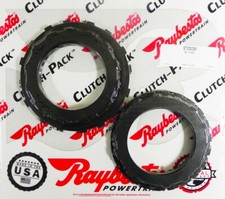
4L80E / 4L85E Master Rebuild Kit with Raybestos Frictions
Frictions, steels, gaskets, seals and sealing rings covering 1997-2011 units, so the only things you buy separately are the hard parts your teardown actually condemns.
See the rebuild kit →Wear point 1: the overdrive roller clutch
This is the one that turns a rebuild into a parts order. Sonnax states the underlying cause directly: insufficient holding power in the overdrive roller clutch is what drives chronic OD roller clutch failure in hardworking 4L80-E and 4L85-E transmissions, and when it lets go, the damage is usually catastrophic. The fix at that point is not a roller clutch. It is the drum, the planetary assembly and the mating components.
The mechanism is a clutch application chart problem, not a materials problem. The OD one-way roller clutch lives inside the overrun/coast clutch drum and holds in 1st through 3rd, then freewheels in 4th. In the Overdrive range that roller clutch is holding by itself — the overrun clutch only applies in the manual ranges, D2 and D1. So a truck that spends its life loaded, in Overdrive, is running the roller clutch with no backup. Heat makes it worse: on overheated units the plastic cage of the OD roller clutch can melt, which takes the roller clutch out in a hurry.
There are two answers. The free one is to tell the customer to drive a loaded truck in a manual range, which applies the overrun clutch and shares the load. The one that works whether or not the customer listens is the Sonnax Smart-Tech overrun clutch valve kit 34200-40K, which fits 1997-and-later units and reroutes hydraulic pressure so the overrun clutch is applied in every range except Overdrive 4th. The difference on the application chart is stark:
| Range / gear | Overrun clutch, OE valve | Overrun clutch with 34200-40K |
|---|---|---|
| Park, Reverse, Neutral | Not applied | Applied |
| Overdrive 1st, 2nd, 3rd | Not applied | Applied |
| Overdrive 4th | Not applied | Not applied |
| Drive 1st, 2nd, 3rd | Applied | Applied |
| D2 and D1 | Applied | Applied |
It installs onto the valve body with no transmission removal, which also makes it a legitimate repair on a unit already in service. On a plow truck, a dump body, or anything towing near its rating, this is the single highest-return item on the list.
Wear point 2: the boost valve, and the 500 psi that breaks cases
If you have ever pulled one of these apart, found a broken direct clutch drum or a cracked case, and had no idea what did it, look at the boost valve. Per Sonnax, a worn boost valve sleeve lets Reverse boost oil cross-leak into the torque signal circuit, and a worn aluminum balance plug lets oil past and unbalances the pressure regulator valve. The documented symptom set is uncontrollable line rise upward of 500 to 600 psi, high line pressure in Reverse, a buzzing noise, broken direct clutch drums, and broken cases.
Note the order of causation, because it matters when a customer asks why they are paying for a valve kit on a unit with a broken hard part. The cross-leak comes first. The pressure comes second. The broken parts come third. Replace the drum without addressing the sleeve and you have bought the job back.
Sonnax offers three versions, and which one you need depends on the unit, not on preference:
- 34200-01K — O-ring style sleeve, retrofittable back to 1989 units. Hardened steel boost valve with spools over 20 percent wider for durability and sealing contact area, annular grooves to reduce the side loading that causes the wear in the first place, external O-rings on the sleeve to compensate for pump cover bore wear, and a replacement aluminum balance plug with an O-ring so the PR valve sees proper back pressure.
- 34200-03K — factory-style sleeve without O-rings, for 1991-later units.
- 34200-10K — O-ring style with an encapsulated relief valve.
Do not confuse a boost valve repair with a line pressure increase. If the goal is more pressure, that is the line pressure booster kit 4L80E-LB1, whose pressure regulator spring runs roughly 10 percent stronger than OE and pairs with a large-ratio boost valve so pressure climbs progressively as load climbs, instead of raising it everywhere including idle.
Wear point 3: the low/reverse servo piston (1996 and later)
A 1996 design change left the low/reverse servo piston more heavily stressed than the early one, and the result is a piston that commonly breaks. The customer feels it as no Reverse. Sonnax spacer kit 34528-01K fits 1996-later units and fixes it with geometry rather than with a stronger piston: the short spacer more than doubles the contact area between the aluminum piston and the spacer, which drops the pressure between the piston and the spacer by 60 percent, and a Belleville spring washer between the piston and apply pin absorbs the shock. No machining, and it drops in during assembly.
Sonnax makes one connection here worth internalizing: excessively high line pressure in Reverse is directly related to boost valve wear and cross-leaks into the EPC oil circuit. Wear point 2 is what breaks the piston in wear point 3. Install the servo spacer and skip the boost valve and you treated the symptom.
Wear point 4: intermediate clutch case lug blowout
The intermediate clutch backing plate retaining ring loads directly against the case lugs, and on hard-working units those lugs blow out. The traditional fix was to delete the intermediate band, which is acceptable in a trans-brake drag car and not acceptable in a truck. The Sonnax case saver retainer 34762-20 (1999-later; use 34762-10 for 1998-and-earlier 4L80-E and all TH400) fits over the intermediate band anchor lug inside the case and extends rearward to support the intermediate clutch backing plate retaining ring, and it is thin enough that the intermediate band still goes in. It will also salvage a case that has already lost one or two lugs.
Two install notes: it requires modification to OE-style intermediate clutch backing plates that do not have a full complement of case lugs, and no modification at all if you run the Sonnax heavy duty backing plate 34144HD-02 (0.275 in. thick, 1999-later; 34144HD-01 at 0.375 in. for 1998-earlier). Decide on this while the case is bare. You cannot add it later without splitting the unit again.
Wear point 5: the pressure regulator valve, cooler flow and idle surge
The OE pressure regulator valve design does not deliver adequate cooler flow at low RPM under high pressure and high demand, which is precisely the condition a loaded truck sits in at a light after a long pull. That is an overheating mechanism designed into the hydraulics. On top of it, Sonnax notes that on 1999-later vehicles the factory EPC pressure was set high at idle, producing an engine surge complaint on 4L80-E and 4L85-E units.
The lube regulated pressure regulator valve 34200-14K carries an encapsulated check valve that allows regulated flow into the converter charge and lube circuit at idle while preventing converter and pump drainback. It improves converter release pressure, significantly increases cooler flow under low RPM and high pressure conditions, and it removes the need to reprogram 1999-later vehicles to cure the surge. The three symptoms that point straight at it: engine surge at idle, low cooler flow, low TCC release pressure.
How to condemn all of this on the bench: vacuum testing
None of the above should be guesswork. Sonnax publishes a vacuum test guide specifically for the GM 4L80-E and 4L85-E valve body that maps the critical wear areas and the exact test locations. A low vacuum reading at a port means bore wear at that valve. The circuits it flags, and the complaint each one generates:
| Valve / circuit | What a worn bore produces |
|---|---|
| TCC regulator valve | Converter shudder, burnt converter, TCC apply and release concerns, TCC codes. Repairs: 34994-01K standard, 34994-18K oversized |
| Actuator feed limit valve and sleeve | Solenoid codes, gear ratio codes, 2nd gear starts, wrong gear starts, no 4th, direct clutch burned, 3rd and 4th slip |
| 3rd and Reverse accumulator control valve | Soft shifts, low accumulator pressure, clutch and band failures |
| 1-2, 2-3 and 3-4 shift valves | Shift complaints in the matching range, bent valves |
| Manual valve | Low line rise, delayed engagement |
| Reverse and low/reverse checkball circuits | Reverse slip, Reverse complaints, no engine braking in manual low, burnt rear band |
| Solenoid filter and end plug | Broken actuator feed limit filters, gear ratio codes |
Two procedural details from that guide that people get wrong. OE valves are tested in their rest position unless the part instructions say otherwise. And checkball circuits are tested with the valve body held vertical so the ball is seated, with the casting valley plugged using foam or putty. Test them flat and you will condemn a good valve body. Pair the vacuum work with a live line pressure reading — our line pressure testing guide covers the gauge procedure, and the 4L85E pressure testing writeup covers this unit specifically.
A valve body vacuum test kit is what turns "the bore looked fine to me" into a number you can defend on an invoice.
Fluid
These units left the factory on DEXRON-III, and that specification is no longer something you can buy. When GM introduced DEXRON-VI in an April 2005 press release, one of the four opening claims was that the fluid was approved for service application on all prior-model-year Hydra-Matic automatic transmissions. DEXRON-III licensing expired in January 2007. So DEXRON-VI is the correct service fluid for a 4L85E today, and it is not a substitution you are making on your own authority — it was designated as the service replacement by the manufacturer that wrote the original spec.
Fill by level, not by quart count. A pan-and-filter service and a dry rebuild with an empty converter and flushed cooler lines are very different volumes, and a deep pan moves the number again. Prime the converter, put in a conservative initial fill, run the selector slowly through every range at idle to charge the passages, then set the level on the dipstick inside the fluid temperature window your service information specifies. A cold check reads low, and chasing that reading is how units get overfilled and aerated. Our 4L80E fluid type and capacity guide covers the family in more detail.
Need parts for this job?
Master rebuild kits, valve body and boost valve kits, servos, hard parts, coolers and bench tooling for the GM 4L85E, all in one place.
Shop 4L85E parts →Which upgrades are actually worth it
Sonnax organizes its 4L80-E and 4L85-E parts into three build tiers, and the tiering is honest about what a working truck needs versus what a race car needs. Ranked by return per dollar on a unit that works for a living:
- Smart-Tech overrun clutch valve kit 34200-40K. It addresses the one failure mode that writes off the drum and the planetary. Valve body only, no transmission removal.
- Boost valve kit first, then the servo spacer kit. 34200-01K, 34200-03K or 34200-10K depending on sleeve style, plus 34528-01K on 1996-later units. Fixing the pressure before the part it broke is the entire point.
- Lube regulated PR valve 34200-14K. Cooler flow at low RPM and high demand, and it kills the 1999-later idle surge without a reflash.
- Case saver retainer 34762-20 or 34762-10. Cheap relative to a scrapped case, and it rescues cases that are already partly gone.
- Heavy duty forward clutch hub 34322-01, heavy duty clutch retaining ring 28124, heavy duty case bushing kit 34006-SPB. The remainder of the Sonnax heavy duty truck basic build.
- Line pressure booster kit 4L80E-LB1 when the customer wants firmer shifts under load without low-speed harshness.
Above that tier, the under-1,000 HP build adds sprag race 34663HD-02, the heavy duty intermediate clutch backing plate, 300M steel input shaft 34670-01 and main shaft 34672-01, and an adjustable low/reverse servo. Over 1,000 HP the shafts step up to Aermet steel (34670-02, 34672-05) and the forward clutch hub becomes extreme duty kit 34322-02K. If you are buying most of the pump and valve body items anyway, Performance Pack HP-4L80E-01 bundles the booster kit, the lube regulated PR valve, the case saver retainer, the reverse servo spacer kit, the case bushing and bearing kit and the accumulator recalibration parts into one box.
The short version
Identify the year stack-up before you order a single hard part, and confirm the sun gear shaft bushing journal protrudes about 0.050 in. during assembly. Assume the overdrive roller clutch has no backup, because in Overdrive it does not, and give it one with 34200-40K. Vacuum test the valve body instead of eyeballing the bores. Treat the boost valve as the root cause of high line pressure, broken drums, broken servo pistons and cracked cases rather than as an afterthought. Add the case saver retainer while the case is bare. Fill it with DEXRON-VI and set the level on the stick at temperature, not on the parts invoice.
Related reading: 4L80E valve body wear and the bench fix, 4L80E TCC shudder diagnosis, and 4L60E vs 4L80E differences.
Sources
- Transmission Digest — "Which Planet Are You On?", Wayne Colonna, ATSG / Transmission Digest technical editor, January 2009, drawn from an ATSG bulletin. Backs the 1997 move to a center-gearbox lubrication system with the cooler return line relocated from the pump to the center support, the resulting redesign of internal hard parts, the 1999 increase in front and rear carrier pinion thickness of 0.075 in., the 0.041 in. sun gear lift and the 0.041 in. shim between the thrust bearing and rear internal ring gear, the existence of three different sun gear shafts with the second design used only on 1997-98 center-lube units, the engine stall or stumble into Overdrive or Reverse caused by fitting a non-center-lube long-journal sun gear shaft to a center-lube unit, the nearly 0.90 in. and nearly flush bushing journal mismatches, the correct 0.050 in. journal protrusion, and the warning about incorrect center supports and rear planetary carriers. transmissiondigest.com
- Transmission Digest — "Understanding 4L80-E Overdrive Clutch Failure," Sonnax TASC Force, February 2017. Backs the overdrive one-way roller clutch being housed inside the overrun/coast clutch drum, that it holds in 1st through 3rd and freewheels in 4th, that in the Overdrive range on the 4L80-E the OD roller clutch holds by itself while the overrun clutch applies only in the manual ranges, that driving in a manual range backs up the roller clutch with the overrun clutch and distributes the load, and that overheating can melt the plastic cage of the overdrive roller clutch and cause rapid failure. transmissiondigest.com
- Sonnax — Smart-Tech Overrun Clutch Valve Kit 34200-40K (GM 4L80-E, 4L85-E). Backs insufficient holding power in the overdrive roller clutch as the underlying cause of chronic OD roller clutch failure in hardworking 4L80-E and 4L85-E units, that failure damage is catastrophic and requires replacing the drum, planetary assembly and mating components, the 1997-later fitment, the patented rerouting that keeps the overrun clutch applied in all ranges except Overdrive 4th, the full range-by-range application chart comparing OE and Sonnax operation, and that it installs onto the valve body with no transmission removal. sonnax.com
- Sonnax — Boost Valve Kit 34200-01K and Low/Reverse Servo Spacer Kit 34528-01K (GM 4L80-E, 4L85-E). The boost valve documentation backs uncontrollable line rise upward of 500 to 600 psi, high line pressure in Reverse, buzzing, broken direct clutch drums and broken cases; the worn sleeve cross-leak of Reverse boost oil into the torque signal circuit and the leaking aluminum balance plug; the hardened steel valve with spools over 20 percent wider, the annular grooves, the external sleeve O-rings compensating for pump cover bore wear, the O-ringed replacement balance plug, the retrofit back to 1989 units, and the 34200-03K and 34200-10K variants. The servo documentation backs the 1996 design change that stresses the low/reverse servo piston, the resulting broken piston and no-Reverse complaint, the over-two-times contact area increase, the 60 percent reduction in pressure between piston and spacer, the added Belleville spring washer, the no-machining install, and the statement that excessively high line pressure in Reverse is directly related to boost valve wear and cross-leaks into the EPC oil circuit. 34200-01K • 34528-01K
- Sonnax — Case Saver Retainer 34762-20 and Lube Regulated Pressure Regulator Valve 34200-14K (GM 4L80-E, 4L85-E). The case saver documentation backs intermediate clutch retaining ring case lug blow out, the 1999-later fitment of 34762-20 and the 1998-earlier / TH400 fitment of 34762-10, that it fits over the intermediate band anchor lug and extends rearward to support the backing plate retaining ring while remaining thin enough to retain the intermediate band, that other case saver designs require eliminating the band, that it salvages cases with one or two blown lugs, and the backing plate requirements including 34144HD-02 at 0.275 in. and 34144HD-01 at 0.375 in. The PR valve documentation backs the OE design preventing adequate cooler flow at low RPM and high pressure and demand, the resulting overheating, the high factory EPC pressure at idle on 1999-later vehicles causing engine surge, the encapsulated check valve permitting regulated converter charge and lube flow at idle, drainback prevention, improved converter release pressure, and the elimination of the reprogramming workaround. 34762-20 • 34200-14K
- Sonnax — "GM 4L80-E, 4L85-E Vacuum Test Guide" (drop-in Zip Valve critical wear areas and vacuum test locations), February 2013. Backs the valve-by-valve wear and complaint table: TCC regulator valve producing converter shudder, burnt converter, TCC apply and release concerns and TCC codes with repairs 34994-01K standard and 34994-18K oversized; actuator feed limit valve and sleeve producing solenoid codes, gear ratio codes, 2nd gear starts, wrong gear starts, no 4th, direct clutch burned and 3rd and 4th slip; the 3rd and Reverse accumulator control valve producing soft shifts, low accumulator pressure and clutch and band failures; the 1-2, 2-3 and 3-4 shift valves; the manual valve producing low line rise and delayed engagement; the Reverse and low/reverse checkball circuits producing Reverse slip, Reverse complaints, no engine braking in manual low and a burnt rear band; the solenoid filter and end plug and broken actuator feed limit filters; and the two procedural rules that OE valves are tested in rest position unless otherwise indicated and that checkball circuits are tested with the valve body vertical, ball seated, and the casting valley plugged with foam or putty. sonnax.com
- Sonnax — "4L80-E Performance & Heavy-Duty Transmission Build Guides," June 2023, and Line Pressure Booster Kit 4L80E-LB1. Backs the statement that many parts listed for the 4L80-E also fit 4L85-E and TH400 units, the three build tiers, and the specific tier contents cited: heavy duty truck basic build with 34200-40K, 34200-14K, 4L80E-LB1, forward clutch hub 34322-01, clutch retaining ring 28124, case saver retainers 34762-10 and 34762-20, servo kits 34912-01K and 34528-01K and case bushing kit 34006-SPB; the under-1,000 HP build adding sprag race 34663HD-02, backing plates 34144HD-01 and 34144HD-02, and 300M input shaft 34670-01 and main shaft 34672-01; the over-1,000 HP build with Aermet shafts 34670-02 and 34672-05 and extreme duty forward clutch hub kit 34322-02K; plus the Performance Pack HP-4L80E-01 contents. The booster kit page backs the pressure regulator springs running approximately 10 percent stronger than OE and the large ratio boost valves delivering progressive pressure increase without overloading the pump at idle. build guides • 4L80E-LB1
- Transmission Digest — "The Path of Least Resistance: The Future of Transmission Fluids," Wayne Colonna, ATSG / Transmission Digest technical editor, January 2007. Backs the April 2005 GM press release introducing DEXRON-VI, the four opening claims including that the fluid was approved for service application on all prior-model-year Hydra-Matic automatic transmissions and was the factory fill standard in all 2006-model-year Hydra-Matic transmissions beginning April 4, 2005, and the expiration of all DEXRON-III licenses in January 2007. transmissiondigest.com