A 4L85E with a shift solenoid complaint almost never comes in described accurately. The owner says it slips. The service writer writes "slipping." What it is actually doing is starting in second gear, because that is what this transmission does when the solenoids stop getting a command or stop getting oil, and a second-gear start behind a big-block feels exactly like a slip.
The fix is cheap when it really is the solenoid. The problem is that a fair number of these units set shift solenoid codes with perfectly good solenoids in them, and the only thing separating the two cases is doing the diagnosis in order: read the application chart, decide whether the code is electrical or performance, test the circuit rather than the part, and only then decide whether you are buying a forty dollar solenoid or opening the valve body.

What the two shift solenoids actually do
The 4L85E is the heavy-duty build of GM's big-case four-speed. Chevrolet Performance rates it at 650 lb-ft of engine torque with ratios of 2.482, 1.482, 1.000 and 0.750 and a 2.077 reverse, and it runs five-pinion carriers where a 4L80E runs four. Electrically it is the same transmission: same valve body layout, same two on-off shift solenoids, same part numbers. That matters when you order, and it matters when you read service information, because Sonnax and everyone else publishes 4L80-E and 4L85-E data as one document.
Shift solenoid A is the 1-2 solenoid, B is the 2-3. They are simple on-off valves the control module energizes in a pattern to route oil to the two shift valves. Four gears out of two solenoids means four combinations, and that pattern is the most useful thing you can carry to the vehicle:
| Commanded gear | Solenoid A (1-2) | Solenoid B (2-3) |
|---|---|---|
| 1st | ON | OFF |
| 2nd | OFF | OFF |
| 3rd | OFF | ON |
| 4th | ON | ON |
Look at the second row. Both solenoids de-energized equals second gear. That is the electrical default on this family, and it is why the headline symptom is a second-gear start rather than a no-move. Pull the case connector and a 4L85E pulls away in second and stays there. Sonnax lists "2nd Gear starts" as a published complaint for the oil circuits feeding these solenoids, for the same reason.
Barry Bartlett, a diagnostician at Certified Transmission writing in Transmission Digest, makes the case for working this way: reviewing which solenoids and friction elements are applied in each gear is what lets you decide whether a shift problem is electrical or mechanical before you take anything apart.
Symptoms, and what each one is actually telling you
Match the complaint to the chart and the failure narrows itself down:
- Starts in 2nd, no upshifts, no downshift to 1st. Both solenoids behaving as de-energized. That is rarely two dead solenoids. It is a power feed, a ground, a connector, or no oil getting to them.
- 1st and 4th only, or 2nd and 3rd only. Solenoid A stuck in one state. A is on in 1st and 4th and off in 2nd and 3rd, so a stuck A costs you two gears that are not next to each other.
- 1st and 2nd only, or 3rd and 4th only. Solenoid B stuck. Same logic, other column.
- Hard, banging shifts on top of the missing gears. Not a second failure. When the module stores a shift solenoid fault it commands maximum line pressure and drops converter lockup as a protection strategy. The harshness is the strategy, and it leaves with the code.
- One missing gear, normal shift feel, no code stored. Now you are looking at the shift valve in its bore rather than the solenoid feeding it. Sonnax lists that exact set of complaints for the 4L80-E and 4L85-E 1-2 and 2-3 shift valves: "2nd Gear starts, No 4th, 3-4 Neutral, No 3rd."
Electrical code or performance code: two different jobs
Do not lump the shift solenoid codes together. On this family you will see electrical circuit codes (P0753 for solenoid A, P0758 for solenoid B) and performance codes (P0751 and P0756). They do not mean the same thing. An electrical code means the module saw an open, a short, or a driver fault on the control circuit — a wiring and resistance problem you chase with a meter.
A performance code means the electrical side looked fine, but the gear ratio the module calculated from input and output speed did not match the gear it commanded. GEARS magazine, ATRA's technical publication, puts the causes of a performance code in three buckets: a solenoid stuck open or closed, a blocked valve body or stuck shift valve, and a failed clutch, band or gear. Only the first of those three is fixed by a new solenoid.
That is the trap on a 4L85E. These units live behind 8.1L big-blocks, diesel vans, motorhome chassis and duallies that tow near the 650 lb-ft ceiling, and a burnt clutch pack sets a ratio-based performance code every bit as reliably as a lazy solenoid. Before ordering anything on a P0751 or P0756, verify the ratio yourself: level ground, steady throttle, compare the input speed and output speed PIDs and do the division. A commanded 2nd that returns 2.482 is a solenoid or valve problem. A commanded 2nd that returns a number drifting away from 1.482 as load comes on is a clutch slipping, and no solenoid will fix it.
Test the circuit, not the part
Bench-testing a solenoid with an ohmmeter and calling it good is how solenoid jobs come back. GEARS lays out a better sequence, and its numbers are worth writing down.
Start with the power side. These solenoids are fed battery voltage through an ignition-fed circuit and switched on the ground side by the control module, so one bad feed takes out everything at once and produces the both-solenoids-off second-gear start. Confirm system voltage at the case connector first.
Then work the ground side with a meter, not a test light. GEARS is specific about why: a test light will glow at around 8 volts, which is nowhere near the resolution needed to condemn a solenoid circuit. Their working numbers:
- Shift solenoid circuit resistance: 20 to 30 ohms. Measure at the solenoid, then measure again through the harness and compare the two.
- Verify with current, not just resistance. 12.6 volts across 20 to 30 ohms works out to 0.42 to 0.63 amps. Put an ammeter inline and see whether the circuit actually flows that. A solenoid that reads fine cold and goes open at 180 degrees F fails this test and passes the other one.
- Voltage drop on the ground circuit: less than 0.10 volt. More than that and you have found the fault without opening the transmission.
- If the numbers still do not add up, bypass it. Run a known-good solenoid on a test circuit the module controls directly. If the code stays with a good solenoid on a good circuit, the fault is in the module output, its grounds or its power inputs, not in the transmission.
One more check that costs nothing: with the pan down and the battery connected, have a helper cycle each solenoid with a scan tool while you hold a stethoscope against the solenoid body. A working one clicks. A stuck one does not, no matter how good its resistance reading was.
The reason good solenoids set solenoid codes
This is the part that separates a repair from a comeback, and it is specific to this valve body.
The solenoids do not run on line pressure. They run on actuator feed limit oil, regulated down by the AFL valve to a steady feed in the 80 to 115 psi band. Sonnax's description of the 4L80-E and 4L85-E AFL valve explains why that valve does not survive: large reaction area, heavy side loading, and an EPC solenoid oscillating the torque signal and AFL oil that keeps it moving constantly. The bore wears, and oil pressure to the shift solenoids drops with it.
Starved solenoids set codes. Sonnax's symptom list for the AFL valve kit that repairs the bore, part 34200-16K, reads like a diagnostic for this article: "Wrong gear starts, Clutch failure, Solenoid performance codes, No 4th, Band failure, Low solenoid feed pressure, 2-3 Neutral, 2nd Gear starts." Every one of those gets blamed on a shift solenoid first.
The same valve body carries two filters nobody orders and a plug that likes to fail. Sonnax's 4L80-E and 4L85-E layout calls out the AFL filter end plug with complaints of broken AFL filters, leaking plugs and no upshifts, repaired with kit 34994-17K, plus a separate force motor feed filter. A pan-and-filter service touches neither, which is why a unit can leave with a new filter and still start in second.
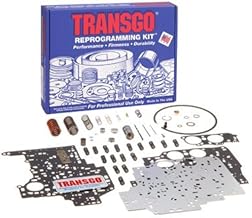
The practical rule: if you have already replaced shift solenoids on a 4L85E and the code came back, stop buying solenoids. The valve body is telling you something. Vacuum testing the bores on the bench is the definitive answer, and our 4L85E valve body problems and testing guide walks through the procedure.
Doing the replacement
Both shift solenoids are on the valve body and come out with the pan down. You are not pulling the transmission. The numbers that matter, from GM's published specification sheet for this unit:
- Fluid: DEXRON VI, called out by name on GM's 4L85E spec sheet. It supersedes the DEXRON III the early units shipped with.
- Refill after bottom pan removal: 7.3 L (7.7 quarts). Dry fill is 12.5 L (13.2 quarts) — a rebuild number, not a solenoid-job number.
- Oil pan to case: 18 lb-ft (24 N·m), in two criss-cross passes from the center of each long side outward, never around in a circle.
- Drain plug, if the pan has one: 25 lb-ft (34 N·m). Cooler pipe connector nut at the case: 28 lb-ft (38 N·m), with a flare nut wrench.
- GM filter 24212452 and pan gasket 08677743 come off the same sheet. Change the filter while you are in there.
Two things before the pan goes back up. Read what came out of it — black fibrous material on the pan floor is clutch lining, and on a performance code that changes the diagnosis entirely, because the ratio fault now has a mechanical explanation. Then check the AFL screen on the separator plate while you can see it. That is the cheapest insurance on this repair.
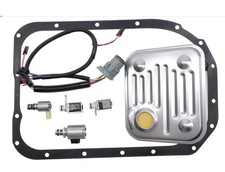
On parts: buy the A and B pair together even if only one tested bad. Same age, same heat cycles, same oil, identical labor. GM carries them as 24230288 and 24230289, cataloged for 4L80E and 4L85E as one application. If the unit is high mileage, the full solenoid set picks up the EPC and TCC solenoids too — and the EPC solenoid is what accelerates that AFL bore wear in the first place.
FAQ
What are the symptoms of a bad shift solenoid on a 4L85E?
The classic set is a pull-away in 2nd gear instead of 1st, a missing gear that follows the application chart rather than a random gear, a hard 1-2 or 2-3 shift because the pressure control strategy goes to maximum line pressure when the control module gives up, and a stored shift solenoid code. A 4L85E that loses all solenoid feed defaults to 2nd gear, so a 2nd gear start with no upshifts is the signature complaint, not a slipping one.
Can a 4L85E shift solenoid code be caused by something other than the solenoid?
Yes, and it is common enough that replacing solenoids first is a gamble. Sonnax lists solenoid performance codes, wrong gear starts and low solenoid feed pressure as symptoms of a worn actuator feed limit valve bore in the 4L80-E and 4L85-E valve body. The AFL valve regulates line pressure down to a steady feed for the solenoids, roughly 80 to 115 psi. When the bore wears, the solenoids are starved and set codes while testing perfectly on the bench.
What resistance should a 4L85E shift solenoid read?
These are on-off solenoids and they read in the low tens of ohms, not fractions of an ohm and not open. GEARS magazine works a shift solenoid circuit to 20 to 30 ohms and then verifies it by current: 12.6 volts across 20 to 30 ohms gives 0.42 to 0.63 amps of real current flow. Resistance alone can pass a solenoid that fails hot or under pressure, so check current flow with the circuit live if the complaint is intermittent.
Do you have to drop the 4L85E to replace shift solenoids?
No. Both shift solenoids sit on the valve body and come out with the pan down. GM specifies a 7.3 liter (7.7 quart) DEXRON VI fill for bottom pan removal on this unit, and 24 N·m (18 lb-ft) on the pan bolts going back together. Budget a pan gasket, a filter and about eight quarts of fluid on top of the solenoid parts, and expect the job to live or die on how clean the pan was.
Is a 4L85E shift solenoid the same as a 4L80E one?
Yes. The 4L85E is the heavy-duty build of the same big-case unit and shares the valve body layout and the solenoid hardware with the 4L80E, which is why the A and B shift solenoid set carries both GM numbers 24230288 and 24230289 and is cataloged for 4L80E and 4L85E together. The differences between the two transmissions are in the gear train, five-pinion carriers instead of four, not in the electrical controls.