P0720 is the generic OBD-II code for an output speed sensor circuit fault. On a Ford 4R75-family transmission it is rarely as simple as the code definition makes it sound. The output shaft speed (OSS) sensor on these units reads a target machined or stamped into the output ring gear, and Ford changed both the target and the sensor for the 2004 model year. Mix early and late parts in a rebuild or a used-unit swap and you get a speed signal that is weak, four times too slow or four times too fast, and a brand-new sensor will not fix any of it. This guide walks through how the 4R75 reads output speed, the year split that causes most of the grief, how to prove the fault with live data, and what actually clears the code.
What the OSS Reads on a 4R75
The OSS is the rear of the two speed sensors on the left side of the case. The front one is the turbine shaft speed (TSS) sensor, which only the electronic 4R75E and 4R70E carry. Both are magnetic pickups: a coil wound around a magnet, producing an AC signal whose frequency rises with the speed of whatever is passing the tip. Transmission Digest technical editor Wayne Colonna of ATSG describes the 2004 change on the 4R70E/4R75E this way: the ring gear went from holes that excited the OSS to extended lugs that now do the job, and there are more lugs than holes.
ATRA's interchange section for the family gives the exact numbers. Before 2004 the sensor read six holes machined around the ring gear. From the 2004 model year the redesigned sensor reads the exciter ring formed by the 24 extended parking pawl lugs. Six pulses per revolution versus 24 is a factor of four, and that ratio explains almost every strange 4R75 speed sensor complaint you will run into.
The PCM leans on this signal hard. It divides turbine speed by output speed to work out which gear the unit is actually in, uses output speed to schedule every upshift, downshift and converter clutch apply, and on TSS-equipped units compares the two to watch for slip. When the OSS signal drops out or makes no sense, the PCM sets P0720 and goes to failsafe: firm shifts, a limited gear range and no converter lockup. Depending on application, a related ratio or vehicle speed code may set alongside it.
Step Zero: Which 4R75 Is in the Truck?
Before you order anything, find out what you have. Read the transmission code on the Safety Compliance Certification Label on the driver's door. Ford's 2006 F-150 owner guide decodes it: code A is the 4R70E and code Q is the 4R75E. Then note the build year. 2004-and-later units use the 24-lug ring gear and the short late sensor. 2001 to 2003 units use the six-hole ring gear and the longer sensor with the square connector. Units older than 2001 have an oval connector, per ATRA.
That matters because 4R75 cores get swapped and rebuilt with parts pulled from a wide pool of 4R70W, 4R75W and AODE donors. The ring gears look similar at a glance. The sensors look similar at a glance. The PCM can tell the difference instantly.
Cause 1: Early Ring Gear in a Late Unit
Put a six-hole ring gear into a 2004-up transmission and the late sensor now sees one quarter of the pulses it expects. ATRA puts it plainly: an early ring gear in a late transmission results in a 75% reduction in the output speed sensor signal and will not let the transmission shift out of first gear. Colonna compares it to the classic 4L80-E problem where a missing speed sensor ring left the OSS reading park lugs and showing roughly half the real road speed, with very late shifts as the result.
On the road this looks like a truck that winds out first gear, or hangs in a low gear far too long, and a speedometer (on applications that drive it from this signal) that reads a fraction of real speed. Whether P0720 itself sets depends on how implausible the signal looks to the PCM. Some trucks set P0720, some set a ratio code, and some set nothing and just shift wrong. The scan tool math below catches all three.
Cause 2: Late Ring Gear in an Early Unit
The reverse mistake is just as common after a rebuild. ATRA says a late ring gear in an early transmission produces an output speed signal 400% faster than it should and shifts the transmission into fourth gear by the time you hit 10 mph. A Mercury Marauder owner on that model's enthusiast forum described exactly this after a rebuild: the shop had installed a 24-lug ring gear in place of the original six-hole ring, the speedometer read about four times fast, and a new output speed sensor changed nothing. That is a single owner's report, not a test, but it matches ATRA's numbers to the decimal.
There is a physical clue if you look for it. Colonna notes that the early-design OSS is longer and will make contact with the extended lugs on the newer ring gear. Shops that hit that interference sometimes "fix" it by installing the shorter late sensor in the early unit. That does not work. The signal is still four times fast and the truck still shifts to fourth at walking speed.
Cause 3: The Wrong-Length Sensor
Even with the right ring gear, the sensor has to match it. ATRA says the OSS length stayed the same from 2001 until the 2004 ring gear change. After that, the late sensor is shorter. Install the short late sensor in a 2001-2003 unit and it sits too far from the six holes: ATRA warns of a weak signal and intermittent OSS codes. Install the long early sensor in a 2004-and-up unit and the tip hits the lugs. ATRA says that will damage the sensor, and once the tip is chewed up the signal goes with it.
This is the version of P0720 that comes and goes. The code sets on a hot drive or at highway speed, clears, and comes back. If the sensor tip shows scuffing or the code is intermittent after recent work, check the sensor length against the build year before you replace anything.
For a 2004-and-up truck, Ford's parts catalog lists the vehicle speed sensor assembly 3L3Z-7H103-AA, now superseded by 6L3Z-7H103-AA, for AODE-W/4R70E and 4R75E units with TSS. Match that to the door code and build year rather than to a generic "fits F-150" listing.
Cause 4: Connector, Wiring and the Sensor Itself
Once the hard parts are confirmed correct, P0720 becomes an ordinary circuit diagnosis. The OSS sits low on the case where it catches road spray, heat from the exhaust and the occasional rock. Unplug it and look at both halves of the connector for green corrosion, spread or pushed-back terminals, and ATF wicking into the plug. Follow the harness along the case and look for chafing at the clips. A wiggle test with live data running finds the intermittent ones.
Pull the sensor and look at the tip. A magnetic pickup collects ferrous debris. A tip packed with metal fuzz weakens the signal, and it also tells you something inside the unit is shedding steel. That is a second diagnosis, not a cleaning job.
For the sensor itself, an open or dead short on an ohmmeter is conclusive. Otherwise, compare its resistance against a known-good sensor of the same part number, then do the test that actually proves it: back-probe the sensor on AC volts, raise the drive wheels safely, run it in gear, and watch for an AC voltage that climbs with output speed. A sensor that ohms fine but makes no AC output has failed internally or is too far from its target, which sends you back to Cause 3.
Diagnosing It on the Scan Tool
Do not condemn a speed sensor from a single PID. Sonnax's speed sensor diagnostic article for Ford's 10R family lays out a method that works on any Ford automatic with turbine and output sensors: record engine speed, turbine shaft speed, output shaft speed, commanded gear, measured gear ratio and vehicle speed together, and use the disagreement between the raw speed PIDs to find which sensor is lying.
- Stationary, in gear, brake held. Output speed should read zero. A steady reading with the truck parked points at electrical noise or a damaged circuit.
- Moving at any speed. Output speed must register. If road speed and OSS stay at zero while the truck rolls, the signal is not reaching the PCM: sensor, connector, wiring, or a missing target.
- Third gear, steady cruise (TSS units). Third is 1.00 to 1 on the 4R75, so turbine speed and output speed should match almost exactly. If OSS reads about one quarter of TSS, suspect an early six-hole ring gear in a late unit. If it reads about four times TSS, you have a late 24-lug ring gear in an early unit.
- The other gears. Turbine divided by output should land near 2.84 in first, 1.55 in second and 0.70 in overdrive. ATRA confirms the planetary ratios did not change between the 4R70W and the 4R75E. Ratios that are right in every gear but drop out intermittently point back at the sensor length, air gap or a connector.
On an early non-TSS 4R75W, use vehicle speed from another source (a GPS speed app works) against the OSS-derived speed on the scan tool. A clean factor of four in either direction is a ring gear mismatch, not a sensor.
Shop the part for this fix
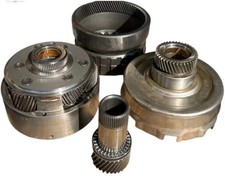
If the ring gear is the problem, the clean fix is a complete 2004-up planetary set with the lug-style, no-holes ring gear and the non-magnetic sun shell the TSS needs, so every part matches the late sensors.
Get the 4R75W 2004-up planetary set →Need a sensor or harness instead? Browse the full 4R75W parts collection.
Fluid Spec and Capacity
Fix the code, then service the fluid, especially if the truck spent time shifting wrong or slipping in failsafe. The 4R75E takes MERCON V. Ford's 2006 F-150 owner guide lists Motorcraft MERCON V, part XT-5-QM, at 13.9 quarts (13.2 L) for both the 4R70E and the 4R75E. That is a total capacity: a pan drop gets you only a portion of it, so set the final level hot on the dipstick.
P0720 Checklist for the 4R75
- Read the door label code and note the build year: 2004-up uses the 24-lug ring gear and short sensor; 2001-2003 uses six holes and the long sensor.
- Ask whether the unit was rebuilt or swapped. Most ring gear mismatches start there.
- Scan live data. Output speed should read zero stopped and register as soon as the truck moves.
- In third gear, compare turbine and output speed. A 4 to 1 or 1 to 4 split is a ring gear mismatch.
- Inspect the OSS connector and harness, then wiggle-test with live data running.
- Pull the sensor. Check the tip for debris and contact marks, and check its length against the build year.
- Test the sensor for opens and shorts, then for AC output that rises with speed.
- Correct the ring gear or sensor so both match the build year. Do not mix early and late parts.
- Refill with MERCON V and set the level hot on the dipstick.
FAQ
Can a new output speed sensor fix P0720 on a 4R75?
Only if the sensor is actually the fault. On these units the OSS reads a target on the output ring gear, and Ford changed that target from six holes to 24 lugs for 2004. If an early ring gear is in a late unit, or the reverse, the signal is off by a factor of four and no sensor will fix it.
Why does my 4R75 shift into fourth at 10 mph after a rebuild?
That is the classic sign of a late 24-lug ring gear installed in an early six-hole transmission. ATRA says the output speed signal comes out 400% fast, so the PCM thinks the truck is moving four times faster than it is and upshifts almost immediately.
Why is my 4R75E stuck in first gear with a low speedometer reading?
An early six-hole ring gear in a 2004-and-up unit cuts the output speed signal by 75%, and ATRA says the transmission will not shift out of first. Compare turbine and output speed in a steady gear on the scan tool to confirm it before ordering parts.
Are early and late 4R75 output speed sensors interchangeable?
No. ATRA says the late 2004-up sensor is shorter: in a 2001-2003 unit it can produce a weak signal and intermittent OSS codes, and an early sensor installed in a 2004-up unit will be damaged by the lugs. Match the sensor and ring gear to the build year.
Working a 4R75 this week?
Planetary sets, rebuild kits, solenoids, harnesses and valve body parts — shipped fast from the USA.
Shop 4R75W parts →Sources
- ATRA — "Ford 4R70W/4R70/75E" technical manual interchange section, 2009 (PDF). Backs the 2004 model year output speed sensor redesign reading the 24 extended parking pawl lugs instead of six holes machined around the ring gear; the 75% signal reduction and no shift out of first with an early ring gear in a late unit; the 400% fast signal and fourth gear by 10 mph with a late ring gear in an early unit; the oval-to-square connector change in 2001; the sensor length change in 2004 with weak signal and intermittent OSS codes from a late sensor in 01-03 units and damage to an early sensor in 04-up units; and the unchanged planetary ratios. atracom.blob.core.windows.net
- Transmission Digest — "Repeat Performance, Not by Popular Demand," Wayne Colonna, ATSG, December 1, 2006. Backs the description of the 2004-and-newer 4R70E/4R75E ring gear changing from holes to extended lugs to excite the OSS; rapid upshifts when the later ring gear and later OSS go into early applications; the longer early OSS contacting the extended lugs; the shorter late sensor not being the answer; late shifts when the early ring gear goes into a later 4R75E; and the 4L80-E comparison. transmissiondigest.com
- Ford Motor Company — 2006 F-150 Owner Guide, Maintenance and Specifications (archived PDF). Backs the door label transmission codes (A = 4R70E, Q = 4R75E) and the 13.9 quart (13.2 L) Motorcraft MERCON V, XT-5-QM, capacity for the 4R70E and 4R75E. fordservicecontent.com (archive.org)
- Ford parts catalog — Sensor Assembly 3L3Z-7H103-AA (via Ford Parts Giant). Backs the late vehicle speed sensor part number, its supersession to 6L3Z-7H103-AA, and its listed fitment to AODE-W/4R70E and 4R75E units with TSS. fordpartsgiant.com
- Sonnax — "Diagnosing Ford 10R60, 10R80 & 10R140 Series Speed Sensor Issues," Jim Mobley, February 8, 2024. Backs the scan tool method: record engine speed, turbine speed, output speed, commanded gear, measured gear ratio and vehicle speed together, and use disagreement between the raw speed PIDs to identify which sensor is reporting incorrectly. sonnax.com
- Sonnax — Ford 4R75W transmission reference. Backs the 4R75W family breakdown by year and the valve body and harness changes across 2001-2008 and 2009-later units, used here to separate early and late builds. sonnax.com