P0715 is the generic OBD-II code for an input/turbine speed sensor "A" circuit fault. On a Ford 4R75-family transmission it carries a trap that the generic code definition will never warn you about: plenty of 4R75 units have no turbine shaft speed sensor at all, and the ones that do will only read it correctly if the right sun shell, center support and wiring are inside the case. Throwing a sensor at a P0715 on one of these trucks fixes it some of the time. The rest of the time the sensor is fine and the signal is being blocked or lost somewhere between the forward drum and the PCM.
Step Zero: Is It a 4R75W or a 4R75E?
The name matters here. The 4R75W is the heavy-duty version of the 4R70W, and the original W units did not carry a turbine shaft speed sensor. The electronic 4R75E, along with its lighter sibling the 4R70E, added one. ATRA's interchange section for this family describes the input speed sensor as something the 4R70E/75E "now incorporate," along with the hardware changes that make it work.
Do not guess from the model year. Read the transmission code on the Safety Compliance Certification Label on the driver's door. Ford's 2006 F-150 owner guide decodes it: code A is the 4R70E and code Q is the 4R75E. The 2006 Crown Victoria owner guide lists the 4R75E as code Q (Livonia build) or S (Sharonville build). Ford's parts catalog lists the turbine shaft speed sensor itself, part number 3L3Z-7M101-AA, for 2004-and-up F-150 and E-Series, 2005-2006 Expedition, 2005-2011 Grand Marquis and Town Car, and 2007-2011 Crown Victoria applications.
Used-unit swaps are common here. An early 4R75W behind a later PCM that expects a turbine signal will set P0715 every key cycle, and no sensor will fix it. If the unit is a W, sort out the mismatch first.
How the 4R75E Reads Turbine Speed
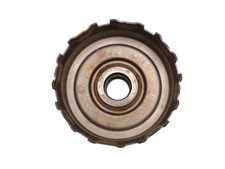
The 4R75E's TSS does not read a tone wheel pressed onto the input shaft. It reads raised stampings on the forward clutch drum, and it reads them through the sun shell that wraps around that drum. ATRA calls the sun shell change "the single most important change" on these units and notes it is something you cannot see with the naked eye: the 4R70E/75E sun shell is non-magnetic, because the sensor has to pick up the forward drum stamping through it.
That design makes the sensor completely dependent on parts most people never think of as electrical. A magnetic pickup produces its signal from changes in a magnetic field. Put steel between the sensor and its target and the field never changes, so the sensor makes no usable signal no matter how new it is. Too much distance between sensor tip and drum weakens it the same way.
Here is what the PCM does with that signal. It has no gear position sensor. It calculates the gear the unit is actually in by dividing turbine speed by output speed, compares that against the gear it commanded, and uses turbine speed to schedule shifts and shape EPC pressure during each shift. Lose the turbine signal and the PCM loses its slip calculation, so it sets P0715 and falls back to failsafe: firm shifts, a limited gear range and no converter lockup.
Cause 1: A Magnetic Sun Shell After a Rebuild
If the code showed up on the first road test after an overhaul, check the shell before anything else. 4R75 rebuilds pull parts from a wide pool of 4R70W, 4R75W and AODE donors, and the early shells look nearly identical. ATRA is blunt about the result of getting it wrong: failure to use a non-magnetic sun shell results in harsh or no shifting with possible ratio and input speed sensor codes. That is P0715, often with a ratio code beside it.
The check is a magnet. If it sticks to the shell, that shell does not belong in a TSS case. Do it on the bench, not after installation. Check any weld repair at the wear area too: ATRA Technical Bulletin #1929 (October 2019) warns that welding rod is ferrous and interferes with the turbine sensor signal, and that a repaired shell can read correctly at rest and then go erratic once the truck moves. ATRA's instruction is not to use a repaired sun shell in a unit with the turbine shaft speed sensor. That pattern usually sets the range/performance code rather than P0715; see the 4R75W P0716 guide.
Replace it correctly, too. The 2004-and-up shell is also dimensionally different: height from the bottom of the sun gear to the bearing surface was cut by .030 in. to make room for a thicker two-piece bearing (2.0550 in. on the early part versus 2.0250 in. on the late part, with the related dimension going from 1.177 in. to 1.167 in.). ATRA says the sun shell, bearing and forward sun gear must change as a set or end play will be wrong, and Ford sells the set as service kit 4L3Z-7D234-AA. Swap the shell alone and you have traded an electrical code for an end play problem.
Cause 2: An Early Center Support
The 4R70E/75E center support has an extra notch machined into it to clear the turbine speed sensor. Per ATRA, if you install a 4R70W support in a 4R70E/75E case, the turbine speed sensor will not install all the way into the case.
A sensor that will not seat sits too far from the forward drum, and that extra air gap is exactly the weak-signal fault described above. The tell on the bench is simple: the sensor should drop into its bore and sit flush with light hand pressure. If it stops short, find out what it is hitting instead of forcing it. ATRA notes that in a pinch you can grind the notch into an early support without causing a problem, but that is a support-out job with careful cleanup of every chip, not something to attempt through the sensor bore.
Cause 3: The Internal Harness and Case Connector
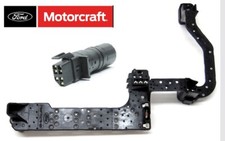
A good sensor reading a good target still sets P0715 if the signal never reaches the PCM. Inside the case, the TSS circuit runs through the transmission's internal harness to the case connector, and that harness changed over the life of the 4R75. Sonnax's 4R75W reference splits the valve bodies by wiring: 2001-2008 units use a molded lead frame harness, while 2009-and-later units use solenoids that connect to a soft wire harness. ATRA adds that installing the wrong wiring harness can create multiple codes and erratic shifts.
So when a unit gets rebuilt with a harness from a different year, or the case connector gets disturbed during the job, expect electrical codes to follow. Unplug the case connector and inspect both halves under good light. Look for a terminal sitting lower than its neighbors, spread female terminals, green corrosion, or ATF wicking up the wires. A terminal pushed back a millimeter looks fine and conducts nothing.
Cause 4: External Wiring and the Sensor Itself
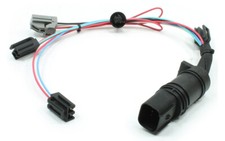
Only after the first three are ruled out does the sensor become the likely suspect. Check the external connector and the harness run along the case for chafing and corrosion. And when you pull the sensor, look at its tip. A magnetic pickup collects ferrous debris, and a tip packed with clutch-plate fuzz or steel slivers both weakens the signal and tells you something is wearing inside the unit. That debris is a second diagnosis, not a cleaning job.
Diagnosing It on the Scan Tool
Do not condemn a speed sensor from a single PID. Sonnax's speed sensor diagnostic article for Ford's 10R family lays out a method that works on any Ford automatic with a TSS: record engine speed, turbine shaft speed (raw), output shaft speed (raw), commanded gear and measured gear ratio together, and read them as a set.
- Park and Neutral, engine running. The turbine is driven by the converter with no clutch holding it, so turbine speed should read close to engine idle. Sonnax describes normal operation as the TSS showing RPM in Park and Neutral. Zero turbine speed here means no signal reaching the PCM: sensor, air gap, shell, support or wiring.
- Drive or Reverse, foot on the brake. Now a clutch ties the turbine to an output that is not turning, so turbine speed should fall to zero. Sonnax notes the same thing: zero RPM in Reverse or Drive with the vehicle stationary is normal. A turbine reading that stays at idle speed in gear is a fault of its own.
- Ratio math on the road. Divide turbine speed by output speed in each steady gear and compare against the 4R75's ratios: about 2.84 in first, 1.55 in second, 1.00 in third and 0.70 in overdrive, with reverse near 2.32. ATRA confirms the planetary ratio did not change between the 4R70W and 4R75E. A turbine signal that tracks but reads low or jumps around in every gear points at air gap or a shell problem, not a dead sensor.
Pay attention to how the code behaves. A P0715 that sets immediately at key-on-engine-running and never recovers reads as an open or shorted circuit or no target at all. A signal that drops out only above a certain speed, or only once the fluid is hot, reads as marginal air gap, a terminal that loses contact as it expands, or a chafed wire.
Testing the Sensor on the Bench
With the target and connector cleared, test the sensor. First measure resistance across its two pins: an open or a dead short is conclusive. Otherwise, compare against a known-good sensor of the same part number.
The second test proves it. A magnetic pickup generates its own AC voltage when a target moves past it. Back-probe it on AC volts and idle the engine in Neutral: a good sensor at the right air gap makes a voltage that climbs with speed. A sensor that passes resistance but makes no AC has either failed internally or is too far from its target, which sends you back to the center support and the shell. Finish with a wiggle test of the harness while watching live data.
Shop the 4R75W/4R75E parts for this fix
Speed sensors, internal harnesses, non-magnetic sun shells and the rest of the parts that clear a P0715, sorted by transmission. Confirm whether you have the W or the E before you order, because the sensor, shell and harness are not shared across the change.
Get the 4R75W input speed sensor →Not sure which one you need? Browse the full 4R75W parts collection.
Fluid Spec and Capacity
The 4R75E takes MERCON V. Ford's 2006 F-150 owner guide lists Motorcraft MERCON V, part XT-5-QM, at 13.9 quarts (13.2 L) for both the 4R70E and the 4R75E. The 2006 Crown Victoria guide lists the same 13.9 quarts for the 4R75E, with a Police or Handling Package refill capacity of 12.8 quarts (12.1 L), and says to set the final level by the dipstick's normal operating range. Ford's current fluid chart keeps MERCON V as the spec for the 4R70W, 4R70E, 4R75W and 4R75E, and cautions against supplemental additives, treatments and cleaning agents.
P0715 Checklist for the 4R75
- Read the door label code. Confirm it is an E unit (F-150 code Q, Crown Victoria code Q or S) and that the case actually has a TSS.
- Scan live data. Turbine speed should read near idle in Park and Neutral and fall to zero in gear with the brake held.
- Check the ratio math in each gear against 2.84, 1.55, 1.00 and 0.70.
- Inspect the case connector and external harness for pushed-back terminals, corrosion and chafing.
- Pull the sensor. Check the tip for debris, then test resistance and AC output.
- If the unit is apart, magnet-check the sun shell and confirm the center support has the sensor notch.
- Replace the shell, bearing and forward sun gear as a set (4L3Z-7D234-AA) and reset end play.
- Match the internal harness to the build year: molded lead frame through 2008, soft wire harness from 2009.
- Refill with MERCON V. No additives.
FAQ
Does every 4R75W have a turbine shaft speed sensor?
No. The original 4R75W did not use one. The sensor came with the electronic 4R75E and 4R70E, along with a non-magnetic sun shell and a center support notched to clear it. Check the transmission code on the door label: on a 2006 F-150, code Q is the 4R75E, and on a 2006 Crown Victoria the 4R75E is code Q or S.
Why did P0715 show up right after a 4R75E rebuild?
Usually because of a build part, not the sensor. ATRA lists two: a magnetic sun shell, which blocks the sensor from reading the forward drum and causes harsh or no shifting with ratio and input speed sensor codes, and an early 4R70W center support, which keeps the sensor from seating all the way into the case. A wrong-year internal harness is the third thing to check.
What should turbine speed read on a scan tool?
With the engine running in Park or Neutral, turbine speed should read close to engine idle. In Drive or Reverse with the brake held it should drop to zero, because a clutch ties the turbine to the stopped output. Zero in Park and Neutral means no signal is reaching the PCM.
What fluid and how much does a 4R75E take?
MERCON V. Ford's 2006 F-150 and Crown Victoria owner guides list 13.9 quarts (13.2 L) for the 4R75E, with 12.8 quarts (12.1 L) for the Crown Victoria Police or Handling Package. Set the final level by the dipstick, and do not add supplemental additives.
Working a 4R75E this week?
Non-magnetic sun shells, internal harnesses, solenoids, valve body parts and rebuild kits — shipped fast from the USA.
Shop 4R75W parts →Sources
- ATRA — "Ford 4R70W/4R70/75E" technical manual interchange section, 2009 (PDF). Backs the 4R70E/75E incorporating an input speed sensor; the non-magnetic sun shell requirement so the sensor can read the forward drum stamping, and the harsh or no shifting with ratio and input speed sensor codes when it is wrong; the center support notch and the sensor not installing fully with a 4R70W support; the .030 in. sun shell height change (2.0550/2.0250 in., 1.177/1.167 in.) and Ford service kit 4L3Z-7D234-AA; unchanged planetary ratio; and the warning that the wrong wiring harness can create multiple codes and erratic shifts. atracom.blob.core.windows.net
- ATRA — Technical Bulletin #1929, "4R70W, 4R75W, 4R70E, 4R75E Input Speed Sensor Codes, Erratic Reading," October 2019 (PDF). Backs the warning that weld repairs to the sun shell wear area add ferrous material that interferes with the turbine shaft speed sensor signal, the reading-correct-at-rest then erratic-in-motion symptom, and the instruction not to use a repaired shell in a TSS unit. atracom.blob.core.windows.net
- Ford Motor Company — 2006 F-150 Owner Guide, Maintenance and Specifications (archived PDF). Backs the transmission code table (A = 4R70E, Q = 4R75E) and the 4R70E/4R75E refill capacity of 13.9 quarts (13.2 L) of Motorcraft MERCON V, part XT-5-QM. fordservicecontent.com (archive.org)
- Ford Motor Company — 2006 Crown Victoria Owner Guide, Maintenance and Specifications (archived PDF). Backs the 4R75E transmission codes Q (Livonia) and S (Sharonville), the 13.9 quart (13.2 L) MERCON V capacity, the 12.8 quart (12.1 L) Police or Handling Package refill capacity, and setting the level by the dipstick's normal operating range. fordservicecontent.com (archive.org)
- Ford Customer Service Division — "Automatic Transmission Fluid Chart" (PDF). Backs MERCON V as the specified fluid for the 4R70W, 4R70E, 4R75W and 4R75E, and the caution against supplemental transmission fluid additives, treatments and cleaning agents. fcsdchemicalsandlubricants.com
- Sonnax — "Diagnosing Ford 10R60, 10R80 & 10R140 Series Speed Sensor Issues," Jim Mobley, February 8, 2024. Backs the scan tool method used here: record engine speed, turbine shaft speed raw, output shaft speed raw, commanded gear and measured gear ratio together; TSS showing RPM in Park and Neutral and zero RPM in Reverse or Drive while stationary; and dividing input speed by output speed to check measured ratio. sonnax.com
- Sonnax — Ford 4R75W transmission reference. Backs the harness change across the 4R75 family: F095 valve bodies for 2001-2008 units with solenoids on a molded lead frame harness, and F098 for 2009-later units with solenoids on a soft wire harness. sonnax.com