Every few weeks someone calls in convinced their 4T65E needs "the special pink fluid" or that dumping ten quarts of whatever is on the shelf at the parts store will fix a harsh shift. Neither is true, and the actual answer is short: the fluid spec changed partway through this transaxle's life, the capacity GM publishes is a total-system number that almost nobody actually pours in during a service, and the change interval depends on how the car is driven, not a round number somebody memorized once.
This one is straight from GM's own documentation — the owner's manual capacity chart, the maintenance schedule, and the SAE paper and service bulletin that explain why the fluid spec moved to DEXRON-VI. No guessing, no "my buddy's shop always uses."

The Fluid Spec Actually Changed Mid-Production
The 4T65E ran from the mid-1990s through roughly 2010, which puts it squarely across GM's switch from DEXRON-III to DEXRON-VI. Early units left the factory calling for DEXRON-III. GM's own SAE paper on the subject explains why that changed: the DEXRON-VI service-fill specification was developed and factory-filled starting in early 2005, and GM upgraded the spec because the new fluid delivered "significantly improved performance in terms of friction durability, viscosity stability, aeration and foam control and oxidation resistance" compared with what it replaced, with the added benefit of supporting longer drain intervals.
That upgrade was not a parallel fluid you had to pick carefully based on model year. GM's Service Insights technical documentation states plainly that DEXRON-VI "replaces DEXRON-III(H) and DEXRON-II(E)" and is recommended for GM transmissions model year 2006 and newer, which in practice means it is the correct fill for the earlier DEXRON-III 4T65E applications too — it was engineered specifically to take over that role rather than sit beside it. Valvoline's own DEXRON-VI ATF product information sheet backs the same point from the fluid-maker side: the product is officially licensed with GM, approved against DEXRON-VI, and listed as fully back-serviceable against DEXRON-III, DEXRON-II and Allison C4. If a parts counter or a service writer tries to sell a separate "classic DEXRON-III" product for an older 4T65E car, that is a wasted purchase. There is no scenario on this transaxle where using DEXRON-VI instead of the original-spec fluid causes a problem.
What there is a real difference for is going the other direction. Putting old-spec DEXRON-III into a later unit that was factory-filled with DEXRON-VI is the direction GM's documentation does not support, so if you are topping off a 2006-or-newer car and you are not sure what is already in the pan, DEXRON-VI is the safe default rather than a guess at whatever is cheapest on the shelf.
How Much the System Actually Holds
GM publishes a hard number for this, and it is worth writing down because so many online estimates disagree with each other. In the capacity chart for a 4T65E-equipped Chevrolet Impala, GM lists the automatic transmission capacity as 7.4 qt (7.0 L), with a footnote: "When draining/replacing converter, more fluid may be needed."
Two things matter about that number. First, it is a total-system figure — pan, valve body, cooler lines, and converter combined — not a service-fill quantity. Second, the footnote exists because the converter alone holds a meaningful share of that fluid, and a repair that drains or replaces it (a converter swap, a flush that pushes fluid all the way through the cooler circuit) pulls in more than a standard pan-and-filter job ever will.
| Service performed | What it affects |
|---|---|
| Pan drop and filter change | Drains the pan and valve body area only. Recovers a portion of the 7.4 qt total — converter and cooler lines stay full. |
| Fluid and filter change (severe service) | Same pan-drop service, done on GM's shortened interval for hard-use vehicles. |
| Converter drain or replacement | Pulls in meaningfully more fluid than a pan drop. GM's own footnote flags this explicitly. |
| Full system refill after a rebuild | Approaches the full 7.4 qt (7.0 L), plus whatever is lost to residual fluid in the cooler and lines during assembly. |
This is exactly why shops report wildly different quart counts for "a 4T65E fluid change" — they are describing different services, not disagreeing about the transmission. Whatever you drain from the pan, the right habit is to measure it, refill close to that measured amount, then finish the job on the dipstick rather than chasing a fixed number from a forum post.
When GM Says to Actually Change It
GM's maintenance schedule does not use one interval for every 4T65E car — it splits normal and severe service, and the gap between them is large enough to matter. Under the severe-service column, the schedule calls for changing the automatic transmission fluid and filter roughly every 50,000 miles. Under normal service, the schedule shows a single scheduled change at 100,000 miles.
GM defines severe service, for this purpose, as a vehicle that is mainly driven under one or more of these conditions:
- In heavy city traffic where the outside temperature regularly reaches 90°F (32°C) or higher.
- In hilly or mountainous terrain.
- While frequently towing a trailer.
- Used for taxi, police, or delivery service.
Read that list against how most daily-driven 4T65E cars actually live — stop-and-go commuting, hot-climate summers, the occasional small trailer or U-Haul — and a lot of owners who think they are on "normal service" are closer to the severe schedule without realizing it. If you are not certain which column your driving fits, changing it on the 50,000-mile severe-service interval is the cheaper mistake to make.
Checking the Level Without Fooling Yourself
A 4T65E dipstick is notorious for giving a false reading if you skip the setup steps, and most of the "overfilled" or "underfilled" complaints that show up on a second visit trace back to checking it wrong, not to the fluid being wrong. GM's factory procedure is specific for a reason:
- If the vehicle was recently driven above 90°F, at high speed for a while, in heavy traffic, or while towing, wait at least 30 minutes before checking.
- Fluid must be at normal operating temperature — GM specifies 180°F to 200°F (82°C to 93°C). Above 50°F outside, that typically takes about 15 miles of driving to reach; colder than that, drive longer.
- Park on a level surface with the engine running and the parking brake applied. With your foot on the brake, cycle the shift lever through every range, pausing about three seconds in each, then return to Park.
- Let the engine idle for three to five minutes.
- Pull the dipstick, wipe it clean, push it back in all the way, wait three seconds, then pull it out again. Check both sides and read the lower level. It must sit inside the cross-hatched area.
Skip the warm-up drive and you will read low on a perfectly full transmission. Check it right after a long highway run without the cooldown wait and you can read full on a transmission that is actually a quart light. The procedure is annoying, but it is the difference between a real reading and a guess.
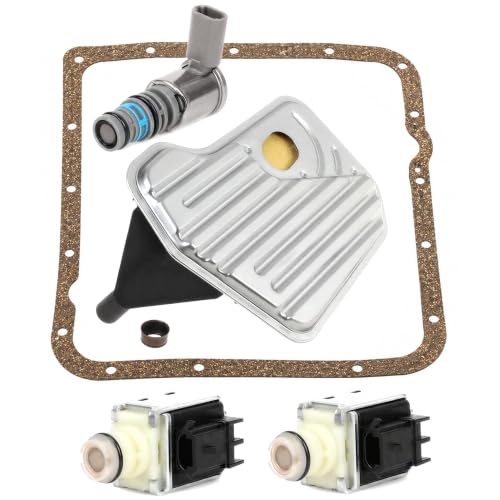
4T60E / 4T65E Transmission Filter and Pan Gasket Kit 58837
Every pan-drop service on this transaxle eats a filter and a gasket. Reusing a heat-set gasket on a pan you just pulled is how a fresh fluid change turns into a comeback leak a week later.
View the filter and gasket kit →What Neglected Fluid Actually Does on This Unit
Fluid service is not cosmetic maintenance on a 4T65E. The pressure control and TCC solenoids run on signal and apply oil that is only as clean as the fluid feeding it, and the valve body bores that regulate line and converter-clutch pressure wear faster when that fluid is old, oxidized, and carrying friction material. Sonnax's own troubleshooting guide for the unit walks through exactly this chain — the pressure regulator valve, the AFL valve and the EPC solenoid all feed each other, and incorrect operation anywhere in that chain raises both line pressure and TCC apply pressure rather than lowering them, which is why a fluid-contamination problem so often shows up as a harsh or erratic shift instead of a soft one. If you are chasing a shudder, a delayed engagement, or a code that will not clear after a fluid service, that is a separate diagnostic path with its own mechanism and its own parts — it is covered in depth in our 4T65E torque converter shudder diagnosis guide rather than repeated here. This article is about getting the fluid itself right so that diagnosis, when you need it, is not fighting dirty or mismatched fluid on top of whatever else is wrong.
FAQ
Can I put DEXRON-VI in an older 4T65E that originally called for DEXRON-III?
Yes. GM's own Service Insights documentation states DEXRON-VI replaces DEXRON-III(H) and DEXRON-II(E) and is backward compatible, and the SAE paper describing the spec says it was written to upgrade the service-fill fluid available for every GM stepped-gear automatic transmission, not just the newest ones. There is no DEXRON-III-only 4T65E on the road that DEXRON-VI cannot legally fill.
How much transmission fluid does a 4T65E hold?
GM's own capacity chart for a 4T65E-equipped Impala lists 7.4 qt (7.0 L) for the automatic transmission, with a footnote that more fluid is needed when the converter is drained or replaced. That is the total system figure, not what comes out during a routine service.
Do I need to put in all 7.4 quarts during a filter change?
No. A pan-drop and filter service only empties the pan and valve body area, not the converter or the cooler lines, so it recovers a portion of the total 7.4-quart system. Pour in roughly what you measured coming out, then finish the fill using the dipstick procedure rather than a fixed quart target.
How often does GM say to change the fluid in a 4T65E?
Under GM's severe-service schedule the fluid and filter get changed roughly every 50,000 miles. Under normal service the manual schedules a single change at 100,000 miles. Severe service is defined as heavy city traffic at 90°F or higher, hilly or mountainous terrain, frequent trailer towing, or taxi, police, or delivery use.
Does the 4T65E have a transmission dipstick?
On the vast majority of 4T65E applications, yes. GM's factory procedure checks the level with the engine running, the fluid between 180°F and 200°F, the shifter cycled through every range, and the lower reading on the dipstick inside the cross-hatched area. Checking cold or checking after hard driving without the 30-minute wait both produce a false reading.
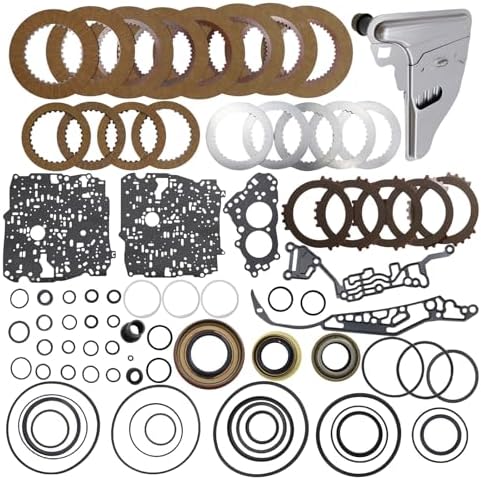
Shop 4T65E filters, pan gaskets, solenoids, valve body components and rebuild kits — shipped fast from the USA.
Shop 4T65E parts →Sources
- General Motors — 2008 Chevrolet Impala Owner Manual. Backs DEXRON-VI as the specified Automatic Transmission Fluid in Recommended Fluids and Lubricants; the 7.4 qt (7.0 L) automatic transmission capacity with the footnote that more fluid may be needed when draining or replacing the converter; the severe-service fluid-and-filter change interval of roughly every 50,000 miles versus a single normal-service change at 100,000 miles; the severe-service definition covering heavy city traffic at 90°F or higher, hilly or mountainous terrain, frequent trailer towing, and taxi, police or delivery use; and the full level-check procedure, including the 30-minute post-driving wait, the 180°F–200°F operating temperature, cycling the shift lever through every range, and reading the lower level in the cross-hatched area. assets.gm.com
- SAE International — "General Motors DEXRON-VI Global Service-Fill Specification," Paper 2006-01-3242. Backs DEXRON-VI being developed and factory-filled starting in early 2005; the specification covering all GM Powertrain stepped-gear automatic transmissions rather than a single model line; the fluid's improved performance in friction durability, viscosity stability, aeration and foam control, and oxidation resistance over what it replaced; and GM's statement that the service-fill specification was upgraded specifically to ensure fluids of that improved performance level were available in the aftermarket. saemobilus.sae.org
- GM Service Insights — "Use the Right Transmission Fluid." Backs DEXRON-VI replacing DEXRON-III(H) and DEXRON-II(E); DEXRON-VI being recommended for GM transmissions model year 2006 and newer calling for DEXRON-VI; and GM's guidance that using the correct current-spec fluid, rather than an older-spec fluid in a newer unit, is necessary to avoid performance issues and warranty concerns. gmserviceinsights.com
- Valvoline — DEXRON-VI ATF Product Information sheet. Backs the fluid being officially licensed with GM, approved against the DEXRON-VI specification, and listed as fully back-serviceable against DEXRON-III, DEXRON-II and Allison C4. valvoline product sheet (PDF)
- Sonnax — Bob Warnke, "Troubleshooting the 4T65-E: A Matter of Interpretation." Backs the pressure regulator valve-to-AFL valve-to-EPC solenoid chain on this unit, and the fact that incorrect valve operation anywhere in that chain raises both line pressure and TCC apply pressure rather than lowering them. sonnax.com