A 2004-2009 Durango with the 4.7L or 5.7L Hemi weighs well over two tons empty, and plenty of them spent their lives pulling a camper or a boat. That is exactly the duty that wears out a 545RFE. When the owner says "it slips," the engine is flaring on a shift or the rpm climbs on a hill with no extra speed. The good news: this transmission tells you which clutch is going before you pull it.
Here is the order we work it. The truck version is in our 545RFE Ram 1500 slipping guide; this one covers what the Durango adds and the towing failures we see most.
First, Make Sure It Is Really Slipping
Three Durango complaints get written up as "slipping" and are not clutch slip at all. Rule them out before you spend the customer's money.
Slow engagement only after sitting overnight
Chrysler's bulletin on RFE delayed engagement covers the 2004-2006 HB Durango. It blames spin-on cooler return filters with part number 04799662AB, which can let fluid drain back out of the converter with the engine off. The first shift into gear in the morning takes a second or two, then the truck drives normally all day. Chrysler says the condition is not harmful, and the fix is a 04799662 filter that is any level other than AB (Underhood Service / ALLDATA bulletin summary). The same bulletin identifies the 545RFE by sales code DGQ and the 45RFE by DG4. Check the code before you order parts, because V6 Durangos do not use a 545RFE.
If the delay is there on every engagement, hot or cold, that is a supply problem, not drain-back. Go to the fluid and P0944 checks below.
A shifter cable that is out of adjustment
ATRA's RFE Quick Learn notes are blunt about this one. A misadjusted shifter cable will not set the PRNDL fault code, but it will cause poor 2-3 shift quality. With the lever in the OD gate, the scan tool should show a PRNDL code of OD. If it shows a temporary code (T3 or T4) in that position, the cable is the most likely cause of a consistently bad 2-3 shift (ATRA). A Durango that flares only on the 2-3 gets this check first.
A driveline noise or lockup that sounds like the transmission
NHTSA recall 13V-038 covers 2009 Durango and Aspen trucks for a rear axle pinion nut that can loosen, with axle lockup as the stated consequence (NHTSA recall data). A clunk on takeoff sends you under the rear axle first, so run the VIN before you quote a rebuild.
Step 1: Fluid and the Primary Filter
Every one of Chrysler's gear ratio error procedures for the 45RFE/545RFE lists low fluid level as the first possible cause. A hot, loaded 545RFE that is a quart low will flare under throttle long before it sets a code.
- Fluid: Mopar ATF+4. Chrysler states Dexron II is not recommended, that clutch chatter can result from improper fluid, and that no additives or sealers should be used (Chrysler fluid information).
- Level: check it in Park, engine idling, at normal operating temperature, around 180 F. Read temperature on the scan tool.
- Pan service torques: pan bolts 105 in-lb, primary filter screw 40 in-lb, cooler return filter 84 in-lb (Chrysler 545RFE specifications).
Read the pan before you refill it. Gray paste on the magnet is normal wear. Black friction lining, flakes of clutch material, or bright aluminum means the slip is mechanical and a fluid service will not cure it. Clean pan and low level? Fix the leak, fill it and road test again.
Step 2: Match the Flare to a Clutch
The 545RFE has no bands. Every forward gear is two friction elements applied together, plus the overrunning clutch in first. Chrysler's road test procedure says slippage shows up as engine flare and "usually means clutch, overrunning clutch, or line pressure problems," and that you find the slipping clutch by comparing which units are applied in each range (Chrysler road test and clutch application chart).
The applied elements from that chart, with the factory ratios:
- 1st (3.00): UD + overrunning clutch, with L/R on only below 150 rpm output speed
- 2nd (1.67): UD + 2C
- 2nd prime (1.50): UD + 4C
- 3rd (1.00): UD + OD
- 4th (0.75): OD + 4C
- 5th (0.67): OD + 2C
- Reverse (3.00): Reverse + L/R
On a Durango, the road test usually lands in one of these patterns:
- Flares in 3rd, 4th and 5th, solid in 1st and 2nd: the overdrive clutch. This is the towing failure. The OD pack carries the load at highway speed in the two gears a loaded Durango lives in.
- Flares in 1st, 2nd and 3rd, fine in 4th and 5th: the underdrive clutch.
- Flares in 2nd and 5th: the 2C clutch. Watch for this one on a truck that also shows a P0735.
- Flares in 4th and on a 2nd-prime kickdown: the 4C clutch.
- Slips only pulling away from a stop in Drive: the overrunning clutch. Try manual 1, where L/R stays applied. If 1 holds and D slips from a stop, the sprag is the suspect.
Know which gear you are in. Chrysler warns that trucks with Electronic Range Select display as a six-speed, with second prime shown as third, third as fourth and so on. A customer who says "it slips in fifth" may really be in fourth.
Step 3: Gear Ratio Codes and Event Data
Codes P0731 through P0736 set when input speed divided by output speed does not match the commanded gear. Chrysler notes each code "can take up to five minutes" of problem identification before the MIL comes on, so an intermittent flare can leave a pending code with no light. Record every bit of DTC event data before you clear anything.
The factory P0734 (4th) and P0735 (5th) tests then ask two questions (Chrysler P0734 procedure):
- Did input rpm read zero in the event data? If so, diagnose it as an input speed sensor fault (P0715), not a slip.
- Was line pressure well below desired? If so, you are chasing pressure first.
For the OD-related codes, read the factory cause list carefully, because most of it is not burned frictions. P0734 lists a failed accumulator cover, cut OD or 4C accumulator seals, a broken or missing OD bleed orifice in the main valve body, a cut 4C tower seal, cut or missing #5 or #6 check balls, a worn solenoid switch valve or plugs, a stuck main regulator valve, a loose or missing dribbler orifice in the reaction shaft support, and a cracked or missing OD/reverse piston bleed orifice. P0735 adds the 2C tower seal and the #7 check ball (Chrysler P0735 procedure). A Durango can flare into 4th and 5th with good lining on the plates if the apply oil is leaking off in the valve body.
Step 4: Line Pressure, Duty Cycle and Load
The 545RFE runs closed-loop line pressure. Read actual pressure from the line pressure sensor on the scan tool, then confirm the sensor: Chrysler's procedure installs Line Pressure Adapter 8259 with a gauge and the original sensor, and the scan tool should match the gauge within plus or minus 10 psi. Test hot, fluid full, engine at 1500 rpm (Chrysler hydraulic pressure test).
Factory in-gear maximum pressures:
- 5.7L Hemi: 160 psi in 1st, 135 psi in 2nd through 5th, 120 psi in neutral, 250 psi in reverse.
- 4.7L: 135 psi in 1st, 120 psi in 2nd through 5th, 120 psi in neutral, 220 psi in reverse.
- Converter lockup: 120 psi (4.7L) and 125 psi (5.7L).
That lockup number matters on a Durango. A flare at steady highway speed with no shift in progress can be the converter clutch letting go, not a gear clutch. Watch TCC slip rpm on the scan tool. If input speed matches the gear ratio but engine speed climbs away from it, the slip is ahead of the gear train.
Now watch the pressure control solenoid. GEARS Magazine notes the RFE PCS runs about 5 percent duty cycle for maximum pressure and 62 percent for minimum. As internal leaks grow, the controller drives duty cycle down to hold desired pressure, so the closer it sits to 5 percent, the more oil the unit is losing. The same article warns that desired pressure is torque-based and drops with low calculated load. Actual and desired can match on the screen and still be too low to hold the clutches under heavy acceleration, which "commonly leads to failed overdrive clutches" (GEARS, "Controlling Pressure 2: Chrysler"). On a tuned Hemi Durango, check desired pressure under load before you rebuild, or the new OD pack will go the same way.
Step 5: Read the Clutch Volume Indexes
The clutch volume index (CVI) is the volume of fluid the controller has learned it takes to stroke each piston against its return spring. ATRA's published ranges for the RFE family, all learned with fluid above 110 F:
- L/R: 82-134 (learned on a 2-1 or 3-1 manual downshift, throttle under 5 degrees)
- 2C: 25-64 (learned on a 3-2 kickdown)
- OD: 25-64 (learned on the 2-3 upshift)
- 4C: 30-64 (learned on a 3-4 upshift)
- UD: 44-92 (learned on a 4-3 kickdown)
A CVI at or over the top of its range means that clutch needs more oil than normal to apply: worn frictions with extra clearance, a cut seal or a leaking circuit. If the OD number is high and the Durango flares into 3rd, 4th and 5th, you have confirmed the clutch without a teardown.
Do not run Quick Learn to make the slip go away. ATRA says it should not be used as a remedy for shift quality complaints, because it resets more than 70 learned parameters, and it belongs after an overhaul or a module replacement or flash.
Step 6: The Fix, and Why OD Jobs Come Back
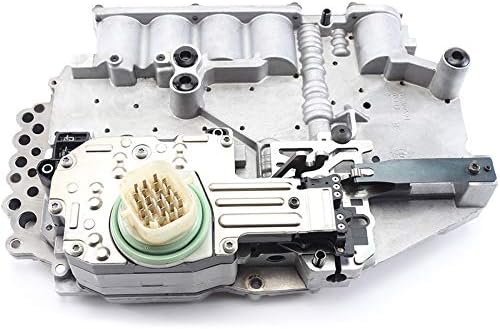
If the evidence points at the valve body (normal CVIs, PCS duty cycle crowding 5 percent, switch valve codes, a clean pan), a tested valve body can fix it without a teardown. If the pan is full of lining and the OD or UD CVI is pegged, the unit is coming out.
When it does, replacing frictions alone is how a Durango comes back in a month. Caleb Perham of the Sonnax TASC Force lays out three areas to check on every RFE overdrive clutch failure (Transmission Digest):
- The solenoid switch valve bore plug. It strokes on the 2-3 and back on the 3-4 to feed the OD clutch, so it moves on nearly every shift and wears its bore. Vacuum test the switch valve and plug.
- The OD dribbler valve in the stator. It is a controlled leak that pre-charges the OD circuit. Restricted, the clutch applies late. Leaking, it can let the clutch drag. Air should pass from the pump side to the drum and not back the other way.
- Clutch clearance. Too tight shortens fill time and can cause bind-up. Too loose lengthens fill time and lets the clutch drag and overheat.
Chrysler's pack clearances for the 545RFE (specifications):
- OD: 0.043-0.073 in. (1.103-1.856 mm)
- UD: 0.033-0.061 in. (0.84-1.54 mm)
- 2C: 0.018-0.053 in. (0.455-1.335 mm)
- 4C: 0.030-0.055 in. (0.770-1.390 mm)
Set them toward the middle of the range, not the loose end. Valve body to case is 105 in-lb. After the job, run Quick Learn, then drive it and watch the CVIs settle over a few cycles. A CVI that keeps climbing after a rebuild points to a leak in that clutch's circuit.
Keeping a Towing Durango from Doing It Again
Most of the burned OD packs we see in Durangos are heat and load stories. Keep the level correct and the cooler clean, use ATF+4 and nothing else in the pan, and service it before it is dark and tired if the truck tows. If the owner tows heavy on long grades, have them pull it out of fifth and let it work in a lower gear with the converter locked, instead of hunting between 4th and 5th with the OD clutch doing all the work. Our 545RFE overheating prevention guide covers cooler flow. A flare caught early is often still a valve body job; ignored, it becomes a rebuild.
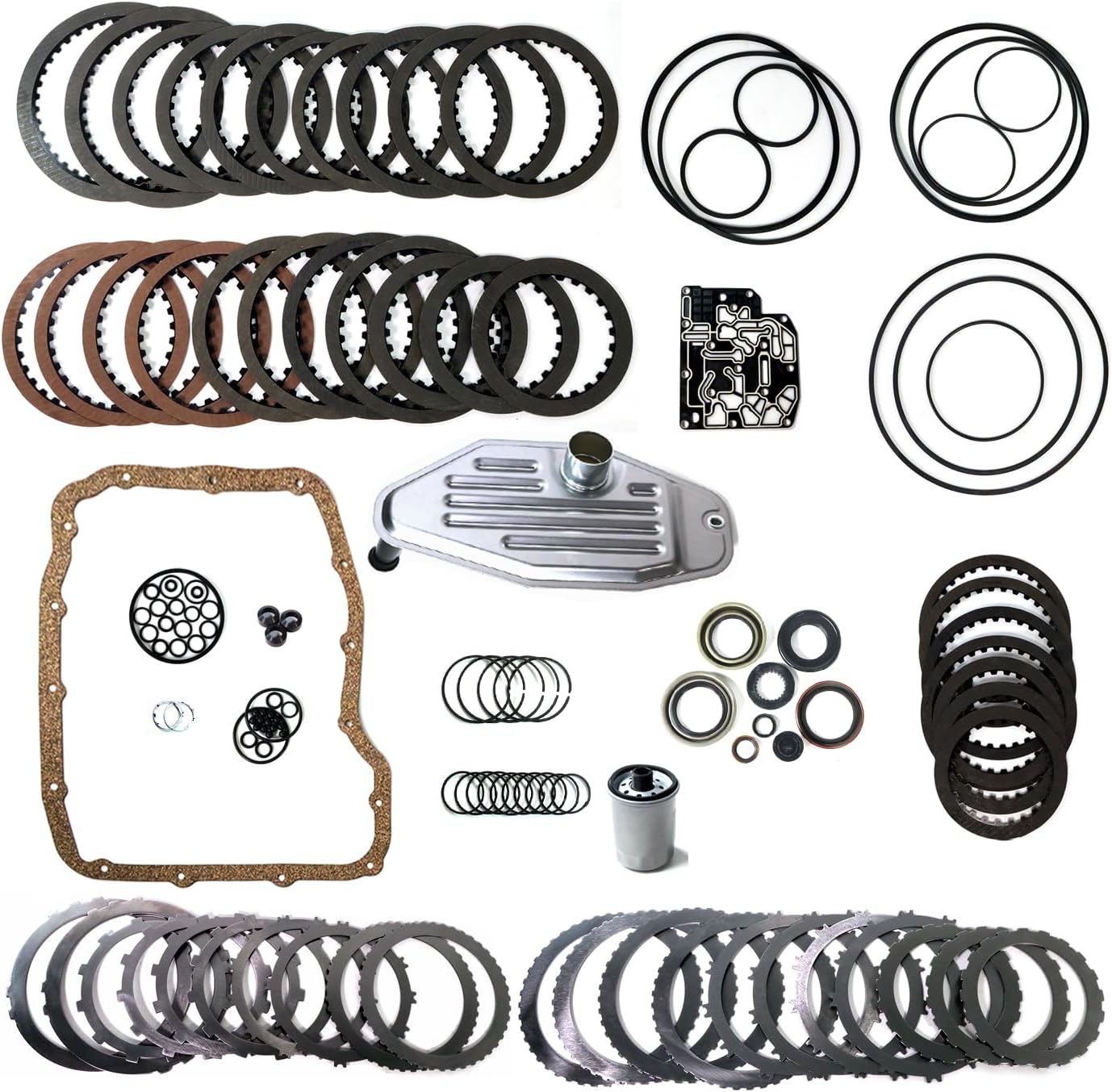
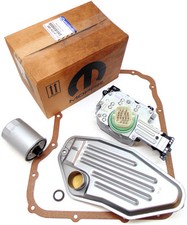
545RFE master rebuild kits, overhaul kits, valve bodies and filters for the 2004-2009 Durango — shipped fast from the USA.
Shop 545RFE parts →Shop the part for this fix
Burned OD pack from towing? The 1999-2018 RFE-family friction clutch kit covers the clutch packs for the rebuild. Confirm the plate count against your 545RFE before ordering.
Shop the RFE friction kit → All RFE-series partsFAQ
Why does my Durango 545RFE slip in 4th and 5th?
Fourth and fifth share the overdrive clutch, and 3rd uses it too, so a flare in those gears points at the OD pack or its apply circuit. Towing at highway speed is the usual cause. Check line pressure and PCS duty cycle under load, the switch valve bore plug, the stator dribbler valve, and OD clearance against Chrysler's 0.043-0.073 in. spec.
Is a slow shift into gear in the morning a slipping transmission?
Usually not. Chrysler's bulletin for 2004-2006 Durangos blames cooler return filters with part number 04799662AB, which can let fluid drain from the converter overnight. A 04799662 filter at any level other than AB corrects it. If the delay happens on every engagement, check fluid level, the primary filter seal and the pump instead.
What fluid and torque specs do I need for a 545RFE Durango pan service?
Use Mopar ATF+4 only, with no additives or sealers. Chrysler's torques are 105 in-lb for the pan bolts, 40 in-lb for the primary filter screw and 84 in-lb for the cooler return filter. Check the level hot, around 180 F, in Park with the engine idling.
Should I run a Quick Learn to fix a slipping 545RFE?
No. ATRA says Quick Learn should not be used as a remedy for shift quality complaints, because it resets more than 70 learned parameters. Read the clutch volume indexes first, since a high CVI tells you which clutch is wearing. Run Quick Learn only after an overhaul or a module replacement or flash.
Related 545RFE guides
Sources
- Chrysler 545RFE service information — Road Testing, Clutch Application Chart, Automatic Transmission Fluid and Transmission Specifications (2007 HB/XK-era 545RFE). Backs engine flare meaning clutch, overrunning clutch or line pressure problems, the applied elements in every range, the L/R 150 rpm note, the ERS display note, gear ratios, all clutch pack clearances, ATF+4 and the no-additive policy, and the pan, filter, cooler return filter and valve body torques. road test and clutch chart, fluid and specifications
- Chrysler 45RFE/545RFE service information — P0734 and P0735 Gear Ratio Error and Hydraulic Pressure Test. Backs the five-minute MIL delay, the input-rpm-zero and line pressure event data checks, the 4th and 5th gear cause lists, adapter 8259 and the plus or minus 10 psi comparison, and the 4.7L and 5.7L in-gear and lockup pressures. P0734, P0735 and pressure test
- ATRA 2002 technical seminar manual — Chrysler 45RFE Quick Learn Procedure (pages 182-187). Backs the CVI definition, the shift conditions that update each CVI, the 110 F minimum and normal ranges, Quick Learn not being a remedy for shift quality complaints, and the shifter cable / PRNDL code check for poor 2-3 shifts. atracom.blob.core.windows.net (PDF)
- GEARS Magazine (ATRA) — "Controlling Pressure 2: Chrysler," Rob Faucett. Backs the 5 and 62 percent PCS duty cycle limits, duty cycle near 5 percent as a sign of internal leakage, and torque-based desired pressure leading to failed overdrive clutches. gearsmagazine.com
- Transmission Digest / Sonnax TASC Force — "Troubleshooting RFE Overdrive Clutch Failure: Three Key Areas to Check," Caleb Perham. Backs the switch valve bore plug stroke sequence and vacuum test, the dribbler valve function and air test direction, and clearance too tight vs too loose. transmissiondigest.com
- Underhood Service (ALLDATA) — Chrysler bulletin summary, "Solving Transmission Delayed Shift Condition on Dodge Durango." Backs the 2004-2006 HB Durango delayed engagement, the 04799662AB cooler return filter cause and fix, and the DGQ / DG4 sales codes. NHTSA recall data backs recall 13V-038 on the 2009 Durango. underhoodservice.com and NHTSA