A 2003-2008 Ram 1500 with a 4.7L or 5.7L Hemi and a 545RFE that flares on a shift is one of the most common jobs in an RFE shop. "It slips" covers half a dozen failures, and the 545RFE lets you tell them apart before you pull the pan: a clutch application chart, gear ratio codes with event data, a live line pressure sensor, and learned clutch volumes.
Here is the order we chase it, with the factory pressures, clearances and capacities. For the general overview, see our 545RFE Ram 1500 common problems guide.

What "Slipping" Means on a Clutch-to-Clutch Unit
The 545RFE has no bands. Every gear is two friction elements applied at once (plus the overrunning clutch in first), and every shift is one clutch releasing while another applies. Chrysler's road test procedure is direct about it: slippage shows up as engine flare, and it "usually means clutch, overrunning clutch, or line pressure problems." So a slip is one of three things: a clutch pack that can no longer hold, a low sprag that will not lock, or pressure that never makes it to the piston.
The factory ratios are 3.00 first, 1.67 second, 1.50 second-prime, 1.00 third, 0.75 fourth, 0.67 fifth and 3.00 reverse. The controller watches input speed (60 teeth on the input clutch hub) against output speed (30 teeth on the park gear). When the ratio does not match the commanded gear, it sets a gear ratio code. That is your first clue as to which gear, and which clutches, are involved.
Step 1: Rule Out Fluid First
Every one of Chrysler's gear ratio error procedures (P0731 through P0736) lists low fluid level as a possible cause, and the 1st and 2nd gear lists also call out a cracked or misinstalled primary oil filter or seal. A filter that is sucking air will make a perfectly good unit flare, so check this before anything else.
- Fluid: Mopar ATF+4 only. It is the only fluid the factory spec lists for the 545RFE.
- Service fill (pan drop): 5.2 L (11 pints) on 4x2 trucks and 6.2 L (13 pints) on 4x4 trucks, per the 2008 Ram fluid capacity chart. The 4x4 number is bigger because of the deep filter and pan.
- Overhaul (dry) fill: 14-16 L (29-33 pints), depending on converter, cooler lines and any auxiliary cooler.
- Pan service torques: pan bolts 105 in-lb, primary filter screw 40 in-lb, cooler return filter 84 in-lb.
When the pan comes off, read it. Fine gray paste on the magnet is normal; black friction material and lining flakes are not. Low fluid and a clean pan? Fix the leak, fill it and road test again. A pan full of friction material means the slip is mechanical.
Step 2: Find the Slipping Clutch with the Application Chart
This is where the 545RFE makes diagnosis easy. Chrysler's 545RFE clutch application chart lists the applied elements for every range:
- 1st: UD + L/R + overrunning clutch (L/R is on only below 150 rpm output shaft speed)
- 2nd: UD + 2C
- 2nd prime: UD + 4C
- 3rd: UD + OD
- 4th: OD + 4C
- 5th: OD + 2C
- Reverse: Reverse + L/R
- Limp-in (D): UD + OD (third gear); limp-in in the 2 position uses UD + 2C
Now line up the road test against it. Every clutch shows up in more than one gear, so the gears that slip and the gears that do not point to one element:
- Slips in 1st, 2nd and 3rd but 4th and 5th are solid: the underdrive (UD) clutch, the one element common to the low gears and missing from 4th and 5th.
- Slips in 3rd, 4th and 5th: the overdrive (OD) clutch. This is the most common slip we see on a high-mileage Ram 1500.
- Slips in 2nd and 5th only: the 2C clutch.
- Slips in 4th (and on a 2nd-prime kickdown): the 4C clutch.
- Slips in 1st from a stop only, other gears fine: the overrunning (low sprag) clutch. Check whether manual low holds; in manual 1 the L/R clutch stays applied and takes the load.
- Reverse slips, everything forward is fine: the reverse clutch, or the L/R circuit if manual low also slips.
One trap: with Electronic Range Select, the display shows a six-speed, with second-prime as third, third as fourth and so on. Know which gear you are really in before you blame a clutch.
Step 3: Read the Codes and the Event Data
The ratio codes are monitored continuously with the engine running and the transmission in gear. Chrysler notes each one "can take up to five minutes" of problem identification before the MIL comes on, so a truck that flares now and then may have a pending code with no light. Pull the codes and record all of the EATX DTC event data before you clear anything. The factory test then asks two questions that save a lot of wasted teardowns:
- Did input rpm read zero in the event data? If yes, it is an input speed sensor or wiring problem, not a slip. Diagnose it as P0715.
- Was line pressure more than 10 psi below desired? If yes, you are chasing a pressure problem first, not a clutch.
If the speed sensors' common ground opens, both read input sensor pulses at a stop in neutral, the controller sees a 1:2 ratio and may set P1794. Check that ground before you believe a ratio code.
The factory cause lists point at specific hard parts. P0731 (1st) includes a failed overrunning clutch and a cut UD piston seal. P0732 (2nd) adds a broken 2C piston casting and a broken reaction carrier to reverse sun gear weld. P0733 (3rd) lists a bent accumulator cover and a broken reverse carrier hub weld. P0734 (4th) calls out a cut 4C tower seal and a loose or missing dribbler orifice in the reaction shaft support. P0735 (5th) adds a cut 2C tower seal and missing check balls. Many of those causes are seals, orifices and check balls, not burned frictions. A 545RFE can flare with lining still on the clutches if the apply oil is leaking off.
Step 4: Verify Line Pressure
The 545RFE runs closed-loop line pressure. You can read actual pressure from the line pressure sensor on the scan tool, and the factory check is to install line pressure adapter 8259 with a gauge and the original sensor, then compare: the scan tool and gauge should agree within plus or minus 10 psi. Test at normal operating temperature with the engine at 1500 rpm.
Chrysler's in-gear maximum pressures for the Ram's engines:
- 5.7L: 160 psi in 1st, 135 psi in 2nd through 5th, 120 psi in neutral, 250 psi in reverse.
- 4.7L: 135 psi in 1st, 120 psi in 2nd, 2nd prime and 3rd.
- Garage shifts: N-R is 220 psi (4.7L) or 250 psi (5.7L); N-1 is 135 psi (4.7L) or 165 psi (5.7L); R-N is 120 psi.
- Upshifts: the 1-2 runs 150 psi on the 5.7L and 120 psi on the 4.7L.
Now check the pressure control solenoid duty cycle. Per GEARS Magazine, it runs about 5 percent for maximum pressure and 62 percent for minimum, and the controller covers internal leaks, such as a worn regulator bore, by pulling it down. The closer it sits to 5 percent just to hold desired pressure, the more oil the unit is losing. A Ram making spec pressure at 6 percent is using up its last reserve.
GEARS also notes desired pressure is torque-based and drops at low calculated load, so actual and desired can match yet be too low to hold under heavy throttle, which "commonly leads to failed overdrive clutches." On a tuned Hemi, check desired pressure under load before you rebuild.
Step 5: Read the Clutch Volume Indexes
The clutch volume index (CVI) is the volume of fluid the controller learned it takes to stroke each clutch piston against its return spring. ATRA's RFE Quick Learn procedure gives these normal ranges for the five learned clutches on the 45RFE, which uses the same clutch set as the 545RFE:
- L/R: 82-134 (updated on a 2-1 or 3-1 manual downshift, throttle below 5 degrees)
- 2C: 25-64 (updated on a 3-2 kickdown, throttle 24-54 degrees)
- OD: 25-64 (updated on the 2-3 upshift)
- 4C: 30-64 (updated on a 3-4 upshift, throttle 5-54 degrees)
- UD: 44-92 (updated on a 4-3 kickdown, throttle 20-54 degrees)
All of them update only with fluid above 110 F. A CVI at or above the top of its range means that clutch needs more oil than normal to apply: worn frictions with growing clearance, a cut seal, or a leaking circuit. If the OD CVI is high and the truck flares into 3rd, 4th and 5th, you have found your clutch without a teardown.
Do not run Quick Learn to cure a slip. ATRA says it should not be used as a remedy for shift quality complaints; it resets more than 70 learned parameters and belongs after an overhaul or a module replacement or flash. Resetting the adapts wipes out the data that told you which clutch was going.
Step 6: The OD Clutch Repeat-Failure Checklist
If the slip is in the overdrive clutch, replacing frictions alone is how you get the truck back in a month. The Sonnax TASC Force, writing in Transmission Digest, breaks repeat OD failures on the 45RFE, 545RFE, 65RFE, 66RFE and 68RFE into three areas:
- Solenoid switch valve: the bore plug wears heaviest because it moves on every shift. On the 1-2 the switch valve strokes to feed 2C; on the 2-3 the plug strokes against the valve; on the 3-4 it strokes back to feed the OD clutch. Vacuum test the bore before you call the valve body good.
- Stator dribbler valve: a restricted dribbler delays OD apply and makes it drag; a leaking one keeps the OD clutch slightly applied. Air test it: air should travel from the pump side to the drum, not the reverse.
- Clutch clearance: too tight shortens fill time and can cause bind-up; too loose lengthens fill time and drags the pack until it overheats.
Set every pack to Chrysler's spec: OD 0.043-0.073 in., UD 0.033-0.061 in., 4C 0.030-0.055 in., 2C 0.018-0.053 in., L/R 0.039-0.069 in. and reverse 0.032-0.049 in. Input shaft end play is 0.018-0.035 in. and output shaft end play is 0.009-0.021 in. When the valve body goes back in, torque the valve body to case bolts to 105 in-lb, the solenoid module screws to 50 in-lb and the accumulator cover screws to 60 in-lb, since a bent or failed accumulator cover is on the factory cause list for 3rd, 4th and 5th gear slips. Then run the learn procedure, as the TASC Force recommends after any RFE repair.
Valve Body Job or Rebuild?
Fluid correct, pan clean, pressure in spec with a healthy duty cycle, CVIs in range, and the flare is on one shift only? Look at the valve body: switch valve and plugs, regulator valve, accumulators and check balls. Friction material in the pan, a CVI far out of range, or pressure that only holds near 5 percent duty cycle? That is a rebuild. While it is apart, inspect the carrier welds, reaction shaft support seal rings and the dribbler orifice. Do not keep driving it: every flare puts heat into the frictions, and a valve body job turns into a rebuild.
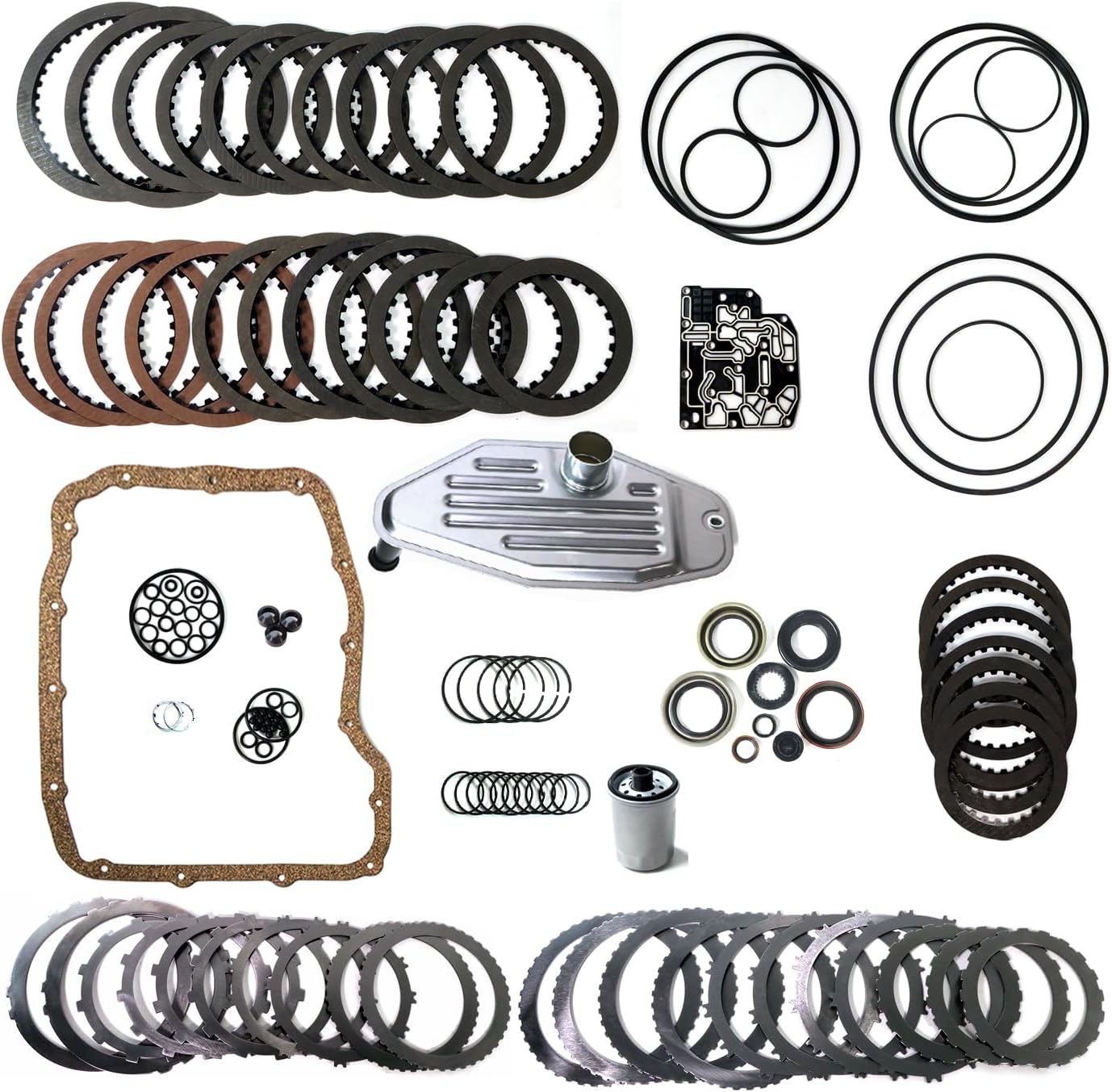
545RFE master rebuild kits, valve bodies, filters and solenoid packs for the 2003-2008 Ram 1500 — shipped fast from the USA.
Shop 545RFE parts →Shop the part for this fix
Burned OD or UD pack? The 1999-2018 RFE-family friction clutch kit covers the clutch packs for a rebuild. Confirm the clutch count against your 545RFE before ordering.
Shop the RFE friction kit → All RFE-series partsFAQ
How do I tell which clutch is slipping in a 545RFE?
Compare the gears that slip against Chrysler's clutch application chart. Each gear uses two clutches, so a slip in 1st, 2nd and 3rd points to the UD clutch, a slip in 3rd, 4th and 5th points to the OD clutch, 2nd and 5th points to 2C, and 4th points to 4C. Confirm it with the gear ratio code and the clutch volume index for that clutch.
Why does my Ram 1500 545RFE slip in 3rd, 4th and 5th?
Those three gears share the overdrive clutch, so the OD pack or its apply circuit is the prime suspect. Check for solenoid switch valve bore plug wear, a restricted or leaking stator dribbler valve, and OD clutch clearance outside 0.043-0.073 in. Also check that torque-based line pressure is not too low under load.
Will a fluid change fix a slipping 545RFE?
Only if the slip is caused by low or wrong fluid or a cracked or misinstalled primary filter. Use Mopar ATF+4, about 5.2 L (11 pints) on a 4x2 Ram 1500 or 6.2 L (13 pints) on a 4x4 for a pan service. If the pan is full of friction material, the clutches are burned and fresh fluid will not bring them back.
Should I run a Quick Learn on a slipping 545RFE?
No. ATRA states Quick Learn should not be used as a remedy for shift quality complaints, because it resets more than 70 learned parameters. Use it after an overhaul, a transmission replacement, or a module replacement or flash. Read the clutch volume indexes first, since they tell you which clutch needs more oil to apply.
Related 545RFE guides
Sources
- Chrysler 545RFE service information — Road Testing, 545RFE Clutch Application Chart and Transmission Specifications (2007 Jeep Commander XK). Backs engine flare meaning clutch, overrunning clutch or line pressure problems, the applied elements in every range including limp-in, the L/R 150 rpm note, the ERS display note, the gear ratios, all clutch pack clearances, shaft end play, ATF+4, and the pan, filter, valve body, solenoid module and accumulator cover torques. road test and clutch chart and specifications
- Chrysler 45RFE/545RFE service information — P0731 through P0736 Gear Ratio Error and Hydraulic Pressure Test. Backs the five-minute MIL delay, the input-rpm-zero and 10 psi below desired event data checks, the 60/30 tooth speed sensor logic and P1794, the per-gear cause lists, adapter 8259 and the plus or minus 10 psi gauge comparison, and the 4.7L and 5.7L garage, upshift and in-gear pressures. P0731, P0732, P0733, P0734, P0735, P0736 and pressure test
- Chrysler — 2008 Ram Fluid Capacities (Ram Body Builder Guide, DR). Backs the 45RFE/545RFE service fill of 5.2 L (11 pt) 4x2 and 6.2 L (13 pt) 4x4 and the 14-16 L (29-33 pt) overhaul fill. rambodybuilder.com (PDF)
- ATRA 2002 technical seminar manual — Chrysler 45RFE Quick Learn Procedure (pages 182-187). Backs the CVI definition, the shift and throttle conditions that update each CVI, the 110 F minimum, the normal ranges, and Quick Learn not being a remedy for shift quality complaints. atracom.blob.core.windows.net (PDF)
- Transmission Digest / Sonnax TASC Force — "Troubleshooting RFE Overdrive Clutch Failure: Three Key Areas to Check," Caleb Perham (July 2023). Backs the switch valve bore plug stroke sequence, the dribbler air test direction and failure modes, clearance too tight vs too loose, and the learn after repair. transmissiondigest.com
- GEARS Magazine (ATRA) — "Controlling Pressure 2: Chrysler," Rob Faucett. Backs the 5 and 62 percent PCS duty cycle limits, duty cycle near 5 percent as a sign of internal leakage, and torque-based desired pressure under low load leading to OD clutch failures. gearsmagazine.com