A 545RFE that takes off in second, will not upshift, and has the check engine light on is usually not broken inside. The module took its hands off the wheel. Chrysler calls it limp-in or default mode, and the stored codes tell you whether you are chasing a wire, a solenoid pack, a sticking valve, or a clutch that is really slipping.
The short version: in limp-in the transmission control relay is off, the solenoids and pressure switches lose power, and the valve body makes only Park, Reverse, Neutral, 2nd and 3rd from the lever. Read every code. P0882-family codes point to the relay circuit, P0750-P0770 are electrical only, switch valve codes (P1775/P1776) can be valve body wear, and ratio codes (P0731-P0736) mean something really slipped.
What "Stuck in One Gear" Means on a 545RFE
The 545RFE is a five-speed with clutch-to-clutch shifts and no bands. Every apply comes from a solenoid in the pack on the valve body, and the module confirms each apply with pressure switches in the same assembly.
Chrysler's operation description spells out the backup plan. Without electronic assist, the hydraulic control system provides Park, Reverse, Neutral, Second and Third based solely on where the driver puts the shift lever. That design exists so the vehicle can still be driven when the electronic control system fails, or when the module sees a condition it considers potentially damaging to the transmission (Chrysler 545RFE operation). That is the "stuck in one gear" complaint: a launch in second, no first, no fourth or fifth, and often no converter lockup.
One Jeep wrinkle: Electronic Range Select vehicles (WK, WH, XK and XH) do not get 2nd in limp-in because the shifter has no "2" or "1" position, so they launch in the higher hydraulic gear.
How the module puts it there
The switch that actually drops the transmission into default is the transmission control relay. Per Chrysler's P0882 theory of operation, the relay supplies power to the solenoids and pressure switches in normal operation, and its output is fed back to the module as a sense circuit called "Transmission Control Relay Output." When the relay is off, no power reaches the solenoids or pressure switches, and the transmission is in limp-in (Chrysler P0882).
Jarad Warren's write-up in GEARS fills in the strategy on the TIPM-equipped trucks. The PCM commands the relay through the TIPM, and the relay gets shut off for two different reasons: a circuit fault, to protect the wiring, and a transmission fault such as a ratio code, to force limp mode and prevent further damage. Some vehicles have no separate relay because it is built into the TIPM (GEARS, Dec. 2018). So limp-in is not automatically electrical; a slipping clutch puts it there as fast as a broken wire.
Step 1: Do the Pre-Diagnostic Work Chrysler Asks For
Do the basics in the order the factory procedure lists them.
- Charge the battery. Chrysler says testing should only be done with the battery fully charged to avoid a false diagnosis. Low system voltage shows up as power-input and solenoid codes that are not real.
- Check the fluid hot. The 545RFE takes ATF+4. A low level causes slipping, which sets ratio codes, which triggers limp-in. Chrysler's level check is in Park after at least one minute at idle, with the level in the HOT band at about 180 F, and the true fluid temperature read on a scan tool in Reverse or a forward gear (Chrysler Fluid Level Check). Fix leaks before anything else.
- Read engine codes first and fix driveability faults before the transmission side.
- Record every transmission code. Write down stored, active and pending codes. The procedure says to treat a pending code as a matured one.
- Save the event data. The DTC event data tells you the gear, speed and temperature when the code set. A battery disconnect erases it and resets every learned transmission value to default, which can make the shifts erratic for a while.
- Run the shift lever position test. If it fails, go to the P0706 range sensor diagnosis before anything else.
- Look for software. Check for TSBs. Some shift and default complaints are fixed by a PCM or TCM flash.
The pre-diagnostic procedure also says to pull up the Clutch Volume Index (CVI) data on any gear ratio code. A CVI far out of line with the others points at that clutch before the pan comes off.
Step 2: Sort the Codes Into Four Buckets
Group the codes, then diagnose the group that makes the others possible.
| Code group | Examples | What it usually means |
|---|---|---|
| Relay / power input | P0882 TCM Power Input Low, P0883, P0884, P0890 | Relay, fuse, ground, relay output wire, TIPM or module. Fix these first. |
| Solenoid circuit | P0750 LR, P0755 2C, P0760 OD, P0765 UD, P0770 4C | Strictly electrical: wiring, connector, solenoid pack, or module. |
| Pressure switch / switch valve | P0841, P0846, P0871, P0876, P0988, P1775, P1776 | Low relay voltage, a solenoid pack fault, or a sticking solenoid switch valve. |
| Gear ratio | P0731 to P0736 | The gear the module commanded is not the ratio it measured. Something slipped. |
The order matters. Chrysler's P0882 chart warns that inadequate relay output voltage can also set P0846, P0869, P0871, P0876 or P0988, and that those do not indicate an internal transmission or solenoid problem. Repair the power fault and the related pressure switch codes go with it (Chrysler P0882).
Step 3: The Relay Circuit (P0882)
P0882 is monitored when the ignition goes from Off to Run and from Start to Run. It sets when there is less than 3.0 volts on the transmission control relay output circuits while the module is energizing the relay. The factory cause list:
- Fused B+ feed to the relay open (check the fuse, and if it is blown, find the short to ground before replacing it)
- Relay ground circuit open
- Relay control circuit open or shorted to ground
- Relay output circuit open or shorted to ground
- Relay stuck open
- The powertrain control module
The chart wants a test light that glows as brightly on the feed and ground as it does straight across the battery; dim is a fail. It also warns against probing the PCM harness connectors, which spreads the terminals. Use the Miller 8815 breakout or an equivalent.
One thing the factory chart does not mention. Warren documented 545RFE trucks where a shorted solenoid pack pulled the relay output voltage down and set P0882 by itself, because the solenoid pack's main power feed is spliced into the relay output wires. His bench check uses pin 10 of the transmission connector as the common feed: about 1.8 ohms to each shift solenoid, about 3.7 ohms for the line pressure control solenoid, and about 300 ohms from pin 10 to pins 11, 14, 15 and 16 for the internal resistors. The shorted pack he showed read 0.003 ohms on the low/reverse-TCC solenoid. His shortcut on a hard P0882 that sets without starting the engine is to unplug the pack, plug a known-good spare pack into the harness outside the transmission, clear the code, and turn the key on. No code means the pack in the truck is the problem (GEARS, Dec. 2018).
Step 4: Solenoid Circuit Codes (P0750 to P0770)
The six solenoids are tested constantly. Chrysler's P0760 theory explains how: each inactive solenoid is turned on for a few milliseconds and each active one turned off, and the module listens for the inductive spike that pulse creates. The check runs at power-up and every 10 seconds after. Three failed checks in a row set the code, or just one if the test was run in response to a ratio or pressure switch error (Chrysler P0760).
The same page carries the most useful sentence in the whole manual for this complaint: a solenoid circuit code is strictly an electrical fault and cannot be caused by any internal transmission failure other than an open in the solenoid/TRS assembly. If the solenoid assembly needs replacing, do not replace the valve body. The cause list is the circuit to that solenoid (open, short to ground, or short to another circuit), the solenoid/TRS assembly, and the module. If a TCM power-input code is also present, Chrysler sends you back to that first.
In practice: check the harness along the case and frame for chafing, check the transmission connector for pushed-out pins and fluid wicking, and run the actuation test. If the code resets with the harness proven good, the pack is the part.
Step 5: Switch Valve Codes (P1775 and P1776)
The low/reverse solenoid does two jobs, and the solenoid switch valve decides which one. Per Chrysler's P1776 theory, the switch valve sits in its downshifted position in 1st and routes low/reverse solenoid oil to the low/reverse clutch. In 2nd through 5th it moves to the upshifted position and sends that same oil to the torque converter clutch. The module modulates the converter by raising the low/reverse solenoid duty cycle until engine-to-input slip is within 60 rpm, then goes to full 100 percent apply (Chrysler P1776).
P1776, Solenoid Switch Valve Latched in LR Position, sets when the low/reverse pressure switch closes during partial or full converter lockup, after two failed lockup attempts. Its counterpart P1775, latched in TCC position, is the opposite failure. The factory tree checks for a related P0841, then the low/reverse pressure switch sense circuit (above 5.0 ohms is an open), and then the switch valve itself for sticking.
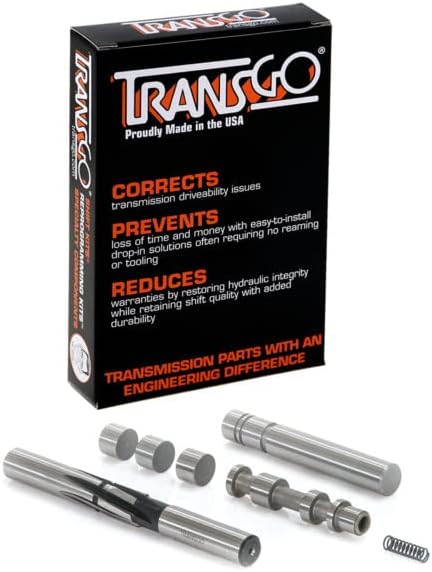
On high-mileage units the switch valve bore wears, and the same worn bore can also show up as P0841, P0871 or P0988 and as second-gear starts. That is a valve body repair, not a solenoid pack. A switch valve repair kit reamed to an oversize valve fixes the bore if the rest of the valve body is healthy. If it is not, a remanufactured valve body is the faster fix.
Step 6: Gear Ratio Codes Mean Something Really Slipped
When P0731 through P0736 are the only codes, the electronics did their job: the measured ratio was wrong, so the module shut the relay off to save the unit. Check fluid, then the CVIs, then the pan.
One related code changes the order: P0944, loss of hydraulic pump prime. Chrysler runs the loss-of-prime test when the transmission slips in a forward gear and none of the pressure switches that should be closed show pressure; the PCM turns on available elements and sets the code if no switch responds. The factory text says a sustained loss of prime leaves the vehicle unable to move. Its cause list starts with the cheap things: shift lever out of adjustment, improper fluid level, a cracked or improperly installed primary oil filter or seal, and a loose cooler return filter, ahead of a sticking main regulator valve and the pump itself (Chrysler P0944). If P0944 shows up with the ratio codes, especially right after a pan service, check the level and the filter seal before condemning clutches.
Chris Adams of Certified Transmission described a 2011 Ram 2500 with a 545RFE and the 5.7L that came in with P0734 and P0735 and a neutral on the 3-4 shift. The fluid was burnt and the pan inspection found a failed accumulator plate and a pan full of debris, so it got a remanufactured unit. The replacement then made hard, delayed forced 3-2 downshifts. A new valve body did not fix it; a lab scope showed bad multi-select and 2C solenoid patterns, and after the wiring tested good, a new programmed PCM cured it (Transmission Digest, Sept. 2021). The module can be the bad part too.
After the Repair
- Clear codes, then run the Quick Learn with the scan tool so the module relearns clutch volumes. Skip it and a good repair can shift badly enough to look like it failed.
- Drive it through every gear with converter lockup and watch for the code to return. The P1776 monitor needs repeated lockup attempts, so a short parking-lot drive does not prove anything.
- Use ATF+4 only, and if the pan came off, replace the sump filter and the cooler return filter. Our 545RFE filter and pan service guide covers the procedure.
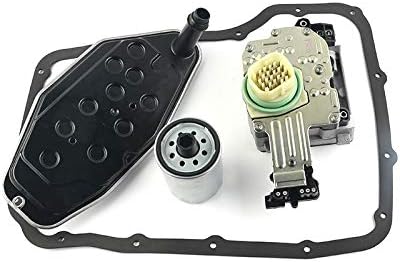
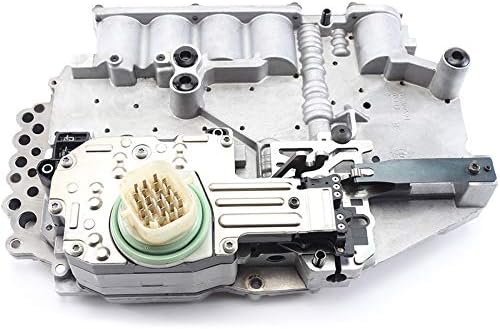
RFE-family shift solenoid block pack (2004-2018)
The solenoid pack fixes solenoid circuit codes and the shorted-pack P0882. This block pack serves the RFE family that includes the 545RFE; match the connector and model year to your unit before ordering.
View the solenoid block pack →Or browse the full RFE-family parts collection.
Frequently Asked Questions
Why is my 545RFE stuck in second gear?
The module has turned off the transmission control relay and put the 545RFE in limp-in. With no power to the solenoids and pressure switches, the valve body only makes Park, Reverse, Neutral, 2nd and 3rd from the shift lever. The relay is shut off for a circuit fault or for a transmission fault such as a gear ratio code, so read every stored code to find out which.
Will clearing the codes or disconnecting the battery fix 545RFE limp mode?
It can bring the shifts back until the fault sets again, but it fixes nothing. Chrysler notes that a battery disconnect erases the DTC event data and resets all learned transmission values, so you lose the evidence and the truck may shift erratically until it relearns. Record the codes and event data first.
Can a bad solenoid pack cause P0882 on a 545RFE?
Yes. Factory information blames the relay circuit, TIPM or module, but GEARS documented 545RFE trucks where a shorted solenoid pack pulled the relay output below 3.0 volts. Unplug the pack, plug in a known-good spare outside the transmission, clear the code and key on. If the code stays away, replace the pack.
Do I need a valve body for a 545RFE solenoid code?
Not for a solenoid circuit code. Chrysler states P0750 through P0770 are strictly electrical and cannot be caused by an internal failure other than an open in the solenoid assembly, and says not to replace the valve body. Switch valve codes like P1775 and P1776 are different and can point to a worn switch valve bore in the valve body.
Solenoid packs, valve bodies, switch valve kits, filters and master rebuild kits for the 545RFE, shipped fast from the USA.
Shop 545RFE parts →Sources
- Chrysler 545RFE service information (2007 Jeep Commander XK), "Operation." Backs the hydraulic limp-in design providing Park, Reverse, Neutral, Second and Third from the shift lever alone, the conditions that trigger limp-in, and the ERS vehicles (WK, WH, XK, XH) that do not get 2nd in limp-in. Chrysler 545RFE Operation
- Chrysler 45RFE/545RFE service information, "P0882 - TCM Power Input Low." Backs the transmission control relay powering the solenoids and pressure switches, relay-off equals limp-in, the under-3.0-volt set condition, the monitor timing, the related pressure switch codes caused by low relay voltage, and the possible-cause list. Chrysler P0882
- Chrysler 45RFE/545RFE service information, "P0760 - OD Solenoid Circuit." Backs the six-solenoid inductive-spike continuity test, the power-up and 10-second monitor, the three-failure set condition, and the statement that solenoid circuit codes are strictly electrical and do not call for a valve body. Chrysler P0760
- Chrysler 45RFE/545RFE service information, "P1776 - Solenoid Switch Valve Latched in LR Position." Backs the switch valve routing low/reverse solenoid oil to the L/R clutch in 1st and the TCC in 2nd-5th, the 60 rpm slip target before full lockup, the set condition, and the diagnostic order including the 5.0 ohm sense-circuit check. Chrysler P1776
- GEARS Magazine (ATRA), Jarad Warren, "An Uncommon Fix for Code P0882," December 2018. Backs the relay shut-off strategy for circuit faults and ratio codes, the relay built into the TIPM on some vehicles, the solenoid pack resistance values (1.8, 3.7 and 300 ohms) and the spare-pack bypass test. GEARS, Dec. 2018
- Transmission Digest, Chris Adams (Certified Transmission), "545RFE Transmission with Hard Forced 3-2 Shifts," September 2021. Backs the 2011 Ram 2500 5.7L case with P0734/P0735, the failed accumulator plate, and the PCM replacement found by lab scope. Transmission Digest, Sept. 2021
- Chrysler 45RFE/545RFE service information (2007 Jeep Grand Cherokee WK), "Fluid Level Check" and "P0944 - Loss of Hydraulic Pump Prime." Backs the Park, one-minute idle, 180 F HOT band and in-gear scan tool temperature procedure, and the P0944 monitor, set condition, unable-to-move statement and cause list. fluid level check and P0944