Shift complaints on a 2003-2008 Ram 1500 with the 545RFE come in described every way possible: "it bangs into second," "it won't shift out of third," "the light came on and now it's sluggish." Behind most of them is a short list of faults, and the 545RFE gives you the data to sort them out: five pressure switches, a line pressure sensor, a coded range sensor, and learned clutch volumes for every element.
This guide works shift quality and shift timing problems. If the engine flares on the shift, that is a slip, and our 545RFE Ram 1500 slipping guide walks that chase clutch by clutch. Here we deal with harsh shifts, wrong-gear and no-upshift complaints, limp mode, and converter lockup trouble.

How the 545RFE Decides When and How to Shift
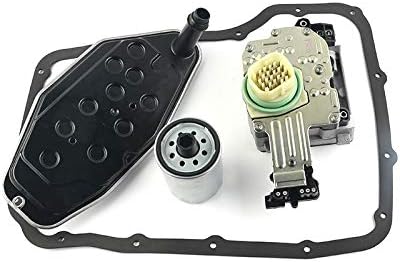
There are no shift valves and no governor in this unit. Chrysler describes the 545RFE as having "full electronic control of all automatic up and downshifts" with real-time adaptive closed-loop shift and pressure control. Every shift is clutch-to-clutch, timed from input and output speed, so a shift complaint here is usually an oil-control problem rather than a burned clutch. If oil does not reach the piston when the controller expects it, the shift is harsh, soft, or aborted. The parts involved:
- The solenoid pack. On a 2003-2008 Ram it is the white-connector pack, which Sonnax notes ran from 2000 to 2009 with six solenoids. The 2010-up gray-connector pack has only five solenoids and, per Sonnax, cannot back-service the earlier units. Order by year.
- Five pressure switches (L/R, 2C, 4C, UD, OD) that confirm each clutch circuit got pressure, and the source of most hydraulic DTCs.
- The transmission range sensor (TRS), part of what Chrysler calls the Solenoid/TRS Assembly.
- The line pressure sensor (LPS), closing the loop on the pressure control solenoid.
- The solenoid switch valve (SSV), routing L/R solenoid oil to the L/R clutch (first) or the converter clutch (second through fifth).
Per Chrysler's P0868 theory of operation, line pressure is held at a preset 120 or 135 psi during shifts and in Park and Neutral "to ensure consistent shift quality," and is torque-based the rest of the time. If a leak keeps the unit from hitting that preset, every shift suffers.
Match the Complaint to a Starting Point
Chrysler's road test procedure tells you to note whether shifts are "harsh, spongy, delayed, early, or if part throttle downshifts are sensitive." Write down which one before you plug in, because each points to a different system:
- Stuck in what feels like third, no upshift or downshift, MIL on: limp-in. Codes first.
- Harsh or bind-up feel on one specific shift, often with no lockup: solenoid switch valve and its plugs.
- Harsh or soft shifts across the board, sometimes with P0868: line pressure, the filter, the main regulator, or the sensor.
- Erratic shifting, wrong gear for the lever position, no-start in Park, P0706: range sensor or shifter cable adjustment.
- Harsh shifts right after a battery disconnect, module flash or repair: adaptives that need to relearn.
Step 1: Fluid, Filter and Cable Before Anything Electrical
The pre-diagnostic checks matter more on this unit than most, because the pressure switch logic depends on oil reaching the switches on time. Chrysler's P0841 (L/R pressure switch rationality) cause list includes low fluid level, a cracked or misinstalled primary oil filter or filter seal, and a sticking main regulator valve in the pump valve body. P0868 lists the same filter faults plus a loose cooler return spin-on filter.
- Fluid: Mopar ATF+4 only, per the factory specification.
- Service fill: 5.2 L (11 pints) on a 4x2 Ram 1500 and 6.2 L (13 pints) on a 4x4 after a pan drop, per the 2008 Ram fluid capacity chart. Check the level hot and in Park.
- Torques: oil pan bolts 105 in-lb, cooler return filter 84 in-lb.
- Shift cable: Chrysler lists "shifter out of adjustment" as the first possible cause of P0706. If the cable puts the manual valve and the TRS between detents, you can get a wrong-gear or no-crank complaint with a perfectly good transmission.
Step 2: Limp-In and What Puts It There
When the controller sees something it considers damaging, or loses control entirely, it shuts off solenoid power and the valve body falls back to hydraulics. Chrysler states the hydraulic system alone provides Park, Reverse, Neutral, second and third "based solely on driver shift lever selection." From the clutch application chart, limp-in in Drive is UD plus OD, which is third gear. In the 2 position, limp-in gives second (UD plus 2C). Chrysler notes that vehicles with Electronic Range Select get no second in limp-in because the lever has no 2 or 1 position; a Ram 1500 with a conventional column shifter that has a 2 detent keeps it.
A truck that "pulls away like it's in third and never shifts" is in limp-in. Pull codes and freeze-frame before clearing anything. The usual triggers:
P0882 (TCM power input low)
Writing in GEARS Magazine, Jarad Warren explains that P0882 sets when the controller sees less than three volts on its transmission power output circuits. On TIPM-equipped trucks the PCM commands the TIPM, which powers the transmission relay circuit back to the PCM and the solenoid pack. The usual culprits are the PCM, the TIPM, or wiring. The uncommon one is a shorted solenoid pack that pulls the supply down, because the pack's main power wire is spliced into that circuit. His bench check: every solenoid gets power from pin 10 of the pack connector. He measured the L/R-TCC solenoid (pin 10 to pin 2) and the other shift solenoids at about 1.8 ohms, the pressure control solenoid at about 3.7 ohms, and the pressure switch resistors (pin 10 to pins 11, 14, 15 and 16) at about 300 ohms each. Sonnax's pin-out chart lists 1.3 and 3.5 ohms for the same solenoids, so treat anything in that neighborhood as normal. A reading near zero is your short. If the code sets key-on without starting, plug a known-good spare pack into the harness outside the transmission and see if it returns.
Ratio and solenoid circuit codes
Gear ratio errors (P0731-P0736) are slip codes; follow the slipping guide. Solenoid circuit codes (P0750-P0770) are electrical: check the harness and pack connector, then measure against the values above.
Step 3: Range Sensor Problems (P0706)
The TRS on the 545RFE is not a simple potentiometer. Chrysler explains it as five switches on five sense circuits (T41, T42, T3, T1 and T2), each open or closed depending on lever position. The combination is a "PRNDL code." There are 12 valid codes: two for Neutral, one for each other position, and five transition codes between positions. Everything else is invalid, and P0706 sets when the controller sees an invalid code for more than 0.042 seconds.
Chrysler's cause list for P0706: shifter out of adjustment, a TRS sense circuit open or shorted to ground or voltage, metal debris in the oil pan, the TRS itself, or the PCM. That debris item is the one to remember. The TRS contacts sit in the valve body area, and steel fines from a failing unit can bridge them. If the pan has a fuzzy magnet and a P0706, replacing the Solenoid/TRS assembly alone will not keep the code away.
On the scan tool, move the lever slowly through every position and watch the TRS switch states. An invalid state in a detent tells you more than any parts swap.
Step 4: Line Pressure and P0868
The 545RFE regulates line pressure with a pressure control solenoid that runs backwards from what many techs expect. Per Chrysler, 5 percent duty cycle means the solenoid is off and line pressure is at maximum; 62 percent means it is on and pressure is at minimum. Desired line pressure comes from calculated input torque, and the controller compares it continuously against the LPS reading. P0868 sets if actual line pressure stays more than 15 psi below desired for 3.5 seconds while driving in a forward gear.
Chrysler's P0868 test sequence is worth following in order:
- If P0932 (line pressure sensor circuit) is also set, diagnose the sensor circuit first.
- With the engine off, push on the LPS connector and watch the line pressure PID. If it jumps to about 30 psi, you have a connection problem, not a pressure problem.
- Check the 5-volt supply: above 5.5 volts means a short to voltage, and more than 5 ohms of circuit resistance means an open.
- Tee a gauge in and compare. Chrysler says the gauge should read within 5 psi of the scan tool, or the sensor is bad.
- If the sensor is honest, pull the pan and look for a plugged, cracked or split primary filter or O-ring, then a stuck main regulator valve or an internal leak.
Also watch PCS duty cycle: a unit that needs close to 5 percent to hold desired pressure has no reserve left. Shift-by-shift pressure specs are in our 545RFE pressure testing guide.
Step 5: The Solenoid Switch Valve and Lockup Complaints
A harsh or tied-up shift plus no converter lockup points at the SSV bore. Besides routing L/R solenoid oil between the L/R clutch and the converter clutch, Sonnax's Tory Royce notes the valve also directs oil to the 2nd and OD clutches through two shuttle plugs in the end of the bore. As the bore wears, the valve and plugs stick, and Sonnax lists the result as bind-up, codes 841, 868, 871, 988, 1775 and 1776, engine stall, failsafe mode, no lockup, and TCC apply and release concerns.
Two factory codes tell you which way it stuck:
- P1775 (SSV latched in TCC position): on a shift into first, the controller runs a special hydraulic sequence to move the SSV down and watches the L/R pressure switch to confirm it. If the switch does not close, EMCC is inhibited, and three failed attempts in one ignition cycle set the code. Chrysler's possible causes include a sticking switch valve and the Solenoid/TRS assembly.
- P1776 (SSV latched in L/R position): during lockup, the controller ramps the L/R solenoid duty cycle until converter slip is within 60 rpm, then goes to 100 percent (full EMCC). If the L/R pressure switch closes while it is doing that, oil is going to the L/R clutch instead of the converter. Two failed attempts set the code. That is the classic bind-up feel at a lockup or shift event.
The fix is in the casting. Sonnax recommends vacuum testing the bore to decide whether it needs repair, and warns to measure the switch valve before choosing tooling: the original design used a 0.420 in. large spool with 0.453 in. plugs, and the 45RFE-family change to a 0.453 in. spool did not come until about 2010. A 2003-2008 Ram should have the original 0.420 in. valve, but measure it anyway, since valve bodies get swapped.
Step 6: Adaptives, CVIs and When to Run Quick Learn
The controller learns how much oil it takes to stroke each clutch, the clutch volume index (CVI), and uses it to time every shift overlap. ATRA's 45RFE Quick Learn procedure, which applies to the 545RFE clutch set, gives normal ranges of L/R 82-134, 2C 25-64, OD 25-64, 4C 30-64 and UD 44-92, and they only update with fluid above 110 F.
A CVI high in its range means that clutch needs more oil than normal to apply, giving a late or soft shift into that element. One well outside the range is a mechanical or hydraulic problem the controller cannot learn around.
ATRA is blunt that Quick Learn should not be used as a remedy for shift quality complaints, because it resets more than 70 learned parameters. Run it after an overhaul, a transmission or valve body replacement, or a PCM replacement or flash. A truck that shifted fine for 100,000 miles and suddenly bangs into second has a real fault, not a learning problem.
The Repair: Pack, Valve Body or Rebuild
Put the evidence together before you buy parts:
- Electrical fault on a solenoid circuit, P0882 traced to a shorted solenoid, or P0706 with a clean pan: replace the Solenoid/TRS assembly. Use the correct white-connector pack for a 2003-2008 truck.
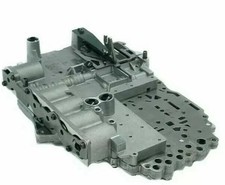
- P1775/P1776, P0841 or P0871, bind-up, or no lockup with good solenoids: valve body. Repair the SSV bore or replace the valve body.
- P0868 with an accurate sensor and a good filter: pump and main regulator, then internal leaks. That usually means a teardown.
- Debris in the pan, CVIs out of range, or ratio codes along with the shift complaint: rebuild. A new pack or valve body in a unit making metal is a comeback.
When the valve body goes back in, torque the valve body to case bolts to 105 in-lb and the solenoid module screws to 50 in-lb, per the factory specification. Refill with ATF+4, check the level hot, and run Quick Learn, since the old adaptives no longer describe the hardware.
545RFE solenoid packs, valve bodies, line pressure and speed sensors, and rebuild kits for the 2003-2008 Ram 1500 — shipped fast from the USA.
Shop 545RFE parts →Shop the part for this fix
Solenoid circuit code or a shorted solenoid behind P0882? The RFE-family shift solenoid kit fits the 1999-up 45RFE design shared by the 545RFE. Match the connector color (white for 2003-2008) before ordering.
Shop the RFE shift solenoid kit → All RFE-series partsFAQ
Why is my Ram 1500 545RFE stuck in third gear?
That is almost always limp-in. When the controller cuts solenoid power, the valve body falls back to hydraulics and gives UD plus OD in Drive, which is third gear, and second in the 2 position. Pull the codes; P0882, gear ratio codes and solenoid circuit codes are the usual triggers.
What causes harsh shifts in a 545RFE?
The common causes are a worn solenoid switch valve bore, line pressure problems such as a cracked primary filter or sticking main regulator, wrong or low fluid, and adaptives that have been reset. If the harsh shift comes with no converter lockup or codes P1775 or P1776, look at the switch valve first.
Will a new solenoid pack fix 545RFE shift problems?
Only when the fault is in the pack: a solenoid circuit code, a shorted solenoid pulling down the supply and setting P0882, or a range sensor fault with a clean pan. Mechanical valve body wear, a bad pump or burned clutches will not be fixed by a pack. On a 2003-2008 Ram, use the white-connector, six-solenoid pack.
Does a Quick Learn fix 545RFE shifting?
Not as a cure. ATRA says Quick Learn should not be used as a remedy for shift quality complaints because it resets more than 70 learned parameters. Run it after a rebuild, a valve body or transmission replacement, or a PCM replacement or flash.
Related 545RFE guides
Sources
- Chrysler 545RFE service information — Operation, Road Testing and Clutch Application Chart (2007 Jeep Commander XK). Backs full electronic adaptive shift control, the hydraulic limp-in gears (P, R, N, second, third) based on lever position, limp-in clutch combinations, the ERS limp-in note, and the road test shift descriptions. operation and road test and clutch chart
- Chrysler 45RFE/545RFE diagnostic procedures — P0706, P0841, P0868, P1775 and P1776. Backs the 12 valid PRNDL codes and 0.042-second set condition, the metal-debris and shifter-adjustment causes, the 5/62 percent PCS duty cycle, the 120/135 psi shift pressure, the 15 psi/3.5 second P0868 set condition and test steps, the SSV function, and the 60 rpm EMCC logic. P0706, P0841, P0868, P1775, P1776; torques and fluid from specifications
- Chrysler — 2008 Ram Fluid Capacities (Ram Body Builder Guide, DR). Backs the 545RFE service fill of 5.2 L (11 pt) 4x2 and 6.2 L (13 pt) 4x4. rambodybuilder.com (PDF)
- Sonnax — "All in the Family: Identification & Repair of Chrysler Solenoid Switch Valve Problems," Tory Royce. Backs the SSV's role feeding 2nd and OD through shuttle plugs, the symptom and code list, vacuum testing, and the 0.420/0.453 in. valve and plug dimensions with the 45RFE-group change around 2010. sonnax.com
- Sonnax — "Identifying Chrysler RFE Solenoid Changes Through the Years," Randall Schroeder (2025). Backs the white-connector pack (2000-2009, six solenoids) and the gray-connector 2010 pack not back-servicing earlier units. sonnax.com
- GEARS Magazine (ATRA) — "An Uncommon Fix for Code P0882," Jarad Warren (December 2018). Backs the under-3-volt set condition, the TIPM power path, the shorted solenoid pack cause, and the 1.8, 3.7 and 300 ohm resistance values. gearsmagazine.com
- Sonnax — "45RFE, 545RFE, 68RFE Solenoid Identification & Connector Pin Out." Backs the 1.3-ohm shift solenoid and 3.5-ohm pressure control solenoid values and pin 10 as the transmission control relay output. sonnax.com
- ATRA 2002 technical seminar manual — Chrysler 45RFE Quick Learn Procedure. Backs the CVI ranges, the 110 F update minimum, and Quick Learn not being a remedy for shift quality complaints. atracom.blob.core.windows.net (PDF)