Every 5R110W looks the same from under the truck. Same bellhousing, same pan, same TorqShift name on the paperwork. Inside, it is at least three different transmissions. Ford changed the pump three times, redid the whole forward gear train for 2005, split the overdrive one-way clutch into gas and diesel versions in 2007, and in late 2008 bolted the one-way clutch to the rear planet. Order a kit or a hard part for the wrong design level and you find out when the frictions will not slide onto the hub.
This guide is the order I go in to pin down a 5R110W before I buy parts: the tag, the build date, what you can see with the pan off, and the internal parts that tell you which design level is on the bench. The tooth counts and dimensions come from the ATSG 5R110W manual, the pump IDs from Sonnax, and the later changes from Transmission Digest. All of them are listed under Sources at the bottom.

Step 1: Read the identification tag
The tag on the case is the first thing to read, and the one most people only half read. The ATSG manual's tag illustration breaks it into four fields:
- Assembly part number, prefix and suffix. The ATSG example reads 3C3P-7000-KB. The 7000 base number is the transmission assembly. The prefix and suffix identify the exact calibration and design level, and that is the number a parts supplier or dealer needs.
- Transmission model. Confirms you are looking at the 5R110W and not a 4R100 in a swapped truck.
- Serial number. Useful for warranty records and for matching a core to its paperwork.
- Build date, in DD MM YY order. The ATSG example is 180302, which is 18 March 2002. Read it day first. A lot of people read it as a US date and get the month wrong.
Look at the prefixes on the Ford numbers that come up with this unit: 3C3P on the 2003 tag, RF3C3P on the first pump, RF5C3P and 5C3Z on the 2005 parts, 9C3P and 9C3Z on the 2008-later parts. In each of these the digit in front of C3 lines up with the design change it belongs to. That makes the prefix a fast sanity check. If a "2003" core has a 9C3P pump in it, somebody has been in there before you.
If the tag is missing or unreadable, which is common on units that have been rebuilt before, skip to the pan-off and teardown checks below. The internal parts do not lie.
Step 2: Go by build date, not model year
The big changes did not all land on a model year boundary. Two of them happened partway through a year:
- Late 2004: Ford dropped the pressure switches from the solenoid body. Per Sonnax, early solenoid bodies had one or five pressure switches, and the computers were never programmed to monitor them.
- Late 2008: Ford began attaching the overdrive one-way clutch permanently to the rear planet, per Mike Riley in Transmission Digest.
A 2004 truck built early in the run and one built late in the run can have different solenoid bodies. The same goes for 2008. The tag build date, or the door-jamb build date if the tag is gone, tells you which side of the change you are on. The 2005 forward gear train change happened at the start of 2005 production, according to ATSG, so the model year is a reliable guide for that one.
Step 3: Pan off, look at the solenoid body
ATSG describes the solenoid body as bolted to the case inside the bottom pan. It holds seven variable force solenoids, the TFT sensor, the manual valve and an over-pressurization relief ball. Early bodies also had five normally closed pressure switches. What you see here dates the body:
- Pressure switches present (one or five): an early body, before the late-2004 change.
- A plug where the switches were: a late body. Sonnax notes that a late-design body works fine in an early one- or five-switch application. Leave the switch wiring in place and do not connect it. Their reference is Ford Special Service Message 17614.
- Connector colors: per ATSG, the natural-colored connectors go to the solenoids and the black ones go to the pressure switches. If you see black connectors, the harness came from an early unit.
The seven solenoids are keyed differently so they cannot go into the wrong bore, and each is held with a large E-clip. GEARS magazine gives a quick way to tell them apart by where the ID mark sits on the snout. PC-A has the mark centered. SSPC-A and SSPC-D have it low, below center, with stepped backs. TCC, SSPC-B, SSPC-C and SSPC-E have it high, with flat backs. ATSG lists the shift solenoids at 4.1 to 4.7 ohms at 72°F. GEARS uses about 4.5 ohms as the quick check.
Step 4: Identify the pump generation
Sonnax documents three pump generations, and the differences are easy to miss. The casting numbers are on the front of the pump body and the rear of the cover:
| Pump | Where it came from | How to identify it |
|---|---|---|
| Gen. 1 | 2003-2004 | RF3C3P-7B324-AA or -AB on the body front and cover rear |
| Gen. 2 | 2005-2007 | 5C3P 7A105-AA and RF5C3P-7B324-AA, -AB or -AC; Al11Si3Cu cast above the number on the cover |
| Gen. 3 | 2008-later | Same castings as Gen. 2, plus 9C3P-7A103-AC near the pump body bolt circle |
The reasons for the changes are useful when you diagnose. Per Sonnax, the Gen. 1 pump was redesigned partly because of low pressure, and the main pressure regulator valve was one area of concern. Gen. 2 got an updated regulator valve and a harder cover casting. The Al11Si3Cu mark means 11 percent silicon and 3 percent copper in the aluminum. Gen. 3 dropped the external cooler filter and bypass assembly, and has a notch cut in the cover so the low diode does not starve for lube at -35°F. Do not install a Gen. 3 pump on a truck that still has the external cooler filter and bypass without checking which way the plumbing and the notch need to go.
Step 5: Teardown, 2003-2004 versus 2005-up
At the start of 2005 production, Ford redesigned the forward gear train for durability. ATSG says the forward carrier got a larger diameter and height, taller pinion gears and larger pinion pins, and nearly everything around it changed to match. This is the split that decides which rebuild kit you order, and every item below can be checked with the parts in your hand:
| Part | 2003-2004 | 2005-up |
|---|---|---|
| Intermediate clutch frictions | 24 tooth | 96 tooth (direct clutch housing changed to match) |
| Forward clutch frictions | 90 tooth | 76 tooth |
| Forward clutch steel inside diameter | Approx. 5.117 in. | Approx. 5.372 in. |
| Forward steel / backing plate pilot diameter | Approx. 6.250 in. | Approx. 6.372 in. |
| Sun gear | 42 tooth, snap ring visible from the back | 55 tooth, snap ring not visible, shell about 1/8 in. taller |
| Forward carrier lube dam | 6 tabs | 4 tabs, larger diameter |
| Forward clutch housing hub | Standard lube holes | Larger lube holes for the direct plates |
| Rear planetary carrier | 1st design | 2nd design, 1/8 in. shorter, L/R spline 1/8 in. shorter, re-staked pins |
Two of these are the fastest ID. With the drum apart, count the intermediate friction teeth: 24 is early, 96 is late. With the sun shell out, look at the back. If you can see the retaining snap ring, it is a 2003-2004 shell. Riley's TD article gives the same forward numbers (planet gears from 18 to 23 teeth, ring gear and hub from 78 to 101, sun gear from 42 to 55) and names the 2005 front planetary package 5C3Z-7A398SA, which is now no longer available.
The rear planet is the one place where early and late mix on purpose. Ford changed the rear carrier for 2005 because pinion shafts were walking out of the carrier. The new staking keeps them in. ATSG says the new carrier retrofits to all model years, is required on any rebuild that has the earlier design parts, and that no previous-design rear carrier should be reused. If you find a first-design carrier in a 2003-2004 unit, it comes out regardless of condition.
One caution on the lube dam. ATSG ties the 6-tab and 4-tab dams to 2003-2004 and 2005-up. Riley describes a gas (6 tabs) and diesel (4 tabs) variation in the later service packages. Treat tab count as a match-the-package check, not a year check on its own.
Step 6: 2007 and later, gas versus diesel and the 2008 rear planet
From 2007, which engine is in the truck matters as much as the year. Per TD, the overdrive one-way clutch came in two versions: the gas version is missing two teeth and the diesel version has the full set. Ford released four packages for 2007, depending on engine and whether the truck had PTO. Count the teeth on the OD one-way clutch you pulled and order to match. Do not go by the truck alone, because some of these units have been swapped between gas and diesel trucks.
In late 2008 Ford attached the one-way clutch permanently to the rear planet, which eliminated the separate thrust washers. TD lists the retrofit assemblies as 9C3Z-7D006B for the five-clutch pack and 9C3Z-7D006AB for the six-clutch pack. Count the low/reverse plates before you order. ATSG's early unit uses six frictions and six steels, with a clearance of .070-.120 inch (1.81-3.01 mm) set by selective snap ring.
Step 7: Confirm the fluid for the unit you identified
The 5R110W was released on MERCON SP, and ATSG and TD both say it is not interchangeable with MERCON or MERCON V. Ford's current ATF quick reference chart lists the 5R110 TorqShift under MERCON LV, and its note says Ford authorizes back-servicing these transmissions with MERCON LV for a complete refill and top-off. In practice, a 5R110W of any year gets MERCON LV today. Pre-soak the new frictions in the same fluid before assembly.
Quick identification checklist
- Read the tag: part number with prefix and suffix, then the DD MM YY build date.
- Pan off: pressure switches (early) or plugs (late) in the solenoid body.
- Pump: RF3C3P is Gen. 1. RF5C3P with Al11Si3Cu is Gen. 2. Add 9C3P-7A103-AC at the bolt circle and it is Gen. 3.
- Intermediate frictions: 24 tooth early, 96 tooth late.
- Sun shell: snap ring visible early, hidden late.
- OD one-way clutch (2007-up): two teeth missing is gas, full set is diesel.
- Rear planet: separate one-way clutch, or bolted on (late 2008-up). Count the low/reverse plates.
Take the parts list off the parts in front of you, not off the VIN. Riley makes the same point in TD. With proper checks, a 5R110W can be repaired without extra upgrade packages, and checking stack-up whenever early and late parts are mixed is part of that. ATSG's clearances give you the numbers: coast clutch .030-.050 inch, forward clutch .045-.065 inch, direct clutch .045-.081 inch.
Shop the part for this fix: 5R110W rebuild kit matched to your design level
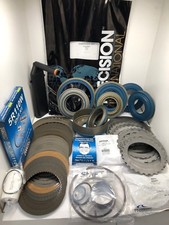
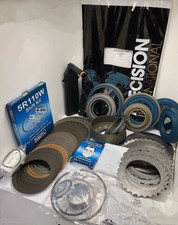
The 2003-2004 and 2005-2007 units take different intermediate and forward frictions, so the kit has to match what you identified. CoreTransmissionParts lists the deluxe kit by year range. Pick the one that matches your tag and teardown.
See the 2005-2007 kit at CoreTransmissionPartsNeed parts for this job?
Once you know the design level, our 5R110 parts page is sorted so you can order to it: master and overhaul kits split by 2003-2004, 2005-2007 and 2008-up, pumps, sun shells, planetaries, clutch drums, solenoid kits and valve bodies. Checkout is on site.
FAQ
How do I tell a 2003-2004 5R110W from a 2005 and later unit?
Count the intermediate clutch friction teeth: 24 teeth is a 2003-2004 unit and 96 teeth is 2005-up. The forward frictions also changed from 90 to 76 teeth, and the 2005-up sun shell has a 55 tooth sun gear with the retaining snap ring hidden on the back. The early shell has 42 teeth and a visible snap ring.
Where is the build date on a 5R110W tag and how do I read it?
The tag lists the assembly part number with its prefix and suffix, the transmission model, a serial number and the build date. The build date is written day, month, year, so 180302 means 18 March 2002. Go by that date rather than the model year, because some changes, like dropping the pressure switches in late 2004, happened partway through a year.
How do I identify a 5R110W pump generation?
Sonnax documents three generations. Gen. 1 (2003-2004) has RF3C3P-7B324 casting numbers. Gen. 2 has RF5C3P-7B324 and an Al11Si3Cu mark on the cover. Gen. 3 (2008-later) has the same castings as Gen. 2 plus a 9C3P-7A103-AC number near the pump body bolt circle.
Is the 5R110W different in gas and diesel trucks?
From 2007, yes. Transmission Digest reports that the overdrive one-way clutch comes in a gas version with two teeth missing and a diesel version with the full set of teeth, and Ford released four packages depending on engine and PTO. Count the teeth on the part you pulled instead of going by the truck.
What fluid does a 5R110W use?
It was released on MERCON SP, which is not interchangeable with MERCON or MERCON V. Ford's current ATF chart lists the 5R110 TorqShift under MERCON LV and authorizes back-servicing with MERCON LV for a complete refill and top-off.
Related guides
- 5R110W Rebuild Cost and What Drives It
- 5R110W Rebuild Wear Points
- 5R110W vs 4R100 Differences
- 5R110W Shift Solenoid Symptoms
- 6R140 vs 5R110W Differences
Sources
- ATSG, "Ford 5R110W (TorqShift)" technical manual (2004). Backs the tag fields and the DD MM YY build date format, the solenoid body contents and connector colors, the 4.1-4.7 ohm shift solenoid resistance, the 2005 changes to the intermediate frictions (24 to 96 tooth), forward frictions (90 to 76 tooth), forward steel and backing plate diameters, sun shell (42 to 55 tooth, snap ring, 1/8 inch taller), forward carrier lube dam and forward clutch housing, the rear carrier redesign and retrofit rule, and the clutch clearances. ATSG manual (PDF)
- Sonnax, Transmission Report Vol. 6 No. 2 (June 2015), "5R110W Pump Problems & Variations." Backs the three pump generations and their casting IDs (RF3C3P-7B324, RF5C3P-7B324, 5C3P 7A105-AA, Al11Si3Cu, 9C3P-7A103-AC), the low-pressure reason for the Gen. 1 redesign, and the Gen. 3 cover notch that protects the low diode at -35°F. Sonnax report (PDF)
- Sonnax, "5R110W Pressure Switches Notice" and "5R110W Solenoid Identification & Functions." Backs the one or five pressure switches on early bodies, their removal in late 2004, late bodies working in early applications with the switch wiring left disconnected, SSM 17614, and the solenoid names and functions. sonnax.com (switches) and sonnax.com (solenoids)
- Transmission Digest, Mike Riley, "5R110W Upgrades." Backs the 2005 front planetary tooth counts and package 5C3Z-7A398SA, the gas and diesel lube dam note, the 2007 gas and diesel OD one-way clutch split and four packages, the late 2008 rear planet change with 9C3Z-7D006B and 9C3Z-7D006AB, and checking stack-up when mixing parts. transmissiondigest.com
- GEARS magazine (ATRA), Jarad Warren, "Ford 5R110: Money in Your Pocket." Backs identifying the solenoids by the position of the ID mark on the snout and the approximately 4.5 ohm check. gearsmagazine.com
- Ford Customer Service Division, Motorcraft automatic transmission fluid quick reference chart. Backs MERCON LV for the 5R110 TorqShift and Ford's authorization to back-service with MERCON LV. Ford ATF chart (PDF)