These two units share a driveway more often than they share a shop bench. Somebody's 2012 Silverado has a 6L80 in it, their neighbor's 2021 has a 10L80, and both trucks look identical from ten feet away. Inside, they have almost nothing in common. Different gear count, different fluid, different clutch control philosophy, different control module location, and a completely different set of things that go wrong.
The 6L80 has been in GM's rear-drive line since 2006. The 10L80 arrived in the 2017 Camaro ZL1, spread to the Tahoe, Suburban, Escalade and Yukon Denali for 2018, and became the V8 truck transmission in the Silverado and Sierra 1500 from 2019 on. It is the GM half of a joint program with Ford, whose version is the 10R80, and the two are physically the same transmission with different electronic controls.
Here is the builder-to-builder breakdown: the numbers, the hydraulics, the failures, and the honest answer on interchange.
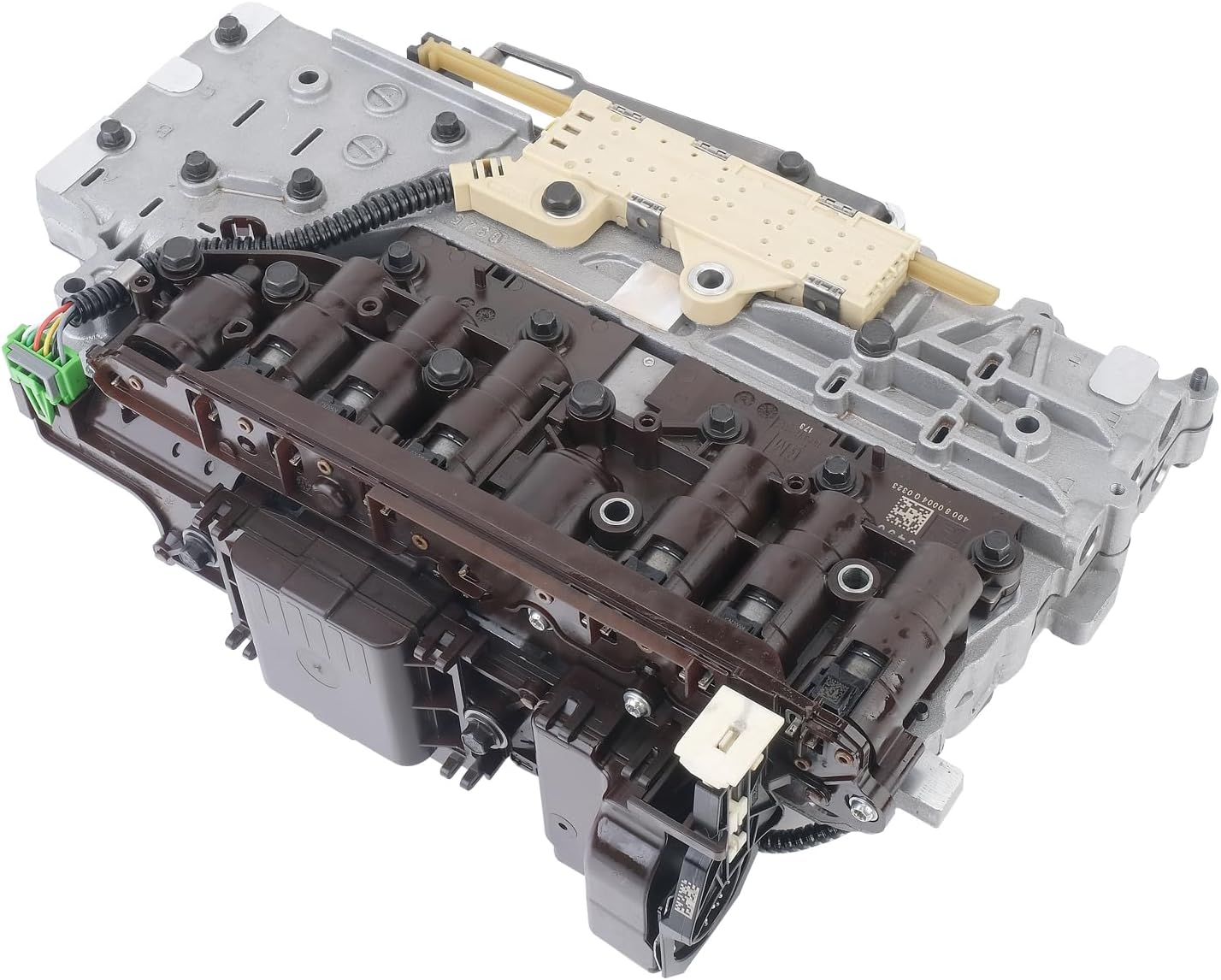
The Numbers, Side by Side
Fluid type and service capacity below come straight from GM's own 2025 Transmission Capacities and Fluids chart. Everything on that chart for the 10L80 — RPO MQB, MQC, MHT, MI2, MHS and MHU across Silverado 1500, Sierra 1500, Tahoe, Suburban, Yukon, Escalade, CT4 and CT5 — lists the same 7.7 L / 8.1 qt service fill and the same DEXRON ULV fluid.
| Spec | 6L80 | 10L80 |
|---|---|---|
| Speeds | 6 | 10 |
| First gear | 4.02 | 4.70 |
| Top gear | 0.67 (6th) | 0.64 (10th) |
| Full ratio set | 4.02 / 2.36 / 1.53 / 1.15 / 0.85 / 0.67 | 4.70 / 2.99 / 2.15 / 1.80 / 1.52 / 1.28 / 1.00 / 0.85 / 0.69 / 0.64 |
| Reverse | 3.06 | 4.87 |
| Ratio spread | 6.04 | 7.39 |
| Overdrive ratios | 2 (5th, 6th) | 3 (8th, 9th, 10th) |
| Fluid | DEXRON VI | DEXRON ULV |
| Service fill (GM chart) | 6L90 listed at 5.7 L / 6.0 qt | 7.7 L / 8.1 qt |
| Control module | TEHCM inside the pan | External TCM, out of the fluid |
| Solenoid count | 7 in the TEHCM | 8 pressure-regulating, plus a default disable on-off |
| Clutch control | Clutch control valve per clutch, checkballs | Gen 1: latch valves. Gen 2: feed limit low/high plus boost balls |
| Ford counterpart | None | 10R80, physically identical |
| Max input torque (published) | 440 lb-ft | ~800 Nm (~590 lb-ft) nominal |
The ratio spread is where the ten-speed earns its name. A 7.39 spread against the 6L80's 6.04 means a numerically deeper 4.70 first gear for launch and a taller 0.64 tenth for cruise, with far smaller steps in between. Three overdrive ratios instead of two is not a marketing line; it is why the same 5.3L truck turns several hundred fewer rpm at 70 mph with the ten-speed behind it.
On raw torque capacity, be careful with the numbers floating around. GM does not publish a clean retail input torque figure for the 10L80 the way it does for its crate and industrial units. The commonly cited nominal figure is roughly 800 Nm, about 590 lb-ft, against the 6L80's long-published 440 lb-ft input rating. Directionally the ten-speed is the stronger unit. It is not in a different class, and it is nowhere near a 10L1000, which GM fills with 13.6 L / 14.4 qt against the 10L80's 7.7 L.
Fluid: These Are Not Interchangeable
This is the first thing to get right and the most common way somebody ruins a good ten-speed. The 6L80 family runs DEXRON VI. The 10L80 runs DEXRON ULV, an ultra-low-viscosity fluid GM introduced alongside the ten-speeds. GM's capacities chart lists DEXRON ULV for every single 10L80 RPO across the entire lineup, and DEXRON VI for the 6L family in the same document.
The reason matters more than the label. The 10L80's clutch regulating solenoids are linear-force units with an individual pin that contacts the regulating valve directly. There is no conventional solenoid feed circuit behind them the way there is on a 6L80. Clutch apply timing is a function of how that solenoid pin strokes the valve against a specific fluid viscosity. Put DEXRON VI in a ten-speed and every apply and release event lands late, the TCM's adapts chase a target they cannot reach, and the customer comes back with harsh shifts and a shudder that everybody wants to blame on the converter.
Neither unit has a dipstick. Both are set at a level plug with the fluid inside a specific temperature window from the service procedure. Do not eyeball it and do not set it cold. On the 10L80 in particular, being a quart high or low changes shift feel enough that people go chasing valve body problems that do not exist.
How They Apply Clutches: The Real Difference
6L80: conventional clutch control valves
The 6L80 does what a six-speed of its era does. Solenoid pressure acts on a clutch control valve, the valve regulates line pressure into the clutch circuit, and checkballs and a separator plate route the rest. All of the electronics live in the TEHCM, a module that sits in the pan with the solenoids attached to it, submerged in fluid. When a 6L80 has a shift complaint, you are usually chasing a worn valve bore, a checkball out of position, a plate or gasket problem, or the TEHCM itself.
The bore that fails most is the pressure regulator. Sonnax describes what wear there produces: erratic line pressure, high line pressure, low line pressure, clutch slippage, harsh shifts, low or no cooler flow, burnt clutches, overheating and converter concerns. For years the fix required drilling the pump to restore control. Sonnax has since revised the 6L45/6L50/6L80/6L90 pressure regulator valve kits so the drop-in kit 104520-15K no longer needs pump drilling, with oversized kit 104520-16K available when the bore itself has to be reconditioned.
10L80 Gen 1: latch valves
The first-generation 10L80, built through late 2019, kept the latch valve for clutch control. Apply starts when the linear-force solenoid strokes the regulating valve behind it and pressure feeds the latch valve between spools B and C. That pressure backs up on spool C, which is larger than spool B, and pushes the valve left, regulating apply pressure through a narrow passage. Once inlet pressure overcomes the spring, the latch valve pins fully left and connects full line pressure to the clutch.
That extra valve is one more bore to wear. Sonnax lists a latch valve stem repair kit (105740-47K) for burnt clutches and shift concerns tied to circuit pressure loss, plus an oversized latch valve kit (105740-71K) when the bore is beyond a drop-in.
10L80 Gen 2: feed limit valves and boost balls
GM deleted the latch valves in late 2019. Sonnax calls this the second generation. Gen 2 valve bodies use two new valves — feed limit low and feed limit high — working with a new clutch control circuit built around checkballs referred to as boost balls, which act like a bathtub checkball but sit in a normal pocket.
The numbers are specific and worth memorizing. The feed limit low valve output feeds below the number 5 boost ball. Below 120 psi line pressure the ball seats against the separator plate and the clutch control valve position is governed by a triple orifice acting on the regulating spool. Above the 119 psi limit spec the ball unseats, and the clutch control regulating valve moves right much more quickly. That is the entire clutch regulation strategy on a Gen 2 ten-speed, and it depends on the feed limit low valve holding pressure.
The Feed Limit Low Valve: The Recall You Need to Know
This is the defining 10L80 failure and it is not a rumor, it is a federal safety recall. NHTSA campaign 25V148000, GM number N242480630, covers certain 2019-2020 Cadillac CT6, 2020-2021 CT4 and CT5, and 2020-2022 Chevrolet Camaro vehicles with the ten-speed. NHTSA's own language: the transmission may become damaged internally and cause the wheels to lock up. The remedy is transmission control module monitoring software, free of charge, with owner letters mailed April 7, 2025.
The mechanism is worth understanding because the software does not fix it. The feed limit low valve does double duty. Besides sitting in the boost ball circuit, it acts as a limit valve for solenoid feed to the default disable (DD) on-off solenoid. The DD solenoid controls the default enable and default select valves in the upper valve body. It is always powered on and only drops out on a default event. When it is off, those two valves route line pressure into the exhaust backfill circuit and apply the A, B, C and D clutches through the exhaust ports, which is second gear — that is the power-down default drive strategy.
Now wear the feed limit low valve. Solenoid feed to the DD solenoid drops. The two default valves can no longer be held in check, and depending on what gear is commanded, the unit either falls into a lower gear or binds up. The classic complaint is a vehicle shifting up into seventh or eighth and suddenly dropping to second, or the drive wheels momentarily trying to lock. It is heat-dependent: most of these units behave normally until they are hot. The stored code is usually P0747, which is telling you the E clutch is on when it should be off.
Two things a builder needs to take from that. First, wear can happen early — Sonnax reports 10L1000 units in tow-truck and heavy-trailer service wearing the feed limit low valve out in as few as 35,000 miles. Second, do not keep driving one. Extended operation in that condition will destroy clutch packs, because the unit is intermittently binding up.
How to test it on the bench
Vacuum test the balance end of the feed limit low valve. That is the location that wears. Feed limit low and feed limit high are the same valve train with different springs, so their readings should match each other. A healthy bore reads 18 in-Hg or higher. If the low reads under that, Sonnax offers drop-in feed limit low valve kit 105740-54K and feed limit high kit 105740-58K. If the bore tests below 8 in-Hg, a drop-in will not make up the difference and you want the oversized kits, 105740-59K and 105740-60K, with the tooling to recondition the bore.
Sonnax Feed Limit Low Valve Kit 105740-54K (10L80)
The drop-in kit for the exact bore behind the wheel-lockup recall and P0747. Restores feed limit low valve function and resists future wear in Gen 2 10L60/80/90 and 10L1000 valve bodies.
View the 105740-54K kit →Solenoids and Programming: Do Not Skip This
The 10L80 will punish you for treating solenoids like a 6L80. There are eight pressure-regulating solenoid valves. Solenoids 1 through 6 are normally-low linear units handling shifts and regulated line-pressure clutch control — with the solenoid off, pressure strokes the clutch control valve and lets controlled line pressure into the apply circuit; energized, the control valve stays put and line pressure is blocked. Solenoid 7 is the line pressure solenoid, a normally-high variable force unit. Solenoid 8 is the TCC solenoid, normally low, variable force. A practical consequence: unplug a ten-speed and it has no movement at all, because these solenoids only produce clutch pressure with current.
Solenoids 1, 2, 3 and 6 use a four-land regulating valve. Solenoids 4 and 5 use a five-land valve. They all work the same way but carry different part numbers for different flow rates, so they must go back in their original locations.
The programming requirement is the part that bites shops. Every solenoid valve is flow-tested after assembly at set electrical values, increasing and then decreasing current, and those current-versus-pressure data points are saved to a file number marked on the solenoid housing or the valve body. That file lives on GM's Techline Information System and is programmed into the TCM. If you replace the transmission assembly, the lower control valve body with solenoids, the TCM, or even one solenoid, the TCM has to be programmed with the correct solenoid performance data. Skip it and you have built yourself a shift complaint.
One more bench note: the ten-speed valve bodies use casting-integrated, direct-acting solenoids held in place with retainer clips. Check them for bore tightness while you are in there. Sonnax sells a solenoid stabilization clip insert (105740-01K) and retainer (105740-19K) specifically for loss of shift solenoid control pressure and damaged valve body castings.
Interchange: The Short Answer Is No
People ask this because both units live behind an LS or LT in a rear-drive GM. It does not make them swappable. The blockers, in the order they will stop you:
- Fluid. DEXRON VI versus DEXRON ULV. Not a preference, a design parameter.
- Control. The 6L80 carries its module in the pan. The 10L80 uses an external TCM with solenoid performance data programmed to that specific valve body. There is no way to run one on the other's calibration.
- Converter and cooling. Different converter, different cooler circuit, different thermal management.
- Packaging. Different case, different mount location, different output. Measure for driveshaft length and crossmember position before you commit to anything, because the ten-speed does not drop into a six-speed's hole.
If you are putting a 10L80 behind an engine that never had one, you are doing a powertrain swap with a standalone controller, not a transmission swap. Budget accordingly. Internally, the split that matters is Gen 1 versus Gen 2 within the ten-speed family itself: Gen 1 has latch valves, Gen 2 has feed limit valves and boost balls, and valve body parts do not cross that line.
Need parts for this job?
Rebuild kits, valve body components, solenoids, filters and hard parts for both the 6L80 and the 10L80, organized by unit so you order the right thing the first time.
Shop 6L80 parts → Shop 10L80 parts →Shop 10L80 parts → Shop 6L80 parts →
Which One Do You Actually Want?
For a daily-driven truck, the 10L80 is the better transmission on every measure a customer feels: launch, cruise rpm, shift speed, fuel economy. The catch is that it is far less forgiving. It needs the right low-viscosity fluid, it needs correct solenoid programming any time you touch the control side, and it has a known valve-wear failure serious enough to trigger a federal recall.
The 6L80 is the simpler unit and the one with twenty years of aftermarket support behind it. Its failure list is conventional — pressure regulator bore wear, cracked 1-2-3-4 piston, cracked 3-5-R drum weld, stator support sealing rings, TEHCM problems — and every one of those has a well-known fix and a shelf full of parts.
If you are buying a used truck and you plan to tow with it, the honest advice is not "avoid the ten-speed." It is: find out whether that VIN has an open ten-speed transmission recall, get the software done, and if the unit is out of warranty and showing any hint of a hot-only downshift to second, vacuum test the feed limit valves before you spend money anywhere else.
FAQ
Is the 10L80 stronger than the 6L80?
On published figures, yes, but not by the margin the gear count suggests. The 6L80's long-published maximum input torque is 440 lb-ft; the 10L80 is commonly cited at roughly 800 Nm nominal, about 590 lb-ft. The bigger real-world gain is the 7.39 ratio spread against 6.04, which keeps the engine in its band under load. If you need genuinely heavy-duty capacity, neither is the answer, and that is what the 10L1000 exists for: GM fills it with 14.4 quarts against the 10L80's 8.1.
Can I use DEXRON VI in a 10L80?
No. GM's 2025 transmission capacities chart lists DEXRON ULV for every 10L80 application across Silverado, Sierra, Tahoe, Suburban, Yukon, Escalade, CT4 and CT5. DEXRON VI is the 6L family fluid. The ten-speed's linear-force solenoids contact the clutch regulating valves directly and are calibrated around ULV viscosity, so a heavier fluid changes apply timing and shows up as harsh shifts and converter shudder.
Will a 10L80 bolt in place of a 6L80?
Not as a bolt-in. The two use different fluid, different control architecture (in-pan TEHCM versus an external TCM with solenoid performance data programmed to that specific valve body), a different converter and cooler circuit, and different packaging. A retrofit is a powertrain swap with a standalone controller, driveshaft work and crossmember work, not a transmission swap.
What causes a 10L80 to drop into second gear or lock the wheels?
Wear in the feed limit low valve bore. That valve limits solenoid feed to the default disable solenoid, which holds the default enable and default select valves. When feed pressure drops, those valves can route line pressure into the exhaust backfill circuit and apply the A/B/C/D clutches, which is second gear, or bind the unit. It is usually heat-dependent and typically sets P0747. GM's remedy under recall N242480630 (NHTSA 25V148000) is TCM monitoring software that limits the unit to fifth gear once it detects the wear, but the software does not repair the bore.
How do I know if I have a Gen 1 or Gen 2 10L80 valve body?
By clutch control design. Gen 1, built through late 2019, uses latch valves for clutch apply, the same approach Ford kept on the 10R80 and 10R140. Gen 2, from late 2019 on, deletes the latch valves and adds the feed limit low and feed limit high valves working with boost checkballs. Valve body repair parts do not cross between the two, so identify the generation before ordering anything.
Do I have to program the TCM after replacing 10L80 solenoids?
Yes. Each solenoid is flow-tested at the factory and its current-versus-pressure data points are saved under a file number marked on the solenoid or valve body, stored on GM's Techline Information System and programmed into the TCM. Replacing the transmission, the lower valve body with solenoids, the TCM, or even a single solenoid requires programming the correct solenoid performance data. Solenoids also must go back in their original locations, since they carry different part numbers for different flow rates.
Related Guides
- GM 10L80 Problems and the Valve Body Recall
- 10L80 Shift Solenoid Symptoms and Testing
- 10L80 vs 10L90: What Actually Changes
- 6L80 vs 8L90: Differences and Interchange
- 6L80 Valve Body Problems and Bench Testing
Sources
- General Motors — TechLink "Transmission Capacities & Fluids" chart (2025). GM's own service chart listing DEXRON ULV and a 7.7 L / 8.1 qt service fill for every 10L80 RPO (MQB, MQC, MHT, MI2, MHS, MHU) across Silverado 1500, Sierra 1500, Tahoe, Suburban, Yukon, Escalade, CT4 and CT5; DEXRON VI for the 6L family (6L90 RPO MYD at 5.7 L / 6.0 qt); and 13.6 L / 14.4 qt DEXRON ULV for the 10L1000. gm-techlink.com (PDF)
- NHTSA — Part 573 Safety Recall Report, campaign 25V148000 (GM recall N242480630). Certain 2019-2020 Cadillac CT6, 2020-2021 CT4 and CT5, and 2020-2022 Chevrolet Camaro vehicles with a 10-speed transmission; defect described as the transmission becoming damaged internally and causing the wheels to lock up; remedy is transmission control module monitoring software installed free of charge, with owner letters mailed April 7, 2025. static.nhtsa.gov (PDF)
- Sonnax (Jim Dial, TASC Force) — "Understanding the '19-Later GM 10-Speed Safety Recall." The feed limit low valve as the wear point behind the recall; its dual role limiting solenoid feed to the default disable solenoid; the default enable and default select valves applying the A/B/C/D clutches through the exhaust backfill circuit in second gear; heat-dependent drop from 7th or 8th to 2nd and momentary wheel lockup; DTC P0747; feed limit low wear in as few as 35,000 miles on heavy-duty 10L1000 service; vacuum test of the valve's balance end with an 18 in-Hg or higher target and an 8 in-Hg threshold for going oversized; kits 105740-54K, 105740-58K, 105740-59K and 105740-60K. sonnax.com
- Transmission Digest — "Clutch regulating valves in GM 10-speeds: What you need to know" (Jim Dial). Gen 1 ten-speeds retaining the latch valve for clutch control and how it strokes on the spool B/C area difference; GM deleting latch valves in late 2019 for the Gen 2 design; the feed limit low and feed limit high valves and the boost checkball circuit; the number 5 boost ball seating below 120 psi and unseating above the 119 psi limit spec, and what that does to clutch control valve movement. transmissiondigest.com
- Transmission Digest — "10R80/10L90 10-Speed Solenoid Function." Solenoids 1 through 6 as normally-low linear units for shift and regulated line-pressure clutch control; solenoid 7 as the normally-high line pressure VFS and solenoid 8 as the normally-low TCC VFS; four-land regulating valves on solenoids 1, 2, 3 and 6 versus five-land on 4 and 5; different part numbers per flow rate requiring original locations; and the requirement to program the TCM with solenoid performance data (stored on GM's Techline Information System) after replacing the transmission, the lower valve body with solenoids, the TCM or any solenoid. transmissiondigest.com
- Sonnax — "6L80 Series Pressure Regulator Valve Kits — Now, No Drilling Required!" The 6L45/6L50/6L80/6L90 pressure regulator bore as the chronic wear location, with symptoms including erratic, high and low line pressure, clutch slippage, harsh shifts, low and no cooler flow, burnt clutches, overheated transmission and converter concerns; the revised drop-in kit 104520-15K eliminating the previous pump-drilling step, and oversized pressure regulator and boost valve kit 104520-16K for reconditioning the bore. sonnax.com