Somewhere around the 2015 model year, GM's rear-drive truck line quietly split in two. The 6L80 had been the default six-speed behind small blocks since 2006, and then the 8L90 showed up in the same trucks, the same body styles, sometimes the same trim level with a different engine. Ten years later both units are on shop benches every week, and the questions are always the same three: which one is actually stronger, does anything interchange, and why does the eight-speed feel so different when it goes bad.
The honest answer to the first question surprises most people. On GM's own published numbers, the 8L90 is not a dramatic step up in torque capacity. It is a step up in ratio spread, shift speed and weight, with a completely different hydraulic control philosophy that fails in its own particular ways. Here is the builder-to-builder breakdown, with the real numbers.
Related reading: our 6L80 vs 6L90 comparison and 8L90 pressure testing guide.
The Numbers, Side by Side
The 8L90 figures below come straight off GM's own specification listing for the unit (RPO AH2R, N8X ratio set). The 6L80 figures are the long-published GM ratings for RPO MYC.
| Spec | 6L80 (RPO MYC) | 8L90 (RPO AH2R / M5U) |
|---|---|---|
| Speeds | 6 | 8 |
| First gear | 4.02 | 4.56 |
| Top gear | 0.67 (6th) | 0.65 (8th) |
| Full ratio set | 4.02 / 2.36 / 1.53 / 1.15 / 0.85 / 0.67 | 4.56 / 2.97 / 2.08 / 1.69 / 1.27 / 1.00 / 0.85 / 0.65 |
| Reverse | 3.06 | 3.82 |
| Ratio spread | 6.04 | 7.0 |
| Max engine torque | 440 lb-ft (input) | 460 lb-ft |
| Max gearbox / output torque | 664 lb-ft | 665 lb-ft (900 Nm) |
| Weight | ~195 lb dry | 218 lb (98.9 kg) |
| Fluid | DEXRON VI | DEXRON ULV (vehicle) / DEXRON HP (GM crate listing) |
| Fluid capacity | ~10–13 qt dry fill | 10.3 L |
| Converter | Application specific | 258 mm, 2-path ECCC, turbine damper |
| Control solenoids | TEHCM in pan | 2 on-off + 6 variable force (one per clutch, one TCC) |
| Case | Cast aluminum, removable bell | Die cast aluminum, 2-piece main, bell integrated |
| Thermal bypass valve opens | 158 F (70 C), external | 194 F (90 C), external |
| Max shift speed | — | 6000 rpm |
Look at the torque rows again. GM rates the 8L90 at 665 lb-ft maximum gearbox torque against the 6L80's 664 lb-ft output. That is a rounding difference, not a design leap. The 8L90 gains 20 lb-ft on the input side and it will carry a GCVW up to 22,500 lb, but anyone expecting the eight-speed to be a heavy-duty replacement for a six-speed is reading the marketing, not the spec sheet. If you want more output torque out of a GM rear-drive automatic of this era, the 6L90 is the unit that jumps, not the 8L90.
What GM Actually Bought With Two More Gears
The 8L90 uses four gearsets and five clutches, and GM packaged it to fit essentially the same envelope as the 6L80 and 6L90 family. The payoff is the 7.0 overall ratio spread against the 6L80's 6.04. That buys two things at once: a numerically steeper 4.56 first gear for launch, and a 0.65 top gear for cruise, without the huge rpm holes between gears that a six-speed has to live with. Smaller steps between ratios mean the engine spends more time in its efficient band, which is the entire reason the unit exists.
The second real gain is shift speed. GM's converter and clutch-to-clutch strategy in the 8L90 produces shifts substantially quicker than the 6L80, and the unit does it while weighing about the same. That quick clutch-to-clutch shifting is also exactly why the 8L90 is so unforgiving about hydraulic control, which is where the next section lives.
Different control philosophy
This is the difference that matters most on the bench. The 6L80 concentrates its electronics in the TEHCM, a control module that sits inside the pan and carries the solenoids with it. The 8L90 runs a control solenoid valve body with two on-off solenoids for shift pattern plus six variable force solenoids for shift quality, one for each clutch and one for the converter clutch, and a torque converter clutch controlled by a variable force solenoid running a two-path ECCC converter with a turbine damper.
Practically speaking: on a 6L80 you are usually chasing a valve, a checkball, a separator plate or the TEHCM. On an 8L90 you are chasing a low-flow solenoid signal circuit and the control valve it feeds, and the two failures look nothing alike on a scan tool.
Fluid: The Mistake That Kills 8L90s
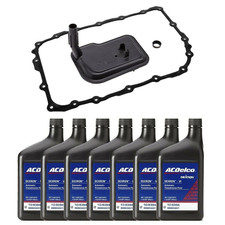
These two units do not share fluid, and this is not a preference argument. The 6L80 runs DEXRON VI. The 8L90 in GM vehicle applications runs the low-viscosity DEXRON ULV; GM's own crate and industrial listing for the 8L90 specifies DEXRON High Performance ATF at a 10.3 liter capacity. ATRA's Gears coverage of the unit is blunt about it: all generations require the correct low-viscosity fluid, and incorrect fluid causes harsh shifts, converter clutch shudder and overheating.
The mechanism is straightforward once you understand the control system above. The 8L90 leans on six variable force solenoids feeding small signal circuits to stroke the clutch control valves. Those circuits are calibrated around a specific fluid viscosity. Put a heavier fluid in and the signal circuits respond differently, apply timing drifts, and the TCM's adaptive tables chase a target they cannot hit. The customer feels a harsh 1-2, a 2-1 clunk on deceleration, and a shudder that everyone wants to blame on the converter.
If you take in an 8L90 with a shudder or harsh shift complaint and no history, verify the fluid before you pull anything. A correct fluid exchange has resolved a meaningful number of these complaints outright.
Cooling: The Spec Nobody Checks
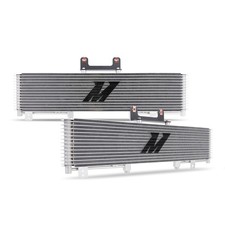
Here is a genuinely useful difference that almost never gets mentioned. Per GM Service Bulletin 22-NA-182 (March 2024), which covers the 6L80, 6L90, 8L90, 10L80, 10L90 and 10L1000 together, the thermal bypass valve open temperatures are not the same across the family:
- 6L80 / 6L90: TBV opens at 158 F (70 C), external to the transmission
- 8L90: TBV opens at 194 F (90 C), external to the transmission
- 10L80 / 10L90 / 10L1000: 143 F (61 C), inside the valve body on most applications
That is a 36-degree difference between the six-speed and the eight-speed before fluid is routed to the cooler. An 8L90 that reads hotter than the 6L80 the customer used to own is very often behaving exactly as designed. Before you chase an overheat complaint into the transmission, the same bulletin says to inspect for a twisted rubber cooler line, which shows up on low mileage vehicles and can set DTC P27EC in the TCM on ETRS units (RPO MHS, MQC). Untwist it, or replace it if it stays misshaped, then set fluid level per the service procedure.
8L90 Master Rebuild Kit with Clutches & Steels
If the eight-speed is coming apart, this is the kit that covers it: frictions, steels, gaskets, seals and pistons for the GM 8L90 in one box. In stock and shipping from the USA.
View the 8L90 master kit →Failure Patterns: They Break Differently
8L90: signal accumulator wear and runaway line pressure
The chronic 8L90 complaint is shift quality, and Sonnax traces it to wear in the signal accumulators of the control solenoid valve body. Each of the seven variable force solenoid circuits carries a small signal accumulator piston whose job is to damp pressure and flow instability so the related clutch control valve behaves. Those pistons are very active and they wear the cast aluminum bore they live in. Because the solenoids are low flow, any signal fluid lost through that wear path has an outsized effect on the control valve downstream. Sonnax reports the S3 and S4 locations are generally the worst.
This is the single most misdiagnosed thing on the unit. GM does not sell the solenoids separately, and swapping one from a core would corrupt the PUN flow-rate programming the TCM uses, so shops default to replacing the whole valve body on any shift or solenoid code. Check the signal accumulator bores first. They vacuum test easily, and Sonnax's guidance is to test with the spring still in the piston and the test port centered in the spring. Whatever you repair, reset the adaptive tables and run a relearn afterward or the shift complaint comes right back.
The second 8L90 failure is nastier because it destroys parts. Sonnax has documented cracks in the worm tracks of 8L45 and 8L90 valve bodies caused by line pressure that simply goes too high. Line pressure on these units should peak around 315 psi, but Sonnax evaluations have measured pressures above 415 psi. The cause is a worn pressure regulator valve lineup combined with a line pressure blow-off spring calibrated too high, over 400 psi in some cases. Excessive leakage at that valve keeps it from stroking to the low-pressure position, and once you have runaway line pressure it can crack the valve body casting outright or shatter a drum. A cracked worm track cannot be repaired; the valve body is scrap. Sonnax's recommendation is to replace the pressure regulator lineup and the blow-off spring every single time you rebuild one of these valve bodies, and to target a 300–315 psi maximum.
6L80: valves, plates and the TEHCM
The 6L80 fails in more conventional places. No-movement and no-Reverse complaints trace to an out-of-place number 5 checkball, an incorrect valve body separator plate or gasket, an improperly indexed snap ring, cracked welds in the 3-5-R drum, a stuck 3-5-R clutch regulator valve, or a TEHCM problem.
Useful numbers for the bench: on a 6L80, a TEHCM line pressure solenoid stuck in exhaust mode gives no line pressure rise at all, with pressure stuck around 60–68 psi and no rise with rpm. Unplugged reads the same. A missing pressure regulator boost valve retaining pin shows up as pressure at or below 30 psi at idle with abnormal movement. A missing pump pressure relief ball and spring, which turns up occasionally in rebuilt pumps, is no movement and no line pressure at all.
Separator plates are their own trap on the 6L80. A Type 2 plate on a Type 1 valve body gives no Forward; a Type 1 plate (#24245720, seven checkballs) on a Type 2 valve body gives no 3rd and no Reverse. In both cases line pressure reads normal, which is what sends people down the wrong road. Early Type 1 valve bodies cannot be updated to the later eight-checkball plate.
Interchange: The Short Version
No, an 8L90 is not a bolt-in for a 6L80. GM packaged the eight-speed to occupy roughly the same space in the vehicle, which is why the two appear in the same trucks across model years, but that is a packaging statement, not an interchange statement. The 8L90 uses a two-piece main case with the bell integrated into the main case where the 6L80 uses a removable bellhousing. It needs its own TCM programming, its own cooler circuit and thermal bypass valve, its own 258 mm converter, and a different fluid. Anyone doing this as a retrofit is doing a powertrain swap, not a transmission swap.
Inside the 8L90 family, interchange is also narrower than people assume. Per ATRA's Gears coverage, GM revised the stator support and cover for 2018 and up to purge air from the C5 circuit and cure delayed engagement and gear dropout (8L90 stator support #24277234, cover #24277964). The 2-3-4-6-8 clutch piston and retainers changed for 2018 as well, from piston #24259281 to #24283348, with different seal groove dimensions, so early and late seals cannot be mixed. The 1-2-7-8-Reverse return spring was strengthened for 2018 with identifying cutouts in two spring lugs and is not intended for backservice, because the TCM programming is matched to it. And the 1-3-5-6-7 clutch drum comes in two capacities identified by a QR code on the drum top: 8L90A carries four clutches, 8L90B carries five. Adding clutches beyond the OEM design hurts shift quality rather than helping it.
There is also a stator and input shaft split. Non-CPA units (gas engines without DFM) use a stator bushing riding a journal on the input shaft. CPA units (diesel and DFM-equipped, 2018 and up) delete the stator bushing and run a polished input shaft tip in the converter bushing, with a longer input shaft and a shorter stator. The two designs cannot be made to work together.
Which One Do You Actually Want?
If the question is durability behind a stock or mildly built small block in a half-ton truck, the two are closer than the gear count suggests, and the deciding factor is usually parts availability and how the unit was maintained. If the question is heavy towing or a high-torque build, neither of these is the answer; the 6L90's 885 lb-ft output rating is the reason it exists.
The 8L90 earns its keep on drivability and efficiency, not on torque headroom. The tradeoff is a hydraulic control system with much less tolerance for wrong fluid, worn signal accumulator bores or an out-of-spec pressure regulator. Maintain it with the right low-viscosity fluid, keep an eye on line pressure, and it will do its job. Neglect any of those three and it will let you know about it in a way the 6L80 never would.
Need parts for this job?
Rebuild kits, valve body components, solenoids, filters and hard parts for both the 6L80 and the 8L90, organized by unit so you order the right thing the first time.
Shop 6L80 parts → Shop 8L90 parts →Shop 6L80 parts → Shop 8L90 parts →
FAQ
Is the 8L90 stronger than the 6L80?
On GM's published numbers it is a narrow win, not a blowout. GM rates the 8L90 at 460 lb-ft maximum engine torque and 665 lb-ft maximum gearbox torque. The 6L80 is generally published at 440 lb-ft maximum input torque and 664 lb-ft output torque. So the 8L90 holds a slightly higher input rating and essentially the same output rating, while weighing 218 lb and carrying eight speeds instead of six. Where the 8L90 clearly wins is ratio spread and shift speed, not raw output torque.
Will an 8L90 bolt in place of a 6L80?
The 8L90 was packaged to occupy roughly the same space as the 6L80 and 6L90 in GM's rear-drive trucks and cars, so it is a common factory-level replacement across model years. It is not a plug-and-play swap in your driveway. The 8L90 uses a two-piece main case with the bell integrated into the main case, different electronic control and TCM programming, a 258 mm converter, its own cooler circuit and thermal bypass valve, and a different fluid. Treat it as a full powertrain swap with control and cooling work, not a bolt-in.
Can I run DEXRON VI in an 8L90?
No. The 6L80 uses DEXRON VI. The 8L90 in GM vehicle applications calls for the low-viscosity DEXRON ULV, and GM's own crate and industrial listing for the 8L90 specifies DEXRON High Performance ATF with a 10.3 liter capacity. These are not interchangeable. Running the heavier fluid in an 8L90 changes solenoid response and clutch apply timing and shows up as harsh shifts, converter clutch shudder and overheating.
Why does my 8L90 run hotter than my old 6L80?
Because GM set the thermal bypass valve much higher on the eight-speed. Per GM bulletin 22-NA-182, the external thermal bypass valve opens at 158 F (70 C) on the 6L80 and 6L90 but at 194 F (90 C) on the 8L90. The eight-speed is designed to run warmer before it sends fluid to the cooler. The same bulletin notes that a twisted rubber cooler line is a real cause of genuine overheating on low mileage vehicles, and can set P27EC on ETRS units, so inspect the lines before condemning the transmission.
What is the most common 8L90 valve body failure?
Wear in the signal accumulator bores of the control solenoid valve body. Each of the seven variable force solenoid circuits carries a small aluminum signal accumulator piston that damps pressure instability, and those pistons wear the cast aluminum bore they ride in. Sonnax reports the S3 and S4 locations are generally the worst. Because the solenoids are low flow, even small leakage past a worn bore has an outsized effect on the clutch control valve it feeds, which is why so many 8L90 shift complaints get misdiagnosed as bad solenoids.
Related Guides
- 6L80 vs 6L90: Differences, Interchange, and Which One You Have
- 4L60E vs 6L80: What Actually Changed
- 8L90 Pressure Testing: Ports, Specs and Procedure
- GM 8L90 / 8L45 Shudder and Harsh Shift: The Real Fix
- 6L80 TCC Shudder Diagnosis
Sources
- GM Powered Solutions — 8L90 8-Speed Automatic Transmission specifications. Official GM figures for the 8L90: 460 lb-ft max engine torque, 665 lb-ft max gearbox torque, the full N8X ratio set (4.56 through 0.65, reverse 3.82), 7.0 ratio spread, 218 lb weight, 258 mm converter, 10.3 L fluid capacity, DEXRON HP fluid, 6000 rpm max shift speed, 22,500 lb GCVW, two-piece main case with integrated bell, and the 2 on-off plus 6 variable force solenoid layout. poweredsolutions.gm.com
- General Motors Service Bulletin 22-NA-182 (March 2024), hosted by NHTSA. Thermal bypass valve open temperatures for the 6L80/6L90 (158 F / 70 C), 8L90 (194 F / 90 C) and 10L80/10L90/10L1000 (143 F / 61 C); twisted cooler line as a cause of overheating on low mileage vehicles; DTC P27EC on ETRS transmissions (RPO MHS, MQC). Supersedes PIP5792E. static.nhtsa.gov (PDF)
- Sonnax — "Watch Out for High Pressure in GM 8L45, 8L90 Valve Bodies" (April 2024). Cracked worm tracks in the valve body casting; line pressure should peak near 315 psi but has been measured above 415 psi; worn pressure regulator valve lineup and a blow-off spring calibrated over 400 psi as the root cause; recommendation to replace the PR lineup and blow-off spring at every rebuild and hold maximum pressure to 300–315 psi. sonnax.com
- Sonnax — "Diagnosing 8L45 & 8L90 Shift Complaints: Always Check the VFS Solenoid Circuits" (April 2021). The seven VFS solenoid circuits and their signal accumulator pistons; why low-flow signal loss has an outsized effect on the clutch control valves; S3 and S4 as the worst-wearing locations; vacuum test method with the spring in place; why GM does not sell the solenoids separately (PUN flow-rate programming). sonnax.com
- Sonnax — "GM 6L45/50, 6L80/90 No Movement Conditions: Analysis & Repair Tips" (March 2023). 6L80 bench numbers: line pressure stuck at 60–68 psi with no rpm rise from a TEHCM line pressure solenoid stuck in exhaust; 30 psi or less at idle from a missing pressure regulator boost valve roll pin; missing pump pressure relief ball and spring; and the Type 1 / Type 2 separator plate mismatches (plate #24245720, seven checkballs) that cause no Forward or no 3rd and no Reverse with normal line pressure. sonnax.com
- Gears Magazine (ATRA) — "8L90 Changes and Updates: They Are Not Created Equal." The 2018 stator support and cover revision for the C5 air purge (support #24277234, cover #24277964); the 2-3-4-6-8 clutch piston change from #24259281 to #24283348 with non-interchangeable seal grooves; the strengthened 2018-up 1-2-7-8-Reverse return spring; 8L90A four-clutch vs 8L90B five-clutch drums identified by QR code; the CPA vs non-CPA stator and input shaft split; and the requirement for the correct low-viscosity fluid. gearsmagazine.com