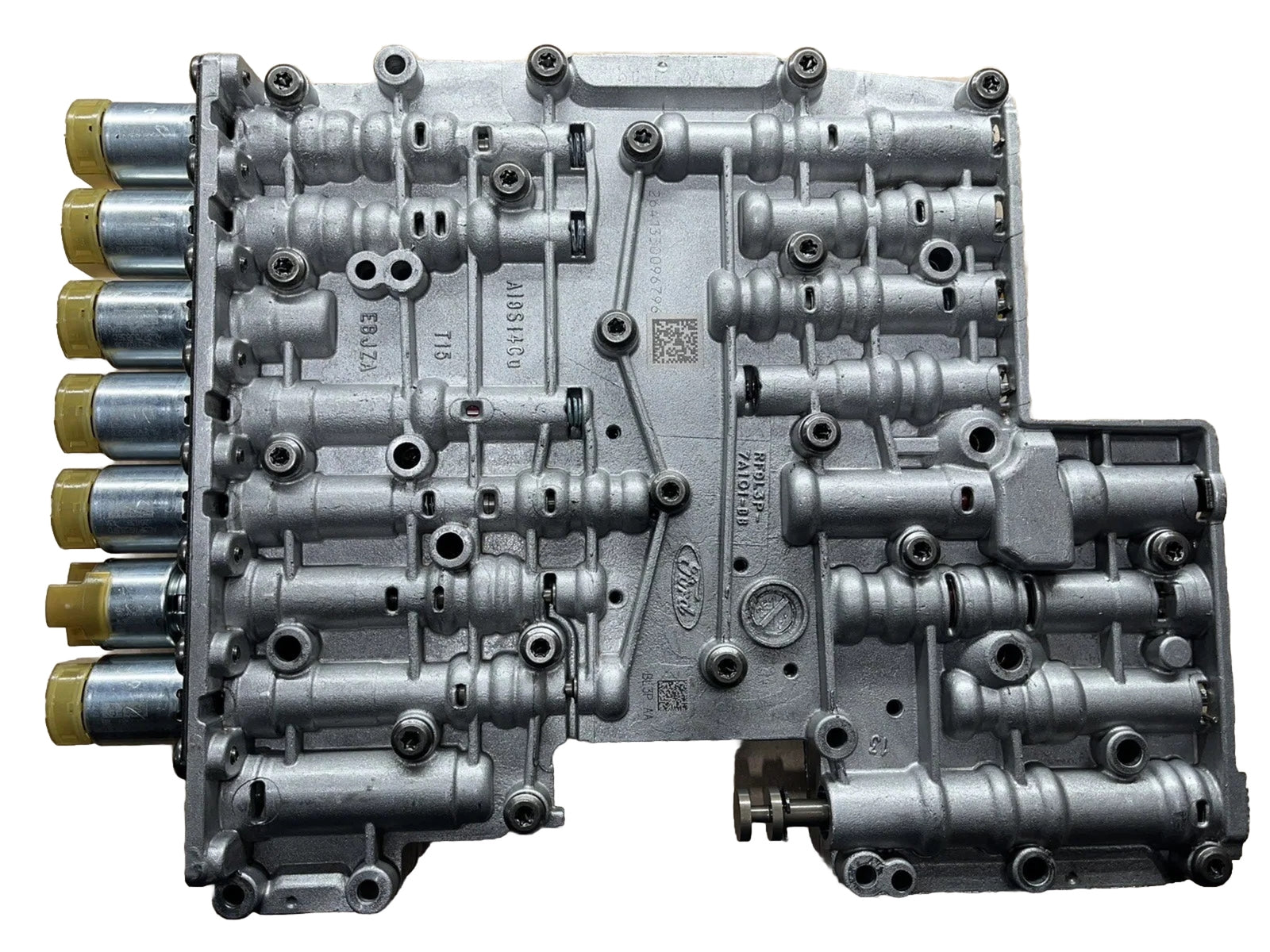
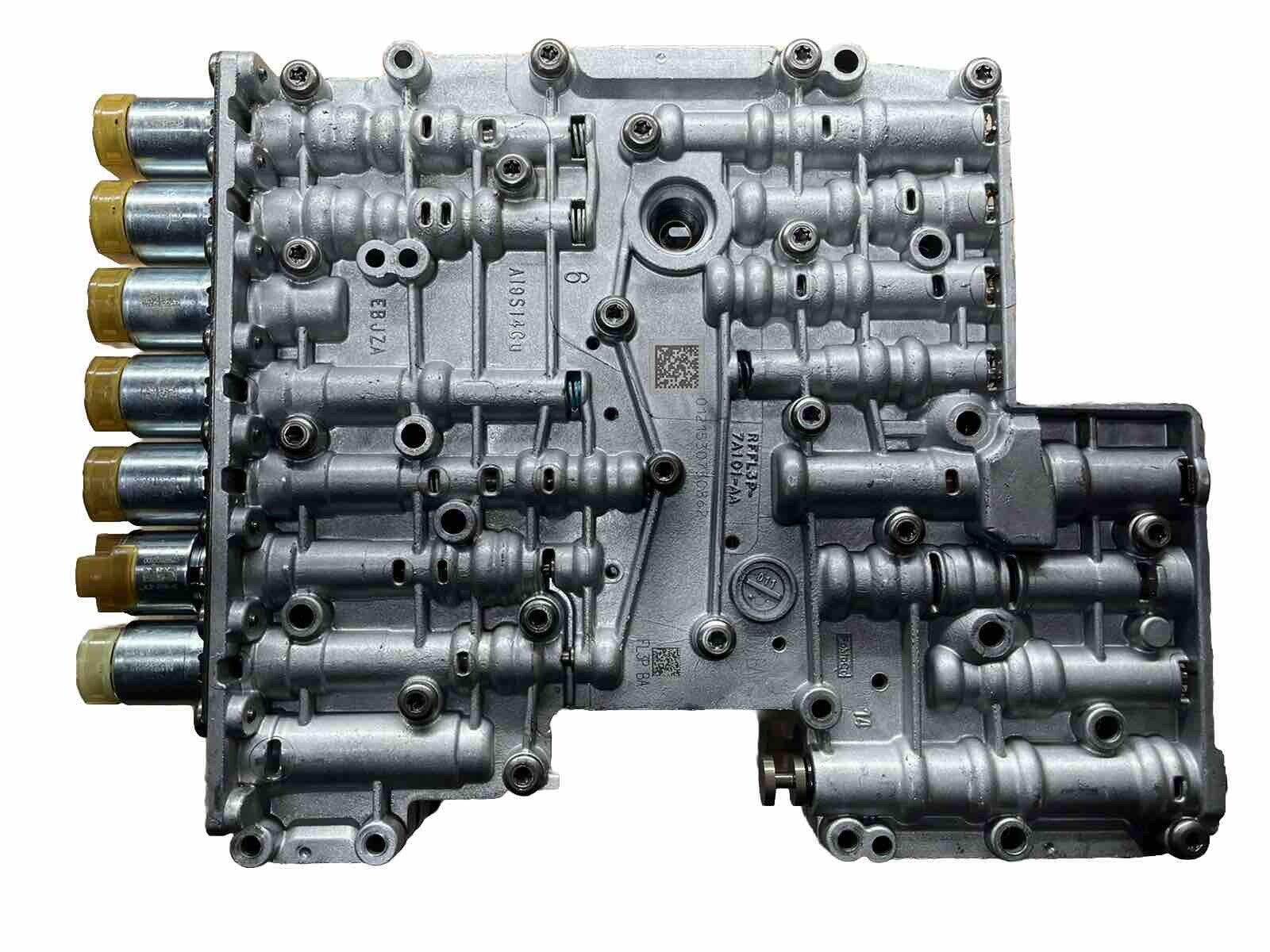
Set a 6R80 valve body on the bench next to a ZF 6HP26 valve body and you will have to look twice. Same general shape, same layout, same German valve names carried through the tech literature. Sonnax puts it plainly in its identification article: these units are all "very similar at first glance," and the slight differences that get overlooked are exactly what gets you in trouble during a rebuild.
That is the whole story of 6R80 vs ZF6HP. Ford did not clone the ZF unit and it did not design its own. It builds a licensed version of the ZF 6HP Generation 1 architecture, then layers its own castings, its own solenoids, its own separator plates, and its own fluid spec on top. So parts look like they should cross, some do, and the ones that do not will cost you a comeback. Here is what actually differs, what interchanges, and how to sort the two apart before you order anything.
The Short Version
| Item | ZF6HP (Gen. 1) | Ford 6R60 / 6R75 / 6R80 |
|---|---|---|
| Family members | 6HP19, 6HP26, 6HP32 | 6R60, 6R75, 6R80, 6R100 |
| Casting design | E-shift or M-shift | M-shift only |
| Casting marking | Number begins with 1068 | "FoMoCo" or "Ford" cast in |
| Separator plate ID | A/B codes, A035/B035 through A053/B053 | E510F early, then AL3P / CL3P / FL3P |
| Solenoid connectors | Blue and yellow EDS (Gen. 1) | Brown/black early, cream 2010-later |
| Factory fluid | ZF LifeguardFluid 6 | MERCON LV |
| Typical applications | BMW, Jaguar, Land Rover, Audi, VW | F-150, Mustang, Explorer, Expedition, Transit |
Where the Shared Architecture Actually Ends
Sonnax groups the ZF6HP19, ZF6HP26 and ZF6HP32 together with the Ford 6R60, 6R75 and 2009–2014 6R80 as one identification bucket, Generation 1, and puts the ZF6HP21, 6HP28 and 6HP34 in a second bucket, Generation 2. That grouping is the useful mental model. A 2010 F-150 6R80 sits in the same valve-component family as a 6HP26 out of a BMW. A 6HP28 out of a later Jaguar does not.
You can see the shared DNA in the valve names. Sonnax lists the OE valve names for this group in ZF's German shorthand: SYS.DR-V for the pressure regulator valve, WK-V for the converter release regulator, WD-V for the bypass clutch control, SCHM-V for the lubrication control, DR.REO-V for the solenoid pressure regulator. Ford kept ZF's hydraulic vocabulary. It did not keep ZF's part numbers.
Where it ends is everywhere Ford had to make the unit fit a truck and a Ford PCM: different castings, different solenoid electricals, different separator plates, a different fluid, and after 2011 a mechanical change to the gearset the ZF units never got.
Four Checks Before You Start the Rebuild
1. Read the casting
There are two basic casting designs across this whole family: an electronic "E-shift" and a mechanical "M-shift." The E-shift casting has a distinct notch that houses an extra solenoid. The ZF family can be either one. All Ford designs use the M-shift. So if you are staring at an E-shift casting with the extra solenoid notch, it is a ZF unit, and the conversation is over.
Then check the markings. Every Ford casting has "FoMoCo" or "Ford" cast into the surface. Every ZF casting carries a casting number beginning with 1068. That is a five-second check and it settles the argument before you spend money.
2. Check solenoid color, position, and band number
On ZF Gen. 1 units the EDS solenoid connector colors were blue and yellow. Sonnax specifically warns not to lean on connector color alone, because heat discolors them — blue drifts toward green and yellow toward tan. Gen. 2 ZF units kept blue and yellow for most positions but switched to orange connectors at the EDS1 and EDS2 locations.
Ford went its own way. Early 6R units used a mix of brown and black solenoid connectors. In 2010 Ford changed to cream-colored solenoids on 2010-later 6R80s, and those carry band numbers between 1 and 5 that indicate flow rate. This is the part that bites people: a solenoid with a given band number has to go back into the same bore it came out of, because shift adaptation is built around that flow rate. Shuffle them during a rebuild and you will spend the next week chasing shift quality that never quite adapts in.
3. Verify the separator plate code
Separator plates matter more here than on most units, because the worm tracks and passages vary considerably by application and the plates are not specific by transmission model. They are specific by valve body code and by the number stamped on the original plate.
ZF uses A/B codes that map to 1068-series stamped numbers: A035/B035 is 1068-327-141, A046/B046 is 1068-327-162, A053/B053 is 1068-327-189, and so on through Gen. 1. Gen. 2 picks up at A063/B063 (1068-327-210) and A065/B065 (1068-327-224). Ford's early applications used the same silicone beaded gasket design under plate code E510F, stamped 6L2P-7Z490-FC or 6L2P-7Z490-FB, then moved to bonded gaskets on later units carrying AL3P, CL3P and FL3P prefixes.
One practical note from the ZF side: those silicone beaded gaskets delaminate, and Sonnax's guidance is to replace them any time the valve body is worked on. Do not reuse one because it looked fine under the light.
4. Measure the pressure regulator valve and sleeve
This is the check that separates a rebuilder from a parts-swapper, and it is the best illustration of why "the 6R80 and 6HP26 are the same unit" is a dangerous simplification. The pressure regulator valve and sleeve are a primary wear area on every one of these transmissions. The basic design carried across both ZF generations and both Ford eras. The dimensions did not.
| Application | Dim. A | Dim. C (dia.) | Dim. D | Dim. E |
|---|---|---|---|---|
| ZF6 Gen. 1, 6R60, 6R75, 6R80 (2009–2014) | .645" | .495" | .568" | .378" |
| ZF6 Gen. 1 with 053 separator plate | .725" | .511" | .649" | .378" |
| ZF6 Gen. 2 | .804" | .511" | .725" | .418" |
| 6R80 (2015-later), 6R100 | .645" | .511" | .568" | .378" |
Read the first and last rows together. A 2015-later 6R80 pressure regulator valve has the same .645" A dimension and the same .568" and .378" dimensions as a 2009–2014 unit, but the C diameter goes from .495" to .511". Drop the wrong one in and it will physically fit the bore and it will not control line pressure correctly. Sonnax makes the same point from the parts side: its oversized PR valve kit 95740-01K fits the 6R80 2009–2014 but cannot be used in units that have an 053 separator plate.
The warning runs the other direction across the ZF family too. Sonnax notes that some BMW 6 and 7 Series units with six accumulators use a different-sized PR valve, most commonly on the A053/B053 plate applications, and that some valve sizes and locations differ from the non-053 Gen. 1 units entirely. Calipers, not assumptions.
The 6R80's Four Design Levels
The other thing that makes "6R80" a slippery term is that Ford revised it four times. Sonnax breaks the unit into four designs with distinct valve body castings:
| Design | Lower valve body | Upper valve body | Key identifier |
|---|---|---|---|
| Design 1 (2009–2010) | 9L3P-7A101-BB | 6L2P-7A092-EB | TCM removed in 2010 |
| Design 2 (10/3/2010–2014) | 9L3P-7A101-BB | BL3P-7A092-BA | D2 regulator valve and passage eliminated from upper VB |
| Design 3 (2015-later) | FL3P-7A101-AA | FL3P-7A092-BA | Extra hole in lower VB for two-pickup filter |
| Design 4 (stop/start) | FL3P-7A101-AA | FL3P-7A092-AA | Case passages for stop/start external pump |
The 6R100 arrived in 2017 as a heavy-duty version of the 6R80, and it uses the same valve body as 6R80 Design 3 (the non-stop/start version). So when a supplier asks "which 6R80," the honest answer is a build date and a casting number, not a model year.
The D2 regulator valve disappearing in Design 2 is not a random cost cut. Per Sonnax, the D2 regulator valve bore was removed to coincide with the addition of the low diode. ATRA's GEARS Magazine covers what that low one-way clutch did on the vehicle side: Ford added it for 2011 to give smoother 1-2 and 2-1 transitions and quicker downshifts, and that one addition forced changes to the case, the C and D support assemblies, the rear planetary, the valve body and molded lead frame, and the wiring harness. Ford also rewrote the D clutch strategy: on earlier units the D clutch applied through all of first gear, while on 2011-later units it applies only until roughly 3 mph and then releases.
That is a real mechanical divergence from the ZF units, and it is the reason a 2009 6R80 core and a 2012 6R80 core are not the same rebuild.
Shift Solenoid E: The 10.5 vs 18 Ohm Trap
The 6R80 has exactly one on/off solenoid, shift solenoid "E," and Ford changed it mid-production. Per Transmission Digest, units built before Nov. 4, 2010 use a solenoid E with 10.5 ohms of resistance, and units built after Nov. 3, 2010 use one with 18 ohms. Ford increased the coil windings inside the solenoid to raise the resistance, and the PCM's solenoid driver is matched to it.
The two are not interchangeable. Beyond ohming it out, the physical tell is the snout color: the 10.5 ohm solenoid has a tan snout, the 18 ohm has a gray snout, and both design levels use blue O-ring seals, so the seal color tells you nothing. The part numbers are 6L2Z-7G484-AA for the 10.5 ohm and AL3Z-7G484-B for the 18 ohm.
Bench procedure is simple: before anything comes apart, put the meter across solenoid E and write down the value. If you read 10.5 ohms you are on a pre-November-2010 unit and every parts decision follows from that. If you read 18 you are on a later one. A digital multimeter on the 200-ohm range is all this takes, and it takes thirty seconds.
6R80 7-Piece Valve Body Solenoid Kit (OEM AL39-7G276-AF)
If the solenoids in your 6R80 are out of spec or the band numbers got shuffled during a previous rebuild, a matched OEM set is cleaner than chasing individual units. This is the seven-piece valve body solenoid kit for the Ford applications, sold as a set so the flow rates stay consistent across the bores.
View the 6R80 solenoid kit at CoreTransmissionParts →Not sure which one you need? Browse the full transmission solenoid collection.
Fluid: The Difference That Actually Kills Units
This is where the "it's basically a ZF" mindset does the most damage. The two families do not share a fluid spec.
Ford specifies MERCON LV for the 6R80. ZF specifies its own LifeguardFluid 6 for 6HP transmissions, and the ZF product data sheet is unusually blunt about substitutions: only ZF LifeguardFluid 6 may be used in these transmissions, and using other oils "can lead to various adverse effects, ranging from significant deterioration in shifting characteristics to transmission failure." The friction behavior is tuned to the clutch material. That is not marketing copy, it is the reason a 6HP shudders after the wrong fill.
ZF's published typical values for LifeguardFluid 6: amber in color, density 840 kg/m³ at 15°C, kinematic viscosity 26.8 mm²/s at 40°C and 5.6 mm²/s at 100°C, Brookfield viscosity 8,500 mPa·s at −40°C, pour point −51°C, flash point 210°C. Container part numbers are S671.090.255 for the 1-liter bottle, S671.090.253 for the 20-liter canister, S671.090.252 for the 209-liter drum.
Two things in that data sheet catch people out. First, there are exceptions inside the 6HP family itself: the 6HP19A, 6HP19X, 6HP26A61 and 6HP28AF must be filled with LifeguardFluid 8, not 6. A 6HP26A61 is still a 6HP26 by name and takes a different fluid. Check the ZF TE-ML 11 lubricant list against the specific unit rather than the model family.
Second, ZF fills these as lifetime units but recommends an oil change after 150,000 km anyway, and shorter intervals under high temperature and load or on a vehicle with unknown history. If a customer with a 180,000-mile Range Rover tells you the dealer said the fluid is lifetime, ZF's own document disagrees with the dealer.
ZF also gives a detail almost nobody follows: containers up to 20 liters must be shaken vigorously for at least 15 seconds before you pour, and drums over 20 liters need stirring for an hour at room temperature. The additive package settles.
Which Is Stronger?
The honest answer is that "stronger" depends on which member of each family you are comparing, because both names cover a torque ladder rather than a single unit. Within ZF Gen. 1, the 6HP19, 6HP26 and 6HP32 ascend in capacity, and within Ford's lineup the 6R60, 6R75 and 6R80 do the same, with the 6R100 sitting above all of them as the heavy-duty version introduced in 2017. Comparing a 6R80 to a 6HP19 is not the same question as comparing it to a 6HP32.
What you can say with confidence at the component level is that Ford kept strengthening its branch after the split. The 2011 low one-way clutch, the reworked C and D supports and rear planetary that came with it, the 2015 valve body and two-pickup filter revision, and finally the 6R100 are all Ford-side changes. The ZF Gen. 1 units did not receive them. If you are choosing between a late Ford unit and an early ZF unit for a build, the late Ford unit has more development behind it. If you are choosing between an early Ford unit and a Gen. 2 ZF unit, the picture flips.
Where both families are equally mortal is the pressure regulator circuit. Bore and sleeve wear there lets fluid escape and hangs the valve, and once line pressure control is gone the clutches do the rest. That failure does not care which badge is on the case.
What Interchanges and What Does Not
- Valve body assemblies: no. Ford is M-shift only, castings and separator plates are Ford-specific, and the solenoids are electrically different. A 6HP26 valve body is not a 6R80 valve body.
- Separator plates: no, and not even within a family. Match by valve body code and the number stamped on the original plate, not by transmission model.
- Solenoids: no across brands, and not always within the 6R80 itself. Solenoid E is the clearest example.
- Individual valves and repair kits: sometimes, within the Gen. 1 group, and only after you measure. That is precisely why Sonnax publishes the PR valve dimension chart.
- Fluid: no. MERCON LV on the Ford side, LifeguardFluid 6 on the ZF side, LifeguardFluid 8 on the four excepted 6HP variants.
One real-world failure worth keeping in mind: Transmission Digest documented a 2010 F-150 6R80 with a post-overhaul no-movement complaint, where line pressure measured 40 PSI in Park and Neutral and dropped to zero in Drive or Reverse. The cause was parts from two different valve body improvement kits mixed together with a new spacer plate. That is exactly the trap this family sets. Mixing generations of parts inside one valve body produces a unit that builds pressure with nothing loaded and loses it the moment a circuit is commanded.
Need parts for this job?
Solenoid sets, lead frames, valve body components, filters, and MERCON LV for the Ford six-speed — matched to the design level you actually have on the bench.
Shop 6R80 parts →Bench Checklist
- Ohm shift solenoid E before disassembly. Record 10.5 or 18 ohms and note the snout color.
- Read the casting: FoMoCo/Ford versus a 1068 casting number, and E-shift versus M-shift.
- Photograph the solenoid layout with band numbers visible before pulling any of them.
- Record the separator plate code and the stamped number. Order by that, not by model year.
- Measure the pressure regulator valve and sleeve against the published dimensions for your specific application.
- Replace silicone beaded gaskets, never reuse them.
- Fill with the correct fluid for the specific unit, and verify whether a ZF application is one of the LifeguardFluid 8 exceptions.
FAQ
Is the Ford 6R80 the same as a ZF 6HP26?
It is the same architecture, not the same transmission. Ford builds the 6R60, 6R75 and 6R80 on the ZF 6HP Generation 1 design under license, and Sonnax groups the ZF6HP19, 6HP26, 6HP32 and the Ford 6R60, 6R75 and 2009–2014 6R80 together for valve identification. But the castings, solenoids, separator plates and calibration are Ford-specific, so a 6HP26 valve body is not a 6R80 valve body.
How do I tell a Ford 6R casting from a ZF 6HP casting?
Look at the casting itself. Per Sonnax, every Ford casting has FoMoCo or Ford cast into the surface, and every ZF casting carries a casting number beginning with 1068. There are also two basic casting designs, an electronic E-shift and a mechanical M-shift. ZF units can be either one, but all Ford designs use the M-shift, and the E-shift casting has a distinct notch that houses an extra solenoid.
Can I put a ZF 6HP26 pressure regulator valve in a 6R80?
Only if the dimensions match, and you have to measure rather than assume. Sonnax lists the ZF6 Gen. 1, 6R60, 6R75 and 2009–2014 6R80 pressure regulator valve with a .645" A dimension and a .495" diameter, while the 2015-later 6R80 and the 6R100 share the .645" A dimension but move to a .511" diameter. Gen. 1 units with an 053 separator plate and all Gen. 2 units are different again. Mismatched valves cause fit and line pressure problems.
Does the 6R80 use the same fluid as a ZF 6HP?
No, and this is the difference that gets units killed. Ford specifies MERCON LV for the 6R80. ZF specifies its own LifeguardFluid 6 for 6HP transmissions and states that using other oils can cause anything from significant deterioration in shifting characteristics to transmission failure. ZF also carves out exceptions: the 6HP19A, 6HP19X, 6HP26A61 and 6HP28AF must be filled with LifeguardFluid 8 instead.
Why are there two different shift solenoid E parts for the 6R80?
Ford raised the coil resistance partway through production. Transmission Digest reports that 6R80 units built before Nov. 4, 2010 use a 10.5 ohm shift solenoid E with a tan snout, part number 6L2Z-7G484-AA, and units built after Nov. 3, 2010 use an 18 ohm solenoid with a gray snout, part number AL3Z-7G484-B. The two are not interchangeable because the PCM solenoid driver is matched to the resistance.
Shop the part for this fix
Solenoid kits, valve body components, and rebuild parts for the Ford six-speed, shipped from the USA.
Shop 6R80 solenoid kits →Related guides
Sources
- Sonnax — How to Identify Similar Ford & ZF6 Transmissions: Four Features to Check Before You Begin a Rebuild. E-shift vs M-shift castings, FoMoCo and 1068 casting markings, solenoid connector colors and 2010-later band numbers, separator plate code chart, 6R80 Design 1–4 valve body casting numbers, and the pressure regulator valve dimension table. sonnax.com
- Sonnax — ZF6HP19/26/32 (Gen. 1), Ford 6R60, 6R75, 2009–2014 6R80 & ZF6HP21/28/34 (Gen. 2) Identification Guide. Generation 1 vs Generation 2 grouping, non-interchangeable PR valves and sleeves, the 053 separator plate caution, and the BMW six-accumulator PR valve note. sonnax.com
- Sonnax — ZF6HP19/26/32 (Gen. 1), Ford 6R60, 6R75, 6R80 (2009–2014) Vacuum Test Guide. The shared OE valve names carried from ZF into the Ford units (SYS.DR-V, WK-V, WD-V, SCHM-V, DR.REO-V) and the 95740-01K oversized pressure regulator valve kit application. sonnax.com
- Transmission Digest — "Ford 6R80 shift solenoid 'E' resistance change: How to tell the difference" (Wayne Colonna). The 10.5 ohm vs 18 ohm split at the Nov. 3/4, 2010 build date, tan vs gray snout identification, blue O-rings on both, and part numbers 6L2Z-7G484-AA and AL3Z-7G484-B. transmissiondigest.com
- GEARS Magazine (ATRA) — "Updates to the Ford 6R80." The 2011 addition of the low one-way clutch, the components it forced changes to (case, C and D supports, rear planetary, valve body and molded lead frame, wiring harness), and the revised D clutch strategy that releases at roughly 3 mph. gearsmagazine.com
- ZF Friedrichshafen AG — ZF LifeguardFluid 6 Product Data Sheet. The fluid-substitution warning, the 6HP19A / 6HP19X / 6HP26A61 / 6HP28AF LifeguardFluid 8 exceptions, the 150,000 km change recommendation, container part numbers, and the typical values (840 kg/m³ at 15°C, 26.8 mm²/s at 40°C, 5.6 mm²/s at 100°C, pour point −51°C, flash point 210°C). aftermarket.zf.com (PDF)