These two get talked about like a model-year update. They are not. The 8HP is the unit that replaced the 6HP in almost every rear-drive European car that mattered, but between them ZF changed the gear train, the number of shift elements applied per gear, the converter oil circuit, and the fluid. What carried over is the valve body architecture, which is both the good news and the reason the same bores wear out on both.
Here is what actually separates them, and where each one costs you money.


The short version
The 6HP26 was the first six-speed automatic in a production passenger car, released by ZF in 2000 out of Saarbrucken and going into the BMW E65 7 Series for 2001. Audi, Jaguar, Bentley, Rolls-Royce, Aston Martin and Ford all followed. The family ran three rear-drive sizes: 6HP19 at 400 Nm (295 lb-ft), 6HP26 at 600 Nm (444 lb-ft) and 6HP32 at 750 Nm (555 lb-ft) maximum engine torque, per ATSG's Niel Speetjens writing in Transmission Digest.
The 8HP arrived behind BMW in 2009 and spread from there. Per Sonnax, the ZF8HP45 and ZF8HP70 turn up in 2009-later BMWs, 2011-later Chrysler 300s, 2015-later Dodge Challengers, 2012-later Chargers, Durangos and Ram 1500s, 2011-later Jeep Grand Cherokees, plus Jaguar and Land Rover. The 8HP45 sits behind V6 engines, the higher-torque 8HP70 behind V8s. Unlike the 6HP, the 8HP designation number is the torque index in Newton-meters, so 8HP45 is 450 Nm and 8HP90 is 900 Nm.
Gear train: Lepelletier versus four planetary sets
This is the real structural break. The 6HP uses a Lepelletier gear train, which is a simple planetary set with the sun gear fixed to the stator support, feeding a Ravigneaux set behind it. That layout is why the 6HP could make six forward gears with only five shift elements, three input clutches and two brakes, and no one-way clutches anywhere in the unit. All the freewheeling functions that a 4HP22 or 5HP19 handled with sprags got handed to the electronic control system instead.
The 6HP26 ratios: 4.171 first, 2.340 second, 1.521 third, 1.143 fourth, 0.867 fifth, 0.691 sixth, and 3.403 reverse. Note there is no direct drive gear. Top to bottom that is a 6.04-to-1 spread.
The 8HP drops the Lepelletier layout entirely for four planetary gear sets, controlled by two brakes (A and B) and three clutches (C, D and E). Sonnax's clutch application chart shows the same pattern in every gear: three of the five shift elements applied, two released. That is the whole trick. Fewer open elements spinning against each other means less parasitic drag, which is how ZF added two gears without adding losses.
The 8HP70 ratios run 4.71, 3.14, 2.10, 1.67, 1.29, 1.00, 0.84 and 0.67. Sixth is direct. That is roughly a 7.0-to-1 spread against the 6HP's 6.04, and the second-generation units widened it further. A deeper first gear and a taller top gear off the same engine is the entire commercial argument for the 8HP.
The valve body: closer than you would expect
Pull both valve bodies and set them side by side and the family resemblance is obvious. Sonnax's own writeup puts it plainly: the upper and lower casting halves are similar in shape and valve bore structure to the 6HP, the lower casting carries a bank of eight EDS solenoids that look familiar, and the upper casting houses the same problematic rubber-tipped solenoid accumulators for the TCC, EPC and individual clutch and brake circuits. The 8HP uses the same type of clutch regulator and clutch holding valves to feed its brakes and clutches.
The pressure regulator valve is the clearest carryover. Sonnax describes the 8HP pressure regulator as identical in function and design to the commonly worn 6HP variety, differing only in size. Both wear in the same way, and for the same reason: constant modulation by a variable force solenoid against an aluminum bore.
Where they diverge is the converter circuit. The 6HP runs a conventional two-path converter circuit. The 8HP adds a torque converter charge path, making it three-path. During release, the pressure regulator sends fluid to the TC pressure valve, which regulates it into charge pressure and routes it through the TC switch valve. During apply, the EDS-2 (TCC) solenoid strokes both the switch valve and the clutch valve, rerouting charge pressure into the cooler and lube circuit while converter return exhausts through the TC return check valve with a minimum of 14.5 psi held in the converter. The converter clutch can apply in any forward gear, first through eighth.
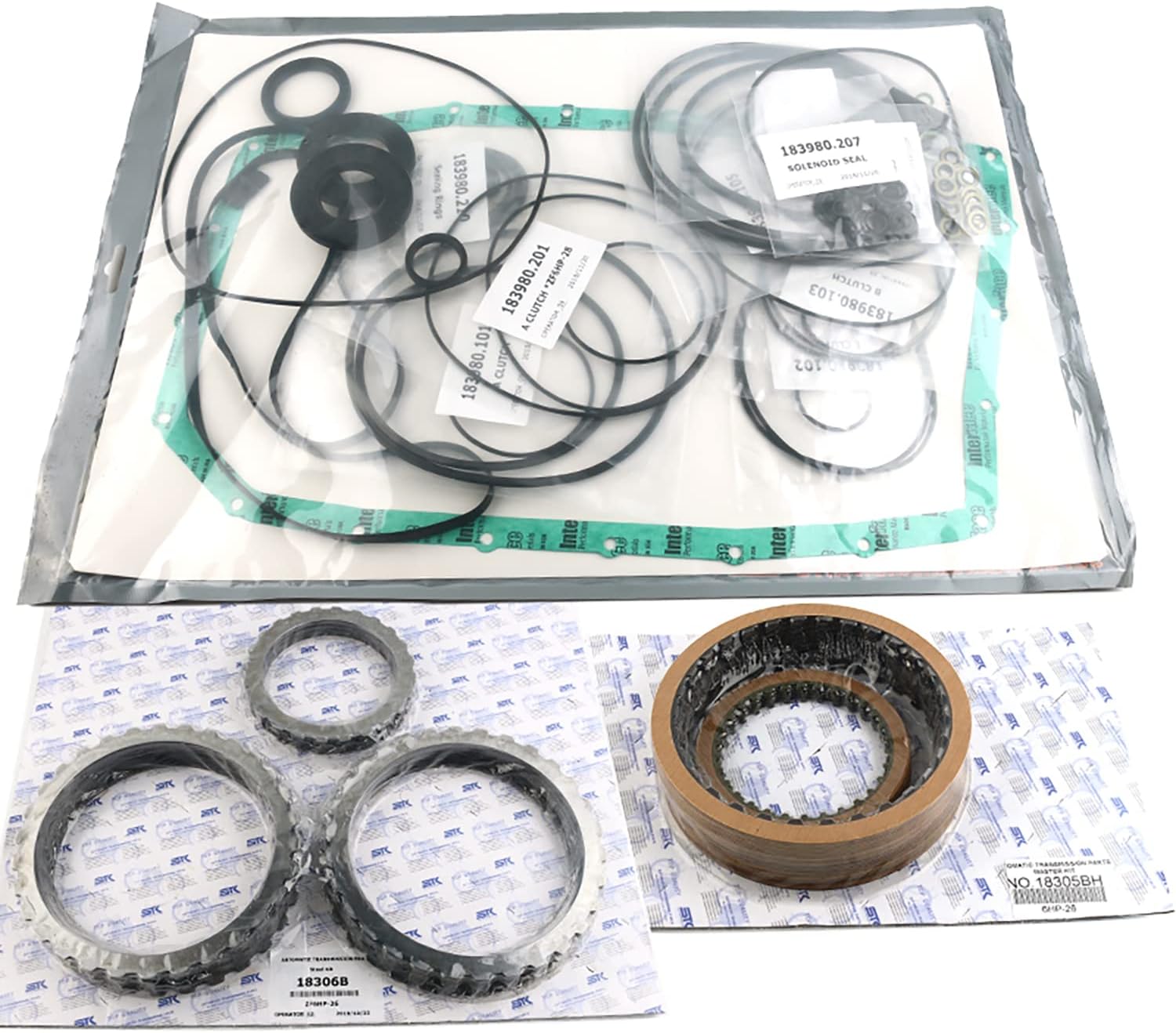
ZF 6HP26 overhaul rebuild kit, 2003-2008, with overhaul gaskets
If the 6HP on your bench is going back together, this is the kit that covers it: frictions, steels, seals and the overhaul gaskets in one box, sized for the 6HP26. Ships from the USA.
See the 6HP26 overhaul kit →What wears, and where
On the 6HP
The pressure regulator bore is the headline. Sonnax's kit 95740-01K covers the ZF6 Gen 1 and Ford 6R60/6R75/6R80 (2009-2014) applications, replacing the OE sleeve with a .629 in. outer diameter and .645 in. length. The symptom list is exactly what you would expect from a leaking line pressure circuit: poor shift quality, flare shifts, harsh shifts, erratic line pressure, slips in forward and reverse, delayed reverse, no reverse and TCC slip. Watch the fitment table, because a ZF6 Gen 1 with an 053 separator plate takes a .657 in. sleeve at .725 in. length, and a Gen 2 takes a .804 in. length. Mixing those up creates pressure problems rather than fixing them.
The other repeat offenders on a 6HP Gen 1 casting, from the Sonnax layout:
- Bypass clutch control valve (95740-13K) — TCC codes, excess TCC slip, cycling RPM, low TCC release pressure, flare and harsh shifts
- Converter release regulator valve (95740-05K) — excess TCC slip and related codes, harsh TCC apply and release
- Lubrication control valve (95740-11K) — planetary failure, bushing failure, lube failures, overheating, low converter pressure
- "E" latch valve (95740-80K, 6HP26 only) — 3-4 bump, 3-4 flare, 3-4 late, gear ratio and solenoid codes, no 4th, no 5th, no 6th
- Accumulator piston kit (95740-15K, seven pistons and springs) — downshift clunk, firm shifts, erratic EDS solenoid control and EDS codes
- Clutch A control valve (95740-09K) and A control boost valve (95740-21K) — 5-4 flare, 5-4 neutral, no 4-5, delayed forward, harsh forward, downshift bind-ups
On the 8HP
Fewer positions, but the worst one is worse. Sonnax names the TC pressure valve as the 8HP valve showing the most severe wear to date, driven by EPC control and constant activity. Its symptom set is harsh TCC apply, excess TCC slip, TCC codes and overheating, TCC lining failure and low TCC release pressure. The other three converter-circuit valves are all variable-force controlled and busy, so all four are worth vacuum testing on every rebuild.
Beyond the converter circuit, the Sonnax vacuum test guide flags the B2 clutch NIC valve (35740-22) for delayed engagement, no forward, no reverse, neutral idle control concerns and burned B clutch; the B2 holding valve (35740-18K) for burned B clutch, 5-6 flare, coastdown clunk and low lube oil flow; and the position and default holding valves A and D (35740-20K) for bump and flare shifts, delayed forward and reverse, burnt clutches, gear loss and gear ratio and solenoid codes.
Mechatronic units, valve bodies, solenoid kits, master rebuild kits, pan and filter kits and the correct LifeGuardFluid for both the 6HP six-speed and the 8HP eight-speed, on one page.
Shop ZF6HP parts →Fluid: check the tag, not the gear count
This is the one that gets people. The intuitive rule, LifeGuardFluid 6 for six-speeds and LifeGuardFluid 8 for eight-speeds, is wrong often enough to burn a unit. ZF's own aftermarket catalog splits it like this:
- LifeGuardFluid 6 — 6HP19, 6HP19X, 6HP21, 6HP26, 6HP26A61, 6HP26X, 6HP28, 6HP28X, 6HP32. Available as a 1L bottle (S671 090 255) or 20L can (S671 090 253).
- LifeGuardFluid 8 — 8HP45, 8HP45X, 8HP55A, 8HP70, 8HP70X, 8HP90, 8HP90A, plus 6HP19A in the Audi A8 only, 6HP19X in the Audi Q7 only, 6HP26A61 and 6HP28AF. 1L bottle is S671 090 312, 20L can is S671 090 311.
Yes, 6HP26A61 and 6HP19X appear on both lists depending on the application. That is not a catalog error, it is exactly why you identify by the tag on the case and the vehicle, not by the number of gears.
Either way, this is not a fluid you improvise on. Per ATSG, the 6HP was designed around a new synthetic low-viscosity ATF specifically to handle the heat of the constant-slip torque converter clutch, with the mechatronic module operating up to 160 degrees C (320 degrees F). The lockup clutch on these units never fully locks; it is designed to run a constant controlled slip to keep engine vibration out of the cabin. Wrong fluid means shudder, and shudder means clutch material in the pan.
Mechatronic: same philosophy, different unit
Neither of these is a bolt-in-a-solenoid transmission. On the 6HP, ZF combined the hydraulic valve body and the electronic control module into a single mechatronic assembly containing the TCM, speed sensors, temperature sensor and range switch. Per ATSG, the high-frequency solenoids cannot be interchanged or altered, because ZF calibrates each solenoid's pressure curve into the software at build. The assembly is serviced as a unit.
The 8HP keeps the same idea with a plastic transmission control module assembly mounted on top of the valve body, housing the TCU, input and output speed sensors and the temperature sensor. Eight EDS solenoids sit in the lower casting, orange- and white-capped on Gen 1.
One 6HP-specific warning worth repeating: ATSG calls electrostatic discharge a genuine hazard for the 6HP mechatronic. Touching the connector pins directly is not allowed, and ZF recommends a grounded wrist strap, anti-static footwear and a grounded work surface. Static off a shop rug is enough to kill one.
Gen 1 versus Gen 2, and why it matters for cores
In 2019, Chrysler, Ram and Jeep applications moved to a second-generation 8HP. Per Sonnax TASC Force specialist Jim Dial writing in Transmission Digest, Gen 1 units are 8HP45, 8HP70 and 8HP90; Gen 2 units are 8HP50, 8HP75 and 8HP95. The changes are structural, not cosmetic:
- Gear ratios changed, which drove numerous hard part changes
- The Gen 1 B brake piston has both an apply circuit (B1) and a release circuit (B2). On Gen 2 the B2 circuit was deleted and replaced with a return spring assembly
- Gen 2 added wave springs between the steel plates on both the A and B brake packs for quicker release
- Deleting B2 forced a valve body redesign. Gen 1 has five valves in the upper casting; Gen 2 has none
- The B and D solenoids swapped positions between generations. Gen 2 solenoids use cream and blue caps and are not interchangeable with the late-2014 845RFE solenoids, because the snout diameters differ
If you are buying an 8HP core or a used valve body, that list is your checklist. A Gen 1 and a Gen 2 will not cover for each other.
6HP26 solenoid kit → 8HP70 steel clutch kit → or browse the full catalog
Diagnosing either one: start with a vacuum test
Both units share the same failure mode at the root, which is aluminum bores wearing oversize under constant variable-force solenoid modulation. That means the same diagnostic tool works on both, and it is not a scan tool.
Vacuum testing the valve body with the valve in its rest position is the fastest way to separate a worn casting from an electrical fault. Pull vacuum at the test location, and a low reading means the valve-to-bore clearance is leaking. Sonnax publishes test locations and target parts for the 6HP19/26/32 Gen 1 casting and for the 8HP45/70 and Chrysler 845RE casting. Do this before you order a mechatronic. A leaking pressure regulator bore will set pressure control codes that read exactly like a failed solenoid, and shops replace a lot of good mechatronic units chasing them.
Practical order of operations on either unit:
- Verify fluid level and condition at the correct temperature, and confirm the fluid on the tag matches the ZF application table above
- Pull codes, then check whether they are pressure control or ratio codes. Pressure control codes on a high-mileage unit point at bore wear more often than at solenoids
- Drop the pan. On BMW 6HP applications the pan is the filter, a molded Polyamide Durethan AKV 35 assembly, so plan on replacing it rather than cleaning it. Do not let the transmission hang on it during R and R; the plastic is not rated to carry the weight
- Vacuum test the pressure regulator, converter circuit and clutch control bores before condemning the mechatronic
- On a 6HP mechatronic, ground yourself before you touch the connector
So which one do you want
The 8HP wins on capability and it is not close. Wider ratio spread, higher torque ceiling, fewer applied elements per gear, and a lockup clutch that can apply in every forward gear. It is a better transmission by every measure ZF cared about.
The 6HP wins on serviceability and parts cost. It has a deeper aftermarket, a longer list of published valve body repairs, cheaper cores, and twenty-plus years of documented failure patterns. When a 6HP breaks you generally know what it is before the pan is off.
The practical answer for most shops: if you are diagnosing a car, the unit in it is the unit you are working on, and the question that actually matters is Gen 1 versus Gen 2 and which LifeGuardFluid the tag calls for. If you are shopping a swap or a build, the 8HP is the stronger platform, but budget for the controller work, not just the transmission.
FAQ
Is the ZF8HP just a ZF6HP with two more gears?
No. The 6HP uses a Lepelletier gear train, a simple planetary set with its sun gear fixed to the stator support feeding a Ravigneaux set, which is how ZF got six forward speeds out of three input clutches and two brakes. The 8HP uses four planetary gear sets controlled by two brakes (A and B) and three clutches (C, D and E). Per Sonnax, only three of those five shift elements are applied in any given gear, which is what keeps drag low across eight ratios. Different gear train, different shift element count per gear, different hardware.
Can I swap a ZF8HP into a car that came with a ZF6HP?
Not as a parts swap. The bellhousing pattern, case length, output flange and driveshaft all change with the application, and the bigger wall is electronic. Both units carry their control module inside the transmission, and on the 6HP the ZF mechatronic contains the TCM, speed sensors, temperature sensor and range switch as one non-serviceable assembly that ZF flashes with vehicle-specific calibration at the factory. An 8HP mechatronic will not talk to a 6HP-era vehicle bus. Retrofits get done, but they are standalone-controller projects, not bolt-ins.
Do the ZF6HP and ZF8HP use the same transmission fluid?
Mostly no, and the exceptions matter. ZF's own aftermarket catalog puts 6HP19, 6HP19X, 6HP21, 6HP26, 6HP26A61, 6HP26X, 6HP28, 6HP28X and 6HP32 on LifeGuardFluid 6, and puts 8HP45, 8HP45X, 8HP55A, 8HP70, 8HP70X, 8HP90 and 8HP90A on LifeGuardFluid 8. Four 6HP variants are called out for LifeGuardFluid 8 instead: 6HP19A in the Audi A8 only, 6HP19X in the Audi Q7 only, 6HP26A61, and 6HP28AF. Read the tag before you order fluid.
Which is stronger, the ZF6HP or the ZF8HP?
The 8HP, by a wide margin at the top of the range. The 6HP family topped out at the 6HP32 at 750 Nm, roughly 555 lb-ft, per ATSG's writeup in Transmission Digest, with the 6HP26 at 600 Nm and the 6HP19 at 400 Nm. The 8HP designation number is the torque index in Newton-meters, so an 8HP90 is a 900 Nm unit and the Gen 2 8HP95 goes higher. Note the 6HP names do not follow that convention, which is why a 6HP26 is a 600 Nm unit and not a 260 Nm one.
Why does the ZF8HP valve body look so much like the ZF6HP valve body?
Because it is a direct evolution of it. Sonnax notes the upper and lower castings are similar in shape and bore structure to the 6HP, the same problematic rubber-tipped solenoid accumulators carry over, and the 8HP uses the same type of clutch regulator and clutch holding valves. The 8HP pressure regulator valve is identical in function and design to the commonly worn 6HP version, just a different size. The one real departure is the converter circuit, which went from two paths to three.
Related guides
- ZF 6HP19 and 6HP26 Transmission Problems
- ZF6HP Limp Mode: Causes and Diagnosis
- ZF6HP TCC Shudder Diagnosis
- ZF8HP Valve Body Wear and the Fix
- ZF8HP Fluid Type and Capacity
Sources
- Transmission Digest — Niel Speetjens (ATSG Technical Field Adviser), "To 6HP or not to 6HP – Is That a Question?", March 1, 2007. Backs the 6HP26 as the first six-speed automatic in a production passenger car, released 2000 and used first in the BMW E65 7 Series for 2001; the Lepelletier gear train description (simple planet with the sun gear fixed to the stator support ahead of a Ravigneaux set, five shift elements, three input clutches and two brakes); the complete 6HP gear ratio set 4.171 / 2.340 / 1.521 / 1.143 / 0.867 / 0.691 with 3.403 reverse and no direct drive or one-way clutches; the torque ratings 6HP19 at 400 Nm, 6HP26 at 600 Nm and 6HP32 at 750 Nm; the constant-slip lockup clutch strategy; the mechatronic as a single non-serviceable assembly with factory-calibrated solenoid pressure curves; the 160 degree C module temperature; the Polyamide Durethan AKV 35 plastic pan that doubles as the filter and cannot carry the unit's weight; and the electrostatic discharge handling requirements. transmissiondigest.com
- Sonnax — "A New Path for ZF," November 9, 2016. Backs the ZF8HP45 and ZF8HP70 application list (2009-later BMW, 2011-later Chrysler 300, 2015-later Challenger, 2012-later Charger/Durango/Ram 1500, 2011-later Grand Cherokee, Jaguar and Land Rover) and the V6 versus V8 split; the valve body similarity to the 6HP19/26/32 and 6HP21/28/34 castings; the eight EDS solenoids and the carried-over rubber-tipped solenoid accumulators; the TCMA housing the TCU, input and output speed sensors and temperature sensor; the four planetary sets with brakes A and B and clutches C, D and E and the clutch application chart showing three elements applied per gear; the three-path converter circuit with EDS-7 (EPC) and EDS-2 (TCC) control, the 14.5 psi minimum converter pressure and TCC apply available in all eight forward gears; the ZF-to-Chrysler valve name cross reference; the statement that the 8HP pressure regulator is identical in function and design to the worn 6HP version; and the TC pressure valve as the most severely worn 8HP valve. sonnax.com
- ZF Aftermarket — "ZF Remanufactured Transmission, Fluids and Kits for Passenger Cars," 2018 catalog (PDF). Backs the official LifeGuardFluid application split: LifeGuardFluid 6 for 6HP19, 6HP19X, 6HP21, 6HP26, 6HP26A61, 6HP26X, 6HP28, 6HP28X and 6HP32; LifeGuardFluid 8 for 8HP45, 8HP45X, 8HP55A, 8HP70, 8HP70X, 8HP90 and 8HP90A plus 6HP19A (Audi A8 only), 6HP19X (Audi Q7 only), 6HP26A61 and 6HP28AF. Also backs the container part numbers: LifeGuardFluid 6 at S671 090 255 (1L) and S671 090 253 (20L), LifeGuardFluid 8 at S671 090 312 (1L) and S671 090 311 (20L). aftermarket.zf.com (PDF)
- Transmission Digest — Jim Dial (Sonnax TASC Force), "Chrysler ZF8 generations 1 and 2 identification guide." Backs the 2019 move to a second-generation unit in Chrysler, Ram and Jeep applications; the Gen 1 designations 8HP45, 8HP70 and 8HP90 versus Gen 2 designations 8HP50, 8HP75 and 8HP95; the gear ratio change driving hard part changes; the deletion of the B2 release circuit and its replacement with a return spring assembly; the wave springs added between steel plates in the A and B brake packs; the five valves in the Gen 1 upper valve body casting versus none in Gen 2; and the B and D solenoid position swap with cream and blue caps that are not interchangeable with 845RFE solenoids due to snout diameter. transmissiondigest.com
- Sonnax — "ZF6HP19/26/32 (Gen. 1) without 053 Separator Plate Valve Body Layout." Backs the 6HP Gen 1 repair positions and part numbers cited in the wear section: Zip Kit ZF6-6R60-ZIP, oversized bypass clutch control valve kit 95740-13K, oversized converter release regulator valve kit 95740-05K, oversized lubrication control valve kit 95740-11K, oversized "E" latch valve kit 95740-80K (6HP26 only), pressure regulator sleeve 95740-03, oversized pressure regulator valve kit 95740-01K, accumulator piston kit 95740-15K (seven pistons and springs), clutch A control boost valve kit 95740-21K and oversized clutch A control valve kit 95740-09K, along with the symptom list tied to each. Also backs that these parts fit both M-shift and E-shift valve bodies and Ford 6R60, 6R75 and 6R80 (2009-2014). sonnax.com
- Sonnax — Oversized Pressure Regulator Valve Kit 95740-01K product and instruction data. Backs the cause statement that excessive valve and bore clearance allows line pressure to exhaust; the symptom list of poor shift quality, flare shifts, harsh shifts, erratic line pressure, slips in forward and reverse, delayed reverse, no reverse and TCC slip; the OE valve name SYS.DR-V; and the dimensional fitment table separating ZF6 Gen 1 and 6R60/6R75/6R80 (.629 in. dia., .645 in. length), ZF6 Gen 1 with the 053 separator plate (.657 in. dia., .725 in. length) and ZF6 Gen 2 (.629 in. dia., .804 in. length), with the warning that mismatching applications causes fit and pressure problems. sonnax.com
- Sonnax — "ZF8HP45, ZF8HP70 & Chrysler 845RE Vacuum Test Guide," December 7, 2016. Backs vacuum testing valves in their rest position as the method for identifying wear, and the specific 8HP wear locations and symptoms cited: B2 clutch NIC valve (35740-22) for delayed engagement, no forward, no reverse, NIC concerns and burned B clutch; B2 holding valve (35740-18K) for burned B clutch, 5-6 flare, coastdown clunk and low lube oil flow; position and default holding valves A and D (35740-20K) for bump and flare shifts, delayed forward and reverse, burnt clutches, gear loss and gear ratio and solenoid codes; and the TC pressure valve for harsh TCC apply, excess TCC slip, TCC codes and overheating, TCC lining failure and low TCC release pressure. sonnax.com