A 700R4 that leaves a spot on the driveway is not news. Most of these units are thirty-plus years old and every external seal on them has been heat-cycled thousands of times. What separates a $15 fix from a $600 one is finding the actual source instead of the lowest drip, because ATF runs downhill and blows backward at speed.
This guide walks the case front to rear, lists what fails at each spot and why, and covers the method GM's service information uses to pin a leak down before you spend money. If the unit is also running hot, read the 700R4 overheating guide too.
Find the source before you buy anything
GM's fluid leak diagnosis procedure, from its service information for its automatic transmissions, is built to stop you from replacing the wrong seal:
- Confirm it is ATF. Fresh DEXRON-type fluid is red; old fluid goes brown and can look a lot like engine oil. Engine oil leaking off a rear main seal or oil pan gasket is the number one thing that gets misdiagnosed as a 700R4 front seal.
- Clean the area with rags, not brake cleaner. GM specifically warns against brake cleaner and other reactive solvents because they can damage rubber gaskets, seals and bushings.
- Drive it 15 to 20 minutes in city traffic until it reaches normal operating temperature. GM says not to idle it or run it on the freeway for this test, because those conditions splatter fluid around and hide the source.
- Park over clean cardboard, shut it off, and look at where the spots land.
If that does not settle it, GM lists two more methods. Spray aerosol leak-tracing powder on the clean case, repeat the drive, and follow the wet path through the powder. Or add the amount of fluorescent dye the kit maker specifies, drive about 15 miles, and trace the glow under a black light uphill to the highest wet point.
GM also says to fix the cause, not just the part: a new gasket will not seal a bent flange. Its list of gasket leak causes includes fluid level or pressure too high, a plugged vent, loose fasteners, warped flanges, the wrong gasket, a porous part and misapplied sealant. Seals add a damaged bore, a scored shaft, and a worn bushing that lets the shaft move.
The front: pump seal, converter, and the bellhousing drip
A drip from the bottom of the bellhousing is the most expensive 700R4 leak, because every transmission source here means pulling the unit. Pull the inspection cover and read the pattern.
- Wet on the back of the converter and the inside of the bellhousing: transmission fluid from the front pump seal, the pump-to-case O-ring, the pump bolt seals, or the converter itself.
- Wet on the engine block side, the flexplate face, and the top of the bellhousing: almost always engine oil from the rear main seal, the oil pan gasket, or a valve cover. Do not pull a transmission for that.
- A wet ring around the converter weld seam: GM lists a leak in the converter weld area as a cause on its own.
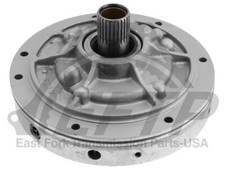
The front pump seal is a metal-clad lip seal riding on the converter hub. Behind it is the pump bushing, and that bushing is why so many 700R4 front seals leak again a few months after somebody replaced just the seal. Per Sonnax's write-up on pump and converter circuits, the hub bushing supports the converter, keeps the inner pump gear centered, and limits how much converter oil bleeds past toward the front seal drainback hole. When the bushing wears, excess flow past it can cause front seal leaks and also lowers converter and lube pressure. Sonnax puts a number on it: an extra .003 inch of clearance on a 2-inch hub creates a leak area similar to a .100 inch hole.
So the right repair is seal and bushing together, which means pulling the pump. A grooved hub, or burrs on the hub or pump drive slots, will cut a new seal. GM documented that exact problem on the 4L60-E (the electronic descendant of the 700R4, with the same pump-to-hub layout) in bulletin 06-07-30-016, which calls for removing small burrs from the converter hub and pump drive slots before installing a new hub-to-pump seal. Also confirm the drainback hole in the pump body below the seal is clear; if it is plugged, converter oil has nowhere to go but out past the lip.
While the pump is out, replace the square-cut O-ring on the pump OD and the pump bolt seals. They leak into the same bellhousing.
The driver side: TV cable, manual shaft, pressure tap and dipstick tube
Four seals live on the driver side of the case above the pan rail, and all of them can be done in the vehicle.
TV cable seal. The throttle valve cable enters the case through an O-ring seal just above the pan. When it hardens it weeps onto the pan rail and looks like a pan gasket leak. Replacing it means dropping the pan to unhook the cable from the TV link on the valve body. Readjust the cable afterward. Gears Magazine (published by ATRA) calls for a coarse setting with the pedal floored, then a light-throttle road test where the 1-2 lands around 15 mph and the 2-3 around 28 mph, and the unit must give a full-throttle 2-1 downshift right after the 1-2. A TV cable left too short will drop line pressure and burn the 3-4 clutch, which is covered in our TV cable and line pressure guide.
Manual shaft seal. The shift lever shaft passes through a lip seal in the case. A worn linkage bushing that lets the lever wobble wears it out fast, so fix the linkage too.
Line pressure tap plug. The pressure test port on the case is a small pipe plug. GM lists a loose line pressure plug as a leak cause; it is common after somebody has had a gauge on it.
Dipstick tube seal. The tube seals into the case with a rubber seal or O-ring. It is cheap and one of the most common real sources of a 700R4 drip. A wet tube and wet bellhousing bolt below it is the giveaway.
The pan: gasket, rail, bolts and drain plug
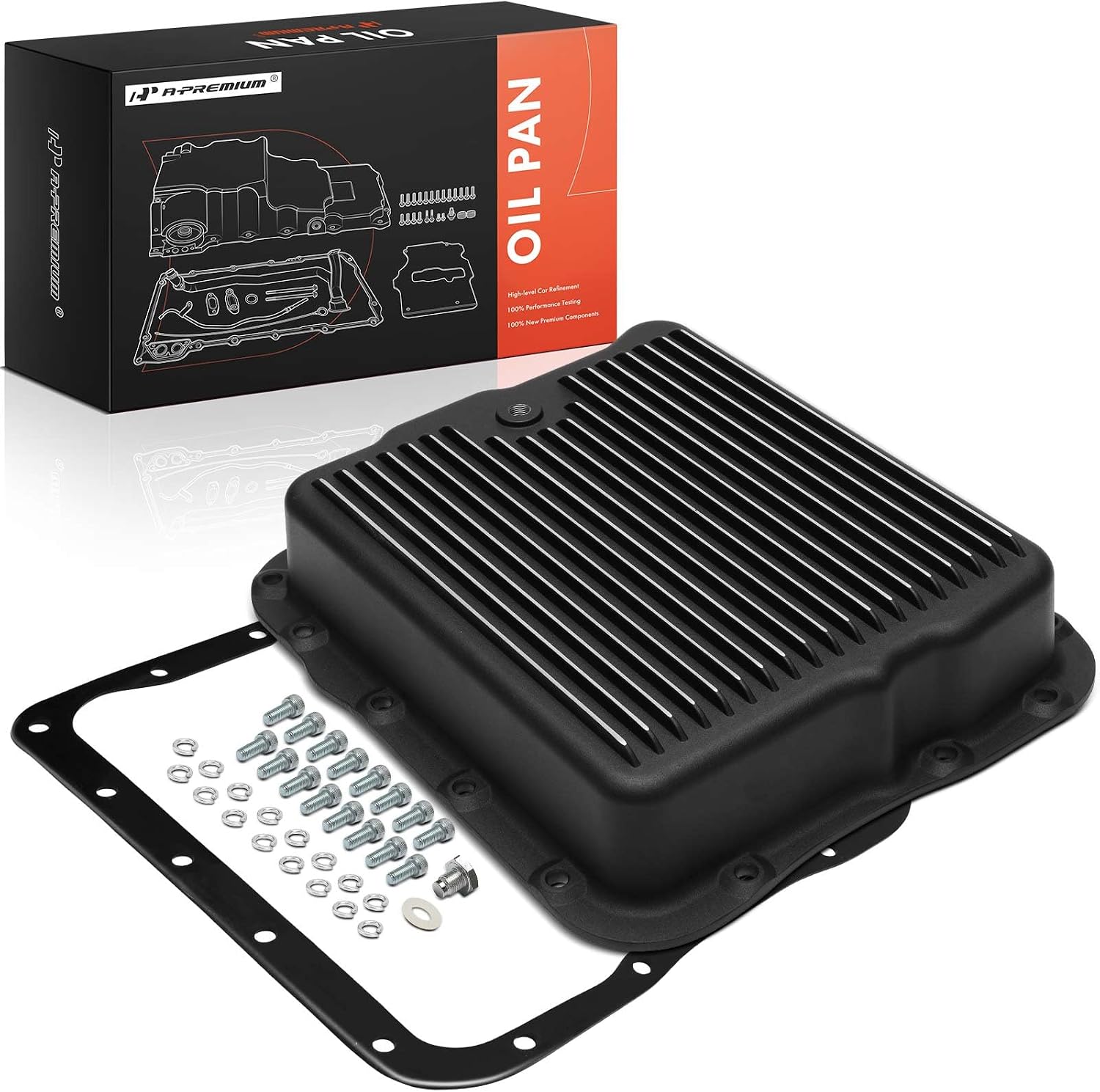
A real pan leak is usually a reused or wrong gasket, loose bolts, or a stamped steel rail dimpled around the bolt holes by over-tightening until the gasket cannot seal between them.
- Check the rail. Lay the pan on a flat bench. If light shows under the rail between bolt holes, flatten the dimples with a hammer on a flat dolly or replace the pan. A cast aluminum pan with a thick rail does not dimple.
- Use the right gasket and do not add silicone to a gasket designed to go on dry. GM lists misapplied sealant as a leak cause, and excess RTV ends up at the filter.
- Torque is low. Tighten in a crisscross pattern with a torque wrench, never an impact. For reference, GM's specification sheet for its Supermatic 4L65-E and 4L70-E crate transmissions (later members of the same family with a molded reusable pan gasket) lists the oil pan to case at 18 ft-lb (24 N-m) and the drain plug at 25 ft-lb (34 N-m). Earlier 700R4s with cork or paper gaskets call for less, so use the figure from the service manual for your year and gasket type. Over-torquing is what dimples the rail in the first place.
Cooler lines and case fittings
The steel cooler lines use inverted flare nuts into fittings threaded into the case. Leaks come from a nut never fully tightened, a flare rounded off with an open-end wrench, a cross-threaded fitting, or hardened rubber hose sections at the radiator end.
Always use a flare-nut wrench on these. GM's Supermatic specification sheet lists the cooler pipe connector nut to case at 28 ft-lb (38 N-m) for that 4L6x-E case, and it identifies the lower case fitting as cooler out and the upper fitting as cooler return. Confirm flow direction on your own unit before you re-plumb anything, especially on a swap where lines have been bent up by hand. GM's sheet also says that whenever a transmission is replaced the cooler and lines must be flushed. If the leak ran it low enough to burn clutches, that debris is in the cooler. Rubber hose sections should be transmission cooler hose, not fuel or heater hose, and should be double-clamped.
The passenger side and the tail: governor cover, speedometer gear, extension housing
Governor cover. The 700R4 governor is serviced through a pressed-in cover on the passenger side of the case. A cover that has been pried out and reused, or one that is rusted around its edge, will weep. Replace it rather than trying to reseal an old one.
Speedometer driven gear housing. On 700R4s with a mechanical speedometer, the driven gear sleeve plugs into the extension housing with an O-ring and a retainer. The O-ring hardens and the sleeve weeps.
Extension housing gasket and rear seal. The tailshaft seal rides on the driveshaft slip yoke. A worn extension housing bushing lets the yoke move around and wears out a new seal in short order, and a yoke with a groove worn into the sealing surface will do the same. Replace the bushing with the seal if there is play. Overfill can also blow fluid past this seal. On 4x4 trucks, transmission fluid getting past the output into the adapter will show up as an overfilled transfer case with red fluid in it, which points at the adapter seal rather than an external leak.
Fluid coming out of the vent or dipstick tube
The 700R4 breathes through a vent on top of the case. Fluid coming out of it, or pushing up the dipstick tube, is not a seal failure. GM's list of causes for a vent leak is short, and includes the one casting problem worth knowing about: an overfilled system, water or coolant in the fluid (it will look milky, and on a truck with an in-radiator cooler that means a failed cooler), a porous case, an incorrect dipstick causing an overfill, or a plugged vent.
The incorrect dipstick cause is common on 700R4 swaps, where the pan, tube and dipstick often come from different donor vehicles. Sonnax has documented this for the 4L60-E series: mismatched dipstick, tube, pan and stop bracket combinations can read normal on the stick while the unit is actually overfilled by about 0.5 to 0.75 quart, or underfilled by as much as 0.75 quart. An overfilled unit foams and pushes fluid out the vent. Check the level hot, running, in Park on level ground.
Where I start, in order
- Check the fluid level hot and running. Rule out overfill and a bad dipstick combination first.
- Clean everything with rags, drive 15 to 20 minutes in town, park on cardboard.
- Check the cheap ones: dipstick tube seal, pressure tap plug, speedometer gear O-ring, cooler line nuts, pan bolts.
- Use dye and a black light if the source is not obvious.
- Do the in-vehicle seals: TV cable, manual shaft, governor cover, tailshaft seal and bushing, pan gasket.
- Only after all of that, pull the inspection cover and decide whether it is a front pump seal, pump O-ring, converter, or engine oil.
If it does come out for a front seal, do the bushing, pump O-ring and bolt seals together and flush the cooler. Pulling a 700R4 twice for the same leak is the expensive way to do it.
FAQ
How do I tell a 700R4 front pump seal leak from an engine rear main seal leak?
Pull the inspection cover. Front seal leaks wet the back of the converter and the inside of the bellhousing; a rear main seal leak wets the engine block side and the flexplate face. Fresh ATF is red, engine oil is brown or black, and dye with a black light settles it when both look dirty.
Can I replace a 700R4 front pump seal without removing the transmission?
No. The seal rides on the converter hub, so the transmission and converter must come out. A worn pump bushing is often what made it leak, so pull the pump and replace the bushing, pump O-ring and bolt seals at the same time, and check the hub for grooves or burrs.
Why is my 700R4 leaking fluid out of the vent?
Usually an overfill, often from a dipstick, tube and pan that do not match, which Sonnax says can overfill the 4L60 family by about 0.5 to 0.75 quart while reading normal. GM also lists coolant in the fluid, a plugged vent and a porous case. Check the level hot and running, and look for milky fluid.
What is the torque spec for 700R4 pan bolts?
It is low and depends on the gasket. GM's sheet for its later 4L65-E and 4L70-E Supermatic units with a molded reusable gasket lists 18 ft-lb, and earlier cork or paper gaskets call for less. Use a torque wrench in a crisscross pattern, never an impact, or you will dimple the pan rail.
Gasket and seal kits, pumps, pans and complete rebuild kits for the 700R4 and 4L60 — shipped fast from the USA.
Shop 700R4 parts →Related 700R4 guides
Sources
- GM Global Service Information — Automatic Transmission Fluid Leak Diagnosis (6T70/6T75 section, 2011 9-4X, hosted on Saab WIS Online). Backs the leak-finding procedure (rag cleaning without brake cleaner, 15-20 minute city drive, cardboard, powder method, dye with about 15 miles of driving and a black light), the gasket and seal cause lists, and the case, converter-end and vent leak causes including converter weld leaks, loose line pressure plugs, porous castings and incorrect dipsticks. saabwisonline.com
- Sonnax — "Anatomy of a Transmission: Oil Flow in the Pump, PR, Converter, Cooler & Lube Circuits". Backs the role of the converter hub bushing in limiting converter oil bleed toward the front seal drainback, excess hub bushing flow causing front seal leaks and lower converter and lube pressure, and .003 inch of extra clearance on a 2 inch hub equaling roughly a .100 inch hole. sonnax.com
- Chevrolet Performance — Supermatic Transmission Specifications, GM P/N 19260445 (4L65-E/4L70-E). Backs the cooler pipe connector nut to case torque of 28 ft-lb (38 N-m), oil pan to case 18 ft-lb (24 N-m), drain plug 25 ft-lb (34 N-m), the lower case fitting as cooler out and the upper as return, and flushing the cooler and lines on any transmission replacement. chevrolet.com (PDF)
- Sonnax — "How to Avoid a Dipstick Move in 4L60-E Series Transmissions". Backs mismatched dipstick, tube, pan and stop bracket combinations reading normal while overfilling by about 0.5 to 0.75 quart or underfilling by up to 0.75 quart, and the 4L60-E being based on the 1982-1992 700-R4. sonnax.com
- Gears Magazine (ATRA) — "A Look Back: Adjusting the THM700-R4 Throttle Valve Cable". Backs the TV cable coarse adjustment, the light-throttle road test targets of a 1-2 shift near 15 mph and a 2-3 near 28 mph, and the requirement for a full-throttle 2-1 downshift after the 1-2 upshift. gearsmagazine.com
Also referenced: GM service bulletin 06-07-30-016 (July 2006), "4L60-E, 4L65-E Automatic Transmission Fluid Leak from Oil Pump or Bell Housing Area," which calls for removing burrs from the converter hub and pump drive slots and replacing the hub-to-pump seal.