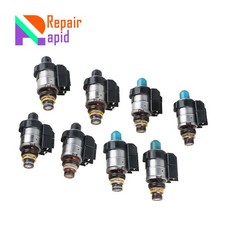
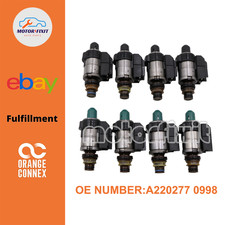
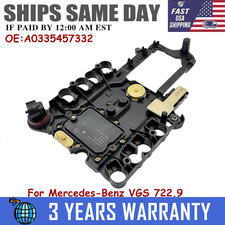
The 722.9 (Mercedes-Benz's seven-speed 7G-TRONIC, built on the NAG2 platform) doesn't have shift solenoids bolted to a separate valve body in the way a lot of other transmissions do. The solenoid pack lives on the conductor plate, which also carries the fully integrated transmission control unit (Mercedes calls it Y3/8n4, or VGS for "Getriebesteuerung"). That packaging choice matters for diagnosis: a solenoid-looking symptom can be a solenoid, a wiring/connector problem on the same plate, a control-unit communication fault, or in at least one documented case a mechanical torque converter problem that just happens to trip a solenoid-circuit fault code. This guide works from three Mercedes-Benz XENTRY bulletins, archived publicly through NHTSA, so you're diagnosing against the factory's own fault tree instead of guessing from symptoms alone.
722.9 Shift Solenoid Symptoms and Replacement
What the Conductor Plate Actually Controls, and What You Can't Fix on It
The 722.9's control module is integrated directly into the conductor plate, which also holds the shift solenoids, per Transmission Digest's technical rundown of the 7G-TRONIC architecture. The conductor plate carries the electrical connections for the sensors, the solenoids, and the connector back to the vehicle harness. The important distinction the article makes: the conductor plate and the control module itself are not serviceable as individual components, but the solenoids and the speed sensor mounted on it are [4]. That's why a 722.9 solenoid fault doesn't automatically mean a full valve body replacement -- in a lot of cases the solenoid or sensor can be swapped on its own.
There's one hard exception to that, and it's documented in Mercedes-Benz bulletin LI27.19-P-057340. If the transmission control unit, designated Y3/8n4 (the "Fully Integrated Transmission Control Unit," or VGS), doesn't show up in the scan tool's quick test, or the tool simply cannot establish communication with it, the bulletin's remedy is specific: perform an ignition reset on the control unit, confirm the transmission connector is fully seated, and inspect the pins for damage. If communication still can't be established after that, the bulletin requires replacing the electrohydraulic controller unit (EHS) -- the conductor plate assembly -- because it is "not possible to transfer the valve characteristics" to a new board under those conditions. The bulletin states plainly that installation of a VGS repair kit is not permitted in this case [3]. In other words: if the control unit itself has gone silent, an aftermarket solenoid repair kit is the wrong part to order, no matter how good the kit is.
Symptoms That Point at the Shift Solenoids
Mercedes-Benz bulletin LI27.00-P-051451, "Shift quality complaints on TRANSMISSION 722.9," lists the documented symptom categories for this failure family: limp-home mode, general transmission function faults, problems during the engaging process, no power flow at all, shift problems, slipping, shifts that are not performed or are delayed, and poor shift quality overall [1]. That's a broad net on paper, but in the field these show up in a fairly consistent handful of ways:
- Limp-home mode. The transmission defaults to a single gear (commonly second) and caps vehicle speed, which is the control strategy's way of protecting the hardware once it loses confidence in solenoid or sensor feedback.
- No power flow. The engine revs but the car doesn't move, or moves with a significant delay -- consistent with a solenoid stuck closed or a clutch pack not receiving line pressure where it should.
- Slipping and inconsistent shifts. RPM flares between gears, or the shift points feel different from one cycle to the next, rather than one single repeatable failure.
- Delayed or missing shifts. The transmission holds a gear longer than it should, or skips an expected shift entirely.
None of these symptoms, on their own, tell you definitively that a solenoid has failed versus a wiring fault, a connector issue, or (as the next section covers) a mechanical problem that only looks electrical. That's exactly why the bulletin's remedy doesn't start with a parts order.
Diagnose It Right: Read the TCU Log and EEPROM Before You Touch Anything
Per bulletin LI27.00-P-051451, before any repair work or adaptation begins, you're supposed to read out the transmission control unit's log file and its EEPROM data and save them as separate files. The bulletin is specific that the EEPROM data "can no longer be reproduced" once adaptation has been performed, so it has to be captured to a USB stick first -- skip that step and you lose the ability to see what the control unit's adaptive values looked like before you started working on it.
After that, the bulletin's preparatory step is to verify the actual gearshift complaint in the presence of the customer, using Star Diagnosis or XENTRY to check the actual values of the engaged gears. From there, the bulletin directs you to work through its attached "Fault Tree NAG2" to isolate the specific cause rather than replacing parts based on symptom alone. It also notes that both the engine control unit and the transmission control unit should be checked for the latest software release, and updated if needed, with another test drive performed afterward, before escalating the case further. Skipping straight to a solenoid kit before this sequence is how a shop ends up replacing a good part.
The TCC Code That Looks Like a Solenoid but Usually Isn't
This is the part of 722.9 solenoid diagnosis that trips up a lot of techs. Mercedes-Benz bulletin LI27.20-P-055758 covers fault codes P074100 ("the wet clutch/torque converter lockup clutch does not close") and P278300 ("the friction power of the torque converter lockup clutch is too high"), both logged by the same VGS control unit that runs the shift solenoids. On a lot of transmissions, a lockup-clutch solenoid code means a bad solenoid. On the 722.9 7G-TRONIC PLUS built between April 2011 and December 2013, the bulletin traces the cause to one of two purely mechanical problems depending on the transmission's serial ID range: increased wear of the torque converter bearing bushing, caused by a rough microsurface on the turbine shaft journal, or a slight internal leak at the sealing ring between the transmission input shaft and the torque converter lockup clutch [2].
The remedy splits by engine code. On vehicles with ENGINE 271, the bulletin's first step is to update the transmission software, clear the fault codes in the VGS, and reset the torque converter's lifecycle adaptation data -- no disassembly. On every other engine, the bulletin calls for pulling the transmission and torque converter apart, micro-finishing the input shaft one time with a 15-micron polishing film, and replacing the torque converter, along with specific prep steps (cleaning the torque converter mount in the crankshaft with brake cleaner, removing fretting rust with 120-grit emery cloth, and greasing the mounting pin with multi-purpose paste before reassembly). Either way, the torque converter's lifecycle data has to be reset afterward through XENTRY or DAS. If you see P0741 or P2783 on a 722.9 in that production window and jump straight to a TCC solenoid swap, you're very likely replacing the wrong part.
Solenoid Codes from a Worn Regulator Bore
One more look-alike before you order a solenoid kit. The shift solenoids on the 722.9 are fed by the supply pressure regulator valve in the valve body, and that valve wears its bore. Sonnax documents that supply pressure regulator bore wear lets fluid escape and causes erratic supply pressure to the control solenoids, and it lists solenoid performance codes, TCC codes, harsh and soft shifts, wrong-gear starts and burnt clutches as the resulting complaints [5]. A brand-new solenoid fed unstable supply oil will still set a performance code. If the codes keep coming back after a solenoid swap, vacuum test the two supply pressure regulator bores; Sonnax's fix is reaming and an oversized valve, part 88740-02, which fits either location [5].
What This Means for Ordering Parts
Put together, the three bulletins point to a simple order of operations before buying anything: pull and save the TCU log and EEPROM data, verify the actual symptom against the bulletin's fault categories, check for a no-communication fault specifically (which rules out a solenoid-level fix entirely), and on torque converter lockup codes, check the production date and engine code before assuming the TCC solenoid is bad. Once a solenoid fault is actually confirmed at the component level, rather than a control-unit or mechanical issue, the solenoid kit (or, if the plate itself is damaged, a full valve body) is the correct part. Matching the right kit revision to your transmission's production years matters here, since the 722.9 went through more than one solenoid and valve body update during its production run -- confirm your vehicle's build date against the kit's listed application range before ordering.
FAQ
Can I replace just one 722.9 shift solenoid, or do I need the whole kit?
On the 722.9, the shift solenoids and the speed sensor are individually serviceable items, while the conductor plate and the integrated control module itself are not, according to Transmission Digest's rundown of the unit's architecture. That means a confirmed single-solenoid fault does not automatically force a full valve body swap. The exception is the no-communication scenario covered in Mercedes-Benz bulletin LI27.19-P-057340: if the transmission control unit (Y3/8n4) will not talk to the scan tool after a reset and a connector check, the bulletin requires replacing the whole electrohydraulic controller unit and explicitly says an aftermarket VGS repair kit is not permitted in that case, because the valve characteristics cannot be transferred to a new board.
My scan tool says the transmission control unit isn't communicating or doesn't show up in the quick test. Is that the solenoids?
Not directly, and Mercedes-Benz bulletin LI27.19-P-057340 lays out the exact order of operations before you touch a solenoid. First perform an ignition reset on the transmission control unit (Y3/8n4), then check that the transmission connector is fully seated and inspect the pins for damage. Only if communication still cannot be established does the bulletin call for replacing the electrohydraulic controller unit (the conductor plate assembly). It also explicitly rules out an aftermarket VGS repair kit for this specific failure, since the valve characteristics cannot be carried over.
I have a torque converter lockup code like P0741 or P2783. Should I just replace the TCC solenoid?
Not before checking the production date. Mercedes-Benz bulletin LI27.20-P-055758 covers fault codes P074100 (lockup clutch will not close) and P278300 (lockup clutch friction power too high) on 722.9 7G-TRONIC PLUS units built between April 2011 and December 2013, and traces both to mechanical wear, not a bad solenoid: either a worn torque converter bearing bushing from a rough turbine-shaft journal surface, or a slight internal leak at the sealing ring between the input shaft and the lockup clutch, depending on the transmission's serial ID range. On ENGINE 271 vehicles the bulletin's first step is a transmission software update and an adaptation reset, not a parts swap; other engines require disassembly, a one-time 15-micron microfinish of the input shaft, and torque converter replacement.
What's the right first diagnostic step before replacing a 722.9 solenoid or valve body?
Read out the transmission control unit's log file and EEPROM data before you start any repair or run a new adaptation. Mercedes-Benz bulletin LI27.00-P-051451 is explicit that the EEPROM data cannot be reproduced once adaptation has been performed, so it has to be saved to a USB stick first. The bulletin then has you verify the actual engaged-gear values with Star Diagnosis or XENTRY in front of the customer, and work through its attached Fault Tree NAG2 to isolate the real failure before any component is replaced.
What symptoms does a failing 722.9 shift solenoid actually cause?
Per the symptom categories listed in Mercedes-Benz bulletin LI27.00-P-051451, a 722.9 solenoid-related complaint falls into one or more of: limp-home mode, no power flow (the transmission won't move the car at all), the transmission slipping, shifts that are not performed or are delayed, and poor shift quality in general. In practice this shows up as the car defaulting to a single gear with reduced top speed, a delay between pressing the gas and actually getting power, or shifts that feel inconsistent from one to the next rather than one specific failure pattern.
Confirmed a bad 722.9 solenoid or valve body?
Solenoid kits and valve bodies matched to your production years, shipped fast from the USA.
Shop 722.9 parts →Sources
- Mercedes-Benz AG — XENTRY Bulletin LI27.00-P-051451, "Shift quality complaints on TRANSMISSION 722.9 (7G-TRONIC and 7G-TRONIC PLUS)," version 5, July 14, 2014 (archived via NHTSA). Backs the required EEPROM/TCU log readout before adaptation, the Star Diagnosis verification step, the Fault Tree NAG2 diagnostic approach, and the documented symptom categories (limp-home mode, no power flow, slips, shifting not performed or delayed, poor shift quality). static.nhtsa.gov
- Mercedes-Benz AG — XENTRY Bulletin LI27.20-P-055758, "Friction power of torque converter lockup clutch is too high (FC 2783) or actuation of torque converter lockup clutch not possible (FC 0741)," version 10, April 7, 2015 (archived via NHTSA). Backs fault codes P074100 and P278300, the two mechanical root-cause windows by serial ID range, the ENGINE 271 software-update-first remedy, and the disassembly/microfinish/torque-converter-replacement remedy for other engines. static.nhtsa.gov
- Mercedes-Benz AG — XENTRY Bulletin LI27.19-P-057340, "Transmission control unit Y3/8n4 (Fully Integrated Transmission Control Unit (VGS)) not listed in quick test; no communication possible with VGS," November 19, 2013 (archived via NHTSA). Backs the ignition-reset and connector-check remedy sequence, the requirement to replace the electrohydraulic controller unit (EHS) when communication cannot be restored, and the explicit prohibition on installing a VGS repair kit in that scenario. static.nhtsa.gov
- Transmission Digest — "Mercedes-Benz 7G-Tronic: Common issues," Andrew Markel, August 5, 2025. Backs the conductor plate/control module architecture, which components are and are not individually serviceable, and the most common customer complaint profile (loss of shift quality or the transmission remaining in gear) tied to the solenoids and their electrical connections. transmissiondigest.com
- Sonnax — Oversized Supply Pressure Regulator Valve 88740-02 (Mercedes 722.9). Backs supply pressure regulator bore wear causing erratic supply pressure to the control solenoids, the listed symptoms (solenoid performance codes, TCC codes, harsh/soft shifts, wrong gear starts, burnt clutches), and the oversized valve that fits either of the two bore locations. sonnax.com/parts/3951
Shop 722.9 solenoid kits, valve bodies, pumps, rebuild kits and the correct ATF — shipped fast from the USA.
Shop 722.9 parts →