P0742 reads like a converter code, so that is usually what gets replaced. On a GM 8L90 that is an expensive way to find out you were wrong. The converter clutch on this unit is commanded by S7, and S7 is a normally-low solenoid. Cut its wire and the clutch releases. Kill the solenoid entirely and the clutch releases. So when the clutch stays locked up anyway, something is putting oil into the apply circuit that the TCM never asked for, and that something is almost always a valve, a bore, or line pressure that has gotten away from the pressure regulator.
This is the diagnosis in the order it actually pays off.
What the 8L90 is doing when it applies the converter clutch
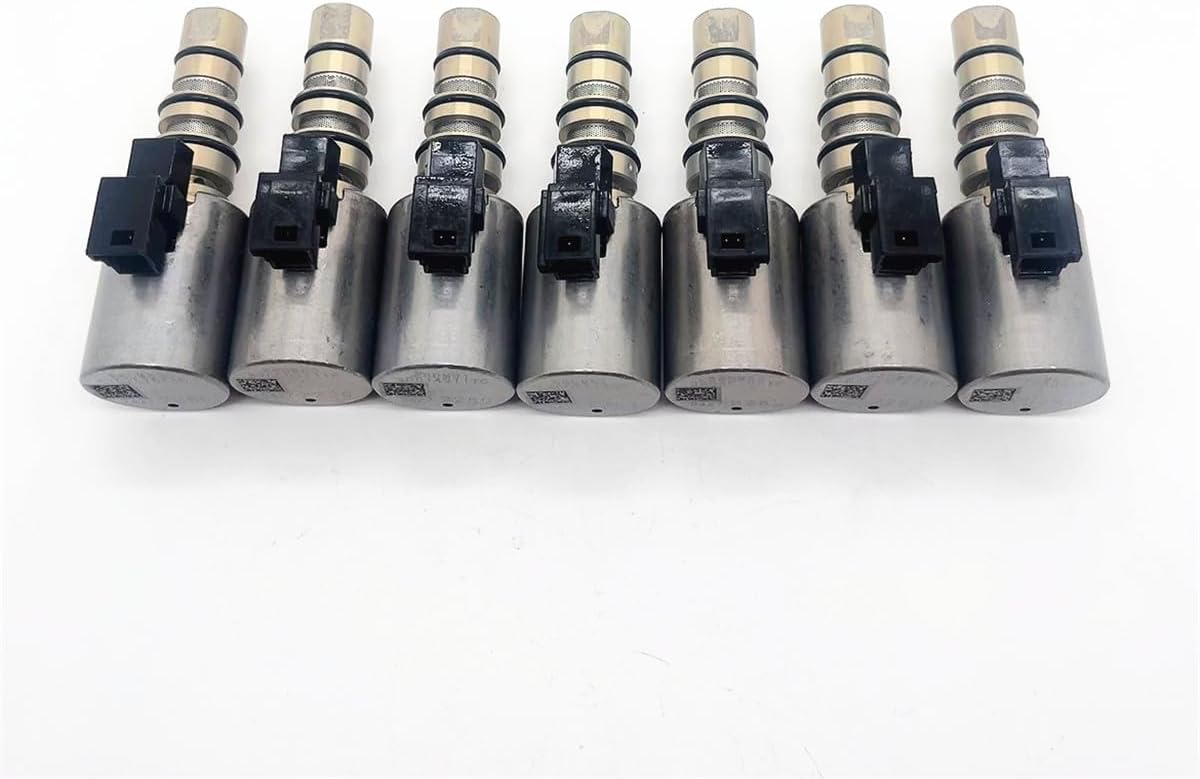
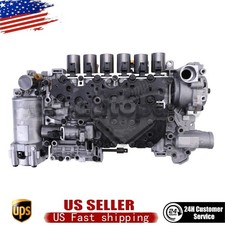
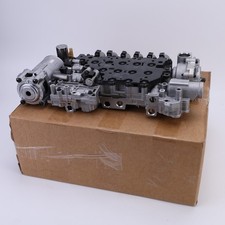
The 8L90 valve body carries nine solenoids. Per ATRA's GEARS breakdown of the unit, seven are variable force pressure control solenoids and two are on/off solenoids, and all of them measure 4.5 to 5.5 ohms. Four of the seven are normally high — S1 (1-2-7-8-Reverse), S4 (2-3-4-6-8), S5 (4-5-6-7-8-Reverse) and the line pressure solenoid. Three are normally low: S2 (1-2-3-4-5-Reverse), S3 (1-3-5-6-7) and S7, the TCC pressure control solenoid.
That normally-low behavior is the whole reason P0742 is a hydraulic code on this transmission. Current up means signal pressure up means clutch apply. No current means no signal pressure, the TCC clutch control valve should return to its released position, and the converter clutch should let go. There is no electrical failure mode that naturally defaults a normally-low circuit to full apply. If you find one, it is because the solenoid is mechanically stuck open with debris in it, not because the wiring failed.
| Complaint | What TCC slip does | Where to look first |
|---|---|---|
| Stuck on (P0742 family) | Stays near 0 RPM through a closed-throttle coastdown to a stop | S7 clutch control valve and bore, line pressure, debris in the solenoid |
| Stuck off / high slip (P0741) | Will not pull down to near 0 RPM when commanded on | Converter charge pressure, converter feed limit valve, bore wear, worn clutch |
| Shudder (18-NA-355) | Applies, but oscillates at 23–28 Hz at cruise | Degraded fluid, wrong ATF spec, converter friction |
One housekeeping note before you go further: read the exact descriptor in GM service information for the VIN in front of you rather than trusting the generic SAE text on a cheap scan tool. GM's 8-speeds set several codes in the TCC-stuck family, and Sonnax documents a specific valve body assembly mistake in the S7 bore that sets P2808 rather than P0742. The repair path is the same; knowing which code you actually have keeps you from chasing the wrong bulletin.
Confirm the clutch is actually stuck before you touch anything
The proof is TCC slip speed, which is engine RPM minus input speed. Graph it, do not stare at a number box.
- Record freeze frame first. Note road speed, engine load and fluid temperature at the moment it set. That tells you whether this happened on a decel or in a cruise band.
- Drive it above 45 mph until the clutch applies and slip drops to near zero. That part working tells you the apply side is fine, which already rules out a lot.
- Lift off and coast down to a stop. This is the test. Slip should open back up as the TCM releases the clutch. If slip sits pinned at zero all the way down and the engine bogs, shudders like a manual being lugged, or stalls as you come to a stop, the clutch is not releasing.
- Command the TCC off with bidirectional control and log the S7 solenoid command alongside slip. If the TCM is commanding zero and the clutch is still locked, the electrical side has done its job and the fault is downstream of the solenoid.
A stuck-on converter clutch has a signature that a slipping one does not: the complaint is worst at low speed and closed throttle, not at cruise. Customers describe it as the truck trying to die at every stop sign. If instead the complaint is a rumble-strip feel at a steady 40 to 50 mph, you are looking at shudder, and that is a different fix.
Put a gauge on it before the pan comes off
Do not skip this on an 8L90, because the pressure story on this unit is genuinely dangerous. Sonnax states that line pressure on the 8L45 and 8L90 should peak at around 315 psi, and that in their own evaluations they have measured units running above 415 psi. The cause is a worn pressure regulator valve lineup leaking badly enough that the valve cannot stroke to its lower pressure position, combined with an OE safeguard blow-off spring calibrated over 400 psi in some cases. Their photos show the result: cracked worm tracks in the valve body casting, which cannot be repaired, and catastrophic drum failure.
Runaway pressure matters to a stuck TCC for a simple reason. Everything in the valve body is sized around a pressure range, and when you exceed it by a third, oil finds every worn clearance in the casting, including the ones feeding converter apply. Chasing a hung TCC valve without knowing what pressure is behind it is guessing.
While the gauge is on, note Sonnax's baseline from the fast learn requirements: line pressure should be normal at a 55 to 60 psi minimum in Drive with pressure rise on throttle. If you cannot make that, the TCC complaint is a symptom of something larger.
The S7 bore, and the trap that eats rebuilt valve bodies
This is the part worth reading twice, because it is a self-inflicted failure that looks exactly like a converter problem.
The 8L valve body uses three different clutch control valves. Per Sonnax's Jim Mobley, the small inner land valves measure .426 in. diameter and the large bores take .443 in. valves — but every one of these valves has .531 in. outside lands at the solenoid end. They look interchangeable in your hand. They are not.
Sonnax spells out what happens with the wrong one in the converter circuit: a .426 in. valve mistakenly installed in the bore of S7 (TCC) causes no TCC apply and/or excessively high RPM slipping TCC apply, and may set code P2808 after extended driving. Related mix-ups have their own signatures. A .426 in. valve in the S3 bore sets P0722 with delayed forward engagements and sloppy upshifts that will not adapt out. The same valve in an early ('19-and-earlier) S4 bore flares the first 1-2 shift out of the gate, seems like it might adapt out, then does it again on the next key cycle. Sonnax notes most of these mistakes will not pass the Fast Learn process, which is a useful early warning that something is in the wrong hole.
The important caveat: this mix-up can only happen when someone has replaced valves with aftermarket valving, which is normal on a high-mileage worn valve body. If the unit still has all OE valving in it and nobody has been inside, it is not the cause. If you bought a rebuilt valve body, or you are working on a unit with unknown history that came back with a TCC complaint, it is very much on the list.
Solenoids carry the same risk. All the solenoid snouts and O-rings share dimensions, and although the harness connectors differ between the three pressure control solenoid types, Sonnax flags one exception worth memorizing: swap the S4 and TCC solenoids in their bores and you get a neutral on the 1-2 shift, because those two sit side by side and the harness will plug into either one.
Beyond assembly mistakes, ordinary wear in the S7 clutch control valve bore lets apply oil cross-leak into a circuit it does not belong in. Vacuum test the bore rather than eyeballing it — the technical booklet in Sonnax's TCC Zip Kit includes vacuum test information and locations for these valve body areas.
Sonnax S2/S3/S4/TCC Clutch Control Valve Kit 154740-11K
This is the kit that addresses the S7 (TCC) clutch control valve bore itself, along with the S2, S3 and S4 bores that wear alongside it. If your vacuum test fails at the TCC bore, or you inherited a valve body with unknown valving in it, this is the repair rather than another converter.
See the S2/S3/S4/TCC clutch control valve kit →Fluid: the thing that makes half of these complaints go away
The 8L90 takes DEXRON HP. Per GEARS, the fluid GM landed on is identified by part number 19417577 and a blue label — Mobil 1 Synthetic LV ATF HP — and the earlier black-bottle and grey-label HP formulations are the ones you want out of the unit. The original fluid turned out to be hygroscopic enough that absorbed moisture changed its friction characteristics, which is the mechanism behind the shudder complaints on these transmissions.
GM's procedure is bulletin 18-NA-355, covering 2015–2019 8L45 and 8L90 applications across Silverado, Sierra, Camaro, Corvette, Colorado, Canyon, Escalade, Yukon, ATS, CTS and CT6. A few numbers worth having on the bench:
- The exchange machine gets filled with 20 quarts of HP fluid, and the procedure exchanges 16 quarts through the unit.
- Never pull more than 3 quarts out at once. GM puts that in a caution box, in capitals, because running the unit dry damages it.
- The cooler line adapter block bolt torques to 22 N·m (16 lb ft).
- The cooler and lines get flushed separately with 2 quarts, one quart in each direction.
- Do not judge the repair on the test drive. GM states full effect takes up to 320 km (200 miles) and a minimum of two cold-to-operating-temperature drive cycles.
GM is also explicit that intermixing other ATF types or aftermarket additive packages leaves the concentration of new fluid too low to work. If a shop already dumped a bottle of shudder-fix additive in it, the exchange still has to be done properly.
Does fluid alone fix P0742? Rarely — a stuck-on clutch is a mechanical condition. But dirty or degraded fluid is exactly what hangs a valve, and doing the exchange correctly is the cheapest step on this list.
The repair, and making it stick
If the S7 bore fails a vacuum test, or you have found the wrong valve in it, fix the valve body rather than replacing the converter. Sonnax's TCC Zip Kit for these units (part 8L45-8L90-TCC-ZIP) is built around exactly this circuit group. It lists TCC apply and release concerns, overheated transmission and converter, loss of cooler flow, loss of lube oil, burnt converter, high TCC slip RPM and codes P0218 and P0741 as the symptoms it addresses, all attributed to loss of oil pressure from worn components in critical oil circuits. Its contents cover the TCC clutch control valve with seal and spring, a converter feed limit valve kit, an O-ringed end plug kit, the pressure regulator and O-ringed shuttle valve kit, and the pressure relief ball valve spring. No reaming and no special tools.
Given what Sonnax found on line pressure, their standing recommendation is worth following whether or not you have a TCC code: replace the pressure regulator lineup and the line pressure blow-off spring every single time you rebuild one of these valve bodies. Kit 154740-29K with pressure relief ball valve spring 154740-18 holds peaks in the 300 to 315 psi range instead of letting them run away.
Then do the relearn properly
Fast learn on a GM 8-speed is fussy, and skipping it is how a good repair comes back. Sonnax's requirements list:
- Fluid temperature must be between 167°F and 185°F (75–85°C), and if your TCM's programming has a different temperature requirement the module may need an update.
- Line pressure normal at 55–60 psi minimum in Drive with rise on throttle, and fluid level verified.
- The vehicle needs one quarter to three quarters of a tank of fuel for fast learn and the driving relearn that follows.
- Battery, alternator, power and ground all healthy — the 8L uses an external TCM and it is sensitive to voltage.
- Any stored powertrain codes, including engine misfires and ABS faults, will block it. So will a cut solenoid O-ring, a loose valve body bolt or a checkball in the wrong location.
Set expectations on the road test, too. Sonnax notes that TCC adapts and relearn after fast learn may still take 200 to 300 miles of driving. A converter clutch that feels slightly off on the first 20 miles is not automatically a failed repair.
One more thing that costs nothing: if you are installing a thermal bypass, do it after fast learn and adaptation are finished. Otherwise you may spend two hours in the bay power braking to reach the required fluid temperature.
The short version
S7 is normally low, so P0742 on an 8L90 is telling you about oil, not wiring. Prove the clutch is stuck with slip speed on a coastdown, put a gauge on line pressure before the pan comes off because these units genuinely run away past 415 psi, vacuum test the S7 clutch control valve bore, and check whether somebody has already been in there and put a .426 in. valve where a .443 in. valve belongs. Get the right DEXRON HP in it per 18-NA-355, replace the pressure regulator lineup while you are in the valve body, and give the adapts 200 to 300 miles before you decide it did not work.
FAQ
Is P0742 on an 8L90 an electrical problem?
Usually not. S7, the TCC pressure control solenoid on the 8L90, is a normally-low solenoid, which means with no current commanded it produces no output pressure and the converter clutch should release on its own. A dead solenoid or a cut wire therefore defaults to TCC off, not TCC on. When the clutch stays applied anyway, oil is reaching the apply circuit without a command, and that points at a valve, a worn bore or line pressure.
Why does my truck stall at a stop with P0742 stored?
Because the converter clutch is mechanically tying the engine to the driveline, exactly like holding a manual transmission in gear and forgetting the clutch pedal. As road speed falls toward zero the engine gets dragged down with it. If the stall happens every time you brake to a stop and the shudder happens only at cruise, you are dealing with a stuck-on clutch, not a shudder complaint.
How do I confirm the converter clutch is stuck on with a scan tool?
Watch TCC slip speed, which is engine RPM minus turbine or input speed. With the clutch released you should see slip open up on a closed-throttle coastdown. If slip stays pinned near zero RPM as the vehicle decelerates toward a stop, and it stays near zero after you command the TCC off with bidirectional control, the clutch is applied when it should not be. Also log the S7 solenoid command so you can prove the TCM is not asking for apply.
Is P0742 the same problem as the GM 8-speed shudder?
No, though they share a family. GM bulletin 18-NA-355 covers a shake or shudder during light throttle acceleration between 25 and 80 mph at steady speed, and GEARS puts that vibration in a 23 to 28 Hz band at roughly 122 to 158 degrees F. That is a clutch slipping in a controlled way on degraded fluid. P0742 is the opposite complaint: the clutch is not releasing at all. Fluid can contribute to both, but the shudder fix alone will not free a hung valve.
What line pressure should an 8L90 make, and why does it matter for TCC?
Sonnax puts the design peak at roughly 315 psi and reports measuring units running above 415 psi in their own evaluations, caused by a worn pressure regulator lineup and a blow-off spring calibrated too high. Runaway pressure shoves oil past worn clearances everywhere, including the converter apply circuit, and it has cracked valve body worm tracks and shattered drums. Put a gauge on the tap before you condemn a converter.
Sources
- General Motors — Service Bulletin 18-NA-355, “Shake and/or Shudder During Light Throttle Acceleration Between 25 and 80 MPH (40 and 128 KM/H) at Steady Speed” (August 2019, NHTSA-hosted PDF). Backs the 2015–2019 8L45 and 8L90 application list across Silverado, Sierra, Camaro, Corvette, Colorado, Canyon, Escalade, Yukon, ATS, CTS and CT6 under RPOs M5N, M5T, M5U and M5X; the 25–80 mph steady-state shudder condition described as driving over rumble strips; the blue label Mobil 1 Synthetic LV ATF HP fluid requirement and the warning that intermixing other transmission fluid types or aftermarket additive packages results in a low concentration of new fluid; the DT-45096 machine filled with 20 quarts and the 16-quart exchange; the caution against removing more than 3 quarts at a time; the 22 N·m (16 lb ft) torque on the cooler line adapter block bolt; the 2-quart cooler and line flush, one quart in each direction; and the statement that full effect takes up to 320 km (200 mi) and a minimum of two cold-to-operating-temperature drive cycles. static.nhtsa.gov (PDF)
- Sonnax — “GM 8L45, 8L90 Valve Body Traps: Clutch Control Valves & Solenoid Mix Ups,” Jim Mobley, May 2026. Backs the three clutch control valves used in 8L valve bodies; the .426 in. small inner land valve versus the .443 in. large valve bore and the shared .531 in. outside lands at the solenoid end that make the mix-up easy; the specific failure of a .426 in. valve installed in the bore of S7 (TCC) causing no TCC apply and/or excessively high RPM slipping TCC apply with possible code P2808 after extended driving; the comparison cases of a .426 in. valve in the S3 bore setting P0722 with delayed forward engagement and sloppy upshifts that will not adapt out, and the same valve in an early ('19-and-earlier) S4 bore flaring the first 1-2 shift and repeating on the next key cycle; the note that most of these mistakes will not pass the Fast Learn process; the point that the mix-up is only possible where aftermarket valving has been installed; and the S4 / TCC solenoid bore swap producing a neutral on the 1-2 shift because the two sit side by side and the harness plugs into either. sonnax.com
- Sonnax — “Watch Out for High Pressure in GM 8L45, 8L90 Valve Bodies,” Chris Leach, April 2024. Backs the roughly 315 psi design peak for 8L45 and 8L90 line pressure and the measured pressures above 415 psi in Sonnax evaluations; the root cause of a worn pressure regulator valve lineup leaking enough that the valve cannot stroke to its lower pressure position, combined with an OE safeguard blow-off spring calibrated over 400 psi in some cases; the resulting cracked valve body worm tracks that cannot be repaired and the catastrophic drum failure caused by runaway line pressure; the recommendation to replace the pressure regulator lineup and line pressure blow-off spring on every valve body rebuild; and pressure regulator with O-ringed shuttle valve kit 154740-29K paired with pressure relief ball valve spring 154740-18 to hold maximum pressures in the 300–315 psi range. sonnax.com
- Sonnax — “Tips for Success with the GM Transmission Fast Learn Process,” Jim Mobley, August 2023. Backs the 167°F to 185°F (75–85°C) fluid temperature requirement for fast learn on GM 8-, 9- and 10-speed units and the note that a TCM programmed with a different temperature requirement may need updating; the 55–60 psi minimum line pressure in Drive with pressure rise on throttle and verified fluid level; the one-quarter to three-quarters fuel tank requirement for fast learn and the subsequent driving relearn cycle; the statement that TCC adapts and relearn after the process may still take 200–300 miles of driving; the list of conditions that prevent fast learn from completing, including valve body wear, solenoid faults, assembly mistakes such as loose bolts and misplaced checkballs, cut solenoid O-rings, system voltage problems and stored powertrain codes; the external TCM on 8L units being sensitive to power and ground issues; and the advice to install a thermal bypass only after fast learn and adaptations are complete. sonnax.com
- Sonnax — TCC Zip Kit, part 8L45-8L90-TCC-ZIP (product and application data). Backs the symptom list this kit addresses on the 8L45 and 8L90 — TCC apply and release concerns, overheated transmission and converter, loss of cooler flow, loss of lube oil, burnt converter, high TCC slip RPM, code P0218 and code P0741 — attributed to loss of oil pressure due to worn components in critical oil circuits; the kit contents covering the TCC clutch control valve with seal and spring, converter feed limit valve kit, O-ringed end plug kit, pressure regulator and O-ringed shuttle valve kit, and pressure relief ball valve spring; the drop-in installation requiring no reaming or special tools; and the included technical booklet containing vacuum testing information and locations at key areas of the valve body. sonnax.com
- ATRA / GEARS Magazine — “8L90 Solenoid Strategies.” Backs the nine-solenoid 8L90 valve body count of seven variable force pressure control solenoids plus two on/off solenoids; the 4.5–5.5 ohm specification shared by all of them; the normally-high group of S1 (1-2-7-8-Reverse), S4 (2-3-4-6-8), S5 (4-5-6-7-8-Reverse) and line pressure control; and the normally-low group of S2 (1-2-3-4-5-Reverse), S3 (1-3-5-6-7) and S7 TCC pressure control — the fact this entire diagnosis rests on. gearsmagazine.com
- ATRA / GEARS Magazine — “What is Causing That? A Look at the GM 8L90's Most Common Concerns.” Backs the 23–28 Hz vibration frequency band that identifies a true TCC-related shudder on the 8L90; the light-throttle window with 40–50 mph typical and the 122–158°F operating temperature range in which it appears; the updated DEXRON HP fluid part number 19417577 identified by its blue label and the advice to avoid the earlier black-bottle and grey-label HP formulations; and the finding that the original fluid behaved hygroscopically, absorbing moisture and altering the fluid's friction dynamics. gearsmagazine.com