P0748 gets more 8L90 valve bodies replaced than it should. The code says "solenoid," the truck shifts badly, and the pan is on the floor before anybody has put a meter on anything. On a GM 8-speed that is backwards. P0748 is a circuit code. It is a complaint about electrical current, not about oil pressure, and the difference decides whether you are buying a valve body or cleaning a connector.
What P0748 is actually naming on an 8L90
The 8L90 valve body carries nine solenoids: seven variable force pressure control (VFS) solenoids and two three-port, on/off, normally closed solenoids. Per ATRA's GEARS breakdown of the unit, the on/off pair are S8, the default control solenoid that operates the default override valve, and S9, the 1-2-3-4-5-Reverse boost solenoid that operates the clutch boost valve. The other seven are current-controlled, and each one runs its own component — the same approach Ford took on the 6R140.
Of those seven, four are normally high: S1 (1-2-7-8-R), S4 (2-3-4-6-8), S5 (4-5-6-7-8-R) and the line pressure solenoid. Three are normally low: S2 (1-2-3-4-5-R), S3 (1-3-5-6-7) and S7, the TCC pressure control solenoid. P0748 lands on the line pressure solenoid, and its normally-high behavior is the first thing that trips people up. When the solenoid is off it passes pressure, and commanded current going up makes its output pressure go down.
| Code family | What the TCM is claiming | Where the fault lives |
|---|---|---|
| Stuck off | Solenoid commanded on, the pressure never arrived | Hydraulic: bore wear, stuck valve, plate screen |
| Stuck on | Circuit pressurized when it should have exhausted | Hydraulic: hung valve, cross-leak, AFL wear |
| P0748 — control circuit | Commanded current and measured current do not agree | Electrical: voltage, ground, connector, coil, TCM driver |
A generic scan tool prints the SAE label, "Pressure Control Solenoid A Electrical." The word electrical is the whole diagnosis. The TCM is not telling you a clutch slipped. It is telling you that when it drove current through that winding, what came back was outside its window — open, shorted, or high-resistance somewhere in the loop.
Why 4.5 to 5.5 ohms does not clear the solenoid
Every solenoid in this valve body measures 4.5–5.5 ohms, per GEARS. That is the whole spec, and it is close to useless as a pass/fail. These are current-controlled solenoids, and on the VFS units the TCM controls both the power and the ground circuit.
The part that matters is calibration. Each solenoid has its own part number and its own flow rate, and that flow data is tied to a Part Unique Number (PUN) marked on the valve body and solenoids, with a Transmission Unique Number (TUN) on the case. Those numbers point at the solenoid performance characteristic data stored in the TCM through GM's Service Programming System. Two solenoids that ohm identically can be calibrated differently, and the TCM will drive them as though they were not.
That has a practical consequence Sonnax spells out: GM does not sell these solenoids separately, and pulling one off a core unit alters the PUN programming the TCM algorithm depends on. It is why shift and solenoid codes on this unit so often end in a valve body plus programming rather than a parts-counter solenoid. Which is exactly why you want to be certain the fault is inside the transmission before you commit to that bill.
Resistance tells you the winding is not open and not dead-shorted. It does not tell you the solenoid is good, and it does not tell you the solenoid is the right one for that TCM.
Diagnose 8L90 P0748 in this order
1. Bulletins and calibrations before tools
Sonnax's own guidance on 8L45 and 8L90 shift and solenoid codes is that some of them clear with programming updates, so a thorough bulletin search is the first move. GM says the same thing in bulletin 16-NA-019: check the ECM and TCM software and calibrations in TIS2Web against what is in the vehicle, and if an update is relevant to the customer concern, perform it before proceeding. Note the catch GM includes in the same paragraph — completing that update clears the clutch adapts, so a Service Fast Learn followed by adaptive learning may be needed afterward.
2. Current flow, with an amp clamp
This is the test that actually addresses the code. GEARS gives working numbers for a GM pressure control solenoid: at idle you should see roughly 10 percent engine load and 0.9 to 1.1 amps of solenoid command. On a wide open throttle pull, just before the 1-2 shift, engine load should climb to 90–100 percent and solenoid command should drop to 0.2 to 0 amps. Amperage falls as load and line pressure rise.
Put an amp clamp on the pressure control solenoid wire and compare what the TCM says it is commanding against what is actually flowing. That single comparison splits the diagnosis in half. If the commanded value is clean and the measured current is erratic or absent, the fault is between the TCM and the coil. If both track together and the truck still misbehaves, the code is telling you the truth about the circuit and your complaint lives somewhere else.
3. Voltage, grounds and the case connector
A current-monitored driver is the first circuit a marginal ground or a corroded pin upsets. Load-test the battery, verify the TCM grounds, and back-probe the solenoid circuit at the case connector with the engine running and the code current while you flex the harness. A P0748 that appears and disappears with harness movement is a connector or a pass-through lead, not a coil.
4. Put a gauge on it before the pan comes off
Do not skip this on an 8L90, because the pressure story on this unit is genuinely dangerous. Sonnax states that line pressure on the 8L45 and 8L90 should peak at around 315 psi, and that in their evaluations they have measured units running above 415 psi. The cause is a worn pressure regulator valve lineup that leaks badly enough the valve cannot stroke to its lower pressure position, combined with an OE safeguard blow-off spring calibrated over 400 psi in some cases. The result is not a shift complaint. It is cracked worm tracks in the valve body casting, which cannot be repaired, and shattered drums.
So when a line pressure solenoid code shows up, get a real number off the tap at idle and at stall before you decide what failed. Pressure that is wildly high or wildly low reframes the entire job.
5. Inside the valve body: the signal accumulator that fakes this code
Here is the wear item that puts shops on the wrong path. Every one of the seven VFS circuits has a small signal accumulator piston that damps pressure and flow instability so the related control valve behaves. Sonnax documents that these very active pistons wear the cast aluminum bore they live in, and because the VFS solenoids are low-flow signal devices, any leak past that wear has an outsized effect on the valve it is supposed to control.
The one that matters here is S6, the line pressure solenoid's signal accumulator, on the low-pressure AFL circuit. Sonnax's chart lists its related complaints as low line pressure, slipping and burnt clutches, and various shift complaints — the exact symptom set a tech tends to blame on a solenoid. Vacuum test it with the spring still in the piston and the test port opening centered on the spring. Sonnax notes S3 and S4 are generally the worst wearers, but S6 is the one that owns line pressure.
While you are in there, look at the actuator feed limit valve. It is the pressure regulator for every solenoid in the unit, holding a consistent feed while line pressure varies. Per GEARS, AFL problems either starve or flood the solenoids and produce shift and line pressure complaints together. If you have a solenoid code plus a pressure complaint plus assorted shift issues, the AFL is a better suspect than any single coil.
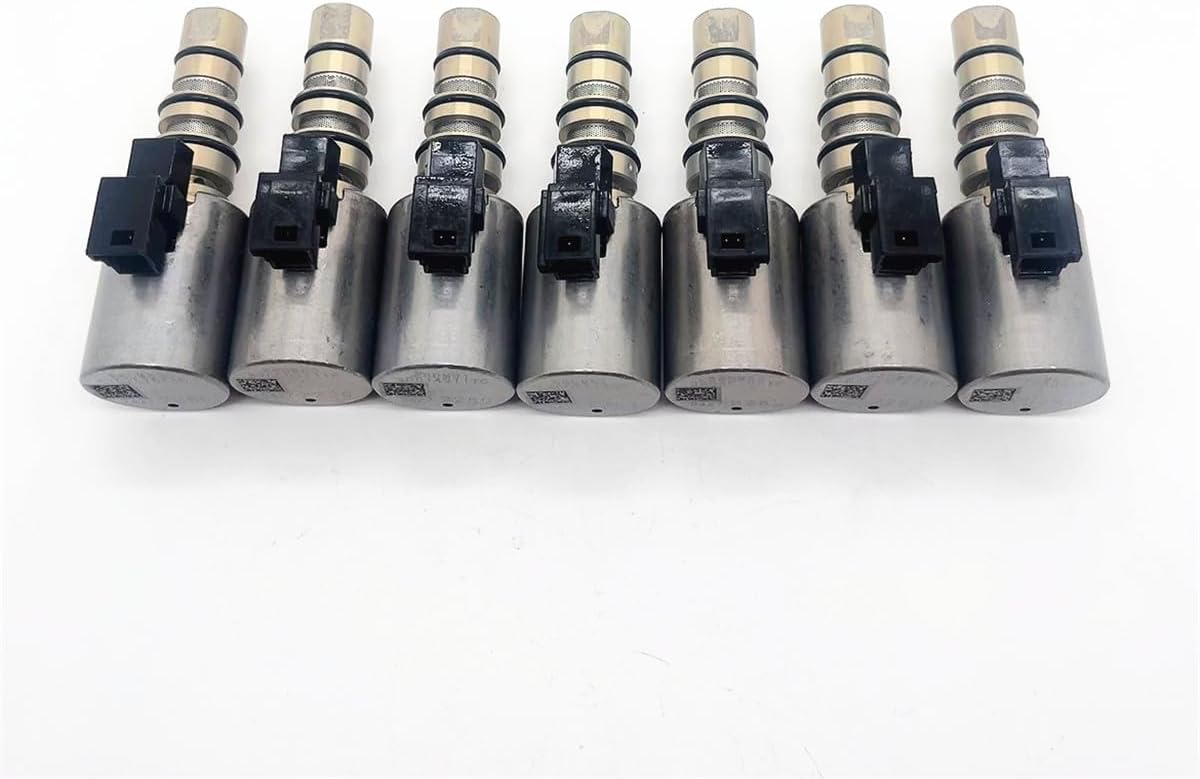
8L90 Shift Solenoid Kit, 9-Piece
If the current test lands on the solenoid body rather than the harness, this is the full nine-solenoid set for the 8L90 valve body, so you are not mixing flow rates across locations. Plan on programming the TCM with the solenoid performance data afterward, or you have traded one complaint for another.
See the 8L90 9-piece solenoid kit →The repair, and the programming step that decides whether it sticks
If the fault is external — ground, connector, harness — fix it and the code is done. If it is internal, the OEM path on this unit is a valve body with solenoids, and then programming.
Both GEARS and GM are explicit that the programming is not optional. Change the transmission, the valve body, the solenoids or the TCM, and you have to pull the unique performance characteristic data through the TIS2Web Service Programming System and load it into the TCM. Document the new PUN or TUN, log in to SPS with the VIN, select transmission control module programming, and supply the number. The system reads the VIN from the ECM through a GM MDI, retrieves the data tree, updates the genealogy tree, and writes the correct solenoid characterization data to the TCM.
Then deal with the adapts. Per 16-NA-019, the Hydra-Matic 8-speed uses line pressure and volume control to compensate for new-build variation and normal wear, with the TCM watching the input speed sensor and output speed sensor during commanded shifts and trimming the corresponding pressure control solenoid signal to hold the calibrated shift timing. After a transmission replacement, GM's instruction is to reset the adapts with Service Fast Learn in GDS 2: Module diagnostics → Transmission Control Module → Configuration / Reset Function → Transmission Service Fast Learn. It runs in the service stall with no driving required. One important distinction from the same bulletin: if nothing was replaced and the customer has one specific shift concern, GM says to skip the Service Fast Learn and run the driving learn procedure for that shift instead.
Fluid and refill
The 8L90 takes DEXRON HP — not LV, not ULV. GM's TechLink capacity chart lists the 8L90 under RPO N8X at 7.0 quarts for a fluid change and 7.4 quarts when the filter goes with it. Mobil 1 Synthetic LV ATF HP is approved and licensed by General Motors against DEXRON HP if you are not buying the ACDelco bottle. Filling an HP unit with the wrong spec produces shift quality complaints that look electrical and are not, which is a miserable way to finish a solenoid job.
What keeps it from coming back
Two things, and neither one is the solenoid.
First, the signal accumulator bores. If you find wear, restore them rather than hoping. Sonnax's drop-in kit 154740-06K reconditions up to four bores with no reaming; the oversized kit 154740-01K covers a full set of seven and is used with tool kit 154740-TL. They specifically call for like aluminum material so bore clearance does not open up at operating temperature.
Second, the pressure regulator lineup. Sonnax's position on this unit is blunt: when you rebuild an 8L45 or 8L90 valve body, replace the pressure regulator lineup and the line pressure blow-off spring every single time. Their pressure regulator and O-ringed shuttle valve kit 154740-29K paired with pressure relief ball valve spring 154740-18 holds peaks in the 300–315 psi range instead of letting them run away. A cracked casting is a total loss, and it is a preventable one.
FAQ
Is P0748 on an 8L90 always a bad solenoid?
No. P0748 is a control-circuit code: the TCM commanded a current through the line pressure solenoid and the current it measured back did not match. A corroded case connector, a bad TCM ground, a weak battery or a TCM driver sets it just as readily as an open winding. Check current flow and voltage before you condemn a valve body that GM will not sell you solenoids for anyway.
What resistance should an 8L90 solenoid read?
Per ATRA's GEARS teardown, all nine 8L90 solenoids measure 4.5 to 5.5 ohms. That number only tells you the winding is not open or dead-shorted. These are current-controlled solenoids with individually flow-rated part numbers, so two solenoids can ohm identically and behave completely differently. Resistance is a screening test, not a verdict.
What should the line pressure control solenoid command be on a scan tool?
GEARS gives the working window: about 0.9 to 1.1 amps at idle with roughly 10 percent engine load, dropping to 0.2 to 0 amps at wide open throttle just before the 1-2 shift with load at 90 to 100 percent. It is a normally-high solenoid, so amperage falls as commanded pressure rises. An amp clamp on the solenoid wire tells you whether the TCM is actually delivering that signal.
How much line pressure should an 8L90 make?
Sonnax puts the design peak at roughly 315 psi. In their evaluations they measured units running above 415 psi because of a worn pressure regulator lineup and a blow-off spring calibrated too high, and that runaway pressure cracked valve body worm tracks and shattered drums. If you are chasing a solenoid code and you have not put a gauge on the tap, you are guessing.
Do I have to reprogram the TCM after replacing an 8L90 valve body?
Yes. Each solenoid carries unique flow-rate characterization data identified by the Part Unique Number on the valve body and the Transmission Unique Number on the case. If you change the transmission, valve body, solenoids or TCM, you have to download that data through SPS and program the TCM, or the shift control algorithm is working from the wrong numbers.
Sources
- General Motors — Service Bulletin 16-NA-019, “Information on Transmission Adaptive Functions and Correcting Low Mileage Harsh Shifts, Slips, or Flares” (August 2016, NHTSA-hosted). Backs the 2016–2017 GM passenger car and truck application with 8L90 and 8L45 automatics under RPOs M5U, M5T, M5N and M5X; the instruction to check ECM/TCM software and calibrations in TIS2Web before performing any learn, and the note that the update clears clutch adapts; the description of the Hydra-Matic 8-speed line pressure and volume control system compensating for build variation and normal wear; the TCM monitoring the input speed sensor and output speed sensor during commanded shifts and adjusting the corresponding pressure control solenoid signal; the five-clutch architecture of the 8-speed; the GDS 2 navigation path Module diagnostics → Transmission Control Module → Configuration / Reset Function → Transmission Service Fast Learn; and the instruction to skip Service Fast Learn and use the driving learn procedure when nothing was replaced. static.nhtsa.gov (PDF)
- ATRA / GEARS Magazine — “8L90 Solenoid Strategies,” GEARS Staff, January/February 2018. Backs the nine-solenoid 8L90 valve body count of seven variable force pressure control solenoids plus two three-port on/off normally closed solenoids (S8 default control operating the default override valve, S9 1-2-3-4-5-Reverse boost operating the clutch boost valve); the normally-high group of S1 (1-2-7-8-R), S4 (2-3-4-6-8), S5 (4-5-6-7-8-R) and the line pressure solenoid; the normally-low group of TCC, S3 (1-3-5-6-7) and S2 (1-2-3-4-5-R); the 4.5–5.5 ohm current-controlled solenoid spec; the Part Unique Number on the valve body and solenoids and the Transmission Unique Number on the case; the TIS2Web SPS reprogramming requirement and its step sequence after changing the transmission, valve body, solenoids or TCM; the TCM controlling both power and ground circuits; and the warning that each solenoid has a different part number and flow rate and must be installed in its original location. gearsmagazine.com
- ATRA / GEARS Magazine — “Controlling Pressure General Motors,” Rob Faucett, August 2023. Backs the scan tool working values of roughly 10 percent engine load and 0.9–1.1 amps of pressure control solenoid command at idle, and 90–100 percent load with solenoid command dropping to 0.2–0 amps during a wide open throttle test just before the 1-2 shift; the inverse relationship where solenoid amperage drops as engine load and line pressure rise; the amp clamp on the pressure control solenoid wire as the way to verify the computer's signal is reaching the transmission; and the actuator feed limit valve acting as the pressure regulator for all solenoids, with AFL problems starving or flooding the solenoids and producing both shift and line pressure complaints. gearsmagazine.com
- Sonnax — “Diagnosing 8L45 & 8L90 Shift Complaints: Always Check the VFS Solenoid Circuits,” Maura Stafford, April 2021. Backs the advice to search bulletins first because some of these codes clear with programming updates; the note that GM does not sell the solenoids separately and that pulling one from a core would alter the PUN programming the TCM algorithm relies on; the signal accumulator piston in every one of the seven VFS circuits, used to damp pressure and flow instability, and the resulting wear of the cast aluminum bore; the point that these are low-flow signal circuits so any leak past that wear has an outsized effect on the related control valve; the S6 signal accumulator piston mapping to the line pressure solenoid on the low (AFL) circuit with related complaints of low line pressure, slipping and burnt clutches, and various shift complaints; the observation that S3 and S4 locations are generally the worst; the vacuum test method with the spring left in the piston and the port centered on the spring; the requirement to use like aluminum material to control thermal expansion clearance; and drop-in signal accumulator piston kit 154740-06K plus oversized kit 154740-01K used with tool kit 154740-TL. sonnax.com
- Sonnax — “Watch Out for High Pressure in GM 8L45, 8L90 Valve Bodies,” Chris Leach, April 2024. Backs the roughly 315 psi design peak for 8L45 and 8L90 line pressure and the measured pressures above 415 psi in Sonnax evaluations; cracked valve body worm tracks that cannot be repaired and catastrophic drum failure caused by runaway line pressure; the root cause of a worn pressure regulator valve lineup leaking enough that the valve cannot stroke to its lower pressure position, combined with an OE blow-off spring calibrated over 400 psi in some cases; the point that a shuttle valve without O-rings may not seal a worn bore; the recommendation to replace the pressure regulator lineup and blow-off spring on every valve body rebuild; and pressure regulator and O-ringed shuttle valve kit 154740-29K with pressure relief ball valve spring 154740-18 to hold peaks in the 300–315 psi range. sonnax.com
- General Motors — GM TechLink “2025 Transmission Capacities & Fluids” reference chart. Backs the DEXRON HP specification for the 8L90 and the fluid change capacity of 7.0 qt without a filter change and 7.4 qt with one, listed under RPO N8X for Express, Savana and Silverado applications, along with the matching 7.0 / 7.4 qt DEXRON HP figures for the 8L80 and 8L45. gm-techlink.com (PDF)
- ExxonMobil — Mobil 1 Synthetic LV ATF HP product data sheet. Backs the fluid identification used here: Mobil 1 Synthetic LV ATF HP is the full synthetic automatic transmission fluid approved and licensed by General Motors against the DEXRON HP specification, which is the spec GM lists for 8L90 applications. mobil.com