The ZF 9HP48, badged 948TE under FCA/Stellantis and shared across Jeep Cherokee, Renegade and Compass, Chrysler 200 and Pacifica, Ram ProMaster City, Fiat 500X, and used in a closely related form in the Honda Pilot, Ridgeline, Acura MDX and TLX, plus a handful of Land Rover Evoque and Discovery Sport applications, has a specific reputation for a delayed engagement complaint: the driver drops it into Drive or Reverse, lets off the brake, and the vehicle sits there a beat too long before it moves. That complaint has two unrelated root causes that happen to produce the identical symptom, and guessing which one you have before testing is how good valve bodies end up pulled for nothing.
This article works the complaint in the order that avoids a comeback: confirm the TCM's adaptive learning and software level first, since that is free to check and well documented on FCA applications, then move to the specific valve body wear Sonnax ties to this exact symptom, with the fluid specification that explains why the delay is worse on a cold morning.

Rule Out the TCM Calibration First
FCA's TSB 21-034-14, issued November 1, 2014 and titled "Flash: 948TE 9 Speed Shift Enhancements And Quick Learn Enable," covers a selective erase-and-reprogram of the transmission control module on 2015 Jeep Cherokee (KL) and Chrysler 200 (UF) models equipped with the 948TE. The bulletin's own stated purpose is to improve transmission downshift response time during normal driving and to enable the wiTECH-based Transmission Quick Learn procedure, the dealer-level tool used to reset and relearn clutch fill adaptation after a battery disconnect, a TCM replacement, or a valve body service.
The practical takeaway for diagnosis: before any part is ordered, confirm the TCM software level is current, and if the clutch adaptation was recently cleared or has never been relearned, run the Quick Learn procedure. A 9HP48/948TE that has not yet logged enough clutch fill-time and fill-pressure learning events will not have fully dialed-in shift feel, including how promptly it engages, and that is a software condition, not a worn part. Honda and Acura applications use their own TCM calibration and bulletin numbers for the same base transmission, so confirm the manufacturer-specific bulletin rather than applying the FCA number directly.
When It Is Not Software: The Solenoid Pressure Regulator Valve
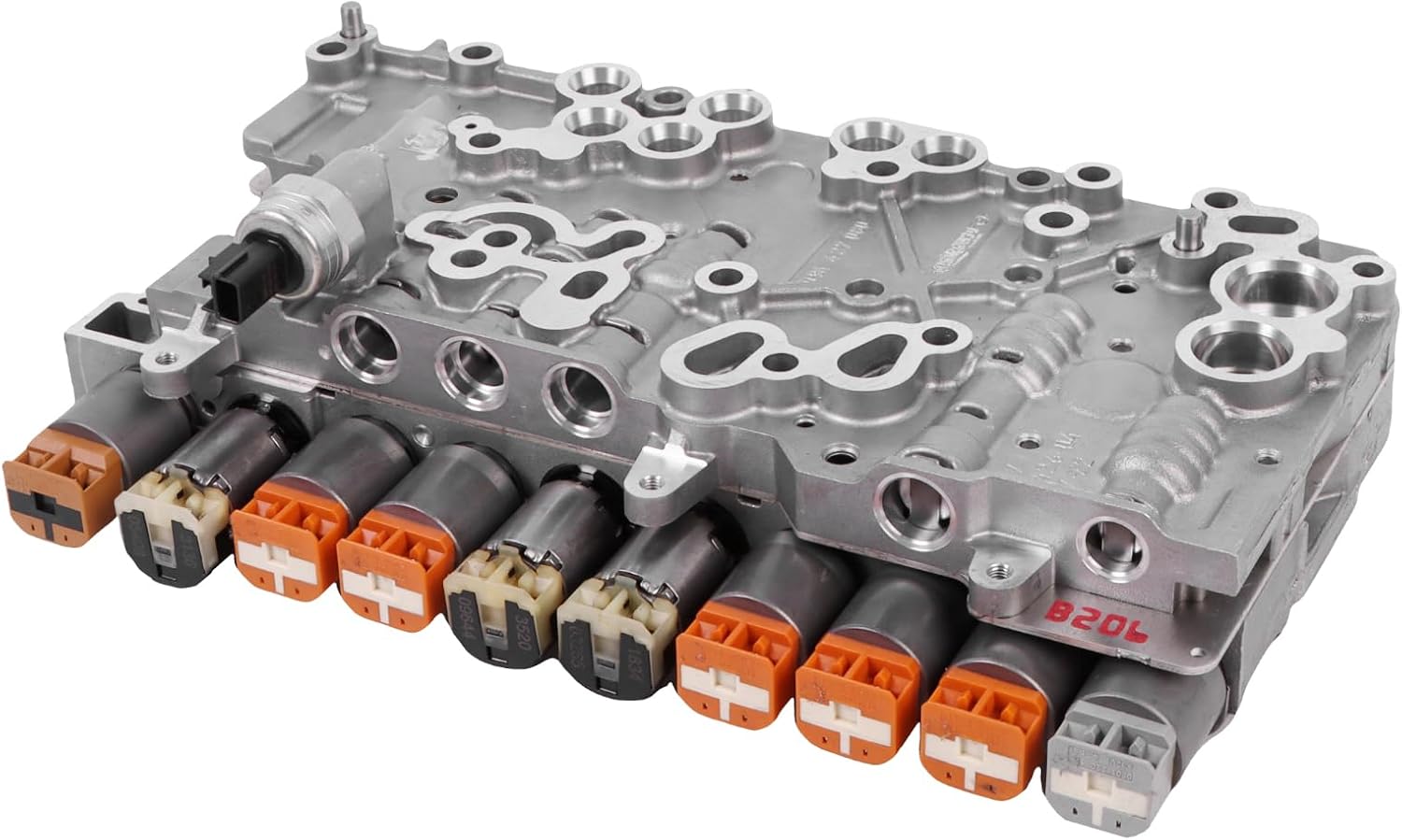
If the TCM software is current, adaptation has been relearned, and the delay is still there, Sonnax's 85740-09K Solenoid Pressure Regulator Valve Kit, built specifically for the ZF9HP48, Chrysler 948TE, and the Honda/Acura 9-speed, names delayed engagement as one of the exact symptoms tied to this one bore. Sonnax's own problem list for this kit also includes harsh downshifts and upshifts, neutral shifts, high line pressure, wrong gear starts, gear ratio and solenoid DTCs, TCC slip, and flare shifts, which is a wide symptom spread for a single worn valve, and why a scattershot parts-cannon approach rarely lands on the first try.
Why One Worn Valve Produces All of That
The solenoid pressure regulator valve's job is to hold steady pressure and volume to the transmission's solenoids under both hot, low-pressure operating conditions. Per Sonnax, wear on the valve's bore surfaces lets pressurized oil leak past it instead of reaching the solenoids, reducing the pressure and volume actually available to them. Starved solenoids cannot fill a clutch pack on command fast enough, which shows up as a delay going into gear; the same starvation can also show up as a flare or a harsh shift depending on which clutch is affected and when in the shift cycle the shortfall happens.
Sonnax's fix is part number 85740-09K, a drop-in Zip Valve design intended for quick installation without machining. The kit includes a hardcoat-anodized aluminum valve, a billet sleeve, a sleeve extension, a new spring, a drill bit, and a plug that allows rerouting of balance oil at the separator plate. The hardened components are built to resist the same premature bore wear that caused the original failure, rather than just replacing a soft valve with another soft valve.
Why the Delay Is Worse Cold
The 9HP48's internal layout, per SAE paper 2013-01-1276 and the ATRA-published technical breakdown in Gears Magazine, uses four multiple-disc clutches (designated B, C, D and E), two dog clutches (A and F), three planetary gearset sections, and a dual-output vane-style oil pump. Every one of those clutches has to fill with fluid before it can apply, and fluid that is thick from cold takes longer to fill a clutch pack than fluid at operating temperature, independent of any valve or solenoid wear.
ZF's own product data sheet for LifeguardFluid 9, the only fluid ZF approves for the 8HP and 9HP family, quantifies exactly how much thicker: viscosity measures 24.9 mm²/s at 40°C but a Brookfield viscosity of 8,850 mPa.s at -40°C, with a pour point of -42°C. That is a dramatic swing in flow resistance between a warmed-up transmission and a cold start in winter, and it is the physical reason a brief hesitation on a cold morning that disappears after the first mile is a different complaint than one that persists once the fluid is at operating temperature. ZF states using any fluid other than LifeguardFluid 9 in these transmissions can range from a measurable deterioration in shift characteristics to outright transmission failure, and while these transmissions are filled for life by design, ZF recommends a change at 150,000 km, sooner under heavy load, high heat, or unknown service history.
| Spec | Value |
|---|---|
| Approved fluid | ZF LifeguardFluid 9 only (8HP/9HP family) |
| Fluid color | Blue |
| Viscosity at 40°C | 24.9 mm²/s |
| Viscosity at 100°C | 5.6 mm²/s |
| Brookfield viscosity at -40°C | 8,850 mPa.s |
| Pour point | -42°C |
| Flash point (COC) | 185°C |
| ZF recommended change interval | 150,000 km (sooner under heavy load/heat) |
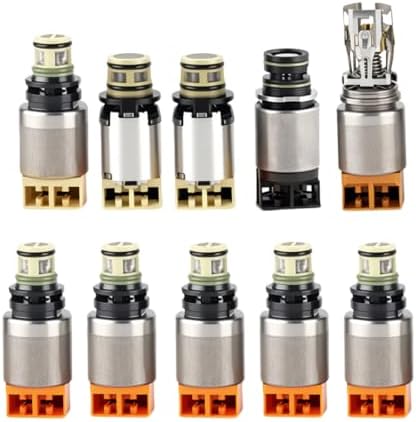
9HP48 Transmission Solenoid Kit, 10-Piece Refurbished
Covers the full solenoid set if a pressure regulator valve repair and a current TCM adaptation both come back clean and the delay persists. Reused solenoids should always return to their original bore position; the TCM learns a flow rate per location.
View the 9HP48 solenoid kit →The Diagnostic Order That Avoids a Comeback
- Scan for active TCM DTCs. Repair any codes before evaluating shift feel; do not run an adaptation relearn over an unresolved fault.
- Confirm the fluid is ZF LifeguardFluid 9 (or the correct OEM-equivalent for Honda/Acura applications) and the level is correct, checked at normal operating temperature.
- Confirm TCM software is current. On 2015 Jeep Cherokee and Chrysler 200 models, check against TSB 21-034-14; other model years and Honda/Acura applications have their own calibration bulletins.
- If the TCM, valve body, or battery was recently replaced or disconnected, run the Quick Learn adaptation procedure before suspecting hardware.
- If the delay persists with current software and no codes, inspect and test the solenoid pressure regulator valve bore; replace with Sonnax 85740-09K where wear is confirmed.
- If the valve tests good, move to the solenoid set itself, returning any reused solenoid to its original bore location.
- Run a drive-cycle or Quick Learn relearn after any valve body or solenoid service, every time, before the vehicle leaves.
Most comebacks on this complaint are not failed repairs. They are a correct repair performed before confirming the TCM software and adaptation were actually current, or a valve replaced on a transmission that only needed a cold-morning warm-up. Work the order above and the delay either clears for free in the first few steps or gets fixed once, on the bench, with a part number instead of a guess.
FAQ
Is a short hesitation on cold mornings normal on a 9HP48?
Some of it is physics, not a defect. ZF's own data sheet for LifeguardFluid 9 lists a Brookfield viscosity of 8,850 mPa.s at -40 degrees C, versus 24.9 mm²/s at 40 degrees C, meaning the fluid is dramatically thicker when cold. That thick fluid fills the clutch packs more slowly until the transmission warms up, which produces a brief, repeatable delay that fades after a few minutes of driving. A delay that persists once the fluid is at operating temperature is not this, and should be diagnosed as described above.
Will a TCM reflash fix delayed engagement by itself?
On FCA applications it can, for a specific population. Chrysler's TSB 21-034-14, issued November 1, 2014, covers a TCM reprogram for 2015 Jeep Cherokee and Chrysler 200 models titled Shift Enhancements and Quick Learn Enable, which improved downshift response and enabled a wiTECH-based Quick Learn adaptation procedure. If the TCM software is behind and the vehicle has never had its clutch fill values relearned, confirming software level and running Quick Learn is the correct first step, before any part is ordered.
What inside the valve body actually causes delayed engagement on a 9HP48?
Sonnax's own documentation for its 85740-09K Solenoid Pressure Regulator Valve Kit, built for the ZF9HP48, Chrysler 948TE and the Honda/Acura 9-speed, ties delayed engagement to wear on the solenoid pressure regulator valve bore. As that bore wears, pressurized oil leaks past it instead of reaching the solenoids, which lowers the pressure and volume available to fill the clutches on a shift. The same wear also shows up as harsh downshifts and upshifts, neutral shifts, wrong gear starts, and gear ratio or solenoid DTCs.
Does the wrong ATF cause delayed engagement on this transmission?
It can. ZF's product data sheet for LifeguardFluid 9 states plainly that using a fluid other than LifeguardFluid 9 in an 8HP or 9HP transmission can range from a measurable deterioration in shift characteristics to outright transmission failure. A low fluid level from a pan gasket or filter O-ring leak produces the same complaint, which is why checking fluid type and level is a free step before any valve or solenoid is condemned.
Does this apply to the Honda and Acura version of the 9-speed too?
Mechanically, yes. The ZF 9HP48 is the same base transmission under FCA's 948TE badge and under Honda and Acura applications including the Pilot, Ridgeline, MDX and TLX; Sonnax's 85740-09K kit is explicitly listed for all three. The TCM software and bulletin numbers differ by manufacturer, so a Honda or Acura tech should confirm the applicable Honda TSB rather than applying the FCA bulletin number, but the solenoid pressure regulator valve wear and the fluid specification are the same across applications.
Sources
- Chrysler Group LLC / NHTSA — Service Bulletin 21-034-14, "Flash: 948TE 9 Speed Shift Enhancements And Quick Learn Enable," November 1, 2014. Backs the 2015 Jeep Cherokee (KL) and Chrysler 200 (UF) application, the TCM reprogram scope, the stated purpose of improving downshift response and enabling the wiTECH Quick Learn adaptation procedure. static.nhtsa.gov (PDF)
- Sonnax — "Solenoid Pressure Regulator Valve Kit," product page, part number 85740-09K. Backs the ZF9HP48/Chrysler 948TE/Honda-Acura 9-speed application, the full symptom list (delayed engagement, harsh downshifts/upshifts, neutral shifts, high line pressure, wrong gear starts, gear ratio and solenoid codes, TCC slip, flare shifts), the root-cause description of bore wear letting pressurized oil leak away from the solenoids, and the kit contents (hardcoat anodized aluminum valve, billet sleeve, sleeve extension, spring, drill bit, plug). sonnax.com
- Gears Magazine (ATRA) — "ZF 9HP48: A Mechanical Marvel," December 2019. Backs the transmission's broad OEM application list (FCA, Honda/Acura, Land Rover), the clutch and gearset construction (four multiple-disc clutches B-E, two dog clutches A and F, three planetary gearset sections, dual-output vane pump), and the documented early shift-quality issues (harsh upshifts/downshifts, delayed engagements, gear ratio error DTCs) resolved largely through TCM reprogramming. gearsmagazine.com
- SAE International — "The ZF Automatic Transmission 9HP48 Transmission System, Design and Mechanical Parts," Technical Paper 2013-01-1276, 2013. Backs the transmission's internal mechanical architecture (four multi-disc clutches, two dog clutches, three planetary gearsets) referenced for the cold-fill explanation. saemobilus.sae.org
- ZF Friedrichshafen AG — Product Data Sheet, ZF LifeguardFluid 9, July 19, 2021. Backs the approval of only LifeguardFluid 9 for the 8HP/9HP family, the warning that other fluids can cause anything from deteriorated shift quality to transmission failure, the fluid properties (blue color, 24.9 mm²/s viscosity at 40°C, 5.6 mm²/s at 100°C, 8,850 mPa.s Brookfield viscosity at -40°C, -42°C pour point, 185°C flash point), and the 150,000 km recommended change interval. aftermarket.zf.com (PDF)