The Allison 1000 behind a 6.6L Duramax will go 300,000 miles if you service it correctly. Most of the ones that reach my bench burned are not victims of bad engineering. They are victims of a service done on the wrong interval, with the wrong fluid, or filled to the wrong level because somebody checked it cold and called it good.
There is also a spec change a lot of shops have not caught up with. Allison introduced TES 668 in 2020 and it is now the fluid the factory recommends across the on-highway lineup, including the 1000 Series. If you are still stocking TES 389 fluid and quoting 50,000 miles on every Allison that rolls in, you are leaving 100,000 miles of service life on the table — and on a severe-duty truck you are quoting an interval four times too long for what you put in.
Everything below comes from the current Allison 1000/2000 Series Operator's Manual (OM8471EN, September 2021) and Allison's published fluid guidance, not forum consensus.
Step 1: Know Which Fluid Is Actually In the Truck
Allison has four on-highway fluid specs in circulation. TES 389 is the old conventional-grade spec. TES 295 is the long-life synthetic spec that has been around roughly two decades. TES 468 is a lower-tier synthetic. TES 668 is the current one, announced in 2020, and per Allison's approved-fluids guidance it is recommended for the 1000, 2000, 3000 and 4000 Series plus the H 40/50 EP and the eGen product lines. Allison's own wording is that customers running TES 295 or TES 468 should "consider Allison's newest fluid spec, TES 668, for their next service."
TES 668 is backward compatible with TES 295, TES 389 and TES 468, so you are not required to flush anything to switch. Chevron, one of the licensed formulators, states plainly that the fluid is backwards-compatible with all three earlier Allison-approved specs, which is what makes the transition practical on a fleet.
Here is the part that catches people. Allison's interval table carries this note: anything less than 100 percent concentration of TES 668 or TES 295 approved fluid is considered a mixture, and a mixture has to run the shorter TES 389 change intervals. It also states that mixtures shall not be used with Prognostics. A pan drop and refill leaves a large share of the old fluid in the converter, cooler and lines. If the truck came in on TES 389 and you refill with TES 668, you have made a mixture, and it stays on the short schedule until you cycle the old fluid out. Tell the customer up front or the long-life fluid upsell turns into a comeback.
One more, straight from the interval table: TES 389 cannot be used in MY09 units.
Step 2: Pick the Right Interval, Not the One You Remember
Allison publishes intervals as a matrix, not a single number. Two things decide which cell you land in: whether Prognostics is turned on in the TCM, and whether the truck is General or Severe vocation. Allison defines Severe as On/Off Highway, Refuse, City Transit and Shuttle Transit. General is everything else. Change at or before the mileage, months, or hours listed, whichever comes first.
With Prognostics off or not calibrated in the TCM, fluid intervals run:
- General vocation, TES 668 or TES 295: 150,000 miles (240,000 km), 4,000 hours, or 48 months
- General vocation, TES 389: 50,000 miles (80,000 km), 2,000 hours, or 24 months
- Severe vocation, TES 668 or TES 295: 75,000 miles (120,000 km), 3,000 hours, or 36 months
- Severe vocation, TES 389: 12,000 miles (20,000 km), 500 hours, or 6 months
The spin-on control main filter is on its own clock, and it is shorter than the fluid clock. General vocation is 50,000 miles, 2,000 hours or 24 months regardless of which of those fluids you run. Severe vocation on TES 668 or TES 295 is also 50,000 miles; severe on TES 389 drops to 12,000 miles, 500 hours or 6 months. The internal filter is an overhaul-only item in every column.
That filter-versus-fluid split is the practical takeaway. On a general-duty Duramax running TES 668, you are changing the spin-on filter three times before the fluid is due. Shops that treat "Allison service" as one event on one interval are either overspending on fluid or running a loaded filter for 100,000 miles.
With Prognostics turned on, fluid and filter both go to "when indicated by the controller, or 48 months, whichever occurs first" on TES 668 and TES 295, and 24 months on TES 389 for MY2010.
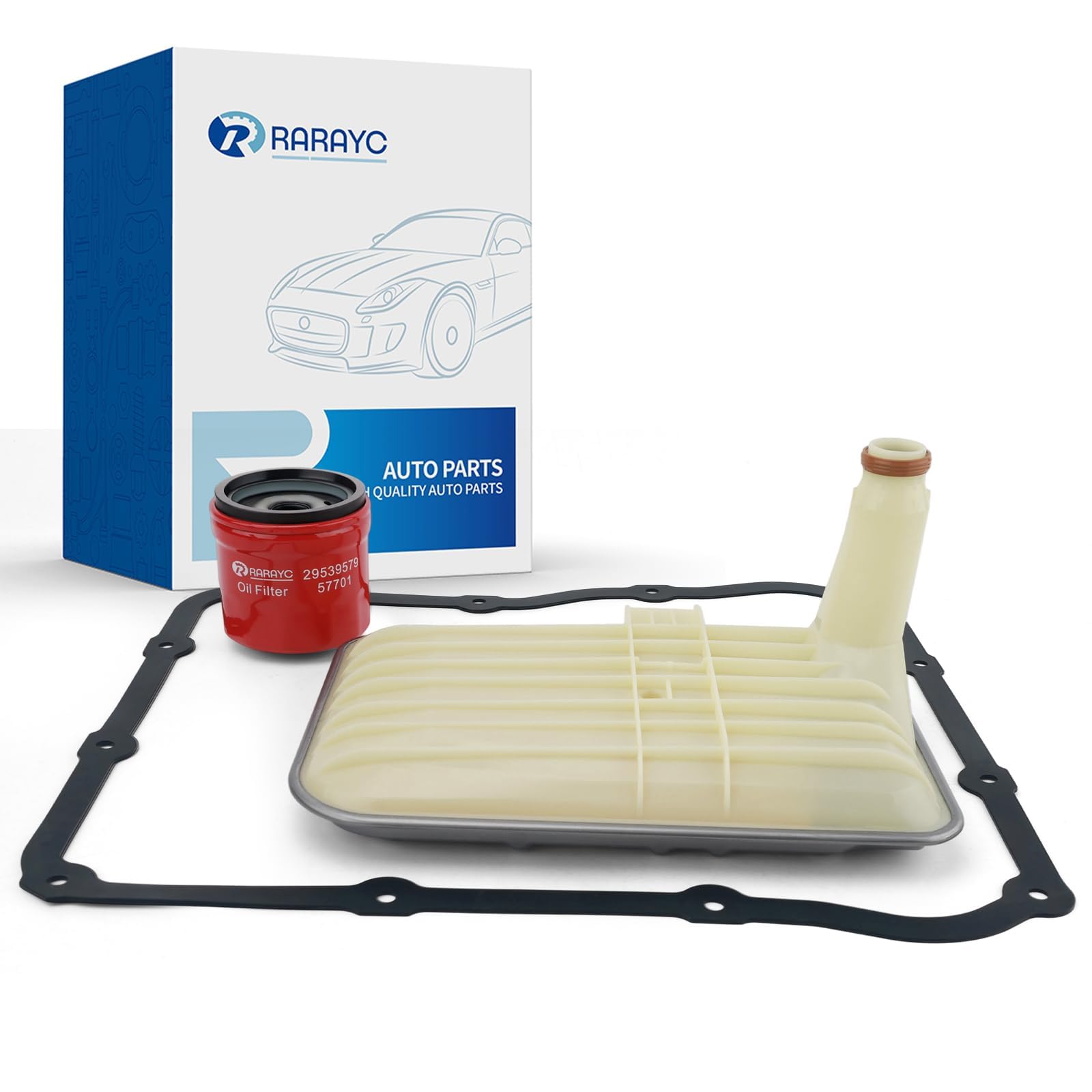
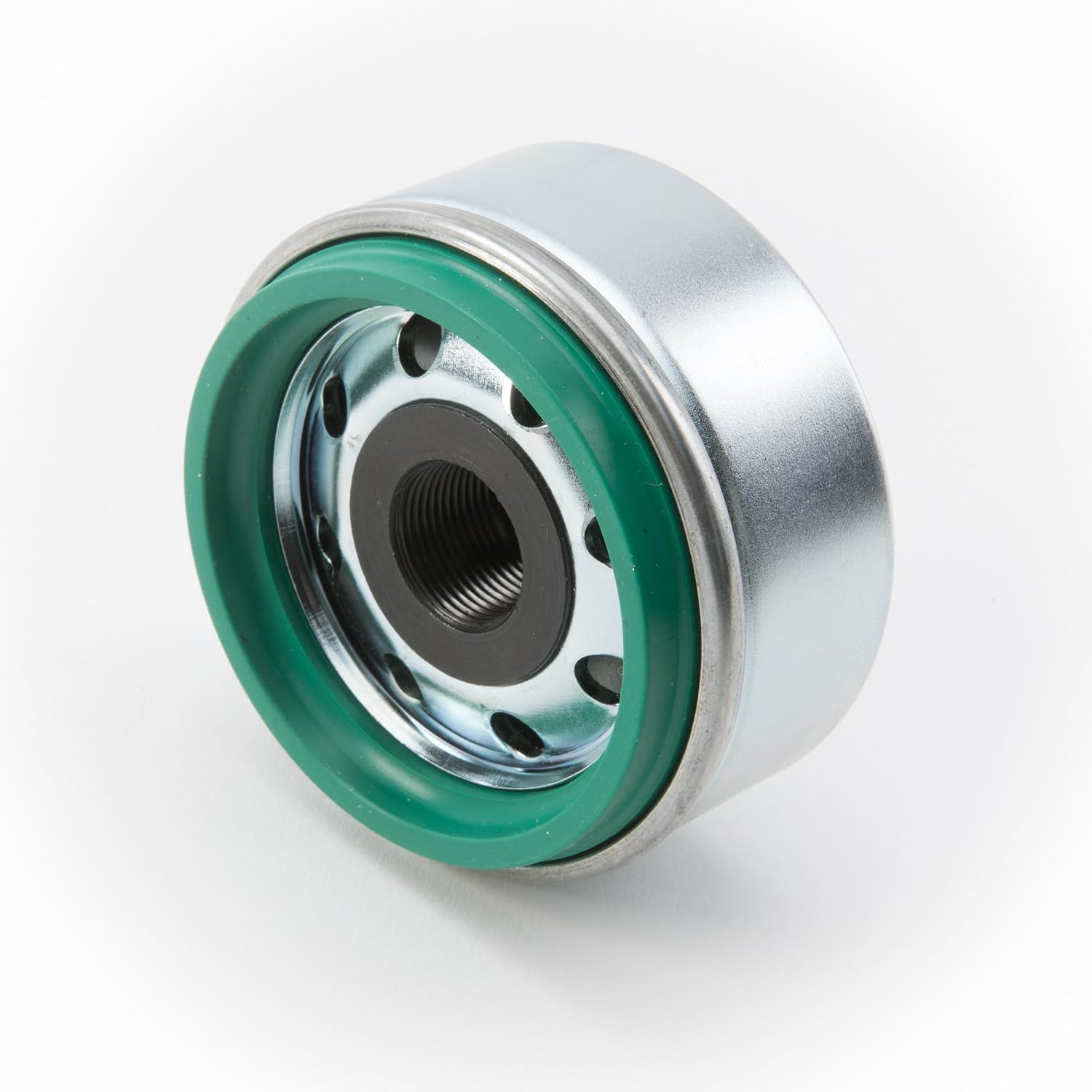
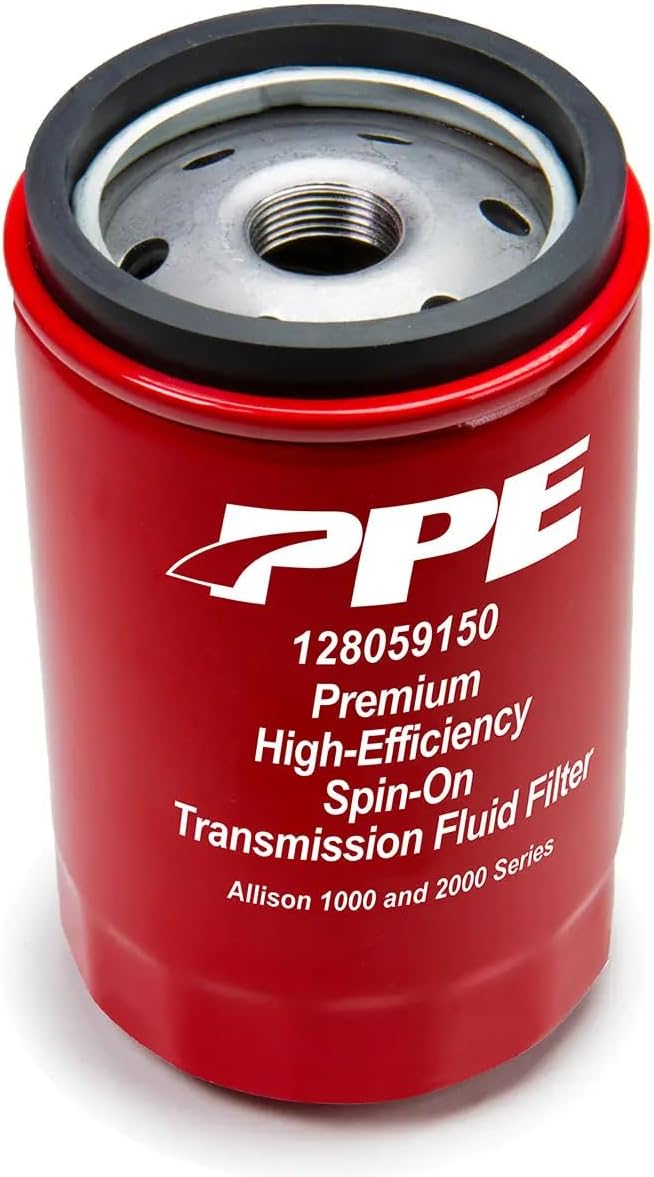
Allison 1000 Spin-On Control Main Filter, P/N 29539579
This is the filter part number Allison specifies for Prognostics-equipped 1000 and 2000 Series units. If the truck runs the service monitor, the correct filter is not optional — the Filter Life Monitor is calibrated around it.
View the 29539579 filter at Core Transmission Parts →Also see the full Allison 1000 parts collection for pan gaskets, deep-pan filters and clutch kits.
Step 3: Capacity Depends on the Sump, and Half the Trucks Are Wrong
"An Allison takes seven quarts" is the most repeated wrong number in this business. Allison lists capacity by sump type in Table 6-4 of the operator's manual:
- Standard sump: initial fill 14 liters (14.8 quarts), refill 10 liters (10.6 quarts)
- Shallow sump: initial fill 12 liters (12.7 quarts), refill 7 liters (7.4 quarts)
Refill is less than initial fill because fluid stays in the converter, cooler and external circuits after a drain. Allison notes these are approximations and do not include external lines and cooler hose, which matters if the system came in dry after a cooler or line replacement.
So look at the pan before you pour anything. A truck running a deep pan, factory or aftermarket, needs the standard-sump quantity and the deep-pan filter. Ordering by model year alone gets this wrong constantly, because plenty of these trucks had a deep pan added somewhere in their life. Match the filter to the pan in front of you.
Step 4: The Service Itself
Drain hot. Allison specifies draining at normal operating sump temperature of 71°C to 93°C (160°F to 200°F), because hot fluid flows faster and drains more completely. A cold drain leaves more of the old fluid behind, which on a fluid-spec change is exactly what you do not want.
The control main filter comes off counterclockwise with a strap wrench or the Allison J-45023 tool. Pull the magnet off the filter attachment tube or the top of the element, clean it, and look at what came off. Allison's instruction is to report any metal pieces larger than dust. That magnet is the cheapest condition report you will get on the unit.
Going back together, lubricate the new filter gasket with transmission fluid, thread it on by hand until the gasket contacts the converter housing or cooler manifold, then turn it exactly one full turn. Allison's caution is explicit: more than one full turn after gasket contact will damage the filter. This is not an engine oil filter you crank down.
Reinstall the drain plug with a new sealing washer and torque it to 30-40 N·m (22-30 lb-ft).
Step 5: Set the Level the Way Allison Says
This is where good services get ruined. The Allison level check is two-stage, and the cold check is not the answer — it exists only to confirm there is enough fluid to run the truck safely until you can do a hot check.
Cold check: level surface, service brake applied, engine at low idle, transmission in Park, PB or Neutral, wheels chocked. Run the engine at 1,000-1,500 rpm for at least one minute to purge air from the system. Apply the brakes and shift D, then N, then R to fill the hydraulic circuits, then back to Park or Neutral and let it idle at 500-800 rpm. Then read the stick, twice. If it is in the COLD band, you can run it. Do not fill above the COLD band on a cold transmission — the level rises with temperature, and an overfull unit aerates and overheats.
Hot check: drive it in D until sump temperature reaches 71°C to 93°C (160°F to 200°F) and converter-out temperature reaches 82°C to 104°C (180°F to 220°F). If there is no transmission temperature gauge, Allison's fallback is to check after the engine coolant gauge has stabilized and the transmission has run under load for at least an hour. Then check on level ground at idle, in Park or Neutral, twice.
Two numbers worth memorizing. The HOT band represents roughly 1.0 liter (1.06 quart) of fluid — that is your entire working window, top to bottom. And if you cannot get two consistent readings, Allison points you at the vent assembly (breather) first. A plugged breather pressurizes the case and makes the stick lie.
Doing an Allison 1000 service this week?
Deep-pan and shallow-pan filter kits, pan gaskets, TES 668 fluid, solenoid kits and the tools to set it up right — shipped fast from the USA.
Shop Allison 1000 parts →Step 6: Read What You Drained
Every fluid change is a free inspection if you look. Allison's contamination criteria are specific enough to make a decision on:
- Water: normal condensation is not to exceed 0.2 percent by volume. Obvious water in the fluid, or transmission fluid showing up in the cooler water on a heat-exchanger setup, means a leak between the water and fluid sides. Pressure test the cooler and replace it if it leaks.
- Ethylene glycol: any trace, or water above 0.2 percent, and Allison calls for disassembly and replacement of seals, gaskets, clutch and friction plates, bearings, torque converters that cannot be disassembled, rusted components, solenoids that do not meet resistance specification, the pressure switch manifold and the internal mode switch. Glycol attacks the friction material. There is no shortcut here.
- Metal: anything past the fine particles the filter normally traps means internal damage, and the unit has to come apart to find the source. That includes cleaning the cooler and every hydraulic circuit the debris could have reached.
To move off the mileage table entirely, Allison's own recommendation is fluid analysis as the primary method for setting intervals. The published oxidation limits are a 25 percent viscosity change from new fluid and a Total Acid Number increase of +3.0 mg KOH. Allison sells an oil analysis kit under P/N 29537805. On a fleet that pays for itself the first time it lets you stretch a service or catches a cooler leak early.
What Skipping This Actually Costs
Degraded fluid does not simply stop lubricating. On the 1000 Series it wears valve bores, and the valve body is where the money goes. Sonnax's parts catalog for the 1000/2000/2400 reads like a map of that damage: the E-shift valve bore is addressed with an oversized valve kit for units that set P0872 or P1711, stick the pressure switch on, drop into failsafe, or start in third gear. The F-trim valve is addressed for overheating, P0741 and TCC surge and slip. The oversized manual valve kit targets low line pressure with delayed Drive and delayed Reverse. On 2010-and-later units, the oversized PCV valve kit targets flare shifts, harsh shifts, delayed engagement and premature clutch failure.
Every one of those is a wear condition accelerated by dirty, oxidized fluid and by running a loaded filter past its interval. A filter costs a fraction of a reconditioned valve body, and a valve body costs a fraction of the clutch pack that burns after the pressure goes away.
If you do end up in the valve body, identify it before you order. Jeff Parlee of the Sonnax TASC Force laid out the four versions in Transmission Digest: 2001-2003 five-speed, upper casting 29536838, lower 29536840, spacer plate 7440, six solenoids and one tube on the bottom; 2004-2005 five-speed, upper 29539798 (29541592 also seen), lower 29539802, plate 9793, plus a seventh solenoid (solenoid G) that reduces line pressure at idle and light-throttle cruise; 2006-2009 six-speed, upper 29542971, lower 29543340, plate stamping 2962 (GM P/N 29542962); and the 2010-later six-speed. Sonnax's reman line follows the same split: AL1004 '01-'03 (one tube, six solenoids), AL1005 '04-'05 (one tube, seven), AL1006 '06-'09 (two tubes, seven), AL1007 '10-later (no tubes, seven). Counting tubes and solenoids on the core beats going by model year.
Prognostics: Let the TCM Do the Math
If the truck has Prognostics enabled, it tracks three things: the Oil Life Monitor, the Filter Life Monitor and the Transmission Health Monitor. When one crosses its threshold the TRANS SERVICE indicator lights. Ignore it long enough and the CHECK TRANS light joins it.
Two requirements come with the feature: an Allison-approved TES 295, TES 668 or TES 389 fluid, and Control Main Filter P/N 29539579. Substitute either and the monitors are calibrated around something that is not in the truck. Mixtures are not to be used with Prognostics at all.
To tell whether a truck has it, watch the service indicator lamp at start-up. It lights five seconds on every vehicle as a bulb check; on a Prognostics-enabled truck it lights again for three seconds after that. The second flash is the tell.
The Short Version
- TES 668 is the current spec, backward compatible with TES 295, 389 and 468.
- Under 100 percent TES 668 or TES 295 is a mixture: short TES 389 intervals, and no Prognostics.
- Fluid on TES 668/295: 150,000 miles, 4,000 hours or 48 months general; 75,000 / 3,000 / 36 severe.
- Spin-on control main filter runs a shorter clock: 50,000 miles, 2,000 hours or 24 months general.
- Shallow sump refill 7.4 quarts; standard sump refill 10.6 quarts. Match the filter to the pan.
- Drain hot at 160-200°F. Filter hand tight plus exactly one full turn. Drain plug 22-30 lb-ft.
- Set the level on the hot check, sump 160-200°F. The HOT band is only about a quart wide.
Sources
- Allison Transmission — 1000 and 2000 Series Operator's Manual, OM8471EN (September 2021). Backs the Table 6-2 fluid and filter change interval matrix (150,000/4,000/48 general and 75,000/3,000/36 severe on TES 668/295; 50,000/2,000/24 and 12,000/500/6 on TES 389; spin-on control main filter at 50,000/2,000/24; internal filter at overhaul), the mixture rule and its Prognostics restriction, the MY09 TES 389 exclusion, the severe-vocation definition, Table 6-4 capacities (standard sump 14 L/14.8 qt initial and 10 L/10.6 qt refill; shallow sump 12 L/12.7 qt initial and 7 L/7.4 qt refill), the 71-93°C (160-200°F) drain and hot-check sump temperature and 82-104°C (180-220°F) converter-out temperature, the cold-check purge procedure, the 1.0 liter (1.06 quart) HOT band width, the one-full-turn filter caution and J-45023 tool, the 30-40 N·m (22-30 lb ft) drain plug torque, the 0.2 percent water limit and the ethylene glycol teardown list, the 25 percent viscosity and +3.0 TAN oxidation limits, oil analysis kit P/N 29537805, and the Prognostics monitors, indicator behavior and Control Main Filter P/N 29539579. Allison 1000/2000 Operator's Manual (PDF)
- Allison Transmission — Allison Approved Fluids. Backs TES 668 as the current recommended spec across the 1000, 2000, 3000 and 4000 Series, H 40/50 EP and eGen product lines, and Allison's recommendation that TES 295 and TES 468 users consider TES 668 at their next service. allisontransmission.com
- Chevron Lubricants — "Meeting the Allison TES 668 Standard for Automatic Transmission Fluids." Backs the 2020 introduction of TES 668, its backward compatibility with Allison-approved TES 295, TES 389 and TES 468 fluids, and its coverage of the 1000, 2000, 3000 and 4000 Series. chevronlubricants.com
- Transmission Digest — "Identifying Allison 1000/2000/2400 Valve Bodies," Jeff Parlee, Sonnax TASC Force, January 1, 2017. Backs the four valve body versions and their casting and spacer plate numbers (29536838/29536840 with plate 7440 for '01-'03; 29539798 or 29541592 with 29539802 and plate 9793 for '04-'05; 29542971/29543340 with spacer plate stamping 2962, GM P/N 29542962, for '06-'09) and the function of the added solenoid G in reducing line pressure at idle and light-throttle cruise. transmissiondigest.com
- Sonnax — Allison 1000/2000/2400 transmission parts and tech resources. Backs the valve-wear-to-symptom mapping cited above (E-shift valve with P0872, P1711, pressure switch stuck on, failsafe and third-gear starts; F-trim valve with overheating, P0741 and TCC surge/slip; oversized manual valve kit with low line pressure and delayed Drive/Reverse; the '10-later oversized PCV valve kit with flare shifts, harsh shifts, delayed engagement and premature clutch failure) and the AL1004/AL1005/AL1006/AL1007 reman valve body identification by tube and solenoid count. sonnax.com