An AODE that starts in 2nd, goes 1-2 and never takes 3rd, or jumps straight from 1st to 4th usually gets called "a bad transmission." Often it is a shift solenoid, a wire, or the valve that feeds the solenoids, and all three can be proven or ruled out with the pan still on the car. The good news on this unit is that Ford published exactly what each solenoid failure looks like from the driver's seat. The bad news is that several hydraulic and mechanical faults produce the same symptoms and set the same codes, and that is where money gets wasted.
This guide works from Ford's own 1994 Mustang workshop manual, Section 07-01 for the AODE: the solenoid on/off chart, the failure-mode tables, the EEC-IV trouble codes and Pinpoint Test A, with its resistance specs and harness wire colors. Then it covers the faults that imitate a solenoid, from ATSG, Sonnax and Transmission Digest. Everything is listed under Sources.
How the AODE picks a gear with two solenoids
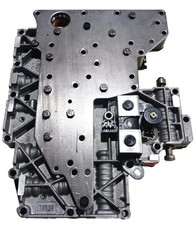
The AODE is the electronic version of the AOD, introduced for the 1992 model year. The ATSG update handbook for this family notes that shift timing, shift feel and converter clutch apply are all run by the EEC-IV processor. Ford's manual lists four electronic solenoids in the main control valve body (7A100): two on/off shift solenoids in one assembly (7G484), a pulse-width modulated torque converter clutch solenoid (7G136) and an electronic pressure control (EPC) solenoid (7G383).
Ford describes the shift solenoids as two-way, normally open. By turning SS1 and SS2 on and off, the PCM controls the pressure reaching the three shift valves. Four combinations give four gears:
| PCM commanded gear | SS1 | SS2 | TCC |
|---|---|---|---|
| P / R / N | ON | OFF | Hydraulically disabled |
| 1st | ON | OFF | Hydraulically disabled |
| 2nd | OFF | OFF | Electronically controlled |
| 3rd | OFF | ON | Electronically controlled |
| 4th | ON | ON | Electronically controlled |
Source: Ford 1994 Mustang Workshop Manual, Section 07-01, Solenoid Operation Chart. Manual 2 runs OFF/OFF (2nd), and Manual 1 runs ON/OFF (1st).
Learn this chart and you can read most AODE solenoid complaints backwards. The one fact worth memorizing: both solenoids off is 2nd gear. Unplug the case connector and the transmission does not go to neutral or fall into a limp 3rd. It runs in 2nd.
What each failure looks like from the driver's seat
Ford's component function chart in the same manual spells out the symptoms by failure. A solenoid can fail "on" or "off" electrically (PCM driver, wiring, the solenoid coil) or hydraulically (stuck or not sealing). The gears you get depend on which one and which way:
| Failure | Gears available in D | What the driver reports |
|---|---|---|
| SS1 failed ON | 1st and 4th only | Pulls away in 1st, then jumps straight to overdrive |
| SS1 failed OFF | 2nd and 3rd only | Starts in 2nd (sluggish launch), never takes overdrive |
| SS2 failed ON | 3rd and 4th only | Very soft, slow launch from a stop in 3rd or 4th |
| SS2 failed OFF | 1st and 2nd only | Shifts 1-2 then stops upshifting. Engine revs high on the highway |
| Both failed ON | 4th only | Barely moves from a stop |
| Both failed OFF | 2nd only | Starts in 2nd and stays there, like a limp mode |
The detailed failure-mode tables add a detail people miss. With a shift solenoid stuck ON or SS1 stuck OFF, Ford shows the Manual 2 and Manual 1 positions delivering 2nd gear with no engine braking. If a customer says the selector "does nothing" in 1 on a downgrade, that fits a solenoid failure, not a band.
The most common AODE solenoid complaint is the SS2-off pattern: a clean 1-2 and then nothing. Baumann Electronic Controls, who build standalone controllers for this unit, blame that on a No. 2 shift solenoid that is failing to activate or failing to seal when activated, from a defective solenoid, a wiring problem or a bad processor. Keep it separate from the unit that goes 1-2, holds 2nd too long and then drops into neutral where 3rd should be. That is a direct clutch or intermediate stub shaft, and no solenoid will fix it. Our AODE common problems guide covers that failure.
The codes: what they actually tell you
The AODE runs on EEC-IV. In the 1994 Mustang manual, the 5.0L uses three-digit codes read in fast mode on a SUPER STAR II tester (007-0041A) or equivalent, and the 3.8L column lists P-codes. The shift solenoid codes:
| 5.0L code | 3.8L code | Meaning | Can a non-solenoid fault set it? |
|---|---|---|---|
| 621 | P0750 | SS1 circuit failure | No. Electrical only: open, short or PCM driver |
| 622 | P0755 | SS2 circuit failure | No. Electrical only |
| 617 | P1731 | 1-2 shift error | Yes. SS1 or internal parts |
| 618 | P1732 | 2-3 shift error | Yes. SS1, SS2 or internal parts |
| 619 | P1733 | 3-4 shift error | Yes. SS1, SS2 or internal parts |
| n/a | P0751 / P0756 | SS1 / SS2 functional failure (mechanical or hydraulic) | Yes |
That last column is the whole diagnosis in one line. Ford marks 621 and 622 as output circuit checks that are "generated only by electrical conditions." The PCM saw no voltage drop across the solenoid when it fired the driver. Those codes point at wiring, the coil or the PCM. The shift-error codes 617, 618 and 619 set when the PCM commands a shift and does not see the engine rpm drop that should follow. Ford states that shift errors "may also be due to other internal transmission concerns (stuck valves, damaged friction material)." A 618 with no 621 or 622 is not a solenoid diagnosis. It is a starting point.
Two more points from the manual. Shift-error codes need the fault to happen four times in a row, and the converter slip code 628 five times, so follow Ford's drive cycle test exactly when you try to reproduce one: warm up, 4th at 50 mph held 15 seconds, overdrive cancelled and 3rd at 40 mph held 15 seconds, back to 4th, a light brake tap, then a 20-second stop, repeated at least five times. And continuous-memory codes stay stored for 40 warm-up cycles, but they can be erased by disconnecting the battery. Write the codes down before anybody unhooks anything.
One thing the overdrive-off light does not tell you: on the AODE, the flashing transmission control indicator lamp (TCIL) is for a shorted EPC solenoid circuit or a monitored sensor failure. A dead shift solenoid can leave the lamp alone.
Testing it, Ford's way (Pinpoint Test A)
Ford's Pinpoint Test A covers the shift solenoid electrical system only, and it opens with a warning: engine performance, input sensors, harnesses and internal transmission components can all be at fault, so do not replace parts on a code alone. Condensed, the sequence runs like this.
1. Check the connector, then watch the solenoid switch
Make sure the case connector is fully seated and the terminals are clean and tight. Do not pry it off; depress the tab and pull up on the harness connector. Enter Output State test mode after the KOEO self-test (press to wide-open throttle and release to cycle the outputs). With a voltmeter on the 20-volt scale between VPWR and the suspect solenoid circuit at the harness connector, cycle the throttle. The reading should change by at least 0.5 volt each time the PCM switches the solenoid.
Use a meter, not a test light. ATRA's GEARS Magazine makes the point in its solenoid circuit article: a test light will glow at around 8 volts, well below what a shift solenoid needs to work, so a "good" test light proves nothing on a computer-driven circuit.
2. Check the harness between the PCM and the transmission
With a breakout box at the PCM (5.0L: SS1 on pin 51, SS2 on pin 52; 3.8L: SS1 on pin 27, SS2 on pin 1), each signal wire and the VPWR circuit should read under 5 ohms end to end, and more than 10,000 ohms to ground and to the other circuits. Anything else is a vehicle harness repair, not a transmission part.
3. Check the solenoids through the case connector
Ford specifies 20 to 30 ohms for each shift solenoid, measured from its terminal to VPWR, and no continuity from either solenoid circuit to ground. By Ohm's law, a 20 to 30 ohm coil draws roughly 0.4 to 0.6 amp at 12.6 volts, which is why current is a better test than resistance if you have an amp clamp: a coil can read in range cold and still fail to pull in when hot. For reference, the same manual lists the TCC solenoid at 1 to 3 ohms and the EPC solenoid at 2.48 to 5.66 ohms on this application.
4. If it is out of spec, split the harness from the solenoid
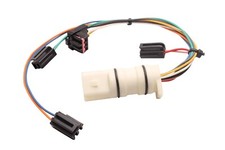
A bad reading at the case connector can be the internal harness, not the solenoid. Drop the pan and unplug the three-wire connector at the shift solenoid assembly. Ford's wire colors: SS1 White, SS2 Black, VPWR White/Black. Each wire should read under 0.5 ohm from the case connector to the three-wire plug and show no continuity to ground; if not, replace the internal harness. Then measure right at the solenoid body: SS1 is the center No. 1 terminal to the + terminal, SS2 is the outboard No. 2 terminal to +, and each should read 20 to 30 ohms with no continuity to ground. Out of spec there means the solenoid assembly gets replaced.
5. If everything reads good, command the gears
Ford's step A5 puts a transmission tester (Rotunda 007-00085) on the case connector and fires each solenoid directly. If the transmission upshifts when the tester commands it, the transmission and solenoids are fine and the fault is in the PCM or vehicle harness. If it will not shift on the tester either, go to the symptom charts. That is where the hydraulic suspects below come in.
The faults that look exactly like a bad solenoid
Solenoid regulator valve bore wear
The shift solenoids only work if they are fed steady, regulated oil. Sonnax explains that the solenoid regulator valve ensures the solenoids are not flooded with more pressure than they can exhaust. When its bore wears, solenoid feed pressure falls. Sonnax lists the results as erratic shifts, 2-3 neutral, neutral after 4th, no 2nd, 3rd and reverse only, and loss of forward under hard acceleration from a stop. Its 76948-14K kit fits the AODE along with the 4R70E/W and 4R75E/W. It needs the 76948-BST2 bore sizing tool, and it adds an O-ringed end plug. Every one of those complaints reads as "solenoid," and none of them will show on an ohmmeter. If Pinpoint Test A passes and the shift is still wrong, look here next.
Wrong ring gear after a rebuild: no upshift at all
ATSG documents a trap on rebuilt units. The AOD and AODE share planetary ratios, so AOD parts get swapped in, and that is fine except for the output shaft ring gear. The AODE ring gear has holes that trigger the output shaft speed sensor. Install an AOD ring gear without them and the PCM gets no output speed signal: the complaint is no upshift, and the code is 639 (P0720, insufficient OSS input), not a solenoid code. Before anyone buys a solenoid for a freshly rebuilt AODE that will not upshift, check the OSS signal. The 1994 manual puts the sensor at 450 to 750 ohms.
A bad aftermarket case connector
Transmission Digest ran a case on the AODE's successor, the 4R70W. After an overhaul with a new hard-wire frame and case connector, the truck started in a higher gear with the check engine light on and several solenoid codes stored. The aftermarket connector had two terminals pushed back so they never touched the harness, and one of them was the 12-volt solenoid supply. Lose the shared VPWR feed and both solenoids go off, which on this family means 2nd gear and a stack of codes. OEM Ford parts cured it. Same lesson on an AODE: a start in 2nd with both SS1 and SS2 codes points at the shared power feed or connector, not two dead solenoids at once.
Worn internals setting shift-error codes
Because 617 through 619 can be set by "damaged friction material," a slipping intermediate or direct clutch can store a shift-error code with a solenoid that is perfectly fine. Baumann lists intermediate clutch slippage alongside the shift solenoids as causes of a rough 2nd with an error code. Check the fluid before you order parts. Burnt fluid and friction material in the pan put the rebuild ahead of the solenoid.
Replacing the shift solenoid assembly
The shift solenoids live on the valve body inside the pan, so this is a pan-off job. Drain and drop the pan, pull the filter, unplug the three-wire connector (pull on the connector, not the wires), remove the solenoid assembly's bolts and swap it. Match the replacement to your year. AODE and later 4R70W solenoid packs and harnesses changed over the years and do not all interchange. Clean the valve body mounting face, torque the bolts to the value in the manual for your year, reconnect, and fit a new filter and pan gasket. Refill with MERCON V or a dual-labeled MERCON/MERCON V fluid per Ford TSB 06-14-4 (details in our AODE fluid change guide), then clear the codes and run Ford's drive cycle to confirm the fix.
If the internal harness tested bad in step 4, replace it while the pan is down. On a thirty-year-old AODE the insulation is often cracked where it runs across the valve body, and it causes the same intermittent symptoms as a failing coil.
Shop the part for this fix: Sonnax solenoid regulator valve kit 76948-14K
If your solenoids and harness pass Ford's tests but you still have erratic shifts, 2-3 neutral or no 2nd, this is the valve kit Sonnax lists for the AODE and 4R70W solenoid regulator bore. CoreTransmissionParts stocks it.
View the 76948-14K kit at CoreTransmissionPartsOr browse the full AODE/4R70W parts collection.
Need parts for this job?
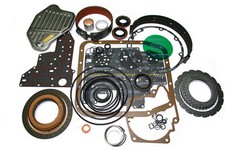
Our AODE parts page has internal wiring harnesses, valve bodies, EPC and TCC solenoids, shift kits and master rebuild kits for 1992-95 AODE units, all on our own checkout. Test first. If step 4 finds the harness bad, buy the harness. If the valve body is worn, a replacement valve body or the Sonnax valve kit is the fix. If the pan is full of friction material, you need a rebuild kit.
FAQ
What are the symptoms of a bad AODE shift solenoid?
It depends on which solenoid fails and which way. Per Ford's 1994 AODE manual, SS1 failed on gives 1st and 4th only, SS1 failed off gives 2nd and 3rd only, SS2 failed on gives 3rd and 4th only, and SS2 failed off gives 1st and 2nd only. Both off leaves the unit in 2nd gear.
Why does my AODE shift 1-2 and then never shift again?
That is the SS2 failed-off pattern: with SS2 dead, the unit only has 1st and 2nd. Baumann blames it on a No. 2 shift solenoid that is failing to activate or seal, a wiring problem or a bad processor. If it instead drops into neutral where 3rd should be, suspect the direct clutch or stub shaft.
What should AODE shift solenoids measure in ohms?
Ford's Pinpoint Test A calls for 20 to 30 ohms on each shift solenoid, measured to VPWR, with no continuity to ground. The internal harness wires (SS1 White, SS2 Black, VPWR White/Black) should each read under 0.5 ohm.
Does code 618 mean the shift solenoid is bad?
Not by itself. Codes 617, 618 and 619 are shift-error codes that Ford says can also be set by stuck valves or damaged friction material. Codes 621 and 622 are the electrical-only solenoid circuit codes.
Why is my AODE stuck in 2nd gear?
With both shift solenoids off, the AODE runs in 2nd. A start in 2nd with both solenoid codes usually points to the shared VPWR feed, the case connector or the harness rather than two failed solenoids at once.
Related guides
Sources
- Ford Motor Company, 1994 Mustang Workshop Manual, Section 07-01 (Transmission, Automatic, AODE), Operation: Transmission Electronic Control System component function. Backs the four valve-body solenoids and part numbers (7G484, 7G136, 7G383), two-way normally open shift solenoids controlling three shift valves, the SS1/SS2 failed-on/failed-off gear lists, 5.0L and 3.8L DTC lists with the electrical-only and non-electrical footnotes, and the TCIL flashing for EPC short or sensor failure. SRB71012
- Ford Motor Company, 1994 Mustang Workshop Manual, Section 07-01, Shift Solenoid Failure Modes and Solenoid Operation Charts. Backs the SS1/SS2/TCC on-off state by gear and range, the failure tables by range selector position, and the no-engine-braking notes in Manual 2 and 1. SRB71013
- Ford Motor Company, 1994 Mustang Workshop Manual, Section 07-01, Diagnosis and Testing: DTC chart and Pinpoint Tests. Backs the 617/618/619/621/622 and P0750/P0751/P0755/P0756/P1731-P1733 definitions, Pinpoint Test A (0.5 V output change, under 5 ohms harness continuity, over 10,000 ohms isolation, 20-30 ohm shift solenoids, SS1 White / SS2 Black / VPWR White/Black internal harness under 0.5 ohm, solenoid terminal layout, Rotunda 007-00085 tester), PCM pins, TCC 1-3 ohms, EPC 2.48-5.66 ohms and OSS 450-750 ohms. SRB71026
- Ford Motor Company, 1994 Mustang Workshop Manual, Section 07-01, On-Board Diagnostic Quick Tests (5.0L) and Transmission Drive Cycle Test. Backs the SUPER STAR II fast-mode requirement, the 40-warm-up-cycle continuous memory and battery-disconnect erase caution, the four-consecutive (617-619) and five-consecutive (628) setting criteria, and the drive cycle steps. SRB71021 and SRB71022
- ATSG (Automatic Transmission Service Group), Update Handbook: AODE, 4R70W, 4R70E, 4R75E (2006). Backs the 1992 AODE introduction, EEC-IV control of shift timing, feel and TCC, and the "AODE No Upshift" bulletin (AOD internal ring gear without speed-sensor trigger holes). ATSG handbook (PDF)
- Sonnax, Solenoid Regulator Valve Kit 76948-14K. Backs the regulator's function, the symptom list (erratic shifts, loss of forward under hard acceleration, 2-3 neutral, neutral after 4th, no 2nd, 3rd and reverse only), AODE/4R70E/4R70W/4R75E/4R75W application, and the required 76948-BST2 tool. sonnax.com
- Transmission Digest, "Ford 4R70W: Solenoid Codes Set." Backs the aftermarket case connector with pushed-back terminals (including the 12-volt solenoid supply) causing a higher-gear start and multiple solenoid codes, cured with OEM parts F8AZ-7G276-BA and F8AZ-7G276-A. transmissiondigest.com
- GEARS Magazine (ATRA), Mike Brown, "A Logical Approach to Solenoid Circuit Testing." Backs using a voltmeter instead of a test light on computer circuits (a test light glows at about 8 volts). gearsmagazine.com
- Baumann Electronic Controls, "Troubleshooting the AODE and 4R70W Transmission." Backs a No. 2 shift solenoid that is failing to activate or seal (solenoid, wiring or processor) as the cause of no 3rd or overdrive, and intermediate clutch slippage or shift solenoids behind a rough 2nd with codes. becontrols.com