On a 4R70W, the EPC solenoid gets blamed for almost every pressure complaint. A truck with soft, flared shifts, a slip on the 2-3 at half throttle, a hard bang into Drive, or a band that burned up at 90,000 miles often gets a new EPC solenoid first. Sometimes that fixes it. Often it covers the real problem for a few weeks, and the unit comes back with a burned forward clutch.
The reason is how Ford built line pressure control on the AODE and 4R70W. The EPC solenoid is only the start of the circuit. Its output oil has to travel through the valve body to the pressure regulator valve, and on a high-mileage unit a lot of it leaks away before it gets there. This guide covers how the circuit works, what a bad EPC solenoid actually feels like, how to test the solenoid and the circuit separately, and when a solenoid is the wrong part to buy.
The short version: The EPC solenoid sets line pressure by feeding oil to the spring end of the pressure regulator valve [3]. More EPC oil means more line pressure. Low or no line rise under throttle, soft or sliding shifts, and throttle buzz can be the solenoid, but on a high-mileage unit they are more often pressure regulator bore wear bleeding EPC oil away [1][2]. Check resistance first (about 2.48-5.66 ohms on the 1992-97 unit [5]), gauge line pressure, then do the compressed air test from Transmission Digest before you buy parts.
How EPC Controls Line Pressure on the 4R70W
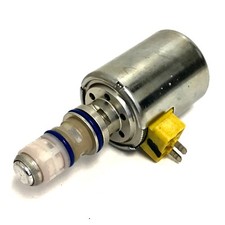
The 4R70W has no TV cable. The PCM reads throttle position, engine load, gear and fluid temperature, then drives the electronic pressure control (EPC) solenoid, a variable force solenoid mounted in the case. Its output, EPC oil, is the signal that sets line pressure. Varying the current varies the output pressure. Gears Magazine's solenoid testing article, using a Ford 5R55E EPC solenoid as the example, shows output pressure dropping as current rises from 0.3 to 1.0 amp [4]. That inverse relationship is the Ford design: Ford's own patent on this control system describes the variable force solenoid turning a 0-1 amp current into a 0-6 bar output, laid out so that zero amps gives maximum pressure as a failure-mode safeguard [7]. That's why an unplugged EPC solenoid gives you maximum pressure, not minimum.
Where the oil goes is what makes this unit different. Sonnax explains that forward line pressure on the AODE/4R70W is controlled by EPC oil acting directly on the spring end of the pressure regulator valve [3]. The factory boost valve assembly only adds pressure in reverse [3]. So in the forward ranges, every pound of line rise the truck gets under throttle depends on EPC oil reaching the PR valve with nothing lost on the way.
Transmission Digest's technical editor Wayne Colonna described the weak spot in an article titled "I Lost My EPC!": EPC pressure is routed to the pressure regulator valve next to a circuit Ford calls the boost circuit, and that circuit returns to the inlet side of the pump [1]. When the PR valve bore wears between those two circuits, EPC oil gets siphoned straight back to the pump. The solenoid can be putting out a perfect signal and the PR valve never sees it.
Symptoms of a Bad EPC Solenoid or Lost EPC Pressure
From the driver's seat, a failed solenoid and a leaking EPC circuit feel almost the same. Both come down to the wrong line pressure. What you feel depends on which way the pressure is wrong.
Low pressure: the common complaint
- Soft, long or sliding shifts, worst at medium to heavy throttle. Colonna describes loss of EPC as no or minimal line rise, which gives medium-to-full throttle slipping in gear and sliding shifts [1].
- Throttle-sensitive buzz or an erratic buzz that follows the pedal. Sonnax lists throttle buzz, low line rise and soft shifts as the complaints tied to PR valve and bore wear [2].
- Gets worse hot. Bore leaks grow as the fluid thins. A truck that shifts fine cold and slides after 20 minutes on the highway is showing you a leak, not a dead solenoid.
- Band and clutch failure. Low line rise under load is how intermediate bands, overdrive bands and forward clutches get burned. Sonnax names clutch and band failure and delayed or uncontrolled reverse pressure among the results [2].
High pressure: the less common complaint
- Harsh engagements and harsh upshifts at every throttle position.
- Maximum pressure all the time with an open EPC circuit, because no current means maximum output on this design.
- A stored EPC circuit code. On the 4R70W, P1746 is the EPC solenoid open circuit and P1747 is EPC solenoid short circuit. Either one usually puts the PCM into a failsafe strategy with firm shifts.
Harsh shifts have plenty of other causes on this unit. The accumulators and the 1-2 accumulator bore in the case are the usual suspects. Our 4R70W harsh shift guide covers those.
Step 1: Scan and Check the Electrical Side
Start with codes and data. Pull stored and pending codes, and record commanded EPC pressure (most scan tools show it in psi), throttle position, gear, and transmission fluid temperature on a test drive. The commanded EPC value should rise smoothly with throttle. If the command itself is flat or erratic, look at inputs first: a TPS glitch or a bad MAF reading changes the load number the PCM uses to calculate pressure.
Then measure the solenoid. Unplug the case connector and ohm the EPC circuit through the connector. TeckPak's installation sheet for its 1992-97 AODE/4R70W EPC solenoid (part 76923) gives 2.48 to 5.66 ohms [5]. A reading near zero means an internal short that will set P1747. An open reading sets P1746. Check the later years against the Ford manual for your model year, since the solenoid and harness changed over the run. If the solenoid reads good through the case connector but the code keeps coming back, check the vehicle harness side and the case connector terminals before you drop the pan.
A resistance test only proves the coil is intact. Gears Magazine makes the point that a solenoid can pass static checks and still fail in use: the 5R55E EPC solenoid in their example held steady at fixed current points, but when current was ramped up and down over 20 seconds, it stuck at minimum pressure for about 5 seconds and then snapped to about half pressure [4]. That is exactly the kind of fault that gives an intermittent flare or bang. A solenoid that tests good on a meter isn't necessarily a good solenoid. A shop with a solenoid tester can prove it, or the gauge test below will show it.
Step 2: Gauge Line Pressure
Put a gauge on the line pressure tap and compare what the unit makes to what it should make. TeckPak lists these line pressure ranges for the AODE/4R70W [5]:
| Range | Closed throttle | Wide open throttle |
|---|---|---|
| P, N, D | 50-75 psi | 160-210 psi |
| Reverse | 80-120 psi | 220-280 psi |
Check it cold and again fully hot. How the readings behave tells you where to look:
- Idle pressure normal, little or no rise with throttle: EPC oil isn't reaching the PR valve. Either the solenoid isn't producing it or the valve body is leaking it.
- Good cold, falls off hot: bore leakage. Solenoids don't usually care much about temperature. Worn bores do.
- High at idle and doesn't change: an open EPC circuit, a stuck solenoid, or a stuck PR valve.
- Forward low, reverse normal: points at the forward side of the circuit, since the OE boost assembly only helps reverse [3].
Our line pressure testing guide covers gauge setup and where the taps are.
Step 3: The Compressed Air Test for Lost EPC
This is the test that keeps you from buying a solenoid you don't need. Colonna's method from Transmission Digest [1]: drop the pan, remove the filter, and blow compressed air into the TV pressure port. Air and fluid coming out around the EPC solenoid area is normal. Air and fluid coming out through the filter opening means the PR valve bore has worn through between the EPC circuit and the boost circuit that returns to the pump inlet, and that's where your EPC pressure is going [1].
Colonna also notes that a small amount of this bore wear can go undetected and still contribute to early forward clutch wear [1]. So a unit with a burned forward clutch deserves this check even if it passed the road test.
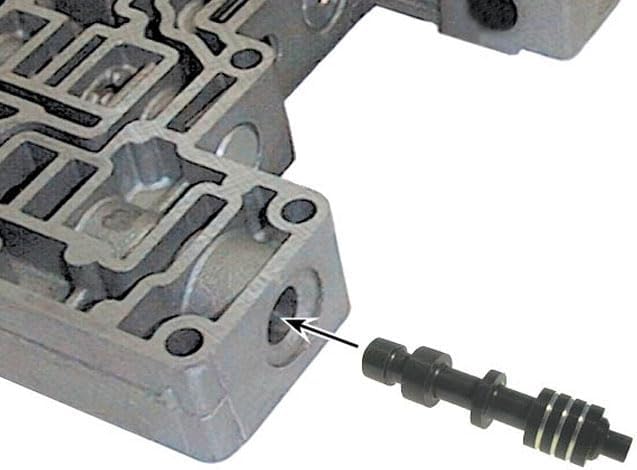
On the bench, vacuum testing is the better tool. Sonnax warns that the 4R70W pressure regulator valve commonly wears badly on the EPC end, and that the casting bore can be worn even when you can't see it [2]. A new valve in a worn bore still leaks. Vacuum test the PR bore and the other EPC-fed valves before you decide what to replace. Our 4R70W valve body testing guide goes bore by bore.
The Fix: Solenoid, Valve Kit, or Valve Body
Replace the EPC solenoid when
It fails the resistance check, it sets P1746 or P1747 with the harness proven good, or line pressure won't follow the command while the air test and bore checks come back clean. On the 1992-97 units the EPC solenoid is adjustable. TeckPak's instructions call for moving the adjuster one-sixth of a turn at a time, clockwise to raise pressure and counterclockwise to lower it, holding the 3/8 in. adjuster while you tighten the 5/8 in. lock nut [5]. The same sheet warns that high pressure in Park after installation usually means an O-ring rolled going in, so grease the snout [5].
Fix the valve body when
The air test blows through the filter or the PR bore fails vacuum. A new solenoid doesn't help here, because the oil it makes still leaks away. Sonnax's answer is to ream the bore and install an oversized pressure regulator valve [2]. Colonna, writing in 2004, said the only cure then was a replacement valve body [1]. Reaming kits have since made the bore repairable on the bench, but a valve body swap is still the quicker fix for a shop without reaming tools, and it's the safer bet when several bores are worn.
Sonnax Oversized Pressure Regulator Valve Kit for the 4R70W
The bench repair for a worn PR valve bore that bleeds off EPC oil: ream the bore and fit the oversized valve so line rise comes back.
View the PR valve kit →Need something else? Browse all 4R70W parts at Core Transmission Parts.
A word on raising pressure
Turning up the EPC adjuster or adding a stiffer PR spring to cover a leak is a temporary fix at best. Sonnax's 4R70W-LB1 line pressure booster kit uses a pressure regulator spring about 10% stronger than OE plus a boost assembly that adds forward-range pressure [3], and it has a place in a towing or performance build. But on a worn valve body it just hides a leak that is still eating EPC oil. Fix the bores first, then decide whether the truck needs more pressure.
Fluid
Refill with MERCON V. Ford's Motorcraft ATF quick reference chart lists MERCON V for the 4R70W/4R70E and 4R75W/E, and cautions against supplemental additives and treatments [6]. Wrong or burned fluid won't cause an EPC fault by itself, but it makes every pressure complaint worse. See our 4R70W fluid type and capacity guide for the fill procedure.
Preventing a Repeat
- Air test or vacuum test every 4R70W valve body you service. High-mileage PR bore wear is too common on this family to skip.
- Don't send out a burned forward clutch or band without checking line rise. Low EPC pressure is what burned it, and new frictions won't last on the same leak.
- Check pressure hot. A cold-only gauge test misses the leak that matters.
- Treat a stored P1746 or P1747 as electrical first. Prove the harness and connector before condemning the solenoid.
EPC solenoids, solenoid kits, boost valve kits and valve bodies for the 4R70W, with checkout on our site.
Shop 4R70W parts →FAQ
What are the symptoms of a bad EPC solenoid on a 4R70W?
The common symptoms are soft or sliding shifts at medium to heavy throttle, little or no line pressure rise under throttle, a throttle-sensitive buzz, and in bad cases slipping in gear. If the solenoid circuit is open, you get the opposite: harsh engagements and firm shifts, because no current means maximum pressure on this design. P1746 or P1747 may also be stored.
What should a 4R70W EPC solenoid read in ohms?
TeckPak's instructions for the 1992-97 AODE/4R70W EPC solenoid list 2.48 to 5.66 ohms. A reading near zero means a shorted coil and usually sets P1747, while an open reading sets P1746. Check later model years against the Ford manual, and remember a good resistance reading does not prove the solenoid regulates pressure correctly.
Can a new EPC solenoid fix low line pressure?
Only if the solenoid was the problem. On a high-mileage 4R70W, EPC oil often leaks away through a worn pressure regulator valve bore before it reaches the PR valve. A new solenoid may raise pressure for a while, but the leak remains. Do the compressed air test through the TV pressure port first; air coming out of the filter opening points to bore wear.
Why does my 4R70W shift worse when it gets hot?
Worn valve body bores leak more as the fluid thins with heat. A 4R70W that shifts firm cold and then slides or buzzes after a long drive is usually losing EPC oil through pressure regulator bore wear rather than suffering a failed solenoid. Gauge line pressure both cold and fully hot to confirm.
Where is the EPC solenoid on a 4R70W?
It is mounted in the transmission case near the manual shaft, held by a bracket and a single 8mm bolt. On 1992-97 units you remove the manual lever position sensor, detent spring and manual shaft to get to it. Grease the solenoid snout before installing so the O-rings do not roll, since a rolled O-ring can cause high line pressure in Park.
Sources
- Transmission Digest — "I Lost My EPC!" (Wayne Colonna, April 2004), on AODE/4R70W EPC oil being siphoned through pressure regulator bore wear into the boost circuit that returns to the pump inlet, the resulting loss of line rise and sliding shifts, and the compressed air test through the TV pressure port. transmissiondigest.com
- Sonnax — "Watch Out for 4R70W PR Valve & Casting Wear," on pressure regulator valve wear at the EPC end, hidden casting bore wear, vacuum testing, reaming for an oversized valve, and the symptoms (soft shifts, low line rise, throttle buzz, clutch and band failure). sonnax.com/tech_resources/1152
- Sonnax — Line Pressure Booster Kit 4R70W-LB1, on forward pressure being controlled by EPC oil acting on the spring end of the PR valve, the OE boost assembly adding pressure only in reverse, and the kit's roughly 10% stronger PR spring. sonnax.com/parts/2173
- Gears Magazine (ATRA) — "How Are You Testing?" (Garrett Herning, Hydra-Test USA), on Ford EPC solenoid output falling as current rises from 0.3 to 1.0 amp, and a solenoid that passed static tests but stuck during a ramped test. gearsmagazine.com
- TeckPak — Installation Instructions, EPC Solenoid for AODE/4R70W 1992-97 (76923), listing 2.48-5.66 ohms, the line pressure ranges by gear and throttle, the adjuster procedure, and the rolled O-ring warning. teckpak-fitzall.com (76923 PDF)
- Ford / Motorcraft — Automatic Transmission Fluid Quick Reference Chart (US), listing MERCON V for the 4R70W/4R70E and 4R75W/E and cautioning against supplemental additives and treatments. fcsdchemicalsandlubricants.com (ATF quick reference PDF)
- Ford Global Technologies — US Patent 5,646,842, "Shift control system for a multiple ratio automatic transmission," describing the variable force solenoid that converts a 0-1 amp current into a 0-6 bar output pressure, with the transfer function laid out for maximum pressure at zero amps. patents.google.com