An AODE that bangs into gear hard enough to rock the car, or one that suddenly slides every shift and flashes the O/D OFF lamp, is usually telling you something about line pressure. On this unit the computer sets line pressure through one part: the Electronic Pressure Control (EPC) solenoid on the valve body. When it or its circuit goes bad, every engagement and every shift changes feel at once, which is the clue that separates an EPC problem from a single worn clutch pack.
The catch is that the solenoid is often blamed for pressure problems it did not cause. This guide walks through how the AODE EPC system works, what each failure mode feels like, the Ford codes and pinpoint test that go with it, and the valve body wear that fakes a dead solenoid. Specs come from Ford's AODE workshop manual section, a Ford patent describing the solenoid, and Sonnax and Transmission Digest bench work. Everything is listed under Sources.
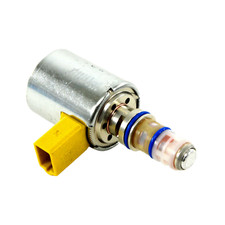
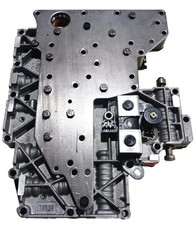
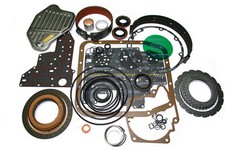
How the AODE EPC solenoid controls line pressure
The AODE EPC is a variable force solenoid, not an on/off or duty-cycle valve. The PCM varies the current through it, and the solenoid puts out a matching signal pressure that the main pressure regulator uses to set line pressure. Ford's own patent on this control system describes the variable force solenoid as turning a 0 to 1 amp current into a 0 to 6 bar output pressure, and states that the transfer function is laid out so that zero amps gives maximum pressure [3].
That second point is the whole key to diagnosing this unit. The solenoid is built so that a failure toward no current fails safe toward high pressure. High pressure means harsh shifts, but it protects the clutches and bands from slipping. More current from the PCM means lower line pressure; less current means higher.
The PCM calculates the pressure it wants from throttle position, engine load, gear, and temperature. That is why Ford's code chart lists so many engine sensors as able to cause "incorrect EPC pressure." A throttle position or MAF sensor that reads wrong gives the PCM a wrong torque estimate, and it commands the wrong line pressure even with a perfect solenoid [2].
Symptoms of a bad AODE EPC solenoid or circuit
Ford's own code definitions describe two opposite failure modes, and they feel nothing alike [2]:
| Failure | Ford code | What Ford says happens | What the driver feels |
|---|---|---|---|
| EPC circuit shorted, or shorted output driver | 624 / P1747 | Minimum EPC pressure (minimum capacity), engine torque limited | Soft, sliding shifts, slipping under load, weak acceleration |
| EPC circuit open, or drive circuit open in PCM | 625 / P1746 | Maximum EPC pressure, harsh engagements and shifts | Neutral-to-Drive clunk, every upshift hard, driveline bang on downshifts |
Ford also notes that the transmission control indicator lamp (the O/D OFF light) flashes for an EPC or sensor failure [2]. A flashing O/D OFF light on an AODE car is not a transmission code by itself; it is a signal to pull codes.
Other symptoms that point at EPC pressure rather than a single component:
- Every shift changed at the same time. A worn 2-3 clutch affects one shift. EPC affects all of them plus engagements.
- Shift feel that changes with temperature. Ford raises EPC pressure when transmission oil temperature exceeds 127 C (270 F), code 657/P1783 [2], so a hot unit that suddenly gets firm may be the PCM protecting itself, not a failing solenoid.
- Harsh shifts with a sensor code stored. Ford lists MLP (range sensor) faults 667/P0707, 668/P0708 and 675 as causing an increase in EPC pressure, and a failed-on A/C cycling switch (P1460) as making EPC pressure slightly low [2].
- Slipping at medium to full throttle, fine at light throttle. That pattern is classic low line rise, and on the AODE it is as likely to be valve body bore wear as the solenoid (see below) [5].
Step 1: Pull codes and check the inputs first
Run the key-on engine-off and engine-running self-tests before touching the transmission. Ford's pinpoint test for the EPC is explicit that it diagnoses the EPC electrical system only, and warns that engine performance, battery, input sensors, harnesses and internal transmission components can cause the same symptoms [2].
Fix any TP, MAF, IAT, MLP or TOT codes before judging shift quality. Ford ties TP faults to harsh engagements and firm shifts, MAF faults to high or low EPC pressure, and an IAT sensor reading pegged hot or cold to "incorrect EPC pressure, either high or low," resulting in harsh or soft shifts [2]. On a car with an aging MAF, clean or replace it and re-evaluate before you drop the pan.
Step 2: Ford Pinpoint Test E (codes 624/P1747 and 625/P1746)
Ford's AODE Pinpoint Test E walks the circuit from the battery to the PCM [2]. In practical terms:
- Power feed. Disconnect the transmission connector (press the button and pull straight up; Ford says not to pry it). Key on, engine off: the EPC PWR circuit at the harness connector should read more than 10.5 volts to ground. Low or zero means an open in the feed.
- Harness continuity. With the PCM disconnected and a breakout box installed, each circuit end to end should read under 5 ohms. On the 5.0L the EPC signal is PCM test pin 38 with power on pins 37 and 57; on the 3.8L the signal is pin 81 with power on pins 71 and 97.
- Shorts to power and ground. The EPC signal circuit should read more than 10,000 ohms to the power pins and to the ground pins. A chafed harness on the transmission case is a common find here.
- Functional test. With a line pressure gauge on the case tap and the transmission tester connected, pressing the EPC switch should light the green LED and drop line pressure. If it does, the transmission side is fine and Ford sends you to the PCM and vehicle harness.
- Solenoid resistance. If line pressure does not drop, measure the solenoid through the tester from the VPWR jack to the EPC jack.
EPC solenoid resistance spec
Ford specifies 2.48 to 5.66 ohms for the AODE EPC solenoid, measured with the meter on the 100-200 ohm range, positive lead on VPWR and negative lead on the EPC jack [1]. The Sonnax 76923 replacement EPC for '92-'97 AODE/4R70W publishes the same 2.48-5.66 ohm window [4]. For reference, the shift solenoids on the same tester read 20-30 ohms and the TCC solenoid 1.0-3.0 ohms [1], so if you read 20-plus ohms you are on the wrong pin.
A solenoid that is inside the window can still be bad. Resistance only proves the coil is intact. It says nothing about a sticking armature or a torn O-ring leaking signal oil, which is why the pressure test in Step 3 matters more.
Step 3: Prove it with a line pressure gauge
This is the test that separates a solenoid problem from a hydraulic one. Ford's transmission tester procedure runs it like this [1]:
- With the engine running in Park and the EPC switch released (zero current), line pressure should go to maximum.
- Press the EPC switch (full current): line pressure should drop to a minimum.
- Hold the switch and shift Park to Reverse and Park to Drive; the unit should engage at idle pressure. Release the switch and engagements should be firm.
Ford's caution is worth repeating: never hold the EPC switch down (minimum line pressure) and stall the transmission against the brakes. At minimum pressure the clutches will slip and burn [1].
For numbers, the Sonnax 76923 instruction sheet lists the AODE/4R70W line pressure targets below [4]:
| Range | Closed throttle | Wide open throttle |
|---|---|---|
| Park, Drive, Neutral | 50-75 psi | 160-210 psi |
| Reverse | 80-120 psi | 220-280 psi |
The same sheet notes that high line pressure in Park after a solenoid install can mean the O-ring rolled out of place during installation [4]. If a new solenoid made the shifts harsher, pull it and check the O-ring before blaming the part.
When the solenoid is fine: pressure regulator bore wear
This is the failure that sells the most unnecessary EPC solenoids. Transmission Digest documented an AODE/4R70W with EPC pressure near zero at any throttle opening, whether the solenoid was plugged in or unplugged [5]. Unplugging should have sent pressure to maximum, so the solenoid was not the problem. The cause was wear in the pressure regulator valve bore between the EPC pressure circuit and the boost circuit, which routes back to the pump inlet. The EPC signal was being pulled away by the pump [5].
Transmission Digest describes the result as a reduction or complete loss of EPC pressure when the unit is hot: little or no line rise, medium- to full-throttle slipping in gear, and sliding shifts. Even minor bore wear that goes unnoticed can cause premature forward clutch wear [5].
The compressed air test
Drop the pan and filter and blow shop air into the TV (EPC) pressure port. Normally air and fluid should only come out around the EPC solenoid area. If air and fluid blow out of the filter pickup, the bore is worn through to the boost circuit [5]. Transmission Digest's fix for that condition was replacing the valve body.
Sonnax sees the same wear pattern across the AODE, 4R70W, 4R70E, 4R75W and 4R75E: scoring on the EPC end of the pressure regulator valve that causes reduced line pressure or low line rise. Their listed symptoms include soft shifts, low line rise, delayed forward and reverse, low reverse boost, throttle buzz, and premature clutch and band failure [6]. Their key warning: if the valve is scored, assume the bore is too, because a worn casting will not seal even with a new valve. Bore wear is hard to see, so vacuum testing is how you confirm it, and the usual repair is reaming and fitting an oversized valve [6]. For '95-earlier units Sonnax lists the 76948-16K oversized pressure regulator and boost valve kit [6].
Replacing the AODE EPC solenoid
The EPC solenoid sits on the valve body and is reached with the pan and filter off. Practical points from the bench:
- Match the year. '92-'97 AODE and early 4R70W use one EPC design; '98-up solenoids are different. Buy by year, not by transmission name alone.
- Check the O-rings and the bore. A torn O-ring leaks signal oil and lowers line pressure just like a weak solenoid.
- Check fluid condition. Debris in the EPC circuit sticks the new solenoid just like the old one. If the pan has clutch material in it, the solenoid is not your only problem.
- Retest line pressure after install. Confirm the max-to-min swing on the gauge and clear codes, then road test.
The AODE was designed around MERCON fluid. Use a MERCON V approved fluid; our fluid spec chart lists the correct spec for every unit.
Shop the part for this fix: Sonnax solenoid regulator valve kit 76948-14K
If the EPC solenoid tests good but pressure is still erratic, the solenoid regulator valve and its bore are next on the list. Sonnax lists this kit for the AODE, 4R70W and 4R75W family, and CoreTransmissionParts stocks it.
View the 76948-14K kit at CoreTransmissionPartsOr browse the full AODE/4R70W parts collection, including EPC solenoids, solenoid kits and pressure regulator valve kits.
Preventing repeat EPC complaints
- Fix engine sensor faults promptly. The PCM builds its EPC command from TP, MAF and temperature data [2], so bad inputs mean bad line pressure.
- Change fluid and filter before the fluid darkens. Varnish and debris stick a variable force solenoid long before they burn a clutch.
- Treat a slow drop in line rise as a valve body warning. Caught early it is a valve kit; ignored, it takes the forward clutch with it [5].
- On any rebuild, vacuum-test the pressure regulator bore, not just the solenoid [6].
Need parts for this job?
Our AODE parts page carries EPC solenoids, solenoid kits, valve bodies and master rebuild kits, all on our own checkout. Buy to the test result: an EPC solenoid when it fails the 2.48-5.66 ohm or pressure swing test, a valve body when the pressure regulator bore fails the air or vacuum test, and a rebuild kit when low pressure has already worn the clutches.
FAQ
What are the symptoms of a bad EPC solenoid on an AODE?
It depends on how it fails. Ford's code chart says a shorted EPC circuit (624/P1747) gives minimum line pressure and limits engine torque, so shifts go soft and the unit can slip. An open circuit (625/P1746) gives maximum line pressure, so engagements and every shift turn harsh. Either way the O/D OFF lamp flashes and all the shifts change feel at once.
What should an AODE EPC solenoid read on an ohmmeter?
Ford specifies 2.48 to 5.66 ohms for the AODE EPC solenoid, measured from the VPWR jack to the EPC jack on the transmission tester. The shift solenoids read 20 to 30 ohms and the TCC solenoid 1.0 to 3.0 ohms, so a reading in the 20s means you are on the wrong pin. A good resistance reading does not prove the solenoid regulates pressure correctly.
What happens if you unplug the EPC solenoid on an AODE?
Line pressure should go to maximum. Ford designed the variable force solenoid so zero current gives maximum pressure, which protects the clutches from slipping. If line pressure stays near zero with the solenoid unplugged, the solenoid is not the problem; Transmission Digest traced that exact condition to pressure regulator bore wear in the valve body.
What line pressure should an AODE have?
The Sonnax 76923 instruction sheet lists 50 to 75 psi in Park, Drive and Neutral and 80 to 120 psi in Reverse at closed throttle, rising to 160 to 210 psi and 220 to 280 psi at wide open throttle. Check it with a gauge on the case line tap and confirm pressure swings from maximum to minimum when the EPC solenoid is commanded.
Can I drive with a bad AODE EPC solenoid?
Short distances only. A solenoid stuck toward high pressure makes harsh shifts that are hard on the driveline but usually will not burn clutches. A low-pressure failure is worse, because the clutches and bands slip under load and wear quickly. Diagnose it before the fluid turns dark and the problem grows into a rebuild.
Related guides
Sources
- Ford Motor Company, 1994 Mustang Workshop Manual, Section 07-01 (AODE), Transmission Tester. Backs the EPC solenoid spec of 2.48-5.66 ohms (100-200 ohm range, VPWR to EPC jack), shift solenoids 20-30 ohms and TCC 1.0-3.0 ohms, the EPC switch test (maximum line pressure released, minimum pressed), engagement checks, and the caution against stalling the transmission with the EPC switch held. SRB71024
- Ford Motor Company, 1994 Mustang Workshop Manual, Section 07-01 (AODE), Diagnostic Trouble Codes and Pinpoint Test E. Backs 624/P1747 (short: minimum EPC pressure, torque limited) and 625/P1746 (open: maximum EPC pressure, harsh shifts), the flashing TCIL, TP/MAF/IAT/MLP/TOT/A-C effects on EPC pressure, the 270 F overtemp code 657/P1783, the over-10.5 V feed check, PCM pins, and the under-5-ohm and over-10,000-ohm harness checks. SRB71026
- Ford Global Technologies, US Patent 5,646,842, Shift control system for a multiple ratio automatic transmission. Backs the variable force solenoid converting 0-1 amp into 0-6 bar output, with maximum pressure at zero amps. patents.google.com
- Sonnax / Teckpak, Installation Instructions: EPC Solenoid for AODE/4R70W '92-'97, part 76923. Backs the 2.48-5.66 ohm spec, the line pressure targets (50-75 / 80-120 psi closed throttle, 160-210 / 220-280 psi open throttle) and the displaced O-ring cause of high line pressure in Park. 76923 PDF
- Transmission Digest, "I Lost My EPC!" Backs the AODE/4R70W case of near-zero EPC pressure plugged or unplugged, pressure regulator bore wear bleeding EPC into the boost circuit and pump inlet, the compressed air test at the TV port, the valve body replacement fix, and forward clutch wear from minor bore wear. transmissiondigest.com
- Sonnax, Watch Out For 4R70W PR Valve and Casting Wear. Backs scoring on the EPC end of the pressure regulator valve in AODE and 4R70W-family units, the symptom list (low line rise, soft shifts, delayed engagements, premature clutch and band failure), vacuum testing the bore, and part 76948-16K for '95-earlier units. sonnax.com