An AODE that bangs into 2nd, flares on the 2-3, skips 3rd or drops into neutral on the 3-4 usually gets blamed on a shift solenoid. Sometimes that's right. More often on a Panther car, F-150 or SN95 Mustang with high miles, the solenoids are fine and the problem is a valve that is sticking in its bore or a bore that's worn enough to leak. The AODE valve body is aluminum, and its spool valves have been moving back and forth in those bores for 150,000 miles or more. Wear doesn't show up as one clean failure. It shows up as a pattern of shift complaints, and you can read that pattern if you know which valve controls what.
This guide ties each symptom to the valves Ford lists for it in the 1994 Mustang Workshop Manual, Section 07-01 (AODE). It also covers the line pressure numbers to test against, the Ford inspection standard for valves and bores, and the wear points Sonnax has documented on the AODE/4R70W valve body. Every spec is listed under Sources.
What the AODE valve body actually controls
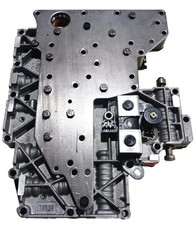
The PCM decides when to shift, but the valve body does the work. Ford's exploded view of the main control assembly (7A100) lists the 1-2, 2-3 and 3-4 shift valves, the main regulator valve with its booster valve and sleeve, three capacity modulator valves, the 2-3 backout valve, the bypass clutch control valve with its plunger and sleeve, several pressure regulator valves and the manual valve [4]. Coasting booster shuttle balls sit between the body and the separator plate, and a converter drain-back valve and solenoid screen live on the body too [4].
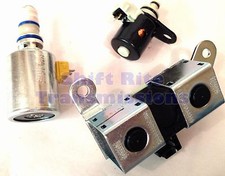
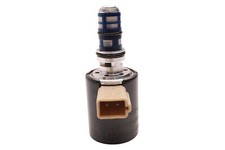
Two shift solenoids, SS1 and SS2, stack on top and move the shift valves. Ford's solenoid chart for the AODE is simple: 1st is SS1 on and SS2 off, 2nd is both off, 3rd is SS1 off and SS2 on, and 4th is both on [3]. The TCC solenoid sits next to them. The EPC solenoid sets line pressure through the main regulator valve.
That split matters for diagnosis. An electrical fault usually sets a code and gives you a hard, repeatable wrong gear. A valve body fault is usually hydraulic: harsh or soft shifts, flares, shifts that come and go with temperature, and wrong gears with no code at all.
Symptoms that point at the valve body
Ford's Diagnosis by Symptom charts give a Hydraulic/Mechanical Routine for each complaint, and each one names the valves to inspect [1]. This is the valve body part of those lists:
| Symptom (Ford routine) | Valve body parts Ford lists |
|---|---|
| Harsh shifts (314) | 1-2 accumulator, 2-3 backout valve, main regulator valve, orifice control valve, overdrive servo regulator valve; EPC solenoid |
| Soft or slipping shifts (313) | Same valve list as harsh shifts; EPC solenoid |
| Early or late shifts (311) | EPC solenoid; valves, accumulators or seals stuck; solenoid screen blocked |
| Erratic shifts or hunting (312) | Valves, accumulators or seals stuck or assembled wrong; solenoid screen blocked |
| No 1-2 shift (320) | 1-2 shift valve, 1-2 accumulator valve, No. 8 ball; SS1 |
| No 2-3 shift (321) | 2-3 shift valve, check ball No. 1 or No. 3, solenoid pressure regulator valve, 2-3 backout valve, 2-3 modulator valve, orifice control valve; SS2 |
| No 3-4 shift (322) | 3-4 shift valve, solenoid pressure regulator valve, OD servo regulator, 3-4 capacity modulator valve, 2-3 backout valve, orifice control valve, 1-2 and 2-3 shift valves |
| Harsh forward engagement (304) | Main regulator valve, 2-3 backout valve, 2-3 accumulator seal or retainer; EPC solenoid |
| Delayed or soft forward (306) | 3-4 shift valve, main regulator valve, orifice control valve, 1-2 or 2-3 accumulator |
| Harsh reverse engagement (303) | No. 6 shuttle ball, No. 5 check ball, manual valve, main regulator valve; EPC solenoid |
| No converter clutch apply (340) | Solenoid pressure regulator valve, manual valve, bypass clutch control valve and plunger, converter pressure limit valve, drain-back valve |
The main regulator valve shows up on almost every line, and the solenoid pressure regulator valve shows up on the no 2-3, no 3-4 and no-lockup lines. Those two are also among the bores Sonnax singles out for wear on this family, and that is not a coincidence.
Main regulator valve wear: harsh, soft and erratic everything
Sonnax states that AODE and 4R70W units often have erratic line pressure, poor line rise or a throttle-sensitive buzz, and that the result can be harsh or soft shifts and band or clutch failure. The cause is worn pressure regulator valve spools that let pressure escape [5]. Sonnax's Brian Wing adds that scoring on the EPC end of the valve is usually easy to see and causes reduced line pressure or low line rise. If the valve looks that bad, the bore is likely worn too, and a new valve in a worn bore still won't seal [5].
Symptoms that fit: shifts that are soft and long when warm, a buzz that changes with throttle, and clutches or the overdrive band burning up after a rebuild that "should" have fixed it.
Solenoid pressure regulator wear: missing gears with no code
This one fools people into buying solenoids. Sonnax explains that the solenoid regulator valve keeps the shift solenoids from getting more pressure than they can exhaust. If the valve sticks, pressure goes too high and you can get wrong-gear starts. The more common problem is bore wear that makes solenoid pressure too low, which causes no 2nd, no 3rd, or a shift to neutral on a 3-4 or 4-3 shift [6].
Compare that to Ford's own chart for a failed solenoid [3]. If SS1 is stuck off, a 1st gear command gives 2nd and a 4th command gives 3rd. If SS2 is stuck off, a 3rd command gives 2nd and a 4th command gives 1st. If you get "no 3rd" or a neutral on the 3-4 that doesn't match either pattern, and the solenoids test good, look at solenoid pressure first.
Boost valve and sleeve: soft or slipping reverse
The reverse boost valve oscillates inside its sleeve until the sleeve wears. Sonnax lists low reverse boost, delayed reverse, reverse slip, no reverse and a burnt reverse clutch as the result [6]. If forward pressures are good and only reverse is weak, this sleeve is a prime suspect before you tear into the reverse clutch.
Step 1: Rule out the electrical side
Every Ford routine above starts with an electrical routine: run Self-Test, then use the transmission tester for the solenoid pinpoint tests [1]. Clear up any codes before you pull the pan. For the valve body itself, two quick checks come from Ford's routines:
- Hand-feel test. Cycle SS1, SS2 or TCC with the tester and put your hand on the solenoid. If you can't feel it operate, replace it and check its O-rings [1].
- Solenoid screen. Ford lists a blocked or damaged solenoid screen in the valve body for early/late, erratic and no-lockup complaints [1]. A screen packed with clutch material starves every solenoid at once.
Step 2: Test line and EPC pressure
Connect a gauge to the line tap and compare against Ford's Pressure Reference Chart 401 [1][2]. Remove the transmission tester and reconnect the vehicle harness first. Ford specifies the pressures with the harness installed [2].
| Condition | 3.8L line (EPC) | 5.0L line (EPC) |
|---|---|---|
| Idle, D/1/2/3/4 | 75-91 psi (15-25) | 32-67 psi (0-10) |
| Idle, Reverse | 54-96 psi (0-10) | 54-96 psi (0-10) |
| Idle, Park | 32-67 psi (0-10) | 32-67 psi (0-10) |
| WOT stall, 1/2 | 160-210 psi (83-93) | 160-210 psi (83-93) |
| WOT stall, Reverse | 194-254 psi (83-93) | 194-254 psi (83-93) |
Ford's procedure: if line pressure is out of spec, check EPC pressure at its own tap. If EPC is out, run Pinpoint Test E on the EPC system. If EPC is good and line is still wrong, the problem is hydraulic [2]. Two cautions from Ford: do the line pressure test before any stall test, and if line pressure is low at stall, stop, because further testing will damage the transmission. Never hold WOT for more than five seconds in any range [2].
How to read it: good EPC with low line pressure points at the main regulator valve, booster, pump or a leak. Good pressure at idle with poor rise at stall points at the regulator and booster. Low pressure only in reverse points at the boost sleeve and reverse circuit. For low forward pressure, Ford's list is the filter and seal, main controls, the pump and the forward clutch [1].
Step 3: Inspect the valve body on the bench
Ford's disassembly is straightforward: pull the solenoid bracket, lift the shift solenoid assembly and TCC solenoid straight up, flip the body, remove the 11 bolts holding the reinforcement and separator plates, and note where the coasting booster shuttle balls sit before they fall out [4]. Take pictures of the check ball locations. A missing or misplaced ball shows up on almost every routine in the table above [1].
Ford's inspection standard is stricter than most people realize [4]:
- Clean everything except the non-metallic shuttle balls in clean solvent and blow dry with moisture-free air.
- Inspect every valve and plunger bore for scores and every passage for blockage.
- Check mating surfaces for burrs and scores.
- Crocus cloth is allowed on valves, but don't round the sharp edges. Those edges meter oil.
- Check springs for distortion.
- Dry valves and plungers must fall from their own weight in their bores. If one drags, it will hang up hot.
- Roll the manual valve on a flat surface to check that it's straight.
The free-fall test finds sticking valves. It won't find worn bores, because a worn bore lets the valve drop just fine. That's what vacuum testing is for. Sonnax's AODE/4R70W vacuum test guide shows the test point for each critical bore [5]. Bore wear is often hard to see, and in most cases a worn bore needs to be reamed and fitted with an oversized valve [5]. For the PR bore, Sonnax describes a homemade tool: drill through an old reverse boost sleeve, seal a 1/4 in. tube into it, put a known-good PR valve in the bore and pull vacuum past the EPC circuit [5].
Step 4: Know which valve body you have
AODE and 4R70W valve bodies look alike, but they aren't all interchangeable. Sonnax's identification guide: 1992 bodies have 13mm dowel pins and an F2 rough forging number, 1993-1995 have 13mm dowels and an F3 number, and 1996-2000 bodies moved to 10mm dowels with an F6 number. The casting number is under the plate [6]. The main regulator valve also changed: Sonnax's 76948-01 fits the '95-and-earlier four-spool valve only, and the '91-'95 and '96-later PR valve designs are not interchangeable [5]. Match the year before you order a valve body or a regulator valve.
The fix
Single worn valve or bore. Replace the valve with a drop-in repair valve, or ream the bore and install an oversized valve if it fails vacuum. This is the right move when one symptom lines up with one valve and the rest of the body vacuum tests good.
Several worn circuits. A high-mileage AODE with harsh shifts, a buzz and a weak reverse usually has wear in more than one bore. A kit that covers the PR valve, boost valve, solenoid regulator and bypass circuit costs less than chasing each one after a comeback.
Replacement valve body. When the casting is worn in several places or someone has been in it before, a replacement body for the correct year is usually cheaper in labor than a bench rebuild.
At reassembly, Ford's torques are 22-26 N·m (190-230 lb-in) for the two guide pin bolts, 11-15 N·m (100-130 lb-in) for the cover and reinforcement plate bolts in sequence, and 9-11 N·m (80-100 lb-in) for the solenoid bracket bolt [4]. Use new gaskets and check the solenoid O-rings. Ford lists loose bolts and damaged gaskets under nearly every symptom [1], because a cross leak at the separator plate can mimic a worn valve.
Shop the part for this fix: Sonnax Sure Cure kit SC-AODE-4R75E
The multi-circuit valve body repair for AODE and 4R70W/4R75 units with worn regulator, boost and solenoid pressure circuits. It's the kit to use when you find wear in more than one bore. CoreTransmissionParts stocks it.
View the Sure Cure kit at CoreTransmissionPartsOr browse the full AODE/4R70W parts collection, including the 76948-02K boost valve, 76948-14K solenoid regulator kit and individual Sonnax valves.
Keeping the valve body alive
- Change fluid and filter before the fluid goes dark. Clutch debris is what scores the valves and clogs the solenoid screen.
- After any service that generates contamination, Ford calls for completely cleaning the valve body, clutches, converter, cooler and every coasting booster shuttle ball, and warns that the contaminants are a major cause of recurring transmission concerns [4]. A dirty reused valve body kills a fresh rebuild.
- Vacuum test the main regulator, boost and solenoid regulator bores on every rebuild, even when the customer only complained about one shift.
- Fix low line pressure early. Every mile at low pressure slips the clutches and bands and adds more debris to the fluid.
Need parts for this job?
Our AODE parts page carries valve bodies, solenoid kits, EPC solenoids, pumps and master rebuild kits for 1992-up AODE units, all on our own checkout. Buy based on your test results: a solenoid kit when a solenoid fails the hand-feel or pinpoint test, an EPC solenoid when EPC pressure is out of spec, and a valve body when the bores fail vacuum in more than one place.
FAQ
What are the symptoms of a bad AODE valve body?
Harsh or soft shifts, flares between gears, erratic shifting or hunting, a delayed or harsh engagement, and missing gears with no trouble code. Ford's symptom routines list the main regulator valve, 2-3 backout valve, orifice control valve, accumulators and shift valves for these complaints. Electrical faults usually set a code, so a shift problem with clean codes and good solenoids points at the valve body.
How do I tell a bad shift solenoid from a bad AODE valve body?
Run Self-Test and the solenoid pinpoint tests first, then cycle each solenoid with the tester and feel for it operating. Ford's failure chart shows fixed wrong-gear patterns for a stuck SS1 or SS2. If the solenoids pass and the symptom does not match those patterns, suspect a sticking shift valve or low solenoid pressure from a worn solenoid regulator bore.
What should AODE line pressure be?
Ford's chart lists 32-67 psi at idle in Drive for the 5.0L and 75-91 psi for the 3.8L, and 160-210 psi at wide-open-throttle stall in 1st or 2nd on both. Reverse at stall should read 194-254 psi. Test with the vehicle harness connected and never hold wide-open throttle more than five seconds.
Can an AODE valve body be rebuilt, or should I replace it?
Both work. If one bore is worn, a drop-in repair valve or a ream-and-oversize fix is the cheapest route. When several bores fail vacuum testing, a multi-circuit repair kit or a replacement valve body for the correct year usually costs less than chasing comebacks.
Will a 4R70W valve body fit an AODE?
Not always. Sonnax identifies 1992 and 1993-1995 AODE bodies by 13mm dowel pins and F2 or F3 forging numbers, while 1996-2000 bodies use 10mm dowels and an F6 number. The main regulator valve design also changed for 1996, so match the year before ordering.
Related guides
Sources
- Ford Motor Company, 1994 Mustang Workshop Manual, Section 07-01 (AODE), Diagnosis by Symptom. Backs the Hydraulic/Mechanical Routines 303, 304, 306, 311-314, 320-322 and 340 and the valves, check balls, accumulators and solenoid screen each one lists; the solenoid hand-feel check; the low-pressure component list (filter, main controls, pump, forward clutch); and Pressure Reference Charts 401A (3.8L) and 401B (5.0L). SRB71019
- Ford Motor Company, 1994 Mustang Workshop Manual, Section 07-01, Line Pressure Test. Backs the gauge procedure, the requirement to remove the tester and reinstall the vehicle harness, the EPC pressure check and Pinpoint Test E referral, and the cautions about running line pressure before stall and never holding WOT over five seconds. SRB71033
- Ford Motor Company, 1994 Mustang Workshop Manual, Section 07-01, Shift Solenoid Failure Modes. Backs the SS1/SS2 on-off chart by gear and the gear obtained when SS1 or SS2 fails on or off. SRB71013
- Ford Motor Company, 1994 Mustang Workshop Manual, Section 07-01, Main Control Valve Body exploded view, disassembly and assembly, and Cleaning and Inspection. Backs the 7A100 valve list, the 11-bolt separator plate removal, the shuttle ball, drain-back valve and filter locations, the torques (22-26 N·m guide pin bolts, 11-15 N·m cover and reinforcement plate bolts, 9-11 N·m solenoid bracket), and the inspection standard including dry valves falling from their own weight and rolling the manual valve; also the Transmission Removal note on cleaning all components after contamination. SRB71044 and SRB71060, SRB71041
- Sonnax, Watch Out for 4R70W Pressure Regulator Valve and Casting Wear (Brian Wing), Main Pressure Regulator Valve 76948-01, and the Ford 4R70E/4R70W/4R75E/4R75W/AODE Vacuum Test Guide. Backs PR valve scoring at the EPC end causing low line pressure and low line rise, worn bores needing ream and oversize, the homemade vacuum test tool, erratic line pressure and throttle-sensitive buzz as symptoms, and the '95-earlier four-spool vs '96-later valve distinction. Article, 76948-01, vacuum test guide
- Sonnax, Solenoid Regulator Valve Kit 76948-14K, Boost Valve Kit 76948-02K, and AODE, 4R70W/75W Valve Body Identification. Backs solenoid regulator bore wear causing no 2nd, no 3rd or neutral on the 3-4/4-3; boost sleeve wear causing low reverse boost, delayed or slipping reverse and burnt reverse clutch; and the 1992 (13mm dowel, F2), 1993-1995 (13mm, F3) and 1996-2000 (10mm, F6) valve body identification. 76948-14K, 76948-02K, identification guide