"It went into limp mode" is the most common way an AODE comes in, and on this unit the phrase needs translating. The AODE does not have a separate limp program the way later Ford units do. What it has is a hydraulic default: when the PCM stops driving the shift solenoids, the valve body puts the transmission in 2nd gear, and when the EPC solenoid loses current, line pressure goes to maximum. So the classic AODE "limp" complaint is a truck or Panther car that takes off in 2nd, will not upshift, and bangs into gear. That symptom is the transmission telling you it lost electrical control.
This guide works from Ford's 1994 Mustang Workshop Manual, Section 07-01 (AODE), which lays out every solenoid failure mode and the pinpoint tests that prove them, plus the valve body wear Sonnax and Transmission Digest document on the AODE/4R70W family. Everything is listed under Sources.
What AODE "limp mode" actually is
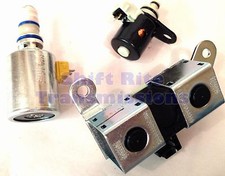
The AODE uses two on/off shift solenoids, SS1 and SS2, in one assembly on the main control. Ford describes them as "two-way, normally open" solenoids that "provide gear selection of first through fourth gears by controlling the pressure to the three shift valves." The gear you get depends on which solenoids the PCM has on. Ford's component description spells out every failure combination:
| Solenoid condition | Gears available (Ford) |
|---|---|
| SS1 failed ON | 1st and 4th only |
| SS1 failed OFF | 2nd and 3rd only |
| SS2 failed ON | 3rd and 4th only |
| SS2 failed OFF | 1st and 2nd only |
| Both failed ON | 4th only |
| Both failed OFF | 2nd only |
Source: Ford 1994 Mustang Workshop Manual, Section 07-01, Transmission Electronic Control System, Shift Solenoid Assembly 7G484. Ford adds that the actual gear also depends "on failure mode and manual lever position."
The last row is the one that matters. Any fault that cuts current to both solenoids at once, whether that is a dead VPWR feed, an unplugged or corroded case connector, a broken internal harness or a PCM that has quit driving outputs, leaves both solenoids off. Both off is 2nd gear only. That is the AODE's failsafe, and it is by design: a 2nd-gear start is slow, but the vehicle can still be driven off the road.
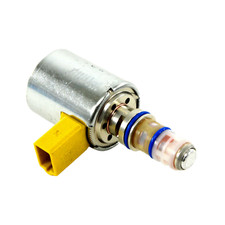
Pressure goes the same direction. The EPC solenoid controls line pressure, and Ford lists EPC "failed OFF" as "maximum EPC pressure, harsh engagements, harsh shifts." The Rotunda tester instructions say it directly: disconnecting the transmission connector "defaults transmission to maximum line pressure." So a complete loss of transmission electrics gives you the full limp picture: 2nd gear only, firm engagements, no converter clutch.
The other "limp" the customer might mean
There is a second failure the PCM does react to. If the EPC solenoid fails ON, or the circuit is shorted (code 624, P1747 on the 3.8L), Ford lists minimum EPC pressure and says the PCM will "limit engine torque (alternate firing)." To the driver that feels like the engine has lost power and is misfiring, and the transmission slips because line pressure is at minimum. Ford also notes the transmission control indicator lamp (the O/D off light) will flash for a shorted EPC circuit or a monitored sensor failure. A flashing O/D light plus a stumbling, down-on-power engine is the AODE's other limp mode, and it points at the EPC circuit, not the shift solenoids.
Sort the symptom before you pull codes
Road test and write down exactly which gears you have. Ford's table does most of the diagnosis for you:
- 2nd only, firm engagements, no lockup: total loss of solenoid power or ground path. Think VPWR, the case connector, the internal harness or the PCM before you think about a solenoid.
- 2nd only but normal shift feel: both shift solenoid circuits lost, EPC still working. Less common, because the solenoids share the VPWR feed with EPC. Look hard at the SS1 and SS2 signal circuits.
- 1st and 2nd, never 3rd or OD: SS2 failed off. One solenoid or one circuit.
- 2nd and 3rd, never 1st or 4th: SS1 failed off.
- Stuck in 4th, or 1st-and-4th: a solenoid failed on, which usually means a circuit shorted to ground or a stuck valve, not lost power.
- Soft, slipping, engine misfire feel, O/D light flashing: EPC failed on or shorted, torque limiting active.
If you only have 1st and 2nd, you do not have the "limp" condition, you have a single-solenoid problem, and our AODE shift solenoid guide covers it in more depth.
Pull codes: what goes with a limp AODE
Ford's instruction is to run the self-test, record all codes and service non-transmission codes first. From the AODE DTC chart, these are the codes that come with a limp or wrong-gear complaint:
- 621 (P0750): SS1 circuit failure. Ford: "circuit failed to provide voltage drop across solenoid. Circuit open or shorted or PCM driver failure." Improper gear selection.
- 622 (P0755): SS2 circuit failure. Same description for SS2.
- 617, 618, 619 (P1731, P1732, P1733): 1-2, 2-3 and 3-4 shift errors. The PCM commanded a shift and did not see the engine rpm drop. Ford notes these can also come from "stuck valves, damaged friction material," so they do not prove a bad solenoid.
- P0751/P1751 and P0756/P1756 (3.8L): shift solenoid 1 or 2 functional failure, "mechanical or hydraulic failure of the shift solenoid."
- 625 (P1746): EPC open circuit. Maximum EPC, harsh engagements and shifts.
- 624 (P1747): EPC shorted or driver fault. Minimum EPC and torque limiting.
- 634 (P1709): MLP out of range. Harsh engagements, firm shift feel, no 3-4 shift. A misadjusted or failing range sensor can look like a partial limp mode.
- 639 (P0720): insufficient OSS input. Ford lists harsh shifts, an abnormal shift schedule and no converter clutch. Without output speed, the PCM cannot schedule shifts properly.
Codes marked with a single asterisk in Ford's chart (621, 622) are "output circuit checks, generated only by electrical conditions." A 621 or 622 is an electrical fault every time. The double-asterisk codes (617-619) "may also be generated by some non-electrical transmission component condition."
Pinpoint Test A: prove the solenoid circuit
Ford's Pinpoint Test A covers codes 617-619, 621, 622 and the P075x solenoid codes. It diagnoses the shift solenoid electrical system only. The steps and values that matter:
- A1: put the PCM in Output State Diagnostic Test Mode so you can toggle the solenoid outputs with the throttle.
- A2, signal check: unplug the transmission connector and inspect both halves with a mirror for pushed-out pins, corrosion, loose wires and damaged seals. Meter from VPWR to the solenoid circuit on the vehicle harness side, then press and release the throttle to cycle the output. The voltage should change by at least 0.5 V. If it does, the PCM and vehicle harness are driving the solenoid.
- A3, harness continuity: PCM disconnected, breakout box 007-00033 installed. Solenoid signal and VPWR from the PCM to the transmission connector should each be under 5 ohms. (5.0L: SS1 is PCM pin 51, SS2 is pin 52. 3.8L: SS1 pin 27, SS2 pin 1.)
- A4, shorts: each circuit should read over 10,000 ohms to power and to chassis ground.
- A7, solenoid resistance at the case: tester in OHMS CHECK, VPWR jack to the SS1 jack, then to the SS2 jack. Each should read 20 to 30 ohms.
- A8: no continuity from either solenoid jack to engine ground.
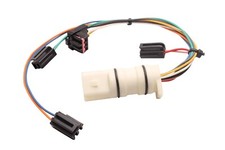
- A9 to A12, inside the pan: drain, drop the pan and check the internal harness. At the 3-wire solenoid connector, SS1 (white), SS2 (black) and VPWR (white/black) should each read under 0.5 ohm from the tester jack, with no continuity to ground. If the harness fails, replace the internal harness. If the harness passes and the solenoid still reads outside 20-30 ohms at its own terminals, replace the solenoid assembly.
That order matters on a limp AODE. The internal harness and the case connector are tested before the solenoid is condemned, and on high-mileage units a chafed internal harness or a leaking case connector is a common reason for losing both solenoids at once. Fluid wicking into the connector is worth checking for at A2 before you go any further.
Ford's full set of tester resistance specs, useful to have on one card:
| Component | Spec (Ford, tester jacks) |
|---|---|
| SS1 | 20-30 ohms |
| SS2 | 20-30 ohms |
| TCC solenoid | 1.0-3.0 ohms |
| EPC solenoid | 2.48-5.66 ohms |
| TOT sensor, 69-104 F | 37K-16K ohms |
| TOT sensor, 159-194 F | 5K-2.7K ohms |
| Internal harness, each lead | under 0.5 ohm |
Source: Ford 1994 Mustang Workshop Manual, Section 07-01, Rotunda Transmission Tester and Pinpoint Test A.
Check the EPC side too (Pinpoint Test E)
Because the EPC solenoid shares VPWR with the shift solenoids, a limp AODE with harsh engagements deserves the EPC test as well. Ford's Pinpoint Test E: EPC PWR at the harness connector over 10.5 V key on, harness circuits under 5 ohms, over 10,000 ohms to power and ground, and 2.48-5.66 ohms across the solenoid. The functional step is the useful one: with a line gauge installed and the tester energizing EPC in Drive, line pressure should drop. If it does not drop, the solenoid is not regulating or the pressure regulator side is holding it up. Our AODE harsh shift guide walks through the EPC test and Ford's pressure chart in detail.
When the electrics pass: it is in the valve body
If Pinpoint Test A passes, the solenoids click, the resistances are in spec and the harness is good, but the transmission still acts like it is missing gears, Ford's "Some or All Shifts Missing" routine (210/310) sends you to fluid level and condition, linkage and MLP adjustment, and then the individual shift routines. On the AODE family there is one valve that deserves a look before anything else.
The solenoid regulator valve
The shift solenoids do not work on raw line pressure. They are fed by the solenoid regulator valve, which keeps the solenoids from being flooded with more pressure than they can exhaust. Sonnax documents that the solenoid regulator valve bore wears in AODE, 4R70W and 4R75 valve bodies, and lists the symptoms: erratic shifts, loss of forward under hard acceleration from a stop, 2-3 neutral, neutral after 4th, no 2nd, and "3rd & Reverse only." Low solenoid feed pressure means the solenoids can be switching correctly while the shift valves they control never stroke. That is a hydraulic limp that no scan tool or ohmmeter will find.
Sonnax's correction is the 76948-14K solenoid regulator valve kit, a hardcoat anodized valve with longer spools for sealing, fitted with their 76948-BST2 bore sizing tool. For bores that are too far gone there is an oversized version that requires reaming.
Pressure regulator bore wear
The second valve body wear point is the main pressure regulator bore. Transmission Digest documents AODE/4R70W units that slip at medium to full throttle and slide through shifts when hot, with EPC pressure near zero at any throttle opening, even with the transmission unplugged. The cause is wear in the pressure regulator valve bore letting EPC oil bleed into the boost circuit, which goes back to the pump inlet. The usual misdiagnosis is an EPC solenoid, and it does not fix it. Their test: pull the pan and filter, blow air into the TV pressure port, and if air and fluid come out through the filter instead of around the EPC solenoid, the bore is worn. At the time of that article the fix was a replacement valve body.
Wrong gear from a stuck valve
Remember that Ford writes the 617-619 shift error codes to include "stuck valves, damaged friction material." A 1-2 shift valve that is stuck, or a clutch that is burned, can make a transmission sit in one gear with perfectly good electrics. If the electrics pass and pressures look right, the per-shift routines (220/320 and on) lead you through the shift valves, check balls and the clutch for the missing gear.
My diagnostic order on a limp AODE
- Check fluid level and condition hot. Low fluid alone can cause lost shifts.
- Road test and write down exactly which gears you have. Compare to Ford's failure table.
- Look at the O/D light. Flashing means EPC or a monitored sensor fault.
- Pull codes. Service engine codes first. Note 621, 622, 624, 625, 617-619, 634 and 639.
- Unplug the case connector and inspect both halves. Check for fluid in the connector.
- Run Pinpoint Test A: 0.5 V output change, under 5 ohms, over 10,000 ohms, 20-30 ohms per solenoid.
- If the case-side reading is bad, drop the pan and split internal harness from solenoid with the under-0.5-ohm checks.
- If everything electrical passes, gauge line and EPC, then go to the solenoid regulator valve and pressure regulator bore.
Two mistakes cost the most time on these. The first is replacing the solenoid pack on a 2nd-gear-only complaint when the real fault is power, connector or harness. Both solenoids rarely fail at the same moment. The second is replacing solenoids when the electrical tests pass. If the ohms and the output switching are good, the fault is hydraulic.
Shop the part for this fix: Sonnax solenoid regulator valve kit 76948-14K
Replaces the worn solenoid regulator valve in AODE and 4R70-family valve bodies, the hydraulic cause of missing gears when the solenoids test good. CoreTransmissionParts stocks it.
View the 76948-14K kit at CoreTransmissionPartsOr browse the full AODE/4R70W parts collection, including shift solenoid kits, internal harnesses and EPC solenoids.
Need parts for this job?
Our AODE parts page has internal wiring harnesses, shift solenoid kits, EPC solenoids and valve bodies for 1992-up AODE units, all on our own checkout. Buy to the test result: an internal harness when the under-0.5-ohm checks fail, a solenoid kit when a solenoid is out of the 20-30 ohm range at its own terminals, and a valve body when the electrics pass and the regulator bores are worn.
FAQ
What is limp mode on an AODE transmission?
The AODE has no separate limp program. When the PCM stops driving both shift solenoids, Ford lists the result as 2nd gear only, and when the EPC solenoid loses current, line pressure goes to maximum. So a limp AODE starts in 2nd, will not upshift and engages hard. It means the transmission lost electrical control.
Why is my AODE stuck in second gear?
Ford's failure table shows both shift solenoids failed off gives 2nd gear only. Because both solenoids rarely fail at once, the usual cause is lost power or ground to both: the VPWR feed, the case connector, the internal harness or the PCM. Run Ford's Pinpoint Test A before buying a solenoid pack.
What should AODE shift solenoids measure?
Ford specifies 20 to 30 ohms for SS1 and SS2, measured from the VPWR jack to each solenoid jack on the transmission tester. Each internal harness lead should read under 0.5 ohm, and the vehicle harness circuits under 5 ohms with more than 10,000 ohms to power and ground.
Can an AODE go into limp mode with good solenoids?
Yes. Sonnax documents solenoid regulator valve bore wear in AODE and 4R70 valve bodies that causes no 2nd, 2-3 neutral and 3rd-and-reverse only, even with the solenoids working. Ford also notes the 617-619 shift error codes can come from stuck valves or damaged friction material.
Why does my AODE lose power and flash the O/D light?
Ford lists an EPC solenoid failed on or shorted (code 624) as minimum EPC pressure with the PCM limiting engine torque by alternate firing. The transmission control indicator lamp flashes for a shorted EPC circuit or a monitored sensor failure. Test the EPC circuit with Pinpoint Test E.
Related guides
Sources
- Ford Motor Company, 1994 Mustang Workshop Manual, Section 07-01 (AODE), Transmission Electronic Control System. Backs SS1/SS2 as two-way normally open solenoids, every failed ON/OFF gear combination including both failed OFF = 2nd gear only, EPC failed ON (minimum EPC, torque limiting by alternate firing) and failed OFF (maximum EPC), the flashing TCIL for a shorted EPC circuit, and the MLP and OSS functions. SRB71012
- Ford Motor Company, 1994 Mustang Workshop Manual, Section 07-01, DTC chart and Pinpoint Tests. Backs codes 617-619/P1731-P1733, 621/P0750, 622/P0755, P0751/P1751, P0756/P1756, 624/P1747, 625/P1746, 634/P1709 and 639/P0720, and Pinpoint Test A values (0.5 V change, under 5 ohms, over 10,000 ohms, 20-30 ohm solenoids, under 0.5 ohm internal harness, PCM pin numbers). SRB71026
- Ford Motor Company, 1994 Mustang Workshop Manual, Section 07-01, Diagnostic Routines. Backs the "Some or All Shifts Missing" routine 210/310 and the per-shift routines it refers to. SRB71019
- Ford Motor Company, 1994 Mustang Workshop Manual, Section 07-01, Rotunda Transmission Tester. Backs the note that disconnecting the transmission connector defaults to maximum line pressure and firm shifts, and the SS1, SS2, TCC, EPC and TOT resistance specs. SRB71024
- Sonnax, Solenoid Regulator Valve Kit 76948-14K. Backs solenoid regulator bore wear in AODE, 4R70 and 4R75 units causing erratic shifts, loss of forward, 2-3 neutral, neutral after 4th, no 2nd and 3rd-and-reverse only, and the 76948-BST2 bore sizing tool. sonnax.com
- Transmission Digest, "I Lost My EPC!" Backs AODE/4R70W pressure regulator bore wear bleeding EPC into the boost circuit, near-zero EPC even unplugged, hot slipping and sliding shifts misdiagnosed as an EPC solenoid, and the compressed-air test at the TV port. transmissiondigest.com