An AODE that runs through 1st, 2nd and 3rd and then just sits there at 2,500 rpm on the highway is one of the more common complaints on Panther cars, F-150s and SN95 Mustangs. The good news is that "no overdrive" on this unit has a short list of causes, and Ford's own service information lets you sort most of them out with a code reader, an ohmmeter and a road test before the pan comes off.
This guide works from Ford's 1994 Mustang Workshop Manual, Section 07-01 (AODE), plus the overdrive servo and band failures Sonnax and Transmission Digest document on this family. Everything is listed under Sources.
First, rule out the overdrive cancel switch
Before anything else, make sure the transmission is actually being allowed to use 4th. The AODE has a Transmission Control Switch (TCS) next to the range selector lever. Ford's description is simple: press it and overdrive is cancelled, so the transmission "will allow automatic shifts from first through third gears only." Press it again and all four gears come back. The PCM lights the Transmission Control Indicator Lamp (TCIL), the "O/D OFF" light, when overdrive is cancelled.
That gives you three quick checks:
- Is the O/D OFF light on? If it is, the PCM thinks overdrive cancel is selected. Press the switch and see whether the lamp goes out.
- Is the light on and will not go out? Ford lists the TCIL circuit fault as code 623. Failed ON means "overdrive cancel mode always indicated." A switch that is stuck, a shorted TCS circuit, or a failed lamp circuit all belong here.
- Does the lamp never come on at all? Ford's 623 definition covers that too: failed OFF, overdrive cancel mode never indicated.
The switch itself has its own code. Ford defines 632 (P1780 on the 3.8L) as "TCS not changing states," which means the switch was not cycled during self-test or the circuit is open or shorted. The listed symptom is "No D cancel when switch is cycled." The KOEO self-test expects you to press the TCS during the test, so a 632 on its own may only mean nobody pressed it. Rerun the test and cycle the switch before you chase wiring.
How the AODE picks 4th: the solenoid chart
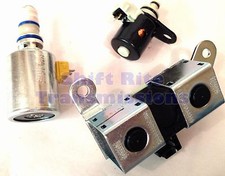
The AODE shifts with two normally open on/off shift solenoids, SS1 and SS2, in one assembly in the main control. Ford's Solenoid Operation Chart for the D (overdrive) range:
| PCM commanded gear (D) | SS1 | SS2 |
|---|---|---|
| 1st | ON | OFF |
| 2nd | OFF | OFF |
| 3rd | OFF | ON |
| 4th | ON | ON |
Source: Ford 1994 Mustang Workshop Manual, Section 07-01, Shift Solenoid Failure Modes and Solenoid Operations Charts.
4th is the only gear that needs both solenoids on, and it is the only gear where SS1 comes back on after being off for 2nd and 3rd. That is why a failed SS1 is the classic "no overdrive" cause on this unit. Ford's failure-mode chart spells out what each failure does in D:
| Failure | Gears you actually get in D (for commanded 1-2-3-4) | What the driver feels |
|---|---|---|
| SS1 always OFF | 2 - 2 - 3 - 3 | 2nd gear starts, 3rd on top, no overdrive |
| SS1 always ON | 1 - 1 - 4 - 4 | 1st, then straight to 4th |
| SS2 always OFF | 1 - 2 - 2 - 1 | 1st and 2nd only, drops to 1st when 4th is commanded |
| SS2 always ON | 4 - 3 - 3 - 4 | Starts in 4th, works 3rd and 4th only |
Ford's electrical component page sums it up the same way: SS1 failed OFF gives "second and third gear only," SS1 failed ON gives first and fourth only. A "no overdrive" complaint that also comes with a lazy take-off is a 2nd-gear start, which puts SS1, its circuit or the PCM driver first. A normal 1-2-3 with no 4th points more toward hydraulics or the band.
Pull codes: the ones that matter for no 4th
The AODE runs on EEC-IV. Pull codes, write them down, and service any non-transmission codes first, as Ford instructs, because TP, MAF and ignition faults all change shift scheduling. These are the transmission codes that bear on a no-overdrive complaint:
- 619 (P1733): 3-4 shift error. The PCM commanded the 3-4 shift and did not see the engine rpm drop. Ford notes this can be the solenoids or "other internal transmission concerns (stuck valves, damaged friction material)." This code tells you the command went out and the shift did not happen.
- 621 (P0750) and 622 (P0755): SS1 or SS2 circuit failure. The circuit did not show the expected voltage drop across the solenoid, from an open, a short or a failed PCM driver. Go to Pinpoint Test A.
- P0751 and P0756 (3.8L): shift solenoid functional failure. Mechanical or hydraulic failure of the solenoid rather than the circuit.
- 634 (P1709): MLP out of range. Easy to miss. Ford lists the symptoms as harsh engagements, firm shift feel and "No 3/4 shift." If the PCM cannot trust the range sensor, it will not reliably command 4th.
- 639 (P0720): insufficient OSS input. The PCM uses output shaft speed for shift scheduling. Lose it and Ford lists harsh shifts, an abnormal shift schedule and no converter clutch.
Also ask whether anything changed on the truck. Ford's shift timing routine (311) calls out tire size and axle ratio changes because they move the shift points. A gear swap or much taller tires can push the 3-4 so late that it looks like it never happens.
Check the MLP sensor while you are there
If 634 is present, or the shift lever feels misadjusted, Ford's MLP chart gives resistance between circuits 359 (GY/R) and 199 (LB/Y) for each position. In D the spec is 361-442 ohms (about 2.09 V). A linkage that parks the sensor on the line between D and 2 is a quick way to lose 4th.
Pinpoint Test A: prove the solenoids and wiring
Ford's Pinpoint Test A covers codes 617-619, 621, 622 and the functional solenoid codes. The steps worth knowing:
- Command output from the PCM. In Output State test mode, with the transmission connector unplugged, put a voltmeter between VPWR and the suspect solenoid circuit on the vehicle harness side. Pressing and releasing the throttle cycles the outputs. The voltage should change by at least 0.5 V. If it does not, the problem is on the vehicle side.
- Vehicle harness. With a breakout box, each solenoid signal wire and VPWR wire from the PCM to the transmission connector should read less than 5 ohms. There should be more than 10,000 ohms to power and to ground.
- Solenoids through the case connector. With the Rotunda tester (007-00085) or equivalent, SS1 and SS2 should each read 20-30 ohms to VPWR and have no continuity to ground.
- Drive test on the tester. In DRIVE mode the tester replaces the PCM. Ford's procedure is to select 4th at 35-45 mph. If the transmission upshifts when the tester commands it, the transmission is good and the fault is in the PCM or vehicle harness. If it will not take 4th on the tester, the problem is inside the transmission.
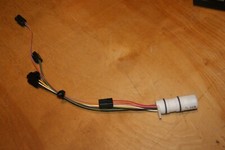
- Internal harness. With the pan off, each internal lead (SS1 white, SS2 black, VPWR white/black) should read less than 0.5 ohm from the tester jack with no short to ground. Out of spec, replace the internal harness.
Ford's hydraulic routine adds one more check: activate each solenoid with the tester and feel for it with your hand on the solenoid. If you cannot feel it operate, replace it and inspect its O-rings. A solenoid that clicks but leaks past a torn O-ring can still fail to hold the shift valve over, which is how you get a 619 with a clean circuit.
Temperature and the cold schedule
The transmission oil temperature (TOT) sensor sits on the main control. Ford says the PCM uses it to decide "whether a cold start shift schedule is necessary," to lock out converter clutch apply when the fluid is cold, and to correct EPC for temperature. An AODE that holds off the 3-4 on the first few cold miles and then behaves may simply be on the cold schedule. If it never changes after full warm-up, check the TOT at the tester jacks. Ford's chart:
| Fluid temperature | TOT resistance |
|---|---|
| 32-68°F (0-20°C) | 100K-37K ohms |
| 69-104°F (21-40°C) | 37K-16K ohms |
| 105-158°F (41-70°C) | 16K-5K ohms |
| 159-194°F (71-90°C) | 5K-2.7K ohms |
| 195-230°F (91-110°C) | 2.7K-1.5K ohms |
Code 637 sets above 869K ohms (open, reads -40°F) and 638 below 597 ohms (grounded, reads 315°F). Ford lists firm shift feel for both. The resistance should drop as the unit warms. If it does not move, replace the sensor.
When the electrics pass: Ford's No 3-4 Shift routine
If the tester commands 4th and the transmission still refuses, you are into Ford's hydraulic/mechanical routine 322. In the order Ford lists them:
- Shift linkage and MLP damaged or misadjusted.
- Pressures. Check line, direct clutch and forward clutch pressures at the taps against the pressure chart. Out of spec, go to the main controls. (The pressure specs are in our AODE slipping guide.)
- Main controls. The 3-4 shift valve, solenoid pressure regulator valve, OD servo regulator, 3-4 capacity modulator valve, 2-3 backout valve, orifice control valve, and the 1-2 and 2-3 shift valves, any of them stuck, damaged or assembled wrong. Also valve body bolts not torqued to spec, damaged gaskets, check balls No. 1, 2, 4 and 7 damaged or missing, and a blocked solenoid screen.
- OD servo. Cover, rod, piston cushion spring or seals damaged.
- Pump. Porosity, cross leaks, missing balls, damaged gaskets.
- OD band and reverse clutch drum damaged, worn or assembled wrong, and the intermediate overrunning clutch.
- Forward clutch assembly. Seals, piston, frictions, and the check ball stuck or not seating.
- Input shaft seals.
The forward clutch is on that list for a reason. 4th is the one gear where the forward clutch releases while the intermediate clutch, direct clutch and overdrive band hold. The 3-4 shift is a swap: forward clutch off, band on. Anything that stops that swap, on either side, can cost you 4th.
The overdrive servo and band: what wears out
This is where most high-mileage no-4th units end up. Sonnax explains the key relationship on this family: the oil that holds the overdrive servo released is forward clutch oil in 1st, 2nd and 3rd. When it shows up, the servo is pushed off. Transmission Digest notes the AODE OD servo does not have a larger release area. Instead it reduces or exhausts apply pressure when release oil is present, so release is still done hydraulically.
The weak point is the servo pin. Per Sonnax, the OD servo pin wears its bore in the case and that release oil leaks. That lets the overdrive band drag in the lower gears and overheats the forward clutch. If the band overheating goes far enough, Sonnax says the band "may not hold in 4th gear," which gives a neutral condition in overdrive and excessive roller clutch rpm when it re-engages on a 4-2 downshift. So a no-4th complaint that comes with a flare, rpm rise or neutral feel when 4th should apply points you at the band and servo, not the solenoids. Their 76833E pin kit seals the bore with two O-rings. It also includes an optional washer that preloads the spring for a firmer 3-4.
The OD servo regulator valve Ford lists in routine 322 wears too. Sonnax's 76948-29K kit, written for the 2001-up 4R70-family valve body, lists "No 4th," "4-3 Neutral" and "Burnt OD band" as symptoms. The cause is wear in the overdrive servo regulator boost valve sleeve, which leaks overdrive oil and stops the servo being regulated properly. The kit fits the later bodies. On an AODE body, the same valve is on Ford's suspect list, so vacuum-test that bore when the body is on the bench.
My diagnostic order on an AODE with no overdrive
- Check the O/D OFF lamp. Cycle the TCS and confirm the lamp follows it.
- Check fluid level and condition hot, Ford's way.
- Pull codes. Service non-transmission codes first. Note 619, 621, 622, 632, 623, 634 and 639.
- Road test and write down exactly which gears you get. Compare them against the failure-mode chart above.
- Run Pinpoint Test A: 0.5 V output change, under 5 ohms harness, 20-30 ohm solenoids, under 0.5 ohm internal harness.
- Command 4th with the tester at 35-45 mph. Takes it: PCM or vehicle harness. Refuses it: internal.
- Gauge line, forward and direct pressures. Then work routine 322, with the OD servo pin bore, servo seals, OD servo regulator and band at the top of the teardown list.
Shop the part for this fix: Sonnax overdrive servo pin kit 76833E
O-ring sealed OD servo pin for AODE and 4R70W cases where the pin has worn the bore and release oil is leaking. Includes the optional washer for a firmer 3-4. CoreTransmissionParts stocks it.
View the 76833E servo pin kit at CoreTransmissionPartsOr browse the full AODE/4R70W parts collection, including OD bands and servo pistons.
Need parts for this job?
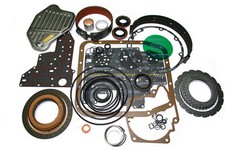
Our AODE parts page has shift solenoid kits, internal wiring harnesses, valve bodies and master rebuild kits for 1992-up AODE units, all on our own checkout. Match the part to the test result, and fix the servo pin bore along with any burnt band.
FAQ
Why won't my AODE shift into overdrive?
Check the O/D OFF light first, because the transmission control switch cancels 4th and the PCM lights the lamp when it does. If the lamp is out, pull codes: 619 is a 3-4 shift error, 621 and 622 are shift solenoid circuit faults, and 634 is an MLP range sensor fault that Ford lists as causing no 3-4 shift. If the electrics test good, the usual internal causes are the overdrive servo, servo pin bore and overdrive band.
Which solenoid controls overdrive on an AODE?
Both. Ford's chart has SS1 and SS2 both ON for 4th, SS1 off and SS2 on for 3rd. Because SS1 has to come back on for the 3-4 shift, an SS1 that has failed off leaves the transmission with 2nd and 3rd only, so it starts in 2nd and never gets overdrive.
What should AODE shift solenoids measure?
Ford specifies 20 to 30 ohms for each shift solenoid, measured from the VPWR jack to the SS-1 or SS-2 jack on the transmission tester, with no continuity to ground. Each internal harness lead should read under 0.5 ohm, and the vehicle harness from the PCM should read under 5 ohms per circuit.
What does code 632 mean on an AODE?
Code 632 (P1780 on the 3.8L) means the transmission control switch did not change states during self-test. It sets if the switch was not pressed during the KOEO test or if the circuit is open or shorted, and Ford lists the symptom as no overdrive cancel when the switch is cycled. Rerun the self-test and press the switch before chasing wiring.
Can a bad overdrive band cause no 4th gear on an AODE?
Yes. Sonnax documents the overdrive servo pin wearing its case bore, which leaks release oil so the band drags and overheats. Once the band is burnt it may not hold in 4th, which feels like a neutral or flare when overdrive should apply. Fix the servo pin bore along with the band or the new band will burn too.
Related guides
Sources
- Ford Motor Company, 1994 Mustang Workshop Manual, Section 07-01 (AODE), Transmission Range Selector and Shift Patterns. Backs the TCS cancelling overdrive to allow 1st through 3rd only, and pressing it again to restore all four gears. SRB71006
- Ford Motor Company, 1994 Mustang Workshop Manual, Section 07-01, Shift Solenoid Failure Modes and Solenoid Operations Charts. Backs the SS1/SS2 on/off states for each gear and the actual gears obtained with each solenoid failed on or off. SRB71013
- Ford Motor Company, 1994 Mustang Workshop Manual, Section 07-01, Transmission Electronic Control System. Backs the TCS/TCIL function and the TCIL failed ON/OFF symptoms, SS1/SS2 failure symptoms, the TOT's role in the cold start shift schedule, and the OSS's role in shift scheduling. SRB71012
- Ford Motor Company, 1994 Mustang Workshop Manual, Section 07-01, Pinpoint Tests and DTC chart. Backs codes 619/P1733, 621/P0750, 622/P0755, 623, 632/P1780, 634, 637/638 and 639/P0720, Pinpoint Test A values (0.5 V, under 5 ohms, over 10,000 ohms, 20-30 ohms, under 0.5 ohm), the TOT resistance chart and the MLP resistance chart. SRB71026
- Ford Motor Company, 1994 Mustang Workshop Manual, Section 07-01, Diagnostic Routines. Backs the No 3-4 Shift routines 222/322 (main control valves, check balls 1, 2, 4 and 7, OD servo, pump, OD band, intermediate overrunning clutch, forward clutch) and routine 311 on tire size and axle ratio changes. SRB71019
- Ford Motor Company, 1994 Mustang Workshop Manual, Section 07-01, Rotunda Transmission Tester. Backs the tester drive test (select 4th at 35-45 mph) and the SS-1/SS-2 20-30 ohm, TCC 1.0-3.0 ohm and EPC 2.48-5.66 ohm specs. SRB71024
- Sonnax, Overdrive Servo Pin Kit 76833E. Backs forward clutch oil acting as OD servo release oil in 1st through 3rd, pin bore wear causing band drag and forward clutch overheating, the band failing to hold 4th with a neutral condition, and the optional washer for a firmer 3-4. sonnax.com
- Sonnax, Overdrive Servo Regulator Kit 76948-29K. Backs No 4th, 4-3 neutral and burnt OD band from wear in the OD servo regulator boost valve sleeve, and the 2001-up 4R70-family fitment. sonnax.com
- Transmission Digest, "First, Do No Harm: Things You Should Know About Performance Servos." Backs the AODE OD servo reducing or exhausting apply pressure when release oil is present. transmissiondigest.com