"It won't move in any gear" is one of the scarier calls a C6 can make, and it's also one of the most commonly misdiagnosed, because the phrase actually covers two unrelated problems. One is a real internal failure: the pump isn't building pressure, or pressure is present but nothing is actually applying inside the case. The other is a transmission that is mechanically fine but is being held out of gear by something in the parking pawl or shift linkage, so the truck feels dead even though nothing inside the case has failed. Working both of those the same way — pulling the pan and guessing — wastes time. This is the order of checks that actually separates them, including two documented parking-pawl failures Ford recalled on this exact transmission.
Rule Out the Parking Pawl and Linkage First
This step gets skipped constantly because techs assume "no movement" has to be internal. On a C6 it doesn't. Ford ran two separate safety recalls on this transmission's park-actuation hardware, and both describe exactly the kind of complaint that gets called in as "it won't move":
- Recall 78V201000 (1979 model year C-6 trucks and cars, roughly 22,000 units): the parking pawl actuating rod had an unhardened cam surface that could deform in use, increasing shift effort and making it hard to release the pawl and engage the parking gear [1].
- Recall 77V185000 (1978 model year C-6 vehicles, roughly 19,000 units): the park actuation support plate was prone to cracking from improper heat treatment during manufacture, and fragments from a cracked plate could lodge in the pawl mechanism — preventing the pawl from engaging or from disengaging from the park gear [2].
Both campaigns are decades old, but the mechanism they describe — a worn or damaged parking pawl path binding up the linkage — doesn't care what year it is. If the pawl won't fully release, or the manual valve inside the valve body isn't actually indexed with the shift lever's detent position because of worn bushings or a bent rod, the truck can sit there doing nothing in every gear position while the clutches and bands inside are perfectly healthy. Before you open the pan, pull the linkage rod off the transmission's detent lever and manually confirm the lever moves freely through its full range and that the pawl releases with the rod disconnected. If it binds here, you've found your problem without touching the valve body.
Confirm Fluid Type and Level
Low fluid that lets the pump pick up air, or fluid that's the wrong type for the unit, both produce the same symptom: pressure that won't build high enough to hold a clutch or band applied under load. Check the level hot, in Park, on level ground, before assuming anything internal is wrong.
Fluid type matters more on a C6 than on most later transmissions because Ford changed specs partway through this unit's production run. Pre-1977 C6 units, and some built through 1980, were designed around Ford spec ESW-M2C33-F — what the trade calls Type F — a high-static-friction fluid built to let the clutches lock up quickly rather than slip into engagement. Per Mobil's product data sheet for its Type F ATF, that fluid is explicitly not recommended as a substitute where a Dexron-II/IIE/III or Mercon-approved fluid is specified, and the reverse is also true: running a modern Mercon/Dexron-spec fluid in a transmission built for Type F changes clutch feel and can contribute to delayed or soft engagement [3]. If your C6's dipstick or case doesn't carry an ESW-M2C33-F stamp, or it's been rebuilt since, check which spec the rebuild kit called for rather than assuming by year alone. We cover the full capacity and cross-reference numbers separately in our C6 fluid type and capacity guide — this section is only the piece that's relevant to a no-movement complaint.
Check Pump Flow and Line Pressure Before Pulling Anything
Once linkage and fluid are confirmed good, the next step is proving the pump is actually moving fluid and building pressure, in that order. This is the same sequence Transmission Digest walks through in its diagnosis of a different three-speed automatic's no-move complaint, and the logic carries over directly to a C6 because the pump-converter-clutch relationship is the same basic hydraulic chain: confirm flow at the cooler return line first, then measure line pressure at the case test port, then only after both check out does the fault point toward the converter or input shaft rather than the pump [4].
- No flow at the cooler line: the front pump itself is the suspect — worn gears, a cracked pump body, or a seized rotor. This almost always means the transmission has to come out.
- Flow is present but line pressure is low or zero at the test port: suspect a stuck pressure regulator valve, a blown case gasket, or a cracked/warped valve body separator plate bleeding pressure internally before it ever reaches a clutch.
- Flow and pressure both check out, but the truck still won't move: the problem has moved past the pump. Pull the converter and inspect where it meets the front pump hub and the input shaft.
On that last point, a converter that didn't get pushed all the way home against the pump during a prior transmission or converter swap is a classic, completely avoidable cause of a brand-new no-move complaint. If there's unusual freeplay at the converter, or it moved forward noticeably when the transmission was mated to the engine, pull it back out and recheck how far it seats before blaming anything inside the case. Also inspect the input shaft tip and the converter's turbine hub for damage at this stage — a chewed set of splines there will pass fluid and pressure all day long while transmitting zero torque.
Bench Checks That Rule Out False Alarms
Jody Carnahan of Certified Transmission, writing a C6-specific diagnostic tips piece, lays out a short bench checklist worth running before you commit to any of the above: a pressure gauge, a vacuum gauge, and a handheld vacuum pump are enough to catch several non-transmission causes of a "won't move" complaint. On industrial and heavy-truck applications with a rear-mounted parking brake, a brake that has fallen out of adjustment can drag hard enough on acceleration to feel like the transmission is fighting itself — check brake adjustment before condemning anything inside the case [5]. He also notes a healthy engine should show roughly 15 to 18 inches of vacuum at idle, and that higher vacuum produces lower modulator pressure while lower vacuum produces higher pressure — a relationship worth confirming with the vacuum pump if the vehicle has any surging or hunting behavior layered on top of the no-move complaint, since a wildly wrong vacuum signal can mask what's really happening with line pressure.
What Actually Fixes It
Once you've isolated where the fault actually lives, the repair follows directly:
- Linkage/parking pawl path: replace the actuating rod, support plate, or worn bushings, and re-adjust the rod so the detent lever seats fully in each position without the slide valve or its operating lever contacting the valve body housing before full travel.
- Manual valve not indexed correctly, or a cracked/warped valve body: replace the valve body rather than chase individual valves — on a unit this old, a cracked case half or a worn bore at the manual valve is rarely worth machining.
- No pump flow or confirmed pump damage: the transmission needs to come out for a pump rebuild or replacement, and the input shaft and converter should be inspected in the same service since a failed pump often takes the shaft tip with it.
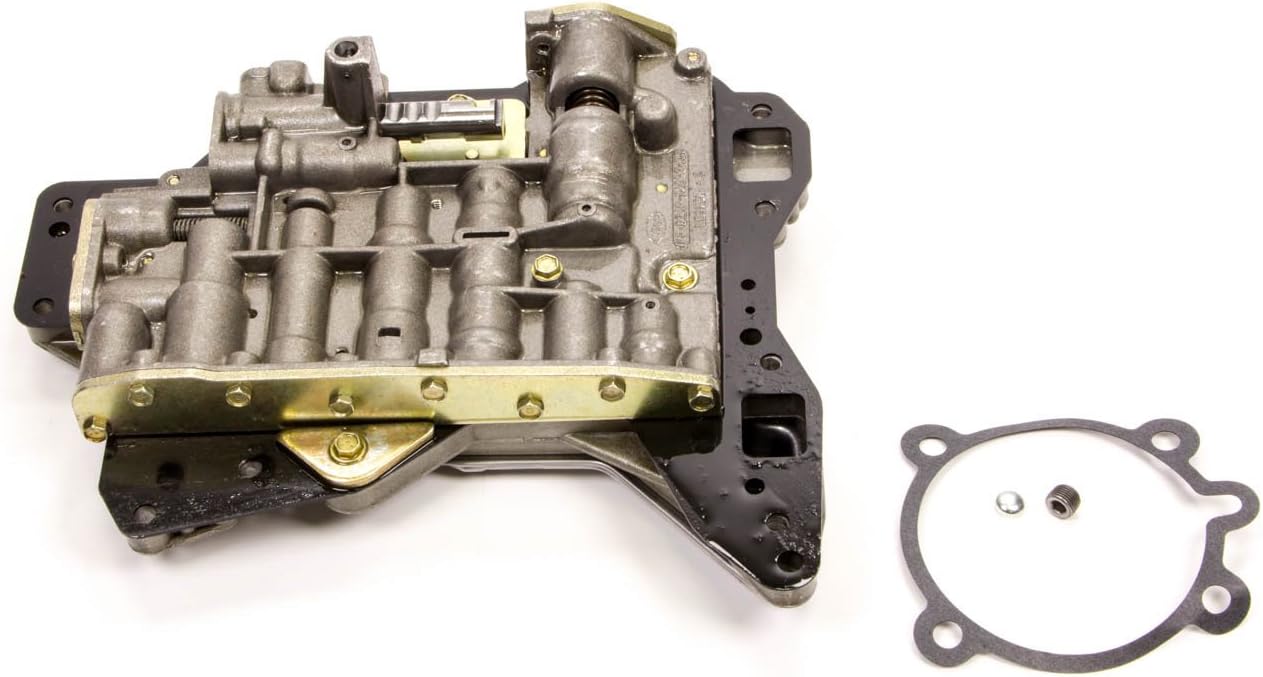
C6 Valve Body – Aftermarket
If the linkage checks out free but the manual valve isn't landing in the right bore position, or the valve body shows a crack at the case half, this is the direct-fit replacement to stop chasing it.
View the valve body →Need parts for this job?
C6 valve bodies, front pumps, filters and fluid — shipped fast from the USA.
Shop C6 parts →FAQ
What's the first thing to check when a C6 won't move in any gear?
Before touching the transmission, confirm the shift linkage actually puts the manual valve where the lever says it does, and that the parking pawl is fully releasing. Ford issued two separate recalls on the C6's park-actuation hardware (actuating rod and support plate), both of which can leave a truck feeling like it won't move even though the lever reads Drive. Only after linkage and fluid level are confirmed good should you move on to a pump and pressure check.
Can low or wrong fluid cause a C6 to not move at all?
Yes. Fluid that is low enough to aerate at the pump pickup, or badly burnt and varnished, will not let the front pump build the pressure needed to apply the forward clutch or the reverse band, and the result reads exactly like an internal failure. Pre-1977 and some 1977-1980 C6 units were built around Type F (Ford spec ESW-M2C33-F) rather than Dexron or Mercon, and the wrong fluid family changes clutch apply feel even when quantity is correct.
Why would a C6 move fine in Drive but act like it won't move in Park?
That is almost always the parking pawl or its linkage, not the gear train. Ford's 1977 and 1978 recalls on C6-equipped trucks describe a park support plate that could crack and shed fragments into the pawl mechanism, and a parking pawl actuating rod whose unhardened cam surface could deform, both of which made the pawl hard to engage or release. A truck that feels stuck in Park, or that won't fully seat in Park, points at that linkage path first.
Does a C6 no-movement complaint always mean a full rebuild?
No. A stuck or worn manual valve linkage, a cracked or warped valve body, a parking pawl rod problem, or a torque converter that never fully seated after a prior service can all produce a dead no-move complaint without the clutch packs or bands being at fault. Pump flow and line pressure checks are what separate those external and valve-body causes from a genuine internal clutch, band, or input shaft failure before you commit to pulling the unit.
How do I tell a bad front pump from a bad torque converter on a C6?
Pull the cooler return line and crank the engine (or run it briefly) to see whether fluid actually flows out, which confirms the pump is turning and moving fluid. If flow is present but line pressure at the test port is low or absent, the pump itself is suspect. If flow and pressure both look correct but the vehicle still will not move, shift your attention to converter seating and the input shaft, since a converter that walked forward off the pump's splines during a prior install, or a damaged input shaft tip, can produce normal pressure with zero power transfer.
Related C6 guides
Sources
- NHTSA — Recall Campaign 78V201000, Ford Motor Company, reported September 15, 1978. Backs the parking pawl actuating rod defect on 1979 model year C-6-equipped Ford/Lincoln vehicles (F100, F150, F250, F350, Econoline, Bronco, Club Wagon, Lincoln), roughly 22,000 units, where an unhardened cam surface on the rod could deform in use, increasing shift effort and causing difficulty releasing the pawl and engaging the parking gear. api.nhtsa.gov
- NHTSA — Recall Campaign 77V185000, Ford Motor Company, reported October 25, 1977. Backs the park actuation support plate defect on 1978 model year C-6-equipped vehicles, roughly 19,000 units, where improper heat treatment during manufacture could cause the plate to crack, with fragments able to lodge in the parking pawl mechanism and prevent the pawl from engaging or disengaging the park gear. api.nhtsa.gov
- Mobil — Product Data Sheet, Mobil Type F ATF. Backs the Ford ESW-M2C33-F (Type F) specification identity and application history on pre-1977 and some 1977-1980 Ford automatic transmissions, and the explicit non-interchangeability with Dexron-II/IIE/III or Mercon-approved fluid. mobil.com
- Transmission Digest — "Sherlock Holmes Approach to an AB60 No-Move Situation." Backs the diagnostic order of operations for a no-movement automatic transmission complaint: confirming pump flow at the cooler return line first, measuring line pressure at the case test port second, and only then investigating torque converter seating and input shaft condition as the next suspects once pump output is confirmed good. transmissiondigest.com
- Jody Carnahan, Certified Transmission — "C6 Diagnostic Tips." Backs the recommended basic diagnostic toolset (pressure gauge, vacuum gauge, handheld vacuum pump), the guidance to check parking-brake drag before blaming the transmission on industrial/heavy-duty applications, and the baseline idle vacuum range of roughly 15 to 18 inches on a healthy engine. aviationpros.com