Every Turbo 350 that has been on the road for forty-plus years leaks somewhere. The question is never "is it leaking," it is "where is it actually coming from," and that is where most people waste money. They throw a pan gasket at a filler-tube drip, or pull the transmission for a front seal that turns out to be a rear main.
GM published a specific list of TH350 leak points in its factory service manuals, along with a procedure for finding the real source. This guide walks through that list in the order I check it on the lift, gives the factory torque specs for each joint, and covers the two leaks that do not drip at all: a ruptured vacuum modulator and fluid coming out the vent. Sources are listed at the bottom.

Find the Source Before You Buy Parts
GM's 1975 chassis service manual for the Turbo Hydra-Matic 350 opens its external leak section with a warning worth repeating: the source of an oil leak can be deceiving because of wind flow around the engine and transmission. Air under the car pushes fluid rearward. GM's own example is a filler tube to case leak that shows up as a leak at the rear of the transmission. If you just look for the wettest spot, you will often be looking in the wrong place.
The factory sequence is simple and it works:
- Degrease the underside of the transmission so you start with dry metal.
- Road test to bring the unit up to operating temperature. GM's porosity procedure calls that roughly 190 degrees F.
- Inspect with the engine running. The pump only pressurizes the case, the cooler lines and the front seal area when the engine is turning.
- Inspect again with the engine off. When a TH350 sits, fluid drains back from the converter and cooler into the pan and raises the level. Seals that are dry while running can weep at rest, and GM specifically lists that drain-back check as its own step.
Wipe the suspect area clean before every look. GM also points out that red dye is added to the transmission fluid at the plant, and that a black light comparison against the engine and transmission dipsticks will tell you whether a leak is engine oil or ATF. On a car with mystery fluid in it, add a UV dye made for ATF, drive it, and use the light. Check both fluid levels before you condemn the front seal, too: Transmission Digest documented a suspected front seal leak where the engine turned out to be the one losing fluid and the transmission seal area was dry once the unit came out (Transmission Digest, Shift Pointers).
GM's TH350 Leak-Point List
Here is the factory list, grouped the way GM groups it, with the torque spec that goes with each joint. Torque values come from GM's 1976 Chevrolet light truck service supplement (ST-330-76) and the 1975 Buick TH350 section, which are not identical in every case; where they differ, both are shown.
| Leak area | GM's listed causes | Factory spec |
|---|---|---|
| Oil pan | Bolts not torqued correctly; gasket damaged or installed wrong; pan rail not flat | 130 in-lb (ST-330-76); 13 lb-ft (1975 Buick) |
| Extension housing | Bolts not torqued; rear seal damaged or installed wrong; square cut extension-to-case seal damaged | Extension to case 25 lb-ft (ST-330-76) |
| Filler pipe | O-ring damaged or missing; filler pipe bracket mispositioned to the engine | -- |
| Vacuum modulator | O-ring damaged or installed wrong | Retainer 130 in-lb (ST-330-76); 12 lb-ft (1975 Buick) |
| Detent (kickdown) cable | Connector O-ring seal damaged or installed wrong | Cable to case 75 in-lb (ST-330-76) |
| Governor cover | Cover not tight; seal damaged; leak between case face and seal | Wire-retained; replace cover if bent |
| Speedometer gear | Driven gear sleeve O-ring damaged | -- |
| Manual shaft | Shift shaft seal damaged or installed wrong | -- |
| Line pressure tap | Plug loose | -- |
| Front of transmission | Pump seal, pump bolts and washer seals, pump housing O-ring, converter weld, porous pump casting | Pump to case 18-1/2 lb-ft (ST-330-76) |
| Cooler fittings | Loose or damaged connectors and line nuts | Connectors to case 25 lb-ft straight / 15 lb-ft tapered; line to connector 10 lb-ft (ST-330-76) |
The Right Side of the Case: Where Most TH350 Drips Start
The filler tube, the modulator and the kickdown cable all sit together on the passenger side of the case, and they share one drip point at the bottom of the case. That is why owners swear the pan gasket is bad when it is not. Check these three before you touch the pan.
Filler tube O-ring
The dipstick tube is pushed into a bore in the case and sealed with an O-ring. GM lists two failure modes: a damaged or missing O-ring, and a filler pipe bracket that is mispositioned to the engine. The second one matters. If the bracket bolt at the engine is pulling the tube sideways, the tube walks out of its bore and no new O-ring will hold. Pull the tube, install the new O-ring lubricated with ATF, seat the tube fully, and then make sure the bracket lines up without being forced. If the tube has been bent or the end is dented, replace it.
Vacuum modulator O-ring
The modulator plugs into the case bore and is held by a retainer and bolt. The 1975 Buick procedure says to lubricate the modulator O-ring to prevent damage during install and torque the retainer bolt to 12 lb-ft; the 1976 Chevy truck supplement lists 130 in-lb, so plan on 11 to 12 lb-ft and stop there. A dry O-ring that gets pinched on the way in will weep on day one.
Detent cable seal
The kickdown cable enters the case near the modulator. GM's ST-330-76 installation step is specific: install a new seal on the detent downshift cable, lubricate it with transmission fluid, and secure the cable to the case with its bolt and washer at 75 in-lb. That is inch-pounds. Crank it like a pan bolt and you crush the seal.
The Pan Gasket, Done Right
When the pan really is the leak, GM's list gives three causes: bolts torqued wrong, gasket damaged or installed wrong, and a pan rail that is not flat. The third one is the reason so many TH350 pan gaskets never seal. Years of overtightened bolts dimple the stamped steel around each hole. Lay the pan upside down on a flat surface and check the rail. Tap dimpled holes flat with a hammer and a block, or replace the pan.
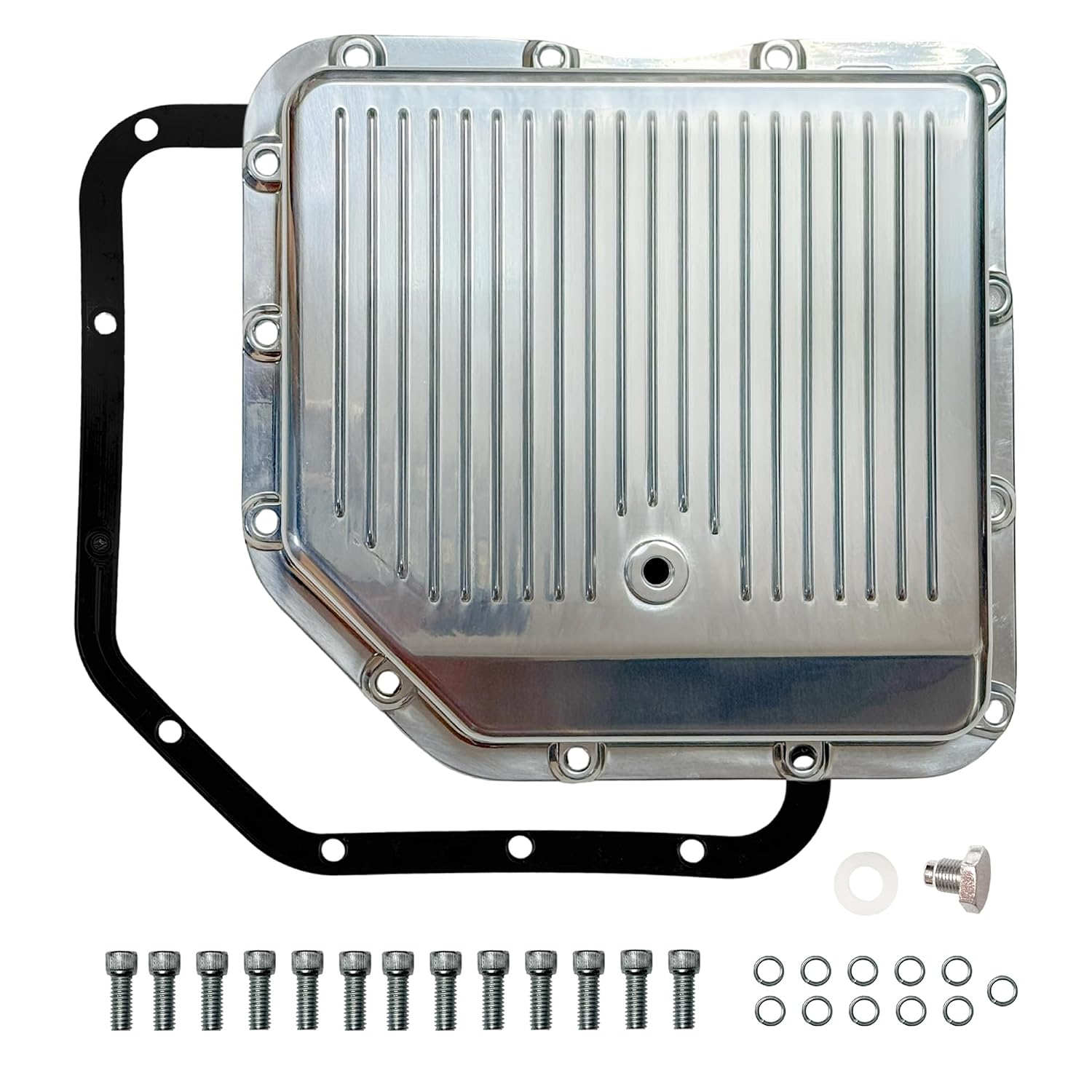
The stock pan uses 13 bolts. Raybestos lists cork gaskets (03G615 and 63G615) and a nitrile gasket (22G615) for the 1969-1986 TH350, and notes that its 515615 filter does not include a gasket, so buy the kit or the gasket separately. Torque is the trap. ST-330-76 lists 130 in-lb, and the 1975 Buick manual says 13 lb-ft. More torque does not seal better; it splits cork and bows the rail between bolts. Tighten in a crisscross pattern in two passes.
Skip the RTV. Moroso's TH350 pan instructions say outright that they do not recommend any type of sealer on the gasket, because small pieces can dislodge and clog the transmission internals. A clean, flat rail and the right gasket seal on their own.
Rear of the Transmission: Extension Housing and Speedometer Gear
A wet tailshaft can be any of four things. Work through them in order:
- Rear seal. GM lists a damaged or improperly installed rear seal. Always check the driveshaft slip yoke surface when one fails. A grooved or rusty yoke will cut a new seal in short order. Drive the new seal in square with the proper installer.
- Square-cut seal, extension to case. This is the seal behind the extension housing flange. If fluid is coming from the seam between the housing and case rather than the seal bore, this is it. Extension housing bolts are 25 lb-ft per ST-330-76.
- Speedometer driven gear O-ring. The driven gear sleeve sits in the extension housing, held by a retainer and bolt, and seals with an O-ring. It is a cheap, easy fix.
- Governor cover. The governor cover sits on the side of the case and is held by a retainer wire. GM lists a loose cover, a damaged seal, or a leak between the case face and the seal. The Buick procedure warns to use extreme care removing the cover because a damaged cover must be replaced.
Front of the Transmission: The One That Means Pulling It
Fluid dripping from the bottom of the bellhousing is the expensive one, because every fix means pulling the transmission. Confirm it is ATF with dye first. Then know that GM lists more than just the seal itself:
- Front pump seal lip cut. GM's note says to check the converter hub. A rough or grooved hub will cut a new seal fast.
- Pump bushing moved or damaged, or the seal's oil return hole plugged or missing. The bushing holds the converter hub centered in the seal. Sonnax notes that worn babbitt TH350 pump bushings let the converter hub and inner pump gear move off center, which damages the pump gears and the pump housing crescent. Sonnax's oil-flow article adds the hydraulic side: converter oil flowing past an oversized hub bushing contributes to front seal leaks, and an extra .003" of clearance on a 2" hub is roughly the same area as a .100" hole (Sonnax, Anatomy of a Transmission). A hub that wobbles in a worn bushing will out-run any new seal, so replace the bushing with the seal.
- Pump attaching bolts loose, or the bolt washer seals damaged or missing. GM calls out the washer-type seals on the pump bolts specifically; reuse the bolts, not the washers. Pump to case is 18-1/2 lb-ft per ST-330-76.
- Pump housing O-ring damaged or cut. The large O-ring around the outside of the pump body. It can be nicked on installation if the pump is not started square.
- Converter leaking in the weld area, or a porous pump casting. If the seal and bushing look fine and fluid is still coming out, look at the converter. GM's converter check fills it with 80 psi of air through a sealing tool and submerges it in water to look for bubbles.
When a TH350 is out for a front leak, I replace the seal, bushing, pump O-ring, pump gasket and bolt washers as a set and inspect the converter hub.
The Leaks That Do Not Drip
Ruptured vacuum modulator
If the fluid level keeps dropping and the floor stays clean, check the modulator first. GM's modulator diagnosis lists "engine burning transmission oil" as one of the symptoms of a failed modulator, along with harsh, delayed or soft shifts, slipping and overheating. When the diaphragm ruptures, manifold vacuum pulls ATF through the vacuum line into the intake and the engine burns it.
GM's test takes two minutes. Pull the modulator, turn it so the vacuum stem points down, and see what comes out. If transmission oil comes out, the diaphragm is bad. GM adds an important caution: gasoline or water vapor can condense on the vacuum side, and if you find that without oil, the modulator must not be changed. Rub the liquid between your fingers; oil feels slick, gas and water do not. GM also says that if no oil is found but the fluid level is continually low with no external leaks, there may be a pinhole leak in the diaphragm and the modulator should be replaced. While you are there, check the vacuum line from the manifold for holes, cracks or dents and the rubber connections at both ends.
Fluid out the vent
Fluid spitting out of the vent is not a seal failure. GM's list for "oil comes out vent pipe" is: transmission overfilled, water in the oil, foreign material between the pump and case or between the pump cover and body, a case that is porous near the converter bosses or pump cover oil channels near the breather, and a pump-to-case gasket that is mispositioned. If water is the cause, take it seriously: Gears Magazine notes that clutches absorb water, the moisture cannot be removed, and contaminated clutches have to be replaced, and it recommends antifreeze and water test strips to tell a radiator cooler leak from water entering through the vent (Gears, Identifying ATF Contamination). Start with the level. GM's checking procedure also notes that water in the fluid gives it a milky, pink cast and can cause spewing; on a truck that has been through deep water, or one with a leaking radiator-tank cooler, that is your answer.
Case Porosity: The In-Car Repair GM Approved
Sometimes the leak is coming straight through the aluminum. GM's manual says TH350 leaks caused by case porosity can be successfully repaired with the transmission in the car. The procedure: bring the unit to roughly 190 degrees F, raise the car, and locate the leak with the engine running in Low, Drive and Reverse. Shut it off, clean the area thoroughly with solvent and a brush and let it air dry, apply epoxy per its maker's instructions so the area is fully covered, and let it cure 3 hours before starting the engine. Then road test and recheck.
Cooler Lines and Fittings
The TH350's steel cooler lines rust, chafe on the frame and loosen at the case fittings. ST-330-76 lists the connectors into the case at 25 lb-ft for straight-thread fittings and 15 lb-ft for tapered pipe-thread fittings, and the line nut to the connector at 10 lb-ft. Use a flare-nut wrench on the line nut and hold the connector with a second wrench so you do not twist the line.
Reseal It Once
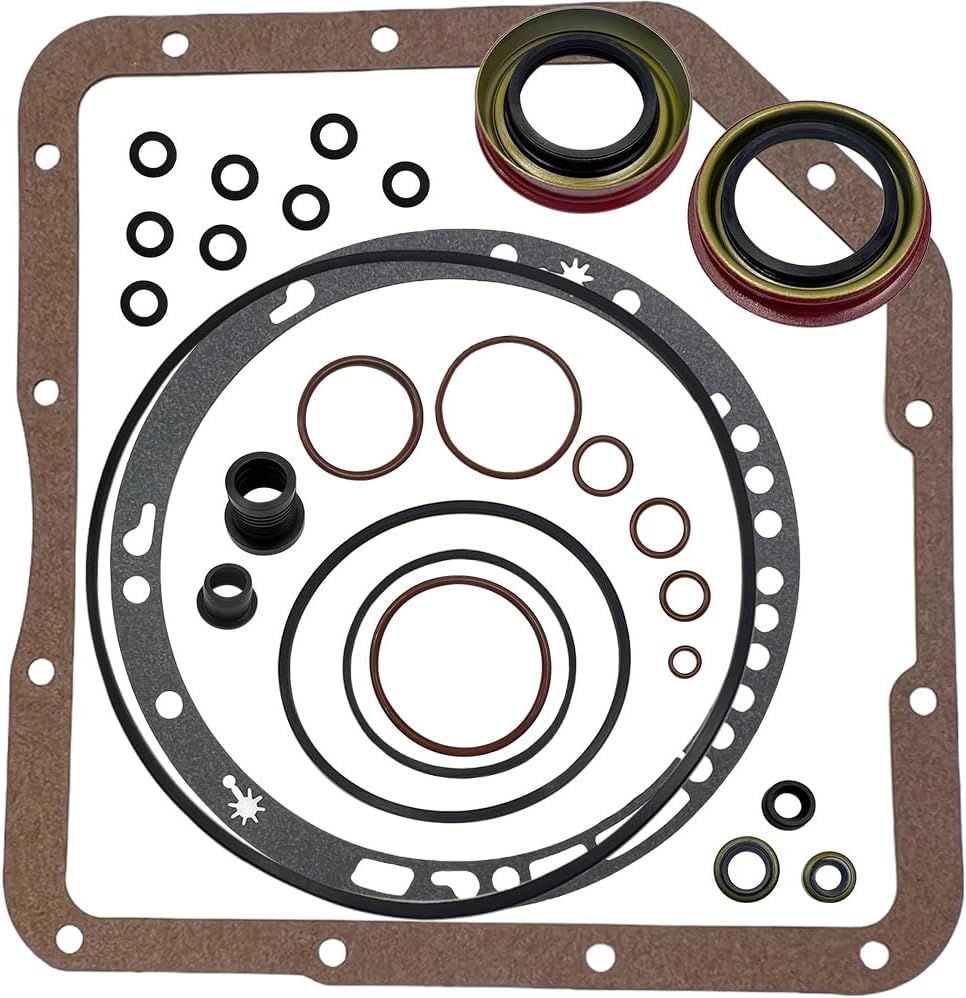
Most TH350 leaks are a set of tired external seals rather than one bad part. An external reseal kit covers the filler tube, modulator, kickdown, speedometer, manual shaft and pan seals in one shot, and on a car you plan to keep it is cheaper than chasing them one at a time.
Shop the part for this fix
One external reseal kit covers the filler tube O-ring, modulator, kickdown, speedometer, shift shaft and pan seals on a Turbo 350, the parts behind most of the leaks above.
Shop the TH350 external reseal kit → or browse all TH350 parts →FAQ
Where does a TH350 usually leak from?
The most common spots are on the passenger side of the case: the filler tube O-ring, the vacuum modulator O-ring and the kickdown cable seal. They all drip from the same low point, so they get mistaken for a pan gasket leak. After those come the pan gasket, the rear seal, the speedometer gear O-ring and the front pump seal.
Why is my TH350 losing fluid with no visible leak?
Check the vacuum modulator. GM lists engine burning transmission oil as a failed-modulator symptom: a ruptured diaphragm lets manifold vacuum pull ATF into the intake. Pull the modulator and point the vacuum stem down; if transmission oil comes out, replace it. GM also says a continually low level with no external leak can mean a pinhole in the diaphragm.
What is the torque spec for TH350 pan bolts?
GM's 1976 light truck supplement lists 130 in-lb (about 11 lb-ft), and the 1975 Buick TH350 manual says 13 lb-ft. Tighten the 13 bolts in a crisscross pattern in two passes. Overtightening splits cork gaskets and dimples the pan rail, which causes the next leak.
Should I use RTV on a TH350 pan gasket?
No. Moroso's TH350 pan instructions recommend against any sealer on the gasket because pieces can break loose and clog the transmission. Use a clean, flat pan rail and a correct cork or nitrile gasket at the factory torque.
Why is fluid coming out of my TH350 vent?
GM's list for fluid out the vent starts with overfilling, then water in the fluid, debris between the pump and case, porosity near the converter bosses and a mispositioned pump-to-case gasket. Check the level hot first. Milky pink fluid means water, often from a leaking radiator cooler or a deep water crossing.
TH350 reseal kits, modulators, pan gaskets, pans with drain plugs and rebuild parts. Shipped fast from the USA.
Shop TH350 parts →Sources
- General Motors / Buick — 1975 Chassis Service Manual, Section 7C, Turbo Hydra-Matic 350-375B Automatic Transmission (PDF). Backs the leak-diagnosis sequence (degrease, road test, inspect running and again after drain-back), the warning that air flow carries leaks rearward with the filler-tube example, plant red dye and black light comparison, the full list of possible leak points (pan, extension housing, filler pipe, modulator, detent cable, governor cover, speedometer gear, manual shaft, pressure tap, front pump items, converter weld, porous casting), the vent pipe causes, water giving a milky pink cast, the case porosity epoxy repair at about 190 F with 3-hour cure, the modulator symptoms including engine burning transmission oil, the stem-down diaphragm test and gas/water caution, the pinhole note, the 80 psi converter leak check, the 13 lb-ft pan bolts and the lubricated modulator O-ring with 12 lb-ft retainer bolt. teambuick.com (PDF)
- General Motors / Chevrolet — 1976 Light Truck Service Overhaul Supplement (ST-330-76), Section 7A and Specifications (PDF). Backs the TH350 torque specs: oil pan 130 in-lb, modulator retainer 130 in-lb, extension to case 25 lb-ft, pump to case 18-1/2 lb-ft, cooler connectors 25 lb-ft straight and 15 lb-ft tapered, cooler line to connector 10 lb-ft, detent cable 75 in-lb; and the new, ATF-lubricated detent cable seal. 73-87chevytrucks.com (PDF)
- Sonnax — Pump Bushing 34034T-01 (GM TH350, TH350C, TH400, Powerglide, AT-540). Backs the statement that worn babbitt pump bushings allow the converter hub and inner pump gear to move off center, damaging the pump gears and pump housing crescent. sonnax.com
- Raybestos Powertrain — 515615 GM TH350 Transmission Filter, 1969-1986. Backs the 13 pan bolts, cork (03G615, 63G615) and nitrile (22G615) pan gasket numbers, and that the 515615 filter does not include a gasket (kit 7615 does). raybestospowertrain.com
- Moroso Performance Products — Turbo 350 Transmission Pan P/N 42010 Installation Instructions (PDF). Backs the recommendation against any sealer on the pan gasket because pieces can dislodge and clog the transmission, and the clean, debris-free mounting surface. moroso.com (PDF)
- Sonnax — "Anatomy of a Transmission: Oil Flow in the Pump-PR-Converter-Cooler-Lube Circuits." Backs that excess converter hub bushing clearance lets converter oil past the bushing and contributes to front seal leaks, and the .003" on a 2" hub equals roughly a .100" hole comparison. sonnax.com
- Transmission Digest — Wayne Colonna, "Shift Pointers: Where's that fluid leak coming from?" (May 2024). Backs checking both fluid levels before assuming a front seal leak; the suspected transmission leak was engine oil. transmissiondigest.com
- Gears Magazine (ATRA) — Mike Brown, "Identifying ATF Contamination." Backs water entering through the transmission vent, clutches absorbing water and needing replacement, and antifreeze/water test strip interpretation. gearsmagazine.com