The Turbo 350 is one of the easiest automatics GM ever built to work on, and most of them that land on a bench today have not failed in any mysterious way. They leak at the modulator or the shift shaft, they lose 2nd gear when the intermediate roller or its race lets go, they burn the direct clutch and lose both 3rd and Reverse, or they get soft and slippy because the aluminum bores in the case and valve body have worn oval after fifty years of cycling. Every one of those has a known cause and a known fix.
This is the list of TH350 problems I see over and over, in the order I check them: the symptom, what is happening inside, how to confirm it before you pull the unit, and the part that fixes it. Specs come from GM service literature and Sonnax's TH350 technical data. The full source list is at the bottom.

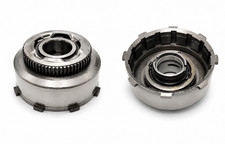

Know the Clutch Chart Before You Diagnose Anything
The TH350 is a three-speed with a 2.52 first, 1.52 second and 1.00 third, built from four clutch packs, one band and two one-way clutches. Almost every TH350 complaint can be narrowed down from this chart before you touch a wrench:
- 1st (Drive): forward clutch plus the low roller clutch.
- 2nd (Drive): forward clutch plus the intermediate clutch, with the intermediate overrun roller clutch holding.
- 3rd: forward clutch plus direct clutch.
- Manual 2nd: adds the intermediate overrun band so you get engine braking.
- Manual 1st (Lo): adds the low/reverse clutch.
- Reverse: direct clutch plus low/reverse clutch.
Read it for shared elements. The direct clutch works in both 3rd and Reverse, so a truck that has lost both is almost always a burned direct pack or a leak feeding it. The intermediate roller is the only thing holding the sun gear in Drive 2nd, so a car that goes 1st straight to 3rd points there first. The band only works in manual 2nd, so "no engine braking in 2" with a normal Drive 2nd points at the band, servo or servo bore and nothing else.
1. Leaking or Ruptured Vacuum Modulator
The modulator sits at the right rear of the case. Engine vacuum on one side of its diaphragm and a spring on the other tell the transmission how hard the engine is working, and that signal sets line pressure and shift timing. When the diaphragm ruptures, engine vacuum pulls ATF straight into the intake.
Symptoms: fluid level dropping with no puddle, white exhaust smoke after startup or under decel, fouled plugs on the cylinders nearest the vacuum port, and shift quality that goes wrong both ways: late, harsh shifts when the diaphragm or valve sticks, or soft, early shifts when the signal is wrong.
Confirm it: pull the vacuum hose off the modulator nipple. Any ATF in the hose or on the nipple means the diaphragm is leaking, and one drop is enough to condemn it. Then put a hand pump on the modulator and see that it holds vacuum. With the engine running at idle you should have strong, steady manifold vacuum at the hose; a cracked line or a vacuum source that bleeds off gives the same late, firm shifts as a stuck modulator.
Fix: replace the modulator and inspect the modulator valve for scoring before you push the new one in. If the engine has a big cam and low idle vacuum, use an adjustable modulator so you can tune shift firmness to the vacuum you actually have. Do not chase a firm shift by turning the adjuster all the way in without checking line pressure; our TH350 line pressure testing guide shows where to tee in the gauge.
2. No 2nd Gear: Intermediate Roller Clutch and Outer Race
This is the classic TH350 failure under power. In Drive 2nd the intermediate clutch locks the intermediate roller's outer race, and the rollers hold the sun gear. If the rollers or their cage fail, or the outer race cracks, nothing holds the sun gear and the transmission freewheels in 2nd.
Symptoms: 1st pulls normally, then the engine flares on the 1-2 shift until the 2-3 comes in, so it feels like 1st to 3rd. Manual 2nd may still pull because the band can hold the sun gear on its own, which is the giveaway: Drive 2nd slips, manual 2nd works, and the problem is the roller, its race, or the intermediate clutch pack.
Why it happens: the OE outer race is the weak point when power goes up. Sonnax puts it plainly: racing a TH350 or TH350C "puts huge stress on the OE intermediate overrun clutch outer race." Their heavy-duty race, part 35723HD-02, is rated at twice the torque capacity of the OE part. Transmission Digest covered the same upgrade from Tri Component (35723HD), made from special alloy steel with improved heat treatment and installed as a drop-in, no machining, alongside the OE-design roller clutch.
Fix: replace the roller clutch and the outer race together. On anything with a modified engine, spend the money on the heavy-duty race now, because the OE race that cracked once will crack again. Check the intermediate clutch frictions while you are there. A slipping intermediate pack makes the roller take shock it was never meant to take.
3. No 3rd and No Reverse: Direct Clutch
Because the direct clutch is shared by 3rd and Reverse, it is the first thing I suspect when both are gone or slipping. The burn is usually a symptom, though, not the cause. The standard TH350 troubleshooting chart for no 2-3 shift points at the same short list every time: damaged sealing rings on the pump hub, damaged seals on the direct clutch piston, a stuck valve, or a misaligned valve body gasket. A leak anywhere in that feed starves the pack, it slips, and it cooks.
Confirm it: a pressure gauge in Reverse tells you whether the circuit is holding. Low Reverse pressure with normal Drive pressure points at the direct or low/reverse feed. If the fluid smells burnt and the pan has black friction material, the pack is done.
Fix: frictions and steels, new direct piston seals, new pump hub sealing rings, and check the direct drum bushing and the stator support bushings for wear. Replacing the frictions without fixing the leak gets you the same comeback in a few thousand miles. The TH350 rebuild wear points guide covers what to measure.
4. Soft Shifts, 1-2 Slip and Delayed Engagement: Worn Case and Valve Bores
This is the problem a lot of people miss on an older TH350. The case and valve body are aluminum, and the parts sliding in them cycle every time the car shifts. After enough miles the bores wear, the leaks grow, and line pressure falls even though every clutch is fresh. Sonnax documents three of these on the TH350 and TH350C specifically:
- 1-2 accumulator bore. Sonnax says it "becomes worn or scored from repeated oscillation during normal operation." Listed symptoms: 1-2 slip, intermediate clutch failure, low line pressure, delayed Forward and delayed Reverse. Their 35719-01K sleeve kit restores the bore and saves the case.
- Intermediate servo bore. The servo bore scores from repeated cycling and leaks pressure. Listed symptoms: no engine braking in manual 2nd, low line pressure in Reverse, Neutral and Drive, and delayed engagement. The fix is the 35709-01K drop-in sleeve kit, no machining.
- Boost valve sleeve in the pump. The steel boost valve reciprocates inside an aluminum sleeve and wears it. Result: low line pressure, soft 1-2 and 2-3 shifts, and Reverse engagement problems or shudder. Sonnax's 35754-01K kit replaces the sleeve and both boost valves.
The point: if you rebuild a TH350 with a fresh clutch kit and it still slips 1-2 or engages slowly, the problem is probably leakage in a worn bore, not your clutches. A slow, mushy 1-2 combined with a gauge reading that is low in every range is the pattern. Vacuum testing the valve body bores and checking the accumulator and servo bores for scoring belongs in every TH350 teardown. Our TH350 valve body guide walks through those checks.
A harsh 1-2 can be the same circuit from the other side. The standard TH350 troubleshooting chart lists a broken or damaged 1-2 accumulator piston, or a restriction in the accumulator feed, as the cause of a harsh 1-2 shift.
5. Late, Early or No Upshifts: Governor and Detent Cable
The TH350 has no computer. It shifts from two hydraulic signals: governor pressure, which rises with road speed, and modulator or detent pressure, which rises with load. If either is wrong, the shift points are wrong.
Governor: a sticking governor valve, worn weights, or a damaged governor drive gear gives upshifts that come too late, never come, or come at random. Sonnax lists the governor (350) and governor gear kit (352) for TH350/TH350C shift concerns. If the speedometer works but the car will not upshift until very high road speed, pull the governor, clean it, and check that the weights move freely and the gear is not chewed.
Detent (kickdown) cable: The same chart's list for no part-throttle downshift includes low line pressure, a defective modulator, a stuck pressure regulator, and a faulty detent valve or cable. On engine swaps and carburetor changes the kickdown cable is often missing or connected wrong, so the car never gets a forced downshift. It must pull the detent valve fully at wide-open throttle. It is not a TV cable like a 700R4, and adjusting it will not change part-throttle shift firmness.
6. External Leaks
Most TH350 "leaks" come from four places: the pan gasket, the modulator O-ring, the shift shaft seal, and the front seal or pump. The shift shaft seal deserves a mention because it comes back. Sonnax lists repeat leakage and a scored shaft as the reason for its 35801-02K shift shaft and seal kit for the TH350. If the shaft is grooved where the seal rides, a new seal alone will not stop it. A front leak that comes back after a new seal often turns out to be a worn pump bushing letting the converter hub wobble; check the bushing before blaming the seal.
7. Overheating and Old Fluid
GM's service schedule for trucks with the TH350 called for Dexron and set two drain intervals: every 15,000 miles in severe service (heavy city traffic, regular 90 F temperatures, hills or mountains, frequent trailer pulling, or commercial use) and every 60,000 miles otherwise. A pan drain on a TH350 takes about 2-1/2 quarts to return the level to the dipstick mark, per GM. That small refill is why a single pan drop barely touches the fluid in the converter. On a unit with dark, burnt fluid, do two or three pan services a few hundred miles apart, or flush through the cooler line.
Heat kills the frictions and hardens the seals that cause problems 3 and 6. Any TH350 that tows, sits behind a high-stall converter or lives in traffic needs an auxiliary cooler. B&M's SuperCooler mounting guide puts numbers on why: fluid kept below 175°F should last as much as 100,000 miles, at 195°F about 50,000 miles, and at 240°F only about 5,000 miles. B&M also recommends routing the fluid through the radiator cooler first and then the auxiliary cooler, mounted in front of the radiator. Our TH350 overheating guide covers cooler sizing and plumbing, and our TH350 towing upgrades guide covers the full heavy-duty build.
Quick Diagnostic Table
| Symptom | Check first |
|---|---|
| Fluid loss, white smoke | Modulator diaphragm (ATF in vacuum hose) |
| 1st to 3rd, manual 2nd works | Intermediate roller clutch and outer race, intermediate clutch |
| No 3rd and no Reverse | Direct clutch, piston seals, pump hub sealing rings |
| No engine braking in manual 2nd | Intermediate band, servo and servo bore |
| Soft 1-2, slow engagement, low pressure all ranges | 1-2 accumulator bore, servo bore, boost valve sleeve |
| Harsh 1-2 | 1-2 accumulator piston or feed restriction, modulator |
| Late or no upshifts | Governor valve, weights, drive gear; vacuum signal |
| No kickdown | Detent cable hookup and travel, detent valve |
Repair or Rebuild?
Problems 1, 5 and 6 are in-car repairs: modulator, governor, kickdown cable and the external seals all come off without pulling the transmission. Problems 2, 3 and 4 mean the unit comes out. If you are in that deep, do the whole job: master kit with frictions and steels, new roller clutches, and sleeve the bores that Sonnax identifies as wear points. The TH350 weighs about 120 pounds and measures 21-3/4 inches, so it is a one-person pull on most cars. The parts that fix it are cheap compared with doing the job twice.
One identification note before you order: the TH350C lockup version arrived in late 1979 and ran through 1984, and it uses its own pump and some unique parts. Confirm which one you have before buying a pump or kit. Our TH350 vs TH400 guide covers identification.
FAQ
What is the most common TH350 problem?
A leaking vacuum modulator is the most common in-car problem: the diaphragm ruptures, engine vacuum pulls ATF into the intake, and you get fluid loss, white smoke and bad shift quality. Inside the unit, the most common hard failure is loss of 2nd gear from a failed intermediate roller clutch or a cracked intermediate outer race.
Why does my TH350 go from 1st straight to 3rd?
In Drive 2nd the intermediate roller clutch holds the sun gear. If the rollers fail or the outer race cracks, 2nd freewheels and the engine flares until the 2-3 shift. If manual 2nd still pulls, the band is holding and the roller, its race or the intermediate clutch pack is the problem.
Why would a TH350 lose both 3rd gear and Reverse?
The direct clutch is applied in both 3rd and Reverse, so losing both points at a burned direct clutch pack or a leak feeding it. Check the direct piston seals and the pump hub sealing rings, because replacing frictions without fixing the leak brings the same failure back.
How much fluid does a TH350 take after a pan drop?
GM specified about 2-1/2 quarts of Dexron to bring the level back to the dipstick mark after draining the TH350 sump. GM's drain interval was 15,000 miles in severe service such as towing, heavy traffic or hot climates, and 60,000 miles otherwise.
Can worn aluminum bores make a rebuilt TH350 slip?
Yes. Sonnax documents worn 1-2 accumulator bores, scored intermediate servo bores and worn boost valve sleeves on the TH350, all of which cause low line pressure, 1-2 slip or soft shifts and delayed engagement even with new clutches. Sleeve kits restore those bores without replacing the case.
Sources
- General Motors / Chevrolet — 1976 Light Truck Service Overhaul Supplement (ST-330-76), Section 0 Lubrication (PDF). Backs the Dexron fluid requirement, the 15,000-mile severe and 60,000-mile normal drain intervals, the severe-service conditions, and the 2-1/2 quart refill after a TH350 pan drain. 73-87chevytrucks.com (PDF)
- Sonnax — 1-2 Accumulator Sleeve Kit 35719-01K (TH350/TH350C). Backs the worn 1-2 accumulator bore cause and its symptoms: 1-2 slip, intermediate clutch failure, low line pressure, delayed Forward and Reverse. sonnax.com
- Sonnax — Intermediate Servo Sleeve Kit 35709-01K (TH350/TH350C). Backs the scored servo bore and its symptoms: no engine braking in manual 2nd, low line pressure in Reverse, Neutral and Drive, delayed engagement. sonnax.com
- Sonnax — Boost Valve Kit 35754-01K (TH350/TH350C). Backs the worn aluminum boost valve sleeve and its symptoms: low line pressure, soft 1-2 and 2-3 shifts, Reverse engagement concerns or shudder. sonnax.com
- Sonnax — "Stop TH350/C Intermediate Race Failure With a Sonnax Heavy Duty Race." Backs the stress on the OE intermediate overrun clutch outer race and the 35723HD-02 race with twice the OE torque capacity. sonnax.com
- Transmission Digest — "Heavy-Duty TH350/350C Intermediate Outer Race." Backs the Tri Component 35723HD race: alloy steel, improved heat treatment, drop-in with no machining, paired with the OE-design roller clutch. transmissiondigest.com
- Sonnax — GM TH350 unit parts listing. Backs the governor (350) and governor gear kit (352) for shift concerns, and the 35801-02K shift shaft and seal kit for repeat leakage and a scored shaft. sonnax.com
- Novak Conversions — GM TH350 transmission reference. Backs the 120 lb weight, 21-3/4 inch length, right-rear modulator location and the late-1979 to 1984 TH350C lockup version. novak-adapt.com
- B&M (Holley) — SuperCooler Mounting Guidelines. Backs the fluid life of about 100,000 / 50,000 / 5,000 miles at 175 / 195 / 240°F and the radiator-cooler-then-auxiliary-cooler routing with front-of-radiator mounting. static.summitracing.com