The Turbo 400 has a reputation for being hard to kill, and it earned it. But the units that come back within a few thousand miles of a rebuild usually did not fail because somebody bought cheap clutches. They failed because the gear train was assembled to the endplay numbers GM published, and GM only published half of them. Sonnax has been blunt about this for years: tech lines have been fielding calls about rapid gear train failure after routine TH400 rebuilds, and the root cause is that the unit has four endplay tolerances while the factory rebuild procedure references only two.
So this guide is organized around where the load actually goes inside the case, not around a teardown checklist.
Follow the thrust before you follow the parts
Rearward thrust starts in the converter. ATRA's GEARS technical staff worked the numbers for a TH400 at high load, where converter charge pressure runs around 60 psi against a maximum line pressure of 180 psi. That 60 psi acting on the front face of the input shaft puts 47 pounds of rearward thrust into the forward clutch housing. Then lube pressure returns through the passage at the rear of the pump stator shaft and through the input shaft, and because the input shaft is pressed into the forward clutch housing, that lube pressure pushes on the housing too, adding another 152 pounds. Total: 199 pounds of rearward thrust on the forward clutch housing every time the unit is loaded.
That load does not stop there. It presses back through the forward clutch hub (616) into the mainshaft, which pushes the rear internal gear (685) and the #22 thrust bearing assembly (686, 687, 688), which presses on the output shaft (691), until the case finally stops it at the output shaft-to-case thrust and selective washers (695, 696). Every one of those parts is a wear item because it stands at the end of a 199 pound line. In extreme cases the normally stationary selective washer spins, tears its locating tabs out of the case, and takes the case with it.
Once you see the path, the inspection list writes itself. Every core gets the #22 bearing, the case thrust and selective washers, and the three rear needle bearing sets and their seats checked, because wear there changes every clearance behind it.
The four endplay checks, and why two of them are missing from the book
This is the single highest-value thing you can add to a TH400 build procedure. Sonnax lays out four tolerances; the last two are absent from OE material entirely.
| Check | Spec | How it is set |
|---|---|---|
| Rear endplay | .007" to.019" | Selective four-tab washer at the bottom of the case |
| Front to rear planetary play | .008" to.015" (.010" is the sweet spot) | Selective four-tab washer between the gear sets |
| Forward clutch hub to direct clutch drum | .008" to.015" | Washer between hub and drum, thicker or thinner as needed |
| Front endplay | .002" to.005" looser than measured rear endplay | Selective washer between pump and forward drum |
Rear endplay is measured with the gear train installed and secured by the center support snap ring, a dial indicator on the output shaft, zeroed with the shaft pushed against the washers, then moved the other way. Out of range means swapping the tab-notched selective washer at the bottom of the case. Those washers identify themselves: no notches is.074–.078", one side tab is.082–.086", two side tabs is.090–.094", one end tab is.098–.102", two end tabs is.106–.110", three end tabs is.114–.118".
The hub-to-drum check is the one that eats gear sets. Stand the assembled gear set with the center support in a vise, seat the direct drum fully on the sun gear shaft, install the washer between hub and drum, hold the hub tight on the support shaft and lift the drum. You want.008" to.015". More than.020" with the thickest washer already in there means something is misassembled or a worn part got past inspection. Sonnax is direct about the consequence of getting this wrong: aggressive wear and failure of the gear sets.
While you are in there, check that the sun gear shaft and sun gear went together right. The long splined end of the shaft mates to the flat side of the sun gear, not the beveled side. Get that backwards and your direct drum settings are wrong before you start. If there are no alignment splines machined in, line the lube hole in the shaft up with the holes in the gear.
Front endplay is checked last, with the forward drum empty, the pump gasket in place so its thickness counts, and the pump held with one finger-tight bolt. Dial indicate input shaft movement and set it.002" to.005" looser than whatever the rear actually measured: rear at.010" means.012" to.015" in front. The front unit selective washers are color coded: yellow.060–.064", blue.071–.075", red.082–.086", brown.093–.097", green.104–.108", black.115–.119", purple.126–.130". Oil-soaked washers discolor, so measure the washer rather than trusting the color.
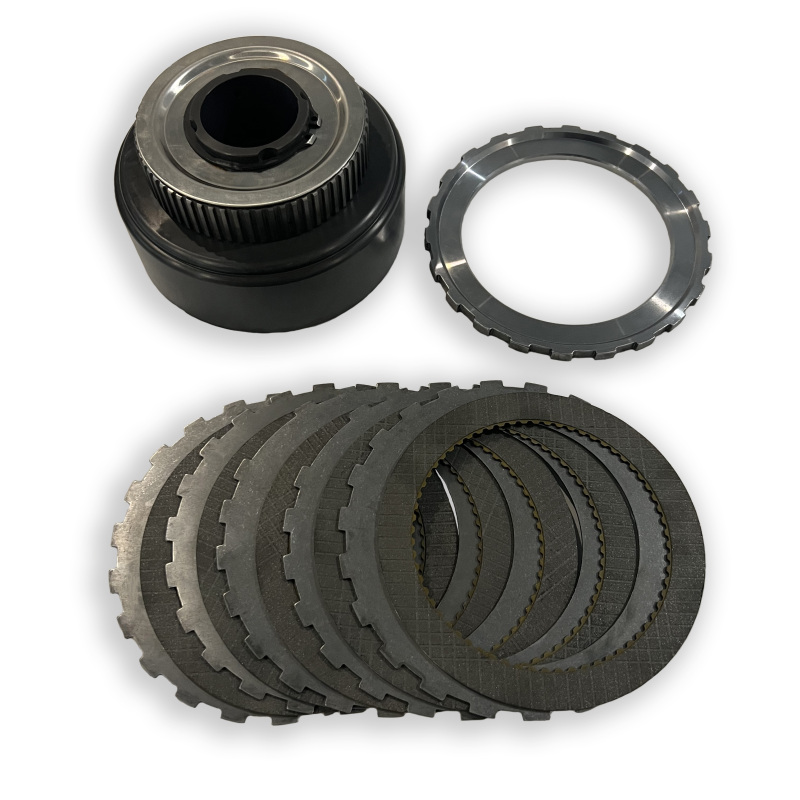
TH400 3L80 Master Overhaul Rebuild Kit, Clutches & Steels
Frictions, steels, gaskets and seals for a full Turbo 400 teardown, so the only thing you are sourcing separately is whatever your endplay measurements tell you to buy.
See the overhaul kit →Direct clutch housing float
Here is a clearance nobody ever wrote a spec for. The direct clutch housing sits between two thrust surfaces: the thrust washer at the rear of the forward clutch hub in front, and the splines where the back of the housing meets the front of the sun gear shaft (664) behind. Assemble the rear section, center support and both drums without clutches, stand it on the bench, press down on the forward housing and lift the direct housing. In most units that movement measures .020" to.025".
That float produces radial runout, and runout produces harmonics, a damaged sealing ring bore in the housing, peened seal ring grooves on the center support, and eventually direct clutch failure. The fix used by builders chasing durability is to replace the OEM thrust washer at the forward clutch hub with a thicker thrust bearing, which seats the direct housing against its stop and reroutes the thrust. The bearing that fits best is Ford P/N E6DZ7F404A, originally the final drive sun gear bearing in AXOD-based transaxles. It requires machining the bearing pad to restore component height minus.030", and you check front section endplay before you machine, because that extra pad material is often what saves your endplay setup.
Reaction carrier float
Same story, further back. With the rear band released, the reaction carrier (666) floats between the thrust washer at the rear of the center support and the washer at the front face of the output carrier. Stand the rear section and center support on the bench, press down on the support and lift the carrier: most units show .050" to.080" of movement.
What that costs you is not theoretical. The bronze thrust washers get destroyed by pinion gear thrust loading, the carrier gets pulled off center and out of engagement with its load bearing journal in manual low, and the gear set goes into a partial bind until band apply pressure fully releases. It is worse on units with a band-on-in-low manual valve body or a transbrake with fixed line pressure. Excess radial runout also chews the reaction carrier bushing and its journal, raises friction between the rear band and the carrier band surface, and skews the one-way clutch rollers. Leaving the silencer ring out makes all of it worse.
The correction is a thicker thrust bearing assembly, commonly the late model TH350 rear pump thrust bearing with selective shims, sitting in a pocket machined.075" deep with a 2.125" inside diameter and 2.875" outside diameter. Set it with a height gauge from the front face of the mainshaft to the front face of the center support bushing bore, shimming until dimension B lands.005" to.010" less than dimension A, then remove that difference from the shims plus another.002" to.006". Target reaction carrier endplay is .002" to.006", tight enough to kill the wobble with enough clearance left for thermal expansion.
Intermediate sprag rollover and the outer race
The intermediate sprag is the classic Turbo 400 hard-parts failure, and it announces itself as a slip or flare on the 1-2 shift with the rest of the unit behaving. What actually fails first is usually the race, not the elements. Sonnax builds heavy duty outer race 34663HD-02 specifically because race damage and sprag rollover are common in high-torque applications. The race is case-hardened alloyed steel with a softer core, and its inner diameter is machined a few ten-thousandths of an inch smaller than OE, which improves element engagement and rollover resistance.
One fitment note before you order: 34663HD-02 is.040" thicker than the TH400 OE race, so on a TH400 roller clutch or sprag-style drum it retrofits with minimal drum machining. The extra thickness adds durability and opens up clutch stack-up options when paired with a thinner intermediate backing plate such as Sonnax 34144HD-01,.375" thick for the TH400.
Case lug blowout at the intermediate clutch
Turn a bare TH400 case over and look at the lugs holding the intermediate clutch backing plate retaining ring. On a unit that has seen power they are cracked, peened or missing, and once a lug lets go the retaining ring walks and the intermediate clutch pack has nothing solid behind it.
Case saver retainers have been around a long time, but historically they required deleting the intermediate band, which is fine in a drag race transbrake unit and unacceptable in a street or work truck build. Sonnax case saver retainer 34762-10 fits over the intermediate band anchor lug inside the case and extends rearward to support the backing plate retaining ring while staying thin enough that the band still installs. It covers all TH400 units and 1998-and-earlier 4L80-E, and it will salvage a case with one or two blown lugs, which is worth knowing when the core is otherwise good.
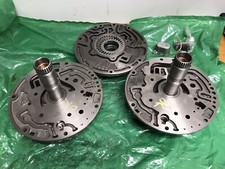
The pressure regulator bore in the pump
A perfect gear train will still cook itself if the pump cannot regulate. In a high-mileage TH400 the hardened steel pressure regulator valve has been oscillating in a cast-iron bore its whole life, and the bore wears. When it does, balance line pressure leaks past the valve and exhausts to sump, so the valve never travels all the way to its lower line pressure position.
The symptom set is specific: high and uncontrollable line pressure, delayed converter charge, and poor Reverse engagement. The damage that follows is high cooler pressure and converter, crankshaft and/or friction element failure, which is exactly how a fresh rebuild ends up back on your bench with a converter complaint that has nothing to do with the converter. Verify it by testing line pressure and testing the pump before you condemn anything else, using the TH400 pressure specifications and procedure. The repair is a valve kit such as Sonnax 34910-03K, which uses a solid PTFE seal ring to separate the balance line circuit from pump suction and stop the cross-leak.
Need parts for this job?
Master overhaul kits, hard parts, thrust bearings and washers, pumps, valve body kits and bench tooling for the Turbo 400, all in one place.
Shop TH400 parts →Which upgrades are actually worth it
Ranked by return per dollar on a street or tow build:
- Setting all four endplays. Costs a set of selective washers and thirty minutes. Prevents the failure mode that generates the most TH400 comebacks.
- New #22 thrust bearing plus case thrust and selective washers, every time. They sit at the end of a 199 pound load path. Reusing them is a gamble on the one part that can destroy the case.
- Heavy duty intermediate sprag race. Cheap insurance against the failure the unit is known for, and appropriate at any power level.
- Case saver retainer on anything towing, racing, or running a transbrake, and on any core with lug damage already present.
- Pressure regulator valve kit if the pump bore is worn, which you determine with a gauge and a pump inspection rather than by assumption.
- Thrust bearing conversions at the forward hub and center support. Machine work and careful measurement, so they belong in heavy duty and performance builds, not in a driver rebuild.
One tool note: this procedure lives or dies on a dial indicator you trust. A dial indicator with a magnetic base is the difference between measuring endplay and estimating it.
The short version
The TH400 is not fragile, it is unforgiving of setup. Check all four endplays, not the two in the book: rear.007" to.019", planetary.008" to.015", hub-to-drum.008" to.015", front.002" to.005" looser than rear. Replace the parts sitting at the end of the 199 pound thrust path instead of washing them off. Know that the direct drum floats.020" to.025" and the reaction carrier floats.050" to.080" from the factory, and decide deliberately whether this build corrects that. Then put a heavy duty race under the intermediate sprag, protect the case lugs if the unit will see load, and confirm the pump can still regulate before you bolt it up.
Sources
- Sonnax — "Mastering Endplay in TH400 Transmissions: A Step-by-Step Guide," Randall Schroeder, Sonnax TASC Force. Backs the finding that the TH400 has four endplay tolerances while GM's published rebuild procedure references only two, all four specifications used here (rear.007–.019", front-to-rear planetary.008–.015" with.010" preferred, forward clutch hub to direct clutch drum.008–.015", front endplay set.002–.005" looser than rear), both selective washer identification charts, the dial indicator procedures, the sun gear shaft flat-side orientation, and the warning that improper hub-to-drum clearance causes aggressive wear and gear set failure. sonnax.com
- GEARS Magazine (ATRA) — "Improve Your 400 and 4L80 Rebuilds," October 2016. Backs the rearward thrust analysis (approximately 60 psi converter charge at high load against 180 psi maximum line pressure, 47 pounds from converter charge plus 152 pounds from lube pressure for 199 pounds total on the forward clutch housing), the thrust path through components 616, 685, 686/687/688, 691, 695 and 696, the selective washer spinning and tearing its case tabs out, direct clutch housing float of.020" to.025" and the damage it causes, the Ford P/N E6DZ7F404A bearing conversion with the minus.030" machining rule, and the lube leak the bearing eliminates. gearsmagazine.com
- GEARS Magazine (ATRA) — "Correcting Carrier Float in a 400 or 4L80 Transmission." Backs stock reaction carrier float of.050" to.080", the two thrust surfaces that define it, the resulting bronze washer destruction from pinion gear thrust loading, off-center carrier engagement in manual low and the partial gear set bind, bushing and journal damage, band friction and skewed one-way clutch rollers, the TH350 rear pump thrust bearing correction with the.075" deep by 2.125" I.D. by 2.875" O.D. pocket, the dimension A/B shimming method, and the.002" to.006" target endplay. gearsmagazine.com
- Sonnax — Pressure Regulator Valve Kit 34910-03K (GM TH400, TH425). Backs the worn pressure regulator bore failure mechanism: the hardened steel valve oscillating in the cast-iron pump bore, balance line pressure leaking past the valve and exhausting to sump so it cannot reach its lower line pressure position, the symptoms of high and uncontrollable line pressure with delayed converter charge and poor Reverse engagement, the resulting high cooler pressure and converter, crankshaft and friction element failure, verification by line pressure and pump testing, and the PTFE seal ring repair. sonnax.com
- Sonnax — Heavy Duty Intermediate Clutch Outer Sprag Race 34663HD-02 (4L80-E, 4L85-E, TH400). Backs the prevalence of race damage and sprag rollover in high-torque applications, the case-hardened alloyed steel with softer core construction, the inner diameter machined a few ten-thousandths of an inch smaller than OE to improve element engagement and rollover resistance, the.040" extra thickness versus the TH400 OE race, the minimal drum machining required for TH400 retrofit, and the pairing with heavy duty intermediate clutch backing plate 34144HD-01 at.375" thick. sonnax.com
- Sonnax — Case Saver Retainer 34762-10 (all TH400, 1998-earlier 4L80-E). Backs the intermediate clutch retaining ring case lug blowout failure, the historical requirement that other case saver designs eliminate the intermediate band, the design that fits over the intermediate band anchor lug and extends rearward to support the backing plate retaining ring while remaining thin enough to retain the band, the ability to salvage cases with one or two blown lugs, and the backing plate modification requirements. sonnax.com