Somebody calls and says the shift solenoid in their Turbo 400 is bad. The parts counter looks it up and sells them one. Then the truck comes back shifting exactly the same, because a TH400 does not have shift solenoids. It has one solenoid, it is called the detent solenoid, and it does not command a single upshift. Everything that decides when this transmission changes gears is hydraulic.
That one fact settles most of these calls before the pan comes down. Below: what the detent solenoid does, the complaints it genuinely causes, how to test the circuit with a meter and then prove it with a gauge, and the three parts that get replaced in its place for nothing.
One solenoid, and it does not shift the transmission
The TH400 is a fully hydraulic three-speed. Shift timing comes from governor pressure, which rises with road speed, pushing against modulated throttle pressure and spring force on the 1-2 and 2-3 shift valves. When governor pressure wins, the valve strokes and the gear changes. Sonnax lays out the same principle in Transmission Digest's hydraulics series: shift valves used to be controlled by governor circuits that opened and closed based on how fast the vehicle was moving, where a modern unit gets that speed information electronically and uses on/off shift solenoids instead. The Turbo 400 is squarely on the old side of that line.
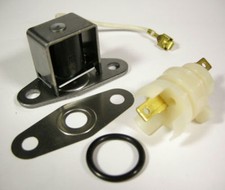
The only electrical device in the valve body is the detent solenoid, also called the kickdown or downshift solenoid. Rostra, which builds the OE-style replacement, lists it as part 52-0604, application GM TH400, part type downshift/kickdown, one pin, 9.5 ohms, superseding GM original equipment number 8629935 and cross-referencing to Transtar and WIT 34420. One bolt holds it to the valve body. One wire runs out through the case connector. It grounds through the case.
Energized, it opens the detent circuit. Detent oil pushes on the shift valves from the side opposite governor pressure, which forces a downshift or holds an upshift off, and it also raises line pressure so a full-throttle shift has the clamp load to survive it. De-energized, the circuit exhausts and the transmission goes back to shifting on governor and modulator signals alone.
Here is the part that matters on the phone: unplug the detent solenoid completely and drive the vehicle. It still shifts 1-2 and 2-3 and it still holds third. All you lose is the forced downshift and the firm full-throttle shift. If the complaint is no second or no third, the solenoid is not your problem.
| Function | What controls it in a TH400 |
|---|---|
| 1-2 and 2-3 upshift timing | Governor pressure vs. modulated throttle pressure and valve springs |
| Shift firmness under load | Vacuum modulator feeding the boost valve, raising line pressure |
| Forced downshift at heavy throttle | Detent solenoid, fed by the throttle-operated detent switch |
| Full-throttle line pressure rise | Detent circuit, on top of the modulator signal |
| Gear range selection | Manual valve and the rooster comb detent ball, purely mechanical |
One more piece of vocabulary, because it trips people up: the word detent covers two unrelated things here. The detent ball and spring on the manual valve lever is what gives the shifter its clicks between P, R, N, D, 2 and 1, and it has nothing to do with the kickdown circuit. Sloppy shifter or no crank in Park is that ball and the linkage, not anything electrical.
Symptoms that really are the detent solenoid
- No forced downshift. Rolling at 35 to 45 mph, floor it, and nothing happens. It should drop to second. This is the number one honest detent solenoid complaint.
- Soft or slipping full-throttle shifts with normal part-throttle shifts. Light throttle around town feels fine, but wind it out and the 1-2 flares. That is missing detent line rise, and it will cook the direct clutch and the intermediate band if you leave it.
- Early upshifts no matter how hard you are in it. The unit shifts at cruise speeds even at wide open throttle because detent pressure never reaches the shift valves.
- Fuse blows the instant you go to wide open throttle. A shorted winding or a chafed feed wire against the case. The solenoid is a low-resistance load, so a short pulls hard.
- Will not upshift at all after a valve body was off. A detent solenoid left loose, or reinstalled without its gasket, leaks the circuit and can hold detent pressure at the shift valves all the time. Check that bolt before condemning anything else.
Symptoms that are not the solenoid
No second gear. No third. Slips in every gear. Shifts at the same road speed regardless of throttle. Shifts late in every range. Harsh or delayed Reverse. Overheating. None of these are detent faults. They live in the governor, the modulator, the pump or the clutches.
Testing the detent circuit, in order
1. Resistance at the case connector
Key off. Unplug the feed wire at the case connector. Put the meter on ohms, one lead on the solenoid terminal and one on clean bare case metal, since the solenoid grounds through the valve body and case. Short your meter leads together first and note the reading, usually 0.2 to 0.4 ohms, then subtract it.
Target is the 9.5 ohms Rostra publishes for the 52-0604. Windings drift with temperature and with age, so treat roughly 8 to 12 ohms at shop temperature as a live solenoid. OL or infinite means an open winding or a broken internal lead. Under about 2 ohms means a shorted winding, and that is the one popping your fuse.
2. Feed voltage at wide open throttle
Leave the connector unplugged, key on and engine off. Backprobe or clip onto the harness side and have a helper push the pedal to the floor. You should see battery voltage, roughly 12.4 to 12.6 volts key-on engine-off and 13.5 to 14.5 volts running. Nothing there means the fault is upstream: the detent switch, its adjustment, the fuse, or the feed wire.
That switch sits behind the accelerator pedal or on the carburetor throttle lever, and it should close before the pedal bottoms out, around 80 to 90 percent throttle. A switch drifted out of adjustment is far more common than a dead solenoid, and it costs nothing to check. If the switch closes but the fuse still blows, go back to step one.
3. Listen for it
Plug the connector back in, key on and engine off, and cycle the pedal to the floor while somebody listens under the truck. You can usually hear or feel the click through the pan. Good resistance and good voltage but no click means the plunger is stuck.
4. Prove it with a gauge
This is the test that actually settles it, because electrical health does not prove the hydraulic circuit works. Put a mechanical gauge on the line pressure tap on the left side of the case. The ATSG THM 400 Techtran manual publishes the factory numbers: in Drive at 1000 rpm with the brakes applied a healthy unit runs roughly 60 to 90 psi, and with the detent solenoid energized that same test should climb into the 90 to 110 psi band.
If resistance and voltage are correct but pressure does not move when the solenoid is energized, the solenoid is fine and the fault is inside the valve body: a stuck detent valve, a missing or mislocated check ball, or a leaking detent circuit. Pull the valve body, do not buy a solenoid.
Jeff Parlee of the Sonnax TASC Force set out the gauge rules in Transmission Digest and they apply here. Use a gauge rated above the maximum pressure you expect: ATRA's Gears magazine puts maximum TH400 line pressure at 180 psi with converter charge around 60 psi under high load, so a 0 to 300 psi gauge is right and a 0 to 100 psi gauge gets destroyed. Read it on a road test, not on a lift, because there is no way to load the transmission on a lift the way the road loads it. Tape the gauge to the windshield rather than bringing it into the cabin, and route the hose clear of the exhaust and driveshaft.
Mityvac MV8000 Selectline Hand Vacuum Pump Tester Kit
You cannot rule out the modulator without pulling a vacuum on it. This is the tester that separates a leaking diaphragm from a good one in about thirty seconds, and it doubles for brake bleeding and every other vacuum check in the bay.
See it in the shop →The three parts that get blamed on the solenoid
The governor
The governor rides on the output shaft, driven by a gear off it, and its weights and valve convert shaft speed into governor pressure. That is the only thing telling the shift valves how fast the vehicle is going. Weights hung up in their bores, a worn governor bore, or a chewed governor drive gear all produce shift points that are wrong or absent no matter what your foot is doing, and that last one leaves nylon shavings in the pan. A unit that will not upshift at any speed but pulls fine in each gear when you move the lever manually is pointing at the governor.
The vacuum modulator
The modulator on the right rear of the case turns manifold vacuum into the throttle-load signal that sets shift firmness and part of line pressure. Pull the vacuum line at the modulator with the engine running. If ATF comes out, the diaphragm is ruptured, the engine has been drinking transmission fluid, and shifts have been soft and early for a while. A cracked or collapsed hose does the same without the mess. One more pattern: a unit that shifts normally warm but stays in first when cold can have water in the modulator or its line freezing the signal off.
The pressure regulator bore in the pump
The sleeper on high-mileage units. Sonnax documents it plainly for the TH400 and TH425: the hardened steel pressure regulator valve oscillates continuously in the cast-iron pump bore and wears it, balance line pressure leaks past the valve and exhausts to the sump, and the valve can no longer move fully to its low-pressure position. You get high and uncontrollable line pressure, delayed converter charge, poor Reverse engagement, and high cooler pressure that takes out the converter and the friction elements. Sonnax kit 34910-03K fits 1971 and later units and restores it without a new pump casting, but cannot be used if the original valve has a through balance hole. You find this with a pressure test, not a meter.
Replacing the detent solenoid
It is a pan-off job and nothing more. There is no drain plug, so break the rear pan bolts loose first and let it pour off the corner. Figure five to six quarts on a pan and filter service.
- Pull the pan and the filter. The solenoid is right there on the valve body, held by a single bolt, with a gasket or seal under its mounting face.
- Replace that gasket every time. A leak at that face bleeds the detent circuit and gives you the exact symptoms you just diagnosed.
- Snug the bolt evenly to the factory value in the ATSG or GM manual. It threads into aluminum. Overtighten it and you crack the boss; leave it loose and the circuit leaks or the unit will not upshift.
- Route the single feed wire so it cannot contact the case, the pan rail or the exhaust. That is where the chafed-wire shorts come from.
- The through-case connector uses an O-ring. Replace it while you are in there or it will weep down the side of the case and get blamed on the pan gasket.
- Refill with a DEXRON-spec ATF, check the level hot in Park at idle on level ground, and retest with the gauge before you call it done.
A 9.5 ohm target does not leave much room for a cheap meter's error, so an auto-ranging digital multimeter earns its keep here.
The short version
- The TH400 has no shift solenoids. It has one detent solenoid: one pin, 9.5 ohms, GM 8629935, Rostra 52-0604.
- It does not command upshifts. It forces downshifts and raises line pressure at heavy throttle.
- Test resistance at the case connector against 9.5 ohms, then check for battery voltage at wide open throttle, then listen for the click.
- Confirm hydraulically: Drive at 1000 rpm should read about 60 to 90 psi and rise into the 90 to 110 psi band with the detent energized.
- Electrically good but no pressure rise means the valve body, not the solenoid.
- No second, no third, or shift points that ignore throttle means governor, modulator or pump.
Need parts for this job?
Detent solenoids, vacuum modulators, governors, filters, pan gaskets, pressure regulator and boost valve kits and rebuild kits for the Turbo 400, all in one place.
Shop TH400 parts →Sources
- Rostra Powertrain Controls — Detent Solenoid, part 52-0604. Backs the specification for the only solenoid in the TH400 valve body: make GM, transmission TH400, part type downshift/kickdown, 9.5 ohms resistance, 1 pin, original equipment number 8629935, Transtar and WIT cross reference 34420. rostrapowertrain.com
- ATSG (Automatic Transmission Service Group) — THM 400 (3L80) Techtran manual, covering assembly, disassembly, diagnosis and troubleshooting for the unit as fitted to GM vehicles. Backs the line pressure specification band used in step four, 60 to 90 psi in Drive at 1000 rpm and 90 to 110 psi in Drive at 1000 rpm with the detent solenoid energized, and the factory torque values referenced for the valve body and detent solenoid. atsgbookstore.com
- Transmission Digest — "Diagnosis with Pressure Gauges," Jeff Parlee, Sonnax TASC Force. Backs the pressure gauge rules used in step four: always use a gauge rated for more pressure than the maximum expected, take readings during a road test rather than on a lift because the transmission cannot be loaded on a lift the way road conditions load it, keep the gauge outside the cabin, and route the hose away from heat sources and moving parts. transmissiondigest.com
- Transmission Digest — "Hydraulics Fundamentals: Shift & Relay Valves," Sonnax. Backs the statement that shift valves in earlier transmissions were controlled by governor circuits that opened and closed the valve based on vehicle road speed, where modern units use ON/OFF shift solenoids and electronic speed sensors instead. transmissiondigest.com
- Sonnax — Pressure Regulator Valve Kit 34910-03K, TH400 and TH425. Backs the pressure regulator bore wear section: the hardened steel valve oscillates in the cast-iron pump bore and wears it, balance line pressure leaks past the valve and exhausts to the sump, the valve cannot move fully to the low line pressure position, and the result is high and uncontrollable line pressure, delayed converter charge, poor Reverse engagement and high cooler pressure. Also backs the 1971-and-later fitment and the through-balance-hole warning. sonnax.com
- Gears Magazine (ATRA) — "Improve Your 400 and 4L80 Rebuilds." Backs the TH400 pressure figures used to size the test gauge: typical converter charge pressure of around 60 psi during high load with a maximum line pressure of 180 psi. gearsmagazine.com
- Sonnax — GM TH400 transmission unit page and symptom index. Backs the mapping of TH400 complaints such as 1-2 soft, 2-3 soft, low line rise, delayed Reverse, poor Reverse engagement and shift concerns to the specific valve body, pump and governor components listed there. sonnax.com