Half the TH350 "rebuilds" that go wrong start before the first bolt comes out. Someone orders a kit for the wrong year, a converter for the wrong case, or a kickdown cable for a transmission that turns out to be a Turbo 400 or a TH250. The Turbo Hydra-matic 350 shared a production era, a bellhousing pattern and a lot of external hardware with its cousins, and a dirty unit under a project car can fool you. This guide walks through how a builder actually identifies a TH350 on the car or on the floor: the pan, the controls hanging off the case, the stamped codes, the bellhousing, the lockup TH350C, and the look-alikes that get mistaken for it.
Do these checks in order. Each one rules out a family of transmissions, and by the end you know not only that it is a TH350 but which TH350, which is what you need to order parts.


Step 1: Count the Pan Bolts and Look at the Pan Shape
The pan is the fastest check, because you can see it from under the car without removing anything. A TH350 pan is held on by 13 bolts and is nearly square, with one corner clipped off at an angle so the pan has five sides. Chevy Hardcore's GM transmission ID guide describes it as a nearly square 13-bolt pan and contrasts it with the Turbo 400 pan, whose irregular outline is often compared to the border of Texas. Novak, which builds TH350 swap adapters, also identifies the unit by its chamfered pan.
Quick pan reference for the GM units people confuse:
- TH350 / TH350C: 13 bolts, nearly square, one clipped corner.
- TH400: 13 bolts, long irregular "Texas" shape.
- 700R4 / 4L60 / 4L60E: 16 bolts, roughly rectangular. These are four-speed overdrive units.
- Powerglide: a two-speed with a different pan outline altogether. If you are looking at a Powerglide, the shift quadrant only has two drive positions.
One warning from the bench: an aftermarket deep or finned pan keeps the bolt pattern but can change the outline. Count bolts, do not just eyeball the shape. If someone has swapped in a pan of the wrong pattern with a universal gasket, it will leak, and that is its own clue.
Step 2: Check How the Kickdown Is Controlled
The second check separates the TH350 from the TH400 and the 700R4, which is the mix-up that costs people the most money. All three were bolted behind the same engines, but each one tells the valve body about throttle position differently. B&M's installation instructions for its GM non-electronic transmissions spell it out:
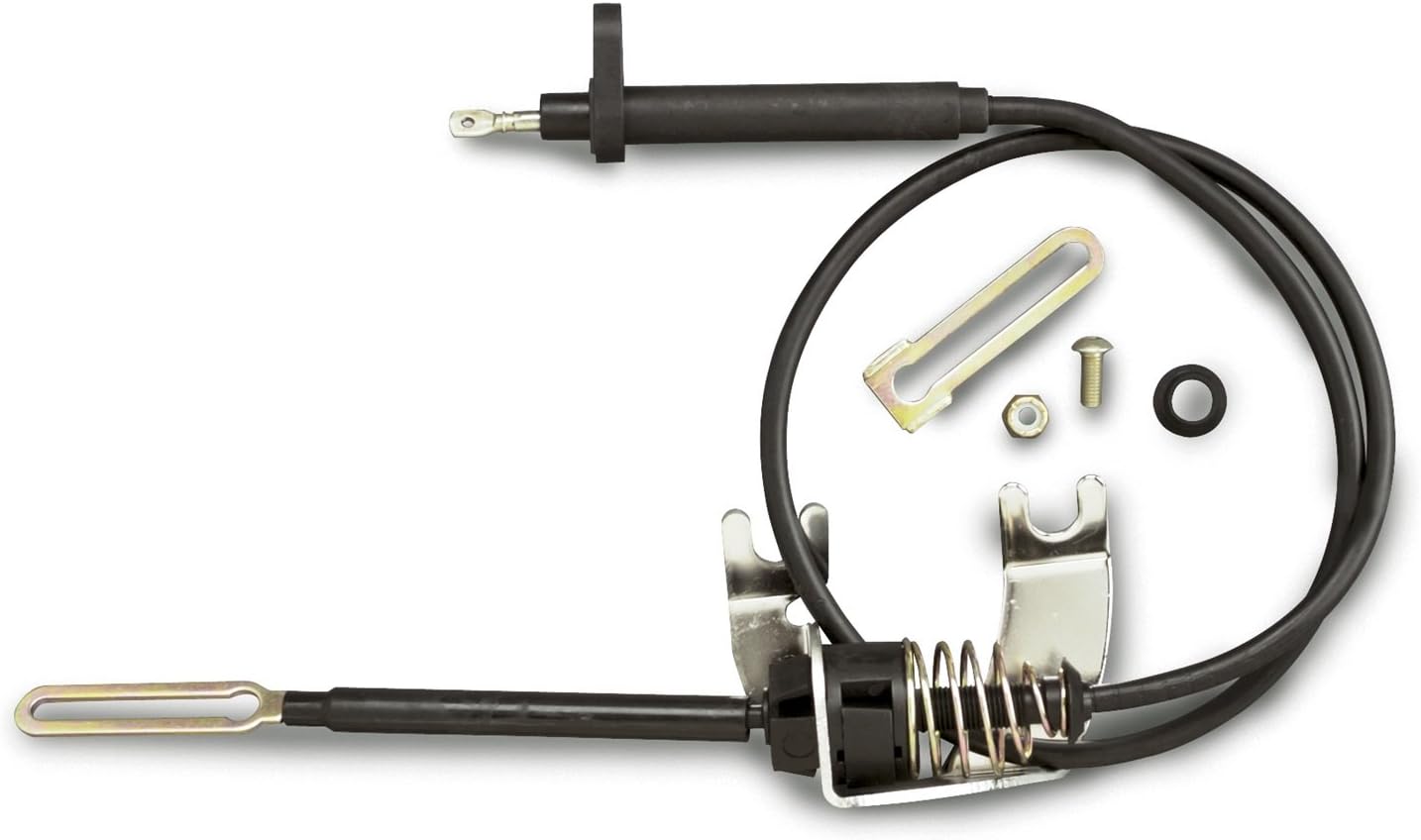
- TH350: a mechanical kickdown cable that runs from the carburetor or throttle body linkage to the case.
- TH400: an electrical kickdown switch with a wire running to a connector on the case. No cable.
- 700R4 / 4L60: a throttle valve (TV) cable. B&M warns that failing to adjust it to factory specs can damage the transmission, which is why mistaking a 700R4 for a TH350 is dangerous.
On a TH350, Lokar's installation instructions for its TH350 and TH200 kickdown cable route the transmission end of the cable down to the passenger side of the transmission, where a single bolt holds the cable housing and a rubber hat seal into the case. If you see a cable entering the passenger side of a 13-bolt-pan, three-speed case, you are looking at a TH350.
The vacuum modulator is not a tiebreaker
Every TH350 with an automatic valve body has a vacuum modulator, a round can on the passenger side of the case with a rubber hose to manifold vacuum. Novak places it at the right rear of the case. But the TH400 has a modulator too, and B&M's instructions say the modulator hose applies to both the TH350 and the TH400 with automatic valve bodies. So the modulator confirms "old-school GM three-speed," not "TH350." The kickdown method is what splits them. A full manual valve body, common on race cars, uses neither the modulator nor the kickdown, which is why B&M notes that manual-body units skip both connections. If both are missing, look for a manual valve body before assuming anything.
Step 3: Measure the Case and Check the Output
If the pan has been swapped and the cable is long gone, the hard dimensions still tell the story. Novak lists the TH350 as a one-piece aluminum case with integral bellhousing, about 21-3/4 inches long, and about 120 pounds. A TH400 is noticeably longer and heavier, which anyone who has wrestled one off a jack remembers.
Two more physical checks that do not need any paperwork:
- Output spline count. Pull the driveshaft and count the yoke splines. A TH350 uses a 27-spline output, the same count as a 700R4. A TH400 uses 32 splines. If your yoke has 32 splines, it is not a TH350, no matter what the seller said.
- Converter depth. B&M's install sheet lists typical converter depth from bellhousing face to converter mounting pads as 1-1/8 inch for the TH350, 700R4 and 4L60, and 1-3/16 inch for the TH400, both plus or minus 0.050 inch. That is a seating check, not an ID check, but it tells you the TH350 and 700R4 share converter geometry.
Tailshaft length varies with the application. Novak notes that 2WD cars and trucks got tailhousings of different lengths, and 4WD units got short output shafts of varying lengths and spline counts to mate to a transfer case. Measure from the rear face of the case to the end of the tailhousing and match it to the vehicle before ordering a driveshaft or a crossmember.
Step 4: Read the Bellhousing Pattern
The TH350 was built with more than one bellhousing pattern, and this matters more than people think on a swap. Novak describes the two main versions:
- Chevrolet pattern: the standard small block and big block Chevy pattern, with a peak at the twelve o'clock position.
- BOP pattern (Buick, Oldsmobile, Pontiac): a "valley" at the twelve o'clock position.
Novak also notes dual-pattern cases that bolt to both. A BOP-pattern TH350 will not bolt to a Chevy engine without an adapter, and Sonnax lists the Buick TH350 as its own converter application, so check the pattern before you buy a converter or a flexplate. Look at the top center of the bellhousing: peak means Chevy, valley means BOP.
Step 5: Find the Stamped Codes
GM stamped TH350 cases with a code that tells you the transmission type, model year and build date. The location moved around over the years. Per Chevy Hardcore's guide, look in three places:
- On the driver's side of the case near where the shift linkage attaches.
- On the passenger side of the case, just above the pan rail.
- On a boss behind the bellhousing flange on the passenger side.
Some units also carry the stamp on the passenger-side 1-2 accumulator cover or on the governor cover. Clean the area with a wire brush and brake cleaner before you give up. Decades of road grime will hide a stamp completely.
GM's own paperwork backs up the hunt. The 1976 Chevrolet Light Duty Truck Service and Overhaul Supplement (ST-330-76) puts the Turbo Hydra-Matic 350 unit number on the right rear vertical surface at the oil pan. It puts the Turbo Hydra-Matic 400 serial number on a light blue plate on the right side of the transmission. That plate is a quick tiebreaker: a riveted blue tag on the passenger side means a Turbo 400, not a TH350. The same supplement notes that the engine unit number's suffix codes the transmission type the engine was built for. On an original-drivetrain truck, the engine pad is worth reading too.
The same guide gives the date format used on GM case stamps: a letter for the transmission type, a digit for the year, a letter for the month, and two digits for the day. The month letters skip around (A for January through T for December, with letters like G, I and L not used), so do not count them off the alphabet: H is June, K is July and M is August. A digit for the year is ambiguous by decade, so use it together with the other clues on this list.
RPO codes on the vehicle
If the transmission is still in the original vehicle, the Service Parts Identification label (usually in the glovebox or on the inside of the trunk lid on GM cars, or the glovebox or door on trucks) lists the RPO codes the vehicle was built with. Novak lists M38 and the related M33 and M39 codes for the standard TH350, and MV4, MX2, MX3 and MX5 for the lockup TH350C. The label tells you what the car left the factory with, not what is in it now, so confirm against the physical checks above.
Step 6: TH350 or TH350C?
This is the identification question that matters most when ordering parts. The TH350C is the lockup-converter version. Novak dates it from late in the 1979 model year through 1984, and identifies it by two things:
- An electrical connector on the left (driver) side of the case, which feeds the converter clutch solenoid.
- The letter "C" cast into the front face of the case.
The TH350C uses a lockup torque converter. Sonnax groups its 298mm (10-inch) single-plate lockup converter parts under one unit page covering the TH250C, TH350C, 200-4R and 4L60/4L60E, which tells you the TH350C converter belongs to that lockup family, not to the open converters behind non-lockup TH350s. On the bench, the lockup input shaft is different too, so a lockup converter will not work correctly in a non-lockup unit without the matching shaft and sealing.
Why it matters for parts: the 1980-and-later units use different pump and sealing parts from the early ones, which is why kits and pumps are sold as 1969-1979 and 1980-1986 versions. A kit for the wrong side of that split leaves you with seals and sealing rings that do not fit. Identify the year first, then order. Some hard parts are shared across both: Sonnax's heavy-duty intermediate overrun clutch outer race, for example, is listed for both the TH350 and TH350C and replaces OE part 6261021.
The Look-Alikes: TH250, TH200 and Swapped Units
TH250 and TH250C
The TH250 is the transmission most often sold as a TH350, because from underneath they look nearly identical: same family case, same 13-bolt pan, same modulator and cable. The difference is inside. The TH250 applies second gear with the intermediate band instead of an intermediate clutch pack and roller clutch, so it has an external band adjusting screw with a locknut on the passenger side of the case. A TH350 has no external band adjuster. Look above the cooler line fittings. If there is a threaded adjuster with a jam nut, it is a TH250 or TH250C, and it is not the unit you want behind a strong engine.
TH200
The TH200 is a lighter-duty three-speed that also uses a kickdown cable. Lokar sells a single cable kit for both the TH350 and TH200 and notes that some TH200 cases have a larger cable opening that needs an adapter seal. A cable alone is not proof of a TH350. Check the pan and case length too.
Swapped and modified units
On a car that has been through a few owners, the transmission may not match the car, and the transmission itself may have been modified. A manual valve body removes the modulator and kickdown hookups. An aftermarket pan changes the outline. A lockup case may be running a non-lockup converter with the connector unplugged. Go through all six steps and trust the hard evidence: bolt count, case length, output splines, bellhousing pattern and the stamp.
Identification Checklist
- 13-bolt pan, nearly square with one clipped corner.
- Kickdown cable on the passenger side, not an electric switch (TH400) or TV cable (700R4).
- No external band adjuster (rules out the TH250).
- Case about 21-3/4 inches long, 27-spline output.
- Bellhousing peak (Chevy) or valley (BOP) at twelve o'clock.
- Case stamp and RPO code checked.
- Electrical connector on the driver side and "C" on the front face means TH350C lockup.
- Year confirmed as 1969-1979 or 1980-1986 before ordering kits or a pump.
With the unit identified, fill it right. B&M's instructions call for about 5 quarts on a dry unit to start, then topping off to the full mark with the engine running at operating temperature, and about 4 quarts on a pan drop. GM's factory figure for a fluid change is lower. The 1976 truck supplement calls for approximately 2-1/2 US quarts of fresh fluid on a TH350 after draining the sump, versus about 7.5 pints on a TH400. Either way, fill to the dipstick hot, not by a number on a bottle. Our TH350 fluid type and capacity guide has the full breakdown.
View the TH350 master rebuild kit →
FAQ
How do I tell a TH350 from a TH400?
Count the pan bolts and look at the shape: both use 13 bolts, but the TH350 pan is nearly square with one clipped corner while the TH400 pan is long and irregular. The TH350 uses a kickdown cable and the TH400 uses an electrical kickdown switch. A TH400 also has a 32-spline output versus 27 splines on a TH350.
How do I know if my TH350 is a lockup TH350C?
Look for an electrical connector on the driver side of the case and a letter C cast into the front face. Novak dates the TH350C from late in the 1979 model year through 1984. It uses a 10-inch single-plate lockup converter from the same family as the TH250C, 200-4R and 4L60.
Where is the ID number stamped on a TH350?
Check the driver side of the case near the shift linkage, the passenger side just above the pan rail, and a boss behind the bellhousing flange on the passenger side. Some units also carry it on the 1-2 accumulator cover or governor cover. Clean the area with a wire brush first, because grime hides the stamp.
How can I tell a TH350 from a TH250?
The TH250 applies second gear with the intermediate band, so it has an external band adjusting screw with a locknut on the passenger side of the case, above the cooler line fittings. A TH350 has no external band adjuster. Otherwise the two look nearly identical from underneath.
Does a TH350 have 13 or 16 pan bolts?
A TH350 pan uses 13 bolts. A 16-bolt pan means a 700R4, 4L60 or 4L60E four-speed overdrive unit, which uses a TV cable that must be adjusted to factory specs.
Sources
- Novak Conversions — The Novak Guide to the GM TH350 Automatic Transmission. Backs the chamfered pan, modulator location, 21-3/4 inch one-piece aluminum case with integral bellhousing, 120 lb weight, Chevy versus BOP bellhousing patterns and dual-pattern cases, TH350C introduction in late 1979 through 1984, the driver-side electrical plug and cast "C", varying 2WD/4WD tailhousings and outputs, and the RPO codes. novak-adapt.com
- B&M (Holley) — Installation Instructions for B&M Automatic Transmissions Replacing GM TH350, TH400 and TH700R4/4L60. Backs TH350 kickdown cable versus TH400 electrical kickdown switch versus 700R4/4L60 TV cable, modulator hookup on TH350 and TH400 automatic-body units only, typical converter depth of 1-1/8 inch (TH350/700R4/4L60) and 1-3/16 inch (TH400), and the 5-quart dry fill procedure. documents.holley.com
- Lokar — TH350 and TH200 Stainless Kickdown Bracket and Cable Installation Instructions (INS0121). Backs cable routing to the passenger side of the transmission, the single retaining bolt and rubber hat seal, and the larger cable opening on some TH200 cases. lokar.com
- Sonnax — GM 298mm LU (TH250C, TH350C, 200-4R, 4L60 and E) Torque Converter. Backs the TH350C sharing the 298mm (10-inch) single-plate lockup converter family with the TH250C, 200-4R and 4L60/4L60E. sonnax.com
- Sonnax — Heavy Duty Intermediate Overrun Clutch Outer Race, Part No. 35723HD-02. Backs the race applying to both TH350 and TH350C units and replacing OE part 6261021. sonnax.com
- Chevy Hardcore — GM Transmission ID Guide: Powerglide, Turbo 350 and Turbo 400. Backs the nearly square 13-bolt TH350 pan versus the irregular TH400 pan, the three common case stamp locations, and the type/year/month/day date code format with its month letters. chevyhardcore.com
- GM / Chevrolet — 1976 Light Duty Truck Service and Overhaul Supplement (ST-330-76). Backs the Turbo Hydra-Matic 350 unit number location on the right rear vertical surface at the oil pan, the Turbo Hydra-Matic 400 serial number on the light blue plate on the right side of the case, the engine unit number coding transmission type, and the factory refill amounts after draining the sump (about 2-1/2 qt TH350, 7.5 pints TH400). 73-87chevytrucks.com