"It slips" is the most common TH350 complaint and the least useful one. A Turbo 350 can flare on the 1-2, slide into third, take a second to grab reverse, or feel loose in every gear, and each of those points at a different part of the unit. A builder who knows which clutch is applied in which gear can usually narrow a slip down to one circuit before the pan comes off. A builder who doesn't ends up buying a shift kit to mask a burned clutch pack, and the unit comes back in six months.
This guide works the problem the way it gets worked on the bench: confirm it is really a slip, rule out the outside causes (fluid, linkage, modulator vacuum), put a gauge on it, then use the gear the slip shows up in to pick the circuit. It covers the 1969-1986 TH350 and the 1980-up TH350C. The factory pressure numbers come from GM's own service literature; the wear items come from Sonnax and Transmission Digest. Sources are listed at the bottom.


The Quick Answer
| Where it slips | Usual suspects |
|---|---|
| Everywhere, including Reverse | Fluid level (low or foamed), plugged filter, modulator, stuck pressure regulator, pump-to-case gasket |
| All forward gears, Reverse fine | Forward clutch pack or forward piston seals |
| On the 1-2 shift / in 2nd | Intermediate clutch, intermediate piston seals, worn 1-2 accumulator bore, intermediate roller and race |
| On the 2-3 shift / in 3rd | Direct clutch, direct piston seals, pump hub sealing rings, 2-3 accumulator seals |
| 3rd and Reverse both | Direct clutch circuit (it is applied in both), worn boost valve sleeve |
| Reverse only | Low/reverse clutch pack or its piston seals |
Know Which Clutch Is Holding
The TH350 is a fully hydraulic three-speed. There is no computer to blame and no solenoid to swap; every shift is the valve body moving oil to a clutch piston. That makes the apply chart your best diagnostic tool:
- Drive, 1st: forward clutch, held by the low roller clutch.
- Drive, 2nd: forward clutch plus the intermediate clutch, held through the intermediate overrun roller clutch.
- Drive, 3rd: forward clutch plus the direct clutch.
- Manual 2nd: adds the intermediate overrun band for engine braking.
- Manual Low: adds the low/reverse clutch for engine braking.
- Reverse: direct clutch plus low/reverse clutch.
Read that list against the symptom. The forward clutch is in every forward gear but not in Reverse, so a unit that slips in all forward gears and backs up fine is pointing at the forward pack. The direct clutch is the only element shared by 3rd and Reverse, so a slip in both is a direct clutch circuit problem until proven otherwise. A slip that only appears in 2nd isolates the intermediate side. And a slip in every range, Reverse included, means the clutches are probably fine and the oil supply feeding them is not.
Step 1: Rule Out the Outside Causes
Fluid level, checked correctly
Low oil is the first item in every TH350 slip chart, and Cliff Ruggles' TH350 rebuild book lists both low oil and high oil that has foamed as causes of slipping in all ranges. GM's own literature explains the trap: the TH350 fluid level rises more than 3/4 inch as it warms from 60 F to 180 F, so a cold dipstick reads low and people overfill. Check it hot, engine running, in Park, on level ground. Look at the stick too. Pink and clean is one story; brown, burnt-smelling fluid with a varnish film on the dipstick means the clutches have already been cooking.
Shift linkage in full detent
This one gets skipped constantly, and GM put it in writing. In the TH350 linkage adjustment section of the 1976 Chevrolet light truck manual (ST-330-76), GM warns that a linkage that does not put the manual valve in full detent "results in reduced oil pressure and in turn partial engagement of the affected clutches." The truck seems to drive normally, and the clutches fail "after only a few miles of operation." Any slip complaint on a vehicle with a worn column, a swapped floor shifter or a new crossmember gets the linkage checked first: set the lever in Neutral by counting detents at the transmission, then adjust the rod so the column stop and the transmission detent agree.
The vacuum modulator and its hose
The modulator is the TH350's throttle sensor. GM describes it as a diaphragm and one spring: the spring pushes the modulator valve toward higher pressure, and engine vacuum pulls against it. Low vacuum (heavy throttle) means high line pressure; high vacuum (light throttle) means low line pressure. That is the system working as designed, and it explains two slip causes that have nothing to do with the clutches:
- A weak modulator spring. Less spring force means less line pressure at every throttle opening, and the clutches slip under load. GM's check was tool J-2466, which compares the spring load of a known-good modulator against the suspect one; if the suspect one does not match, it gets replaced.
- Vacuum trapped at the modulator. Builders regularly find a modulator line replaced with soft rubber hose that collapses with heat. If vacuum gets trapped on the diaphragm, the transmission sees "light throttle" all the time, runs low line pressure under load, and burns the clutches.
Pull the vacuum line at the modulator with the engine idling and confirm strong vacuum, then pull the modulator and look in the vacuum port. Transmission fluid in there means a ruptured diaphragm, which also pulls fluid into the engine and drops the level. An adjustable modulator lets you tune line pressure for a specific engine's vacuum, but it only works if the hose and diaphragm are sound.
Step 2: Put a Gauge on It
Once level, linkage and vacuum check out, stop guessing and measure. GM's oil pressure check for the TH350 (350 V-8, from ST-330-76) is:
| Condition | Drive | L1 / L2 | Reverse |
|---|---|---|---|
| 1200 rpm, brake on, modulator vacuum tube disconnected | 167 psi | 166 psi | 254 psi |
| Modulator connected, engine held at 12 in. Hg absolute manifold pressure | 85 psi | 105 psi | 129 psi |
The vacuum-disconnected reading is your pump-and-regulator test. Transmission Digest's Sonnax TASC Force piece on pressure gauges describes the same approach for modulated units: disconnect the vacuum to get maximum line pressure and see whether the pump can make it. If you cannot reach the high numbers with the vacuum off, the problem is supply side (filter, pump, pressure regulator, boost valve, or a big internal leak), and a clutch pack replacement alone will not fix it.
Two rules from that same article save a lot of misdiagnosis. First, use a gauge rated higher than the highest pressure you expect, which on a TH350 means well above 254 psi in Reverse. Second, take the real readings on a road test, not on the lift, because a transmission on a lift is not loaded the way it is on the road. Tee the gauge hose away from the exhaust and secure the hood. If you have a way to read a clutch circuit as well as line, Transmission Digest gives the threshold: up to about 10 percent below line pressure is normal sealing ring leakage; more than 10 percent means a leak in that circuit.
Step 3: Chase the Slip by Gear
Slips in all forward gears, Reverse is fine
That is the forward clutch. Burned frictions are the usual find, but on a unit that was rebuilt recently, look hard at the forward piston lip seals. A seal installed backwards or rolled during assembly gives a big internal leak, and the pack never gets full apply pressure. The forward and direct pistons also look nearly identical, which GM calls out in its overhaul instructions, and they get swapped.
Slips on the 1-2 shift or in 2nd
The intermediate clutch is doing the work here, and three things kill it. The pack itself (burned plates, damaged or reversed piston seals) is the obvious one. The less obvious one is in the case: Sonnax notes that the TH350 1-2 accumulator bore wears or scores from the accumulator piston oscillating in normal operation. A worn bore leaks line pressure, which shows up as 1-2 slip, delayed Forward and Reverse, and eventually intermediate clutch failure. Once the bore is gone, the fix is a sleeve kit (Sonnax 35719-01K) or a different case. The third is the intermediate overrun roller clutch and its outer race. Sonnax calls race failure a chronic TH350 problem; the OE race tends to fracture at the radial lube holes. A broken race usually feels like a flare into neutral on the 1-2 rather than a gradual slip, but on a road test the two can feel similar, and the race has to be inspected during any intermediate clutch repair.
Slips on the 2-3 shift, or in 3rd and Reverse
The direct clutch is the common element. The Ruggles slip chart lists burnt direct clutch plates, damaged or missing oil sealing rings on the pump hub, damaged direct piston seals, and damaged 2-3 accumulator seals. The pump hub rings are the ones people miss: they carry direct clutch oil from the stationary pump into the rotating drum, and a broken or missing ring bleeds off apply pressure at the exact moment the 2-3 shift needs it. GM also requires a check ball in either the direct clutch housing or the piston; a unit assembled with neither will not hold the direct pack.
Look at the boost valve too, especially when Reverse feels soft or shudders on engagement. Sonnax explains that the steel boost valve wears its aluminum sleeve, and wear in the Reverse boost sleeve causes low line pressure, soft 1-2 and 2-3 shifts, and Reverse engagement complaints. That fault shows up as low numbers on the Reverse gauge reading, not as burned plates, until the plates burn because of it.
Slips in Reverse only
If 3rd is solid and only Reverse slips, the direct clutch is probably fine and the low/reverse clutch is the suspect: worn or burned plates, or leaking piston seals. Confirm with the Reverse pressure reading first. Normal Reverse pressure with a slip points at the pack; low Reverse pressure points back at the supply side and the boost valve.
The Fix: What Can Be Done In the Car
In the car, without a teardown, you can correct the fluid level, replace the filter and pan gasket, adjust the linkage, replace the modulator and its vacuum line, and reset the detent downshift cable. If the slip came from one of those, the unit usually recovers, provided the clutches were not already burned. If the pan is full of dark friction material and the slip is gear-specific, the clutch pack is damaged, and no fluid or modulator change will bring it back.
At that point the correct repair is an overhaul: a master kit with new frictions, steels, seals and sealing rings, plus whatever hard parts the inspection turns up (accumulator bore sleeve, boost valve kit, intermediate race). Do not install a shift kit to hide a slip. A shift kit raises pressure and shortens shift overlap, which feels better on a test drive, but it does not fix a leaking circuit or a burned pack, and the underlying wear keeps going. Fix the leak, then decide whether you want firmer shifts.
Before you order parts, confirm which TH350 you have. The 1980-up TH350C lockup version shares most hard parts but uses different kit contents in places. Our TH350 line pressure testing guide has the full gauge procedure, and the TH350 rebuild wear points guide covers clutch plate counts and the check ball rule in detail.
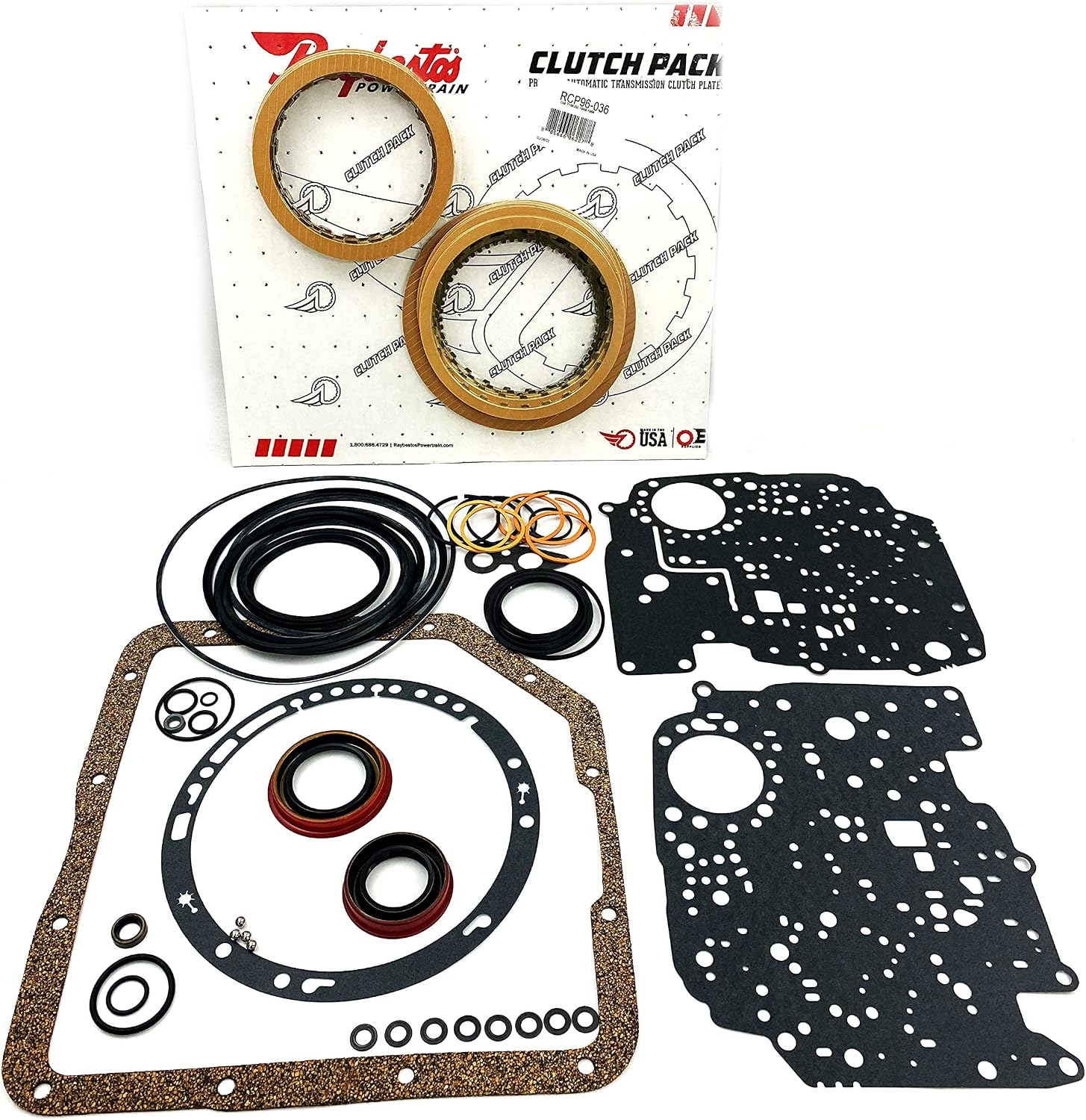
TH350 High-Energy Friction Clutch Kit (Raybestos)
If the pan shows friction material and the slip lines up with one clutch pack, this Raybestos high-energy friction set replaces the burned frictions. Master kits, accumulator sleeve kits and the Sonnax HD intermediate race are in the full TH350 catalog.
View the friction kit →FAQ
Why is my TH350 slipping?
Start outside the transmission: fluid level checked hot (low or overfilled and foamed), shift linkage not reaching full detent, and a weak or vacuum-starved modulator all cause slipping. If those check out, the gear the slip appears in points at the clutch: all forward gears is the forward clutch, 2nd is the intermediate clutch, 3rd and Reverse is the direct clutch, and Reverse only is the low/reverse clutch.
Can a bad vacuum modulator make a TH350 slip?
Yes. The modulator spring pushes line pressure up and engine vacuum pulls it down. A weak spring, or a collapsed vacuum hose that traps vacuum on the diaphragm, makes the transmission run low line pressure under load, and the clutches slip and burn. Check for strong vacuum at the modulator line and look for fluid in the vacuum port, which means a ruptured diaphragm.
What should TH350 line pressure be?
GM's figures for a 350 V-8 are 167 psi in Drive, 166 psi in L1 or L2 and 254 psi in Reverse at 1200 rpm with the modulator vacuum tube disconnected. With the modulator connected and the engine held at 12 in. Hg absolute manifold pressure, they are 85 psi in Drive, 105 psi in L1 or L2 and 129 psi in Reverse.
Why does my TH350 slip in 3rd and Reverse?
The direct clutch is applied in both 3rd and Reverse, so a slip in both points at the direct clutch circuit: burned direct plates, damaged direct piston seals, broken or missing pump hub sealing rings, or a missing direct clutch check ball. A worn Reverse boost valve sleeve can also drop line pressure and cause soft shifts and Reverse engagement problems.
Will a shift kit fix a slipping TH350?
No. A shift kit raises pressure and shortens shift overlap, so the slip may feel better for a while, but it does not seal a leaking circuit or replace a burned clutch pack. Find and fix the leak or worn pack first, then add a shift kit if you want firmer shifts.
Sources
- General Motors / Chevrolet — 1976 Light Truck Service Overhaul Supplement (ST-330-76), Section 7A Turbo Hydra-Matic 350 and Section 0 Lubrication (PDF). Backs the shift linkage caution that operation out of full detent reduces oil pressure and partially engages clutches, causing failure after a few miles; the vacuum modulator description (one diaphragm, one spring, vacuum acting against the spring); the J-2466 spring tension comparison check; the TH350 oil pressure check figures (167/166/254 psi vacuum off at 1200 rpm, 85/105/129 psi at 12 in. Hg absolute, 350 V-8); the 3/4-inch fluid level rise from 60 F to 180 F; and the overhaul cautions that the forward and direct pistons look almost identical and that the direct clutch housing or piston must contain a check ball. 73-87chevytrucks.com (PDF)
- Transmission Digest — Jeff Parlee, Sonnax TASC Force, "Diagnosis with Pressure Gauges." Backs the gauge rating rule, measuring on a road test rather than a lift, disconnecting the vacuum modulator to check maximum pump output on mechanically controlled units, and the 10 percent clutch-circuit-to-line-pressure leak threshold. transmissiondigest.com
- Sonnax — 1-2 Accumulator Sleeve Kit 35719-01K (GM TH350/TH350C). Backs 1-2 accumulator bore wear from repeated oscillation and its symptoms: 1-2 slip, delayed Forward and Reverse, low line pressure, intermediate clutch failure and a destroyed case. sonnax.com
- Sonnax — Boost Valve Kit 35754-01K (GM TH350/TH350C). Backs steel-on-aluminum boost valve sleeve wear and that Reverse boost sleeve wear causes low line pressure, soft 1-2 and 2-3 shifts, and Reverse engagement concerns or shudder. sonnax.com
- Sonnax — Heavy Duty Intermediate Overrun Clutch Outer Race 35723HD-02 (GM TH350/TH350C). Backs intermediate race failure as a chronic TH350 problem and fracture at the radial lube holes. sonnax.com
- Cliff Ruggles, GM Turbo 350 Transmissions: How to Rebuild and Modify (CarTech), troubleshooting chart excerpt. Backs the slip-by-condition lists: all ranges (low oil, foamed high oil, modulator, plugged filter, misaligned valve body gaskets, stuck pressure regulator, pump-to-case gasket, forward clutch), 1-2 shift (intermediate clutch seals and plates, accumulator seals) and 2-3 shift (burnt direct plates, pump hub sealing rings, direct piston seals, 2-3 accumulator seals). chevydiy.com