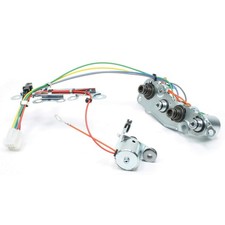
This part is for the earliest RE4F04A, the Jatco-built four-speed automatic that went into the front-drive Nissan Maxima for 1992 and then spread through the Altima, Quest, Infiniti I30 and Mercury Villager through the 1990s. If a 1992-era RE4F04A is slamming into gear, shifting late and hard at every speed, or going soft and slipping between gears, the line pressure solenoid is one of the first suspects. Note what you receive: as the photo shows, the pressure control solenoid comes as a new assembly already on its internal wiring harness, together with a bracket-mounted solenoid group and a separate solenoid on its own lead, with the harness connector that passes out of the case. That suits the early valve body, where Nissan ran the solenoid wiring through the case wall.
What the pressure control solenoid does in an RE4F04A
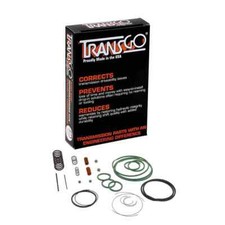
The RE4F04A uses no throttle cable to set line pressure. The control unit reads throttle position and road speed and pulses the line pressure (EPC) solenoid, which in turn biases the pressure regulator in the valve body. More current or less current changes how hard every clutch and band is applied. If the solenoid sticks, loses coil resistance or its harness breaks down, pressure either runs away high, giving bangs and drum stress, or falls low, giving flare and slip that burns frictions. TransGo's kit instructions for this transmission are blunt about it: they call for a new EPC solenoid on every overhaul or repair, say these units tend to get in trouble around 70,000 miles, and warn that runaway line pressure is behind clutch drum blowouts and planetary failures on this model.
Symptoms of a failing line pressure solenoid
- Harsh engagement into Drive and Reverse, sometimes worse once the fluid is hot
- Firm, late upshifts in every gear, or the opposite: soft, flaring shifts with rpm flare between gears
- Transmission held in a failsafe gear with the O/D off light flashing
- Burnt fluid and friction debris after a period of slipping
- On these pre-OBD-II cars, a solenoid fault shown through Nissan's built-in self-diagnosis rather than a standard P-code
How to confirm before you buy
Run the Nissan self-diagnosis for your car to see which solenoid circuit is flagged, then check the resistance of each solenoid circuit at the case connector; our guide to solenoid testing without a factory scan tool explains how to do it on an older vehicle. Do not skip the inputs. Transmission Digest notes that on these Nissans a throttle WOT/idle switch stuck closed, which lives in the throttle position sensor, commands high line pressure and very late upshifts in every range, which feels exactly like a bad pressure solenoid. Fix that first. If both the switch and the solenoid test good and the trans still slips, the problem is likely internal; our shift flare versus slip guide helps separate a pressure issue from worn clutches.
Fitment
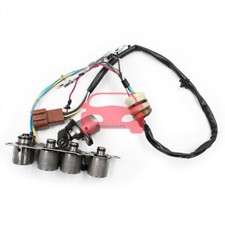
Listed for 1992 RE4F04A. TransGo's identification sheet divides the RE4F04A into the A and V valve bodies, where the internal solenoid wiring extends outside the case and lockup is on-off (1992-1999 Maxima, 1993-1999 Altima, 1993-2002 Quest and Villager, 1995-1999 I30), and the later B bodies from 2000, whose harness stays inside the case and which use PWM lockup. This assembly is the external-harness style shown in the photo, so it is not for a B-body car. Within the A and V group, compare the connector, wire count and solenoid layout on your old harness with the photo, or send us your year, model and VIN to confirm. Other parts for this transmission are on our hard parts page.
Install notes
- Drain the fluid, drop the pan and remove the valve body with the harness attached, noting how every wire is routed and clipped.
- Fit new O-rings to each solenoid and to the case pass-through for the connector, and make sure the case passage O-rings are in place before the valve body goes back up.
- If the trans has a harsh-shift or drum failure history, correct the hydraulic side at the same time with a RE4F04A shift kit, which addresses 1-2 regulator bore wear.
- Refill with Nissan-specified ATF and check the level hot. If the pan is full of clutch material, add a RE4F04A overhaul kit to the job.