A 10L80 has no dipstick and no fill tube. The level is set by a short tube standing up inside the bottom pan, you fill it from underneath against gravity, and the reading is only valid inside a five-degree window with the engine running and the truck in the air. That is a very different job from pulling a stick on a 4L60E, and it is where most of the fluid-related damage on this unit starts.
So this page is two things. First the exact fluid and the exact capacities, which are easy to look up and easy to get wrong. Then the procedure that actually puts that fluid at the right height, because the numbers are worthless without it.
DEXRON ULV, and nothing that sounds close
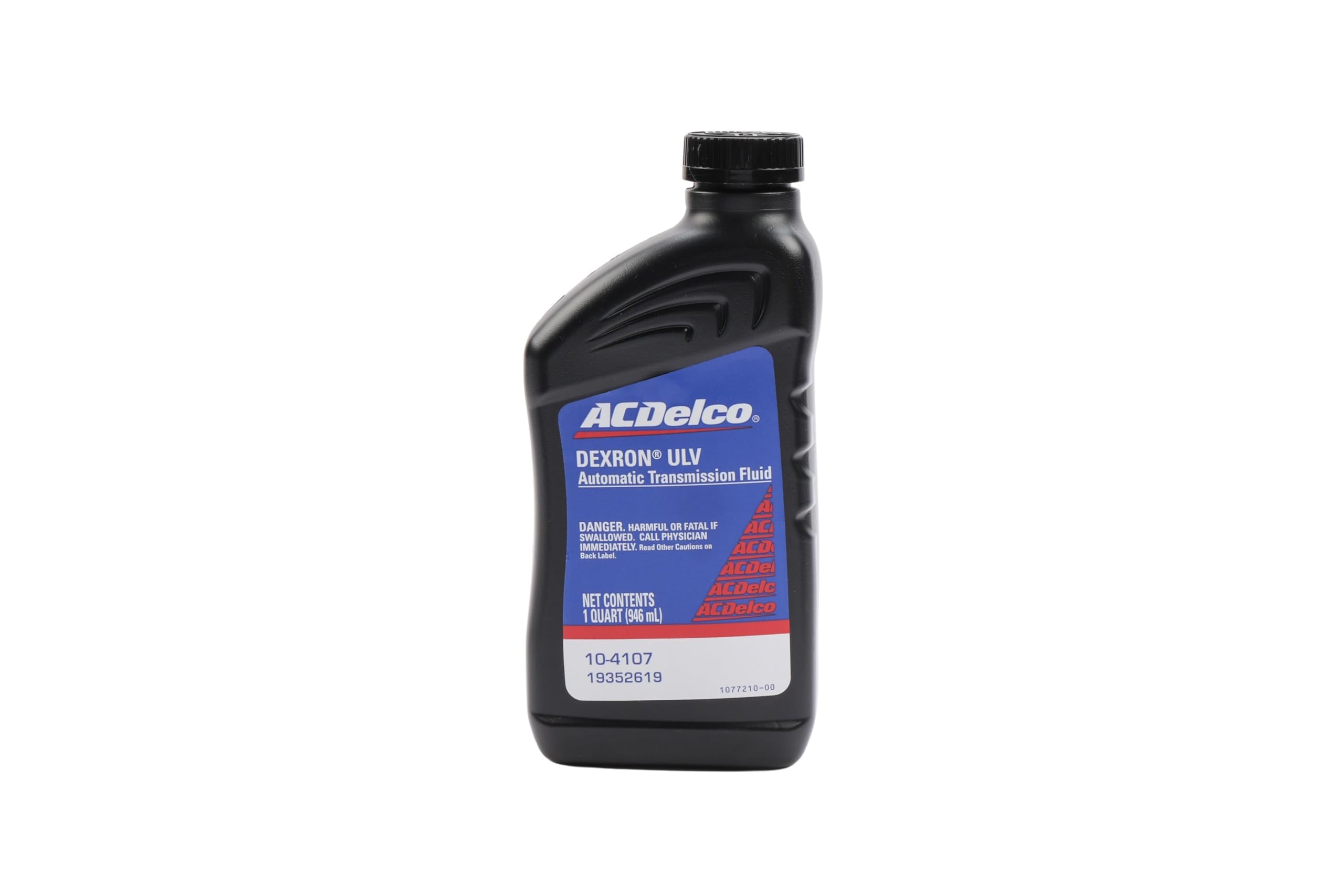
Chevrolet Performance's installation instructions for the 10-speed RWD transmission kit (part no. 19420481) do not leave room for interpretation: use DEXRON ULV, P/N 19352619 in the US and 19352620 in Canada, and failure to use the proper fluid may result in transmission internal damage. The same sheet repeats it inside the fill procedure with a line worth reading twice: do not use DEXRON VI or DEXRON HP. Over the counter, that fluid is ACDelco 10-4107.
GM's 2025 Transmission Capacities and Fluids chart backs it across the range. Every 10L80 row on that chart calls for DEXRON ULV, whether the unit is behind a 5.3 in a Silverado 1500, sitting in a 2500HD, or under an Escalade. The 10L60, 10L90 and 10L1000 rows read the same way.
The reason is viscosity, and the gap is wider than the shelf makes it look. Lubegard's breakdown of the ultra-low-viscosity specifications puts Ford's ULV fluid at 4.5 cSt at 100 C and DEXRON HP at 5.95 cSt at 100 C. That is roughly a 1.45 cSt spread between two fluids sold for broadly similar late-model transmissions. The 10L runs a variable-vane pump packaged inside the valve body itself, and the TCM learns clutch fill times on a fluid whose thickness was a design input. Put a heavier fluid in and every fill event takes longer, the adapts chase it, and you get the soft or flaring shift that sends the unit back to you.
One more line off GM's own sheet that most techs skip: the quart bottles of DEXRON ULV have to be shaken before pouring to stir the additives back in. It costs ten seconds a case.
And no, Ford MERCON ULV is not a substitute because the bottle also says ULV. They are separate licensed OEM specifications that landed in the same viscosity neighborhood at the same time. Fill the GM unit with the GM fluid.
Three capacity numbers, not one
The most common parts-counter mistake on this unit is buying one number's worth of fluid for a different job. Chevrolet Performance publishes all three for the 10-speed RWD:
| Job | Metric | English |
|---|---|---|
| Pan removal and filter replacement | 7.7 liters | 8.1 quarts |
| Overhaul (transmission volume only) | 10.95 liters | 11.6 quarts |
| Complete system (including cooler volume) | 12.52 liters | 13.23 quarts |
GM's 2025 capacities chart lists the same 7.7 L / 8.1 qt fluid change capacity for the 10L80 across the truck and SUV applications, so the two documents agree. What you must not do is grab the number off the wrong row: the 10L1000 is listed at 13.6 L / 14.4 qt for a fluid change. Different unit, nearly twice the fluid.
Practical stocking advice: a pan-and-filter service does not hand you 8.1 quarts back out, because the converter and the cooler keep theirs. Put nine quarts on the bench for a service and fourteen for a full system fill, and expect leftovers. You would rather have a spare quart on the shelf than be a half quart short with the truck on the hoist at 78 C and falling.
There is no dipstick, and one of those plugs is a trap
The GM 10-speed uses a metal pan with a fill level tube and a fill plug located in the pan. That pan plug is the service point. Transmission Digest's teardown of the Ford and GM 10-speed by Mike Souza documents what else is down there, and it is the detail that bites people: there are two large plugs on the rear driver's side of the case just above the pan rail, one embossed CAR and one embossed TRK, plus a smaller plug on top of the case found only on GM models.
Those case plugs are not level check points. Souza's finding is direct, and it matches the absence of any reference to them in the factory fill procedure: the case plugholes are for factory use only, and the fill level tube in the pan sits a bit higher than the bottom of the case plugholes. Fill to the bottom of a case plughole and you have just built an under-filled transmission that reads full to whoever did it.
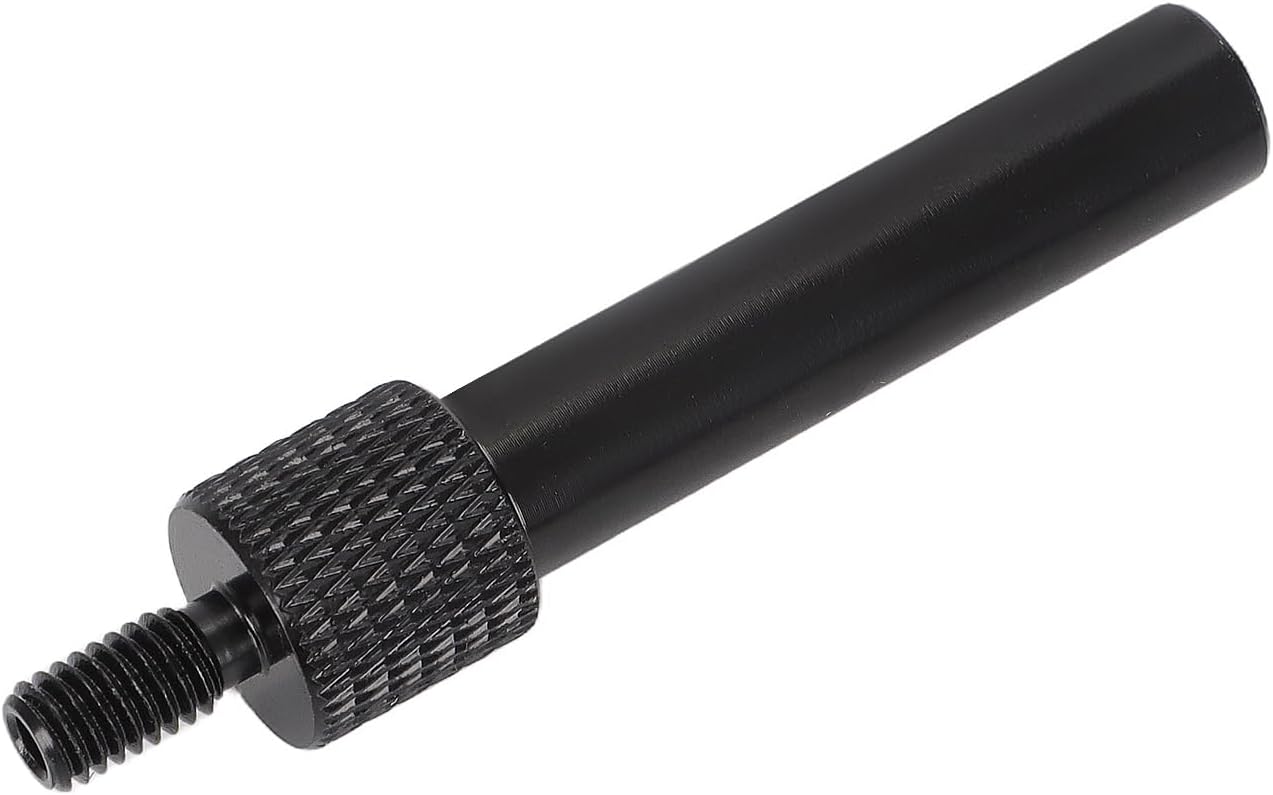
Because you are filling upward into the pan, a hand transfer pump or a threaded ATF filler adapter is not optional equipment here. There is no funnel path into this transmission.
The fill procedure, and why temperature is the whole job
The numbers below come from Chevrolet Performance's 10-speed check-and-fill procedure. It is written for the crate 10L90, but it is the same 10-speed RWD architecture, the same no-dipstick pan-tube level and the same fluid as the production 10L80, and it is the most specific version of this procedure GM publishes outside a service-information subscription.
The window is 75-80 C (167-176 F). GM spells out the consequence of missing it in both directions: if TFT is greater than 80 C you end up under-filled, and if TFT is less than 75 C you end up over-filled. There is also a hard floor. Because the transmission has an internal thermal bypass valve, the level should not be checked until TFT has reached or exceeded 70 C (158 F) at all.
The sequence:
- Start and idle the engine, and get the fluid to normal operating temperature.
- With the brake applied, move the shifter through every range, pausing at least three seconds in each, then return to Park with engine speed low, 500-800 rpm.
- Let it idle at least one minute so any foam settles out.
- If you need heat, set the parking brake, hold the foot brake in a drive range and run converter stalls 10 seconds on, 10 seconds off, never above 1500 rpm. Holding longer or pulling more rpm than that can damage the unit internally.
- Raise the vehicle. It must be level, engine running, shifter in Park.
- Clean around the plug first. GM asks for compressed air and a mirror to confirm the area is clean, because anything that falls in goes straight to the pan.
- Remove the case plug and let fluid drain.
The engine must be running when that level check plug comes out. Pull it with the engine off and you drain far more than the level, and you will hand the customer an under-filled transmission. If fluid comes out as a steady stream, wait for it to slow to a drip. If nothing comes out, add fluid until it runs out in a steady stream and then drips. Reinstall the plug and torque it to 22 N·m (16 lb-ft).
Watch the transmission fluid temperature PID the whole time. On a hoist with no airflow through the cooler, TFT climbs fast, and a level set at 84 C is an under-filled unit no matter how carefully you watched the drip.
What the wrong level actually costs
Overfill is the one GM writes warnings about. Their language is not about shift quality, it is that fluid will overflow from the vent tube, possibly causing a fire, along with foaming and pump cavitation. The mechanism is simple: excess fluid gets whipped by the rotating clutches, aerated fluid is not a solid hydraulic column, and a pump trying to move foam does not hold clutch apply pressure.
Sonnax puts a number on how little it takes. On the 10-speed family, overfilling by as little as one quart causes both overheating and venting, and the usual path to that extra quart is somebody checking and topping off cold, then the fluid expanding as it comes up to temperature. Sonnax also lists normal operating temperature for these 10-speeds as 96-101 C (206-215 F) in service, well above the window you set the level in, which is exactly why a cold top-off finishes long.
Under-fill is quieter and just as expensive. GM describes it as causing premature component wear or damage. Nothing lights up for a half quart low; you just get a clutch pack that has been running a marginal apply volume for 30,000 miles.
One caveat before you blame the level for a hot transmission. GM bulletin 22-NA-182 covers 6L80, 6L90, 8L90, 10L80, 10L90 and 10L1000 vehicles complaining of harsh shifts, shudder, surge, stall, neutral/flare, overheating and above-normal fluid temperature, and names a twisted cooler line on low-mileage vehicles as a root cause, which can set DTC P27EC in the TCM on ETRS units (RPO MHS, MQC). The same bulletin publishes the thermal bypass valve opening temperatures, and they are worth memorizing: on the 10-speeds the TBV is inside the valve body and opens at 143 F (61 C), except on 3.0L LM2 and LZ0 diesels, where it lives on the frame rail and opens at 194 F (90 C). Check the cooler line and know which TBV you have before you pull a pan.
The filter, and why fluid choice reaches further than you think
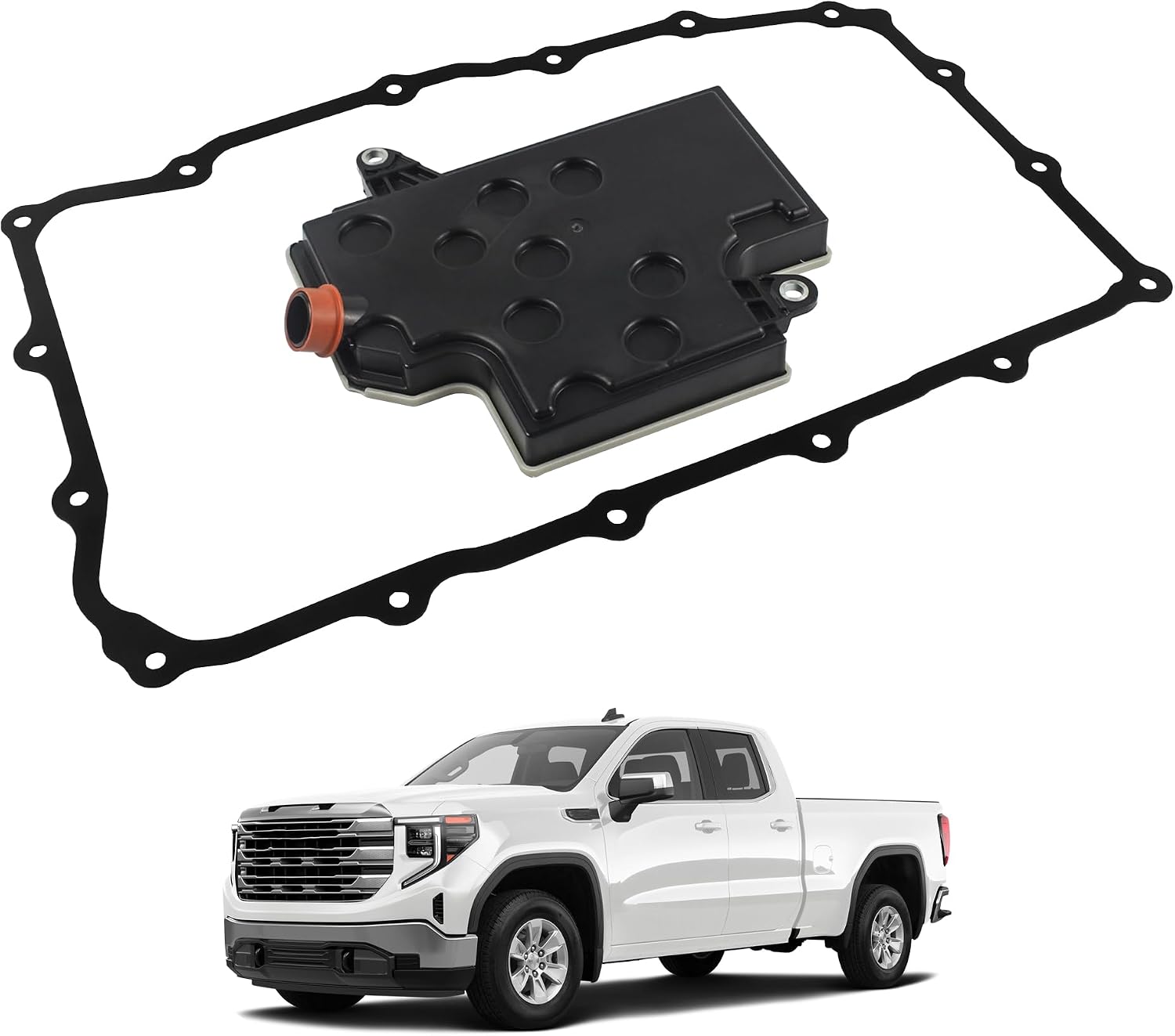
The current GM 10-speed filter and pan gasket carries OEM number 24294355, and it is not a conventional screen. Souza's teardown describes two media types in one assembly, a coarse orange media and a fine white media roughly twice as fine, with a thermal plate between them. Cold, when the fluid is thick, most of the volume takes the path of least restriction through the coarse side so the pump primes quickly. As the fluid heats and thins, the thermal plate moves toward a ledge in the housing, restricting the coarse side and pushing volume through the fine media, so the unit only filters aggressively once the fluid is thin enough to pass without starving the pump. Souza notes the thermal plate has since been eliminated, on the engineering view that viscosity alone biases the flow the same way.
Read that again with the fluid question in mind. The filter's entire strategy is built around a specific viscosity curve. That is a second, quieter reason DEXRON VI does not belong in this transmission.
If you are going deeper than a fluid and filter, ATRA's GEARS coverage of the 10L series is worth having open. Their rebuild guidance: replace the rotating sealing rings, because reused rings leak; address the solenoid retaining clips any time you service the valve body; and inspect the LPC accumulator bore and the Linear Pintle solenoid bores for wear. GEARS also flags a parts reality that changes how you quote the job, since the Linear Pintle solenoids are not available separately, so a failure there means ordering a valve body and programming the supplied PUN.
10L80 Transmission Filter and Pan Gasket Kit (OEM 24294355)
The filter and gasket that go in while the fluid is out, in the correct OEM number for the 10L60/10L80/10L90 pan. Shop the part for this fix at our sister store, CoreTransmissionParts.
View the 10L80 filter and pan gasket kit →Need parts for this job?
DEXRON ULV, filter and pan gasket kits, fill adapters, solenoids and rebuild kits for the GM 10L80, on our own checkout.
Shop 10L80 parts →FAQ
What fluid does a GM 10L80 take?
DEXRON ULV, and only DEXRON ULV. Chevrolet Performance's own 10-speed RWD installation instructions (part no. 19420481) specify P/N 19352619 in the US and 19352620 in Canada, sold over the counter as ACDelco 10-4107, and the same sheet states plainly: do not use DEXRON VI or DEXRON HP. GM's 2025 Transmission Capacities and Fluids chart lists DEXRON ULV for every 10L80 application, from the Silverado and Sierra 1500 through the 2500/3500HD, Tahoe, Suburban, Yukon and Escalade. ULV is a thinner fluid family than DEXRON VI or HP, and the pump, clutch fill volumes and TCM adapts were all designed around that viscosity.
How many quarts of fluid does a 10L80 hold?
There are three different numbers and mixing them up is how units come back. A pan removal and filter replacement takes approximately 7.7 liters, 8.1 quarts. An overhaul, counting transmission volume only, takes 10.95 liters, 11.6 quarts. The complete system including the cooler volume is 12.52 liters, 13.23 quarts. Do not borrow the 10L1000 number: that unit is listed at 13.6 liters, 14.4 quarts for a fluid change.
What temperature do you check 10L80 transmission fluid at?
Transmission fluid temperature needs to be 75-80 C (167-176 F) with the engine running, the vehicle level and the shifter in Park. Above 80 C you will end up under-filled; below 75 C you will end up over-filled. Because the unit has an internal thermal bypass valve, the level should not be checked at all until TFT has reached or exceeded 70 C (158 F). Without a scan tool or a driver information center readout showing TFT, you cannot do this job correctly.
Can I use Ford MERCON ULV in a GM 10L80?
No. Both fluids carry the ULV label and both were developed for 10-speed automatics, but they are separately licensed OEM specifications, not a shared standard. Lubegard's breakdown of the ULV specs puts Ford's fluid at 4.5 cSt at 100 C against 5.95 cSt for DEXRON HP, which shows how far apart nominally similar modern ATFs can sit. Fill a 10L80 with the correct DEXRON ULV and keep the Ford bottle for the 10R.
Why does a 10L80 have no dipstick, and which plug is the level?
GM deleted the fill tube and indicator on this family; the level is set by a short tube standing up inside the bottom pan, checked through the plug in the pan itself. The two large plugs on the rear driver's side of the case, embossed CAR and TRK, are factory-use plugs and are not level check points. The fill level tube in the pan sits slightly higher than the bottom of those case plug holes, so setting the level at a case plug leaves the transmission under-filled.
Related guides
- GM 10L80 Problems and the Valve Body Recall
- 10L80 vs 10L90: Differences, Interchange and Which Is Stronger
- 6L80 vs 10L80: Differences and Interchange
- 10L80 Shift Solenoid Symptoms
- 10L80 P0748: Causes and Fix
Sources
- Chevrolet Performance — Supermatic 10L90 Transmission Kit Installation Instructions, part no. 19420481 (Rev 08SE22). Backs the fluid specification and the entire fill procedure: DEXRON ULV P/N 19352619 US / 19352620 Canada, the instruction not to use DEXRON VI or DEXRON HP, the requirement to shake the quart bottles, the 75-80 C (167-176 F) TFT window with its over- and under-fill consequences, the 70 C (158 F) thermal bypass valve floor, the engine-running requirement at the level plug, the 10-on / 10-off converter stall limit below 1500 rpm, the 22 N·m (16 lb-ft) case plug torque, and all three capacity figures (7.7 L / 8.1 qt service, 10.95 L / 11.6 qt overhaul, 12.52 L / 13.23 qt complete system). chevrolet.com (PDF)
- General Motors TechLink — 2025 Transmission Capacities & Fluids chart (U.S. and Canada). Backs the model-by-model fluid call: DEXRON ULV on the 10L80 rows across Silverado and Sierra 1500 and 2500/3500HD, Tahoe, Suburban, Yukon and Escalade, the 7.7 L / 8.1 qt fluid change capacity for the 10L80, and the separate 13.6 L / 14.4 qt figure for the 10L1000. gm-techlink.com (PDF)
- General Motors — Service Bulletin 22-NA-182, "Information on 6L80, 6L90, 8L90, 10L80, 10L90, 10L1000 Equipped Vehicles with A Harsh Shift, Shudder, Surge, Stall, Neutral/Flare, Transmission Overheating and/or High Transmission Fluid Temperature" (June 2024, NHTSA-hosted). Backs the overheating caveat: twisted cooler line as a root cause on low-mileage vehicles, DTC P27EC setting in the TCM on ETRS transmissions (RPO MHS, MQC), and the thermal bypass valve opening temperatures — 143 F (61 C) inside the valve body on 10L80/10L90/10L1000, and 194 F (90 C) on the frame rail for 3.0L LM2 and LZ0 diesels. static.nhtsa.gov (PDF)
- Sonnax — "Tips for Troubleshooting 10-Speed ATF Venting & Overheating." Backs the overfill consequence and the service temperature reference: overfilling by as little as one quart causing both overheating and venting, the cold-fill path that produces that extra quart, and the 96-101 C (206-215 F) normal operating temperature range. sonnax.com
- Transmission Digest — "10R80/10L90 Ford & GM Ten Speed Unique Filter System," Mike Souza (April 2019). Backs the pan and plug layout and the filter design: the metal GM pan with a fill level tube and fill plug, the two large CAR and TRK case plugs above the pan rail plus the GM-only top case plug, the finding that those case plugholes are factory-use only and sit lower than the pan's fill level tube (so filling to them under-fills the unit), and the dual fine/coarse media filter with its thermal plate and the note that the plate was later eliminated. transmissiondigest.com
- ATRA / GEARS Magazine — "Diagnosing the 10L Series Transmission." Backs the rebuild-side guidance: replacing the rotating sealing rings because reused rings leak, addressing the solenoid retaining clips whenever the valve body is serviced, inspecting the LPC accumulator bore and Linear Pintle solenoid bores for wear, and the fact that Linear Pintle solenoids are not sold separately, requiring a valve body order and PUN programming. gearsmagazine.com
- Lubegard — "The Year of the 10-Speed." Backs the viscosity comparison used to explain why ULV is not interchangeable with older DEXRON grades: Ford's ULV at 4.5 cSt at 100 C against DEXRON HP at 5.95 cSt at 100 C, roughly a 1.45 cSt spread. lubegard.com
Keep the fluid specs on your bench
Every major transmission, the exact fluid it takes and the capacity, on one printable sheet. Free, no fluff.
Get the spec chart →