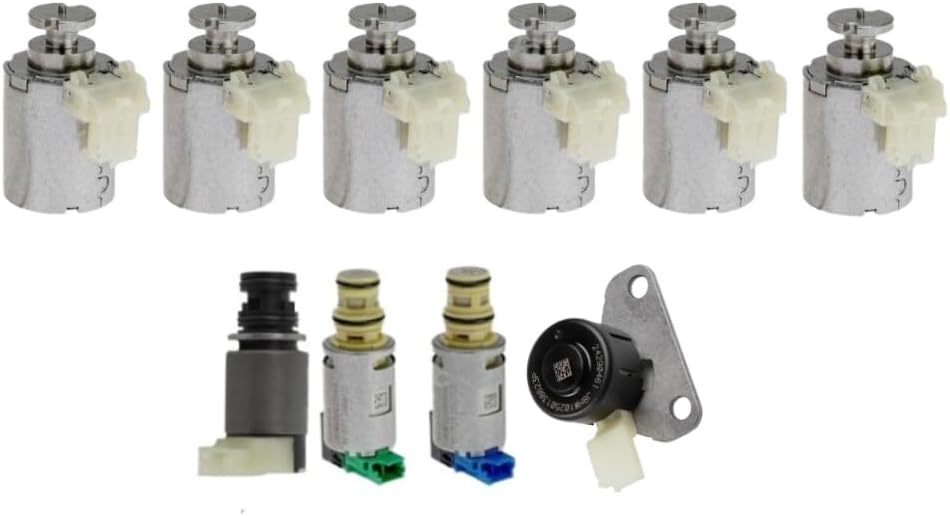
Half the 10L80 pressure control calls that reach the bench start with the wrong vocabulary. Somebody says "EPC solenoid," borrowed from Ford, then goes looking for one part to swap. The GM 10L80 has no EPC solenoid. It has eight pressure-regulating solenoids in the control solenoid valve assembly, and only one of them controls line pressure.
That distinction decides where you look. Per Transmission Digest's teardown of the GM and Ford 10-speed solenoid layout, solenoids 1 through 6 are normally low linear solenoids handling shifts and regulated clutch control, solenoid 7 is the line pressure solenoid and it is a normally high variable force solenoid, and solenoid 8 is a normally low variable force solenoid for the converter clutch. Solenoid 7 is the only part that literally fits the description, and in my experience it is rarely the part that failed.


What actually fails in the pressure control circuit
The solenoid is a small, sealed, current-driven pressure regulator sitting in an aluminum bore, and it does not wear out the way a 4L60E EPC does. What wears is everything around it: the bore it sits in, the clip that holds it centered, the pressure regulator valve it commands, and the damper that smooths its signal.
ATRA's Gears coverage of the 10L series puts the root causes of high-mileage shift quality complaints in a short list: weak or broken solenoid retainer clips, sticking linear pintle solenoids and clutch control valves, a worn LPC accumulator bore, and excessive clutch clearance. Note what is not on that list. The solenoid coil is not the usual suspect.
Retainer clip collapse, and the 0.090 in. that matters
The linear force solenoids are held in the casting by small spring steel retainers. Sonnax documents those retainers collapsing, which lets the solenoid sit off-center in its bore. Each of these solenoids works by extending a pintle roughly 0.090 in. to stroke the clutch control valve behind it. Move the solenoid off-center and that pintle can no longer stroke the valve the same distance, so apply timing and apply pressure both drift. The complaint reaching your service writer is "it shifts hard sometimes." The cause is a 40-cent clip.
Ignore it and a loose solenoid wobbling in its bore chews the casting at the clutch valve bore opening, which turns a retainer kit into a valve body. Replace the clips on every 10-speed valve body that comes apart on your bench.
Main pressure regulator valve bore wear
This is the classic low-line-pressure cause. The pressure regulator valve oscillates constantly in normal operation, and Sonnax's documentation for its oversized main pressure regulator valve kit describes that oscillation wearing the bore until line pressure signal oil cross-leaks to exhaust. The solenoid commands correctly; the pressure never arrives.
Memorize the symptom set Sonnax lists for that bore, because it overlaps almost perfectly with what shops assume is a failed solenoid: low line pressure, various shift concerns, delayed engagement, poor shift quality, burnt clutches, and converter clutch apply and release concerns.
LPC signal damper piston wear, which drives pressure the other way
The opposite complaint has its own bore. The LPC signal damper smooths the line pressure control signal. Sonnax's vacuum test guide for these valve bodies lists bore or piston wear there as producing harsh shifts and high line pressure specifically. So on a 10L80 you can have a high-pressure complaint and a low-pressure complaint that both feel like a pressure control solenoid and live in two different bores an inch apart.
The Gen. 2 split, and the code that sends everyone the wrong way
GM changed the clutch control architecture partway through this transmission's life, and you cannot diagnose a pressure complaint without knowing which version is on your lift. Sonnax's Jim Dial lays it out: GM 10-speeds used latch valves for clutch control until late 2019, after which the valve bodies Sonnax calls Gen. 2 dropped the latch valves and added the feed limit low and feed limit high valves, working with checkballs known as boost balls.
The feed limit low valve has become the pattern failure, and it is why so many 10L80 owners see a pressure control code. It limits line pressure feed to the default disable solenoid, which positions the default enable and default select valves — the pair that puts the transmission into its power-down default mode of 2nd gear in Drive, plus Reverse.
Sonnax reports that valve is under heavy side load and can wear out in as little as 30,000 miles, with many vehicles needing service by 35,000. When it wears, solenoid feed pressure drops, the default valves move when they should not, and the truck does something startling. Sonnax’s published complaint list for it: momentary wheel lockup, code P0747, a downshift to 2nd from a high gear, harsh shifts, 5th gear only, a reduced propulsion message, burnt clutches and clutch failure. The worst of it shows up hot, going into 7th or 8th.
Here is the trap. The generic SAE definition of P0747 is pressure control solenoid A stuck on, so the code names a solenoid. On a Gen. 2 10-speed the cause is usually a worn valve bore feeding that circuit. Shops have replaced whole control solenoid valve assemblies on this code and had the vehicle come back, because the assembly was never the problem.
The recall is a warning light, not a repair
If the vehicle is a 2019-2020 Cadillac CT6, a 2020-2021 CT4 or CT5, or a 2020-2022 Camaro with the 10-speed, check the VIN before you quote anything. GM's Part 573 report for safety recall N242480630, NHTSA campaign 25V-148, covers roughly 90,000 of those vehicles. GM's stated cause is excessive wear in the transmission control valve body causing a fluid leak and a pressure drop that makes valves move unexpectedly. Drivers notice harsh shifting; in rare cases the wheels momentarily lock, which GM measured at under 150 milliseconds. A companion recall, N242454440 (campaign 24V-797), covered the same condition on other applications.
The remedy is transmission control module software that detects the wear roughly 10,000 miles early, limits the transmission to 5th gear and throws a check engine light and a reduced propulsion message. Read that carefully: GM ships a detector, not a repair. If a customer arrives with the recall performed, a 5th-gear-only condition and a reduced propulsion message, the software did its job and the valve body work is still in front of you.
Diagnosing it before the pan comes down
- Scan every module, not just the TCM. ATRA's example is worth carrying: chassis code C0267, low brake fluid level, kills upshifts in Tow Haul mode on these vehicles, and GM's own procedures do not connect the two.
- Rule out normal strategy first. A harsh first engagement after the vehicle has sat is often catalytic converter light-off, not a pressure fault. ATRA documents the CLO program raising idle and retarding timing for 25 to 90 seconds when engine coolant temperature is below 158F (70C) at start-up. If the complaint only occurs in that window, it is normal.
- Look for P175E in history. Transmission Control System, Shift Limiting Active means the TCM already ran a protective pressure and shift management strategy. It tells you the module saw something wrong even if the hard code cleared.
- Read the pan. Uniform dark friction dust across several clutches is a pressure control signature; one burnt clutch with the rest clean is that clutch's own circuit.
- Vacuum test the valve body. This separates a guess from a diagnosis. Sonnax publishes a free vacuum test guide for the Gen. 1 10L60/80/90 and 10R60/80 valve bodies with every test port marked. Two notes people get wrong: test valves in the rest position unless told otherwise, and keep the hole on the backside of the valve body uncovered while testing the LPC signal damper, or the reading means nothing.
The programming step that ruins new parts
This one costs shops real money. Every one of the eight solenoids is flow-tested after assembly with current applied both increasing and decreasing, and the resulting current-versus-pressure data points are saved as a file number marked on the solenoid housing or the valve body. That file lives in GM's Techline Information System and is programmed into the TCM.
Per Transmission Digest, replacing the transmission, the lower control valve body assembly with solenoids, the TCM, or one or more solenoids all require the TCM to be programmed with the correct solenoid performance data. Install a solenoid kit without doing it and the module commands current against the wrong pressure curve, and the customer comes back with a shift quality complaint you created. If you are not set up to program, the job needs to go somewhere that is.
What actually fixes it
Match the repair to the bore, not to the code:
- Harsh shifts with high line pressure: LPC signal damper piston bore. Sonnax kit 105740-04K is a drop-in for a worn damper with no reaming.
- Low line pressure, delayed engagement, burnt clutches: main pressure regulator valve bore. Kit 105740-12K for moderate wear, oversized 105740-20K when the bore is gone.
- P0747, drop to 2nd from a high gear, 5th gear only (Gen. 2): feed limit low valve, kit 105740-54K. Sonnax's guidance is to replace both feed limit valves in every Gen. 2 build even when they pass a vacuum test.
- Intermittent harsh shifts with no clear pressure signature: solenoid retainer clips, every time the valve body is open.
- Worn LPC accumulator or linear pintle solenoid bores: valve body replacement, then programming. ATRA notes those solenoids are not sold separately.
One more thing about shift feel here. ATRA points out the TCM overlaps the oncoming and off-going clutch for about 0.3 seconds on every shift. That narrow window is why a small circuit leak reads as a hard hit rather than a soft slip. Do not write off a "slightly harsh" 10L80 as normal wear.
Sonnax Main Pressure Regulator Valve Kit 105740-12K (10L80)
The honest pitch: if your 10L80 has low line pressure, delayed engagement or burnt clutches and the solenoid checks out electrically, this is the bore that is leaking your pressure signal to exhaust. It is a drop-in repair to the valve body you already have. If the bore is badly worn, step up to the oversized 105740-20K instead. For a Gen. 2 unit with P0747 or a drop to 2nd, the feed limit low valve kit 105740-54K is the one you want.
Shop the part for this fix →Need something else for this job? The full 10L80 parts collection carries the LPC damper kit, solenoid stabilization retainers, the Zip Kit, filters and clutch modules.
Need parts for this job?
Solenoid kits, valve body circuit repairs, filters, pan gaskets and DEXRON ULV are on our 10L80 parts page, with checkout on site. If the valve body is coming off anyway, put the filter, gasket and fluid on the same order so the pan comes down once.
FAQ
What are the symptoms of a bad pressure control solenoid on a 10L80?
The common set is harsh or bumpy shifts, delayed engagement into Drive or Reverse, flare on the upshift followed by a bump, and burnt clutch material in the pan. On Gen. 2 units you can also get a sudden drop to 2nd gear from a high gear, a 5th-gear-only condition and a reduced propulsion message. Those last three are almost never the solenoid itself. They come from the feed limit low valve losing pressure to the default disable solenoid.
Can you replace just the pressure control solenoid on a 10L80?
Usually not. ATRA reports that the linear pintle solenoids in this valve body are not sold separately, so wear in those bores means the valve body goes with them. There is also a programming step: every solenoid is flow-tested at the factory and its current-versus-pressure data file is stored in the TCM, so replacing a solenoid, the valve body or the TCM requires programming the correct performance data. Skip that and the new part will shift worse than the old one.
What causes P0747 on a GM 10-speed?
The generic SAE definition of P0747 is pressure control solenoid A stuck on, which sends most techs straight at the solenoid. On Gen. 2 10L60/10L80/10L90 and 10L1000 units the usual cause is the feed limit low valve wearing its bore and dropping the solenoid feed pressure that holds the default disable circuit in position. Sonnax reports that valve wearing out in as little as 30,000 miles. Check the valve before you condemn the solenoid.
Does the GM 10-speed wheel lock-up recall actually fix the valve?
No. Recall N242480630, filed with NHTSA as campaign 25V-148, installs transmission control module software that watches for the wear signature and limits the transmission to 5th gear roughly 10,000 miles before a lock-up could happen, with a check engine light and a reduced propulsion message. That is a warning system, not a repair. The worn valve is still in the valve body and still has to be serviced.
How do I tell a pressure control problem from a mechanical failure?
Line pressure problems change shift feel across the board and show up on more than one clutch; a mechanical failure is usually gear-specific and repeatable. Read the filter and magnet first. Uniform dark friction dust on several clutches points at pressure control. A single burnt clutch with the rest clean points at that clutch's apply circuit or its clearance.
Related guides
- 10L80 P0748 Causes and Fix
- 10L80 P0961 Causes and Fix
- 10L80 Shift Solenoid Symptoms
- 10L80 Valve Body Symptoms
- 10L80 Harsh Shift Causes
Sources
- Transmission Digest, "10R80/10L90 10-Speed Solenoid Function" — solenoids 1-6 as normally low linear solenoids for shift and clutch control, solenoid 7 as the normally high variable force line pressure solenoid, solenoid 8 as the normally low variable force TCC solenoid, and the solenoid current/pressure data file that must be programmed into the TCM when the transmission, valve body, TCM or any solenoid is replaced. Read the article
- ATRA / Gears Magazine, "Diagnosing the 10L Series Transmission" — root causes of high-mileage shift quality complaints (retainer clips, sticking linear pintle solenoids and clutch control valves, worn LPC accumulator bore, clutch clearance), linear pintle solenoids not available separately, the roughly 0.3-second clutch overlap, DTC P175E shift limiting, chassis code C0267 killing Tow Haul upshifts, and catalytic converter light-off producing a normal harsh garage shift below 158F (70C) for 25 to 90 seconds. Read the Gears article
- Sonnax, "Ford 10R60, 10R80 & GM 10L60/80/90 (Gen. 1) Vacuum Test Guide" — test port locations and the complaint list for each bore, including main pressure regulator valve (low line pressure, delayed engagement, poor shift quality, burnt clutches, TCC apply and release concerns), LPC signal damper piston (harsh shifts, high line pressure) with the note to keep the backside hole uncovered while testing, and solenoid stabilization kits for loss of shift solenoid control pressure. Open the vacuum test guide
- Sonnax, Feed Limit Low Valve Kit 105740-54K product documentation — the feed limit low valve limiting line pressure feed to the default disable solenoid, severe side-load wear in as little as 30,000 miles with many units needing service by 35,000, and the complaint list including code P0747, momentary wheel lockup, downshift to 2nd from high gear, 5th gear only, reduced propulsion message and burnt clutches. Also the note to replace both feed limit valves in every build even when they pass a vacuum test. View the Sonnax documentation
- Sonnax, Jim Dial, "Understanding '19-Later GM 10-Speed Safety Recall" (May 16, 2025) — GM 10-speeds using latch valves for clutch control until late 2019 and Gen. 2 valve bodies replacing them with feed limit low/high valves and boost balls, the default disable solenoid controlling the default enable and default select valves, default drive mode equalling 2nd gear and Reverse, and the complaint pattern occurring hot when shifting into 7th or 8th. Read the Sonnax tech article
- NHTSA, Part 573 Safety Recall Report 25V-148 (GM recall N242480630) — affected vehicles (2019-2020 Cadillac CT6, 2020-2021 CT4 and CT5, 2020-2022 Chevrolet Camaro with the 10-speed), GM's stated cause of excessive valve body wear causing a fluid leak and pressure drop that moves valves unexpectedly, harsh shifting as the driver warning, momentary wheel lock-up measured under 150 ms, and the remedy being TCM software that limits the transmission to 5th gear roughly 10,000 miles before failure. Read the 573 report (NHTSA)