Nobody walks in and says "my clutch overlap is off." They say it bangs into gear, or it slams the 2-3, or it feels like somebody kicked the driveline. On a GM 10-speed that one complaint covers a lot of ground, because ATRA puts the oncoming and off-going clutch overlap at roughly 0.3 seconds. Everything that goes wrong with a shift here happens inside that window, and a flare with a bump on the back side feels exactly like a bind-up from the driver's seat.
So the job is not "fix the harsh shift." The job is working out what is eating that 0.3 seconds, and three of the most common causes are not the transmission at all. Run it in this order and you will stop replacing valve bodies that did not need replacing.

Start with the three harsh shifts that are not broken
The cold garage shift is a catalytic converter strategy
Customer starts the truck, immediately pulls it into reverse, gets a bang. That is very often catalytic converter light-off doing exactly what GM programmed it to do. Per ATRA, when engine coolant temperature is below 158°F (70°C) at start-up, the ECM elevates idle speed, retards spark timing and adds extra injector pulses to heat the converter, and it holds that for 25 to 90 seconds. Drop a transmission into gear against an elevated idle and the engagement is firm by definition.
This happens on both generations and it is not a defect. Qualify the complaint first: if it only ever happens on the first engagement after a cold start inside the first minute and a half, you are done. If it also does it warm, keep reading.
A three-year-old battery fakes a valve body problem
Sonnax describes the pattern precisely on 10-speed work trucks: after a repair the unit does not seem to adapt, and you get harsh engagements or erratic upshifts and downshifts. The next day it is rough for the first few miles, then once it reaches operating temperature it is more or less fine. The rebuilder starts thinking valve body. It is the battery. Sonnax notes batteries in these Ford and GM platforms tend to last about three years, and a truck that has sat in your bay for a few days of teardown and now needs a jump is telling you something. Load test it, check alternator output under load, check grounds. Sonnax also lists system voltage problems among the things that stop a fast learn from completing.
Firm shifts with a code stored somewhere else
Scan every module, not just the TCM. ATRA is explicit that shift strategy and shift quality get altered by codes in other modules and that GM's own procedures do not always draw the connection. The example they give is worth memorizing: chassis DTC C0267 (low brake fluid level) causes no upshifts in Tow/Haul mode, and the truck shifts correctly with Tow/Haul off. And P175E means the TCM has shift limiting active, so it has intentionally changed shift and pressure management to protect the unit. Firm shifts are then a symptom of the protection, not a second fault to chase.
A single delayed clunk after key-on is a known calibration item
If the complaint is one thud, not a harsh shift while driving, listen for the timing. GM TechLink's Mid-January 2025 10-speed diagnostic tips describe an infrequent audible thud delayed 400 to 700 ms after a key start or a garage shift, with severity depending on driveline load. GM ties it to the C2 clutch applying at high line pressure, which stops the rotating parts in Park too quickly, and says the C2 calibration was modified so the C2 knockdown area is pressurized in Park and Neutral while C2 applies. Check the TCM calibration level against the current release before you open anything.
The cooler line GM tells you to look at first
Before the pan comes off a low-mileage truck, go read GM bulletin 22-NA-182 (August 2023, Version 3, which replaced PIP5792E). It covers 6L80, 6L90, 8L90, 10L80, 10L90 and 10L1000 vehicles with harsh shifting, shudder, surging, stalling, neutral/flare or overheating, and the wording that matters is that these complaints show up before or after the transmission has been overhauled. So it applies to your comebacks too.
The cause GM gives is not a valve body. It is a twisted cooler line on low mileage vehicles. On ETRS shift-by-wire units (RPO MHS and MQC), a twisted line may also set P27EC in the TCM. Pull the under-body panels if you need to in order to see the lines clearly, and if one is twisted, disconnect it at the transmission auxiliary cooler, untwist it and reconnect. If it stays misshapen, replace the line, then check fluid level per SI and add if needed.
Know where your thermal bypass valve lives
If the lines are straight, 22-NA-182 points next at the thermal bypass valve. The opening temperatures are worth writing on the wall, because the 10-speed number is much lower than people expect and the valve is not where it sits on the older units:
| Unit | TBV opens at | Location |
|---|---|---|
| 10L80 / 10L90 / 10L1000 | 143°F (61°C) | Inside the valve body, except 3.0L LM2 diesel (external) |
| 8L90 | 194°F (90°C) | External to the transmission |
| 6L80 / 6L90 | 158°F (70°C) | External to the transmission |
That 143°F figure matters in the other direction too. ATRA warns specifically against blocking the cooler bypass valve in full flow mode, because extended operation below the temperature range allotted for adaptive learning causes harsh or binding shifts. A truck running a bypass kit or an oversized aux cooler in cold weather may never get warm enough for the TCM to adapt. Sonnax makes the same point from the service side: install a thermal bypass device after fast learn and adaptations are complete, not before.
How the 10L80 applies a clutch, and why the generation matters
You cannot diagnose shift feel here without knowing which hardware is in front of you. The fastest route is the RPO code from the QR label on the driver's door B-pillar, which also tells you whether the unit is ETRS or cable-shifted and whether it has Auto Start Stop.
Clutch control is different from the 6- and 8-speeds most of us cut our teeth on. There is no solenoid feed circuit for the clutch regulating solenoids. Per Sonnax, the 10-speed family uses a linear force solenoid with an individual pin that physically contacts the regulating valve. That is why a 10-speed has no movement at all unplugged: these solenoids only produce clutch pressure with current flowing.
On Gen. 1 units, apply runs through a latch valve. Regulating valve pressure feeds the clutch between spools B and C; because spool C is larger, that pressure backs up on C as the clutch fills and strokes the valve left, regulating apply through a narrow passage left of spool B. Once inlet pressure overcomes the spring the valve pins fully left and connects straight line pressure between spools A and B. That is your soft-to-firm transition, done hydraulically.
GM changed this in late 2019. Sonnax calls the result Gen. 2: no latch valves, and in their place the feed limit low and feed limit high valves working with check balls Sonnax calls "boost balls." The feed limit low output feeds under the #5 boost ball and seats it against the separator plate while line pressure is below 120 psi. Above the 119 psi feed limit spec the ball unseats, tying clutch apply pressure behind the triple orifice to that 119 psi-limited circuit, and the clutch control regulating valve moves faster.
So on a Gen. 2 unit, shift feel is partly gated by a check ball and a limit valve that do not exist on a Gen. 1. Guess the wrong generation and you will be vacuum testing a bore that is not in your valve body.
The scan tool and gauge pass, in order
- Codes in every module. Chassis, engine, ABS, TCM. Address them before condemning the transmission.
- Fluid type and level. DEXRON ULV only, and per GM's TechLink capacity chart the 10L80 fluid change capacity is 7.7 liters (8.1 quarts) across RPO MQB, MQC, MHT, MI2 and MHS. Sonnax does not soften the warning: ULV is engineered to cut friction and pump workload, and universal or previous-generation fluid produces shift complaints and premature failure.
- System voltage, loaded. Battery, alternator output under load, grounds.
- Line pressure on a real gauge. Sonnax's practical floor, from its fast learn prerequisites, is 55 to 60 psi minimum in Drive with a clear pressure rise on throttle. Below that, or with no rise, you have a hydraulic problem and no relearn will paper over it.
- Temperature. Fast learn needs 167°F to 185°F (75°C to 85°C). If you cannot get the truck there you cannot complete the procedure, and a truck that never gets there in service cannot adapt either.
- Fuel level. Sonnax lists a quarter to three-quarter tank as a hard requirement for fast learn and the drive cycle relearn that follows. It reads like trivia until a procedure keeps aborting on you.
The four wear points behind real intermittent harsh shifts
Once the outside-the-box items are clear and the unit has miles on it, ATRA narrows the source of most shift quality concerns to the valve body and lists four root causes.
| Wear point | What it does to the shift | Fix |
|---|---|---|
| Weak or broken solenoid retainer clips | Heavy CIDAS solenoids wobble in the bore, which causes damage and hang-up of the clutch control valves | Replace the clips any time the valve body is serviced. Sonnax solenoid stabilization retainer kit 105740-19K is the purpose-built version and also stops spring retainer collapse. |
| Sticking linear pintle solenoids or clutch control valves | Apply timing wanders, so the shift is harsh some of the time and normal the rest | Check the solenoid bores for tightness. A donor solenoid has to match the original's band number. |
| Worn LPC accumulator bore | Line pressure signal spikes stop being damped, so pressure runs high and shifts hit hard | ATRA is direct here: wear in the LPC accumulator bore or the linear pintle solenoid bore requires valve body replacement. |
| Excessive clutch clearance | The strategy cannot compensate, which produces harsh or binding shifts | Set clearance to spec on the bench. This one is not fixable from the top. |
Two more items belong on that list from the Sonnax side. Look hard at the separator plate, because the impregnated plate filters come loose and rip, and a displaced filter sticks valves. And go over Sonnax's general 10-speed wear list with a light and a vacuum tester, since a harsh shift can come from any of them: main pressure regulator valve, TCC priority valve, TCC regulator valve, boost valve, and on Gen. 1 units the latch valves, which get beat up by the retainer clip.
The hard economic truth is that the linear pintle solenoids are not sold separately. ATRA notes that a failure there means ordering a valve body and programming the supplied PUN or MCVM number. Which brings up the step people skip.
Check the LPC signal damper before you condemn the casting
One pressure-control bore in the lower valve body can be repaired in place. Sonnax describes the LPC signal damper as the piston that keeps pressure spikes in the LP signal (EPC) circuit from reaching the main pressure regulator valve. When its bore or piston wears, the signal leaks to exhaust, the regulator loses control of main line pressure, and the result Sonnax lists is harsh shifts and high line pressure. That is the same complaint as a worn accumulator, so check this bore first. Sonnax's drop-in kit uses an O-ringed hardcoat piston and a wear-resistant sleeve to seal a worn bore without reaming: 105740-04K for Gen. 1 10L80/10L90 and the Ford 10R units, 105740-05K for Gen. 2 10L80/10L90. If scan data shows line pressure above command and the damper bore is the one leaking, that is a kit, not a valve body.
Program the solenoid data or you built a new problem
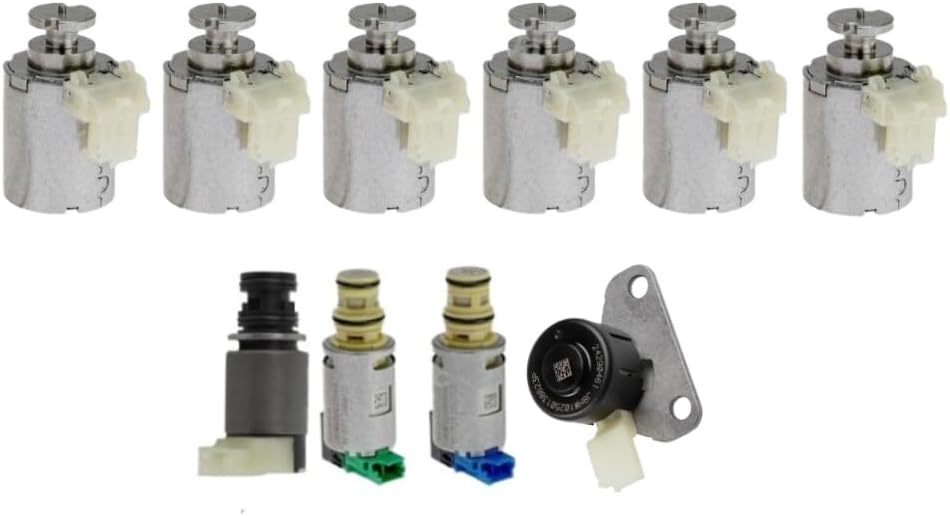
Per Transmission Digest, GM control solenoid valves 1 through 8 are pressure-regulating valves, and every one is flow tested after assembly with current swept up and then back down. Those current-versus-pressure data points are saved to a numbered file, marked on the solenoid housing end or on the valve body itself, and stored on GM's Techline Information System. The TCM has to be holding that file, which means it must be programmed with solenoid performance data after replacing the transmission assembly, the lower control valve body with solenoids, the TCM itself, or one or more solenoids. Skip it and your new solenoid is being commanded with somebody else's calibration, which is a harsh shift you built yourself.
Two details from the same source save comebacks: solenoids 1 through 6 carry different part numbers for different flow rates and must go back in their original locations, and shift solenoids 1, 2, 3 and 6 use a four-land regulating valve while 4 and 5 use a five-land valve.
Gen. 2 only: the feed limit low valve
If you have a Gen. 2 unit with intermittent harsh behavior that gets worse when hot, and especially if it has towed for a living, check the feed limit low valve first. In March 2025 GM issued Safety Recall N242480630 for the 10L1000 and Gen. 2 10L60/80/90 covering a momentary wheel lock-up condition at higher speeds, sometimes with a downshift back to 2nd gear.
The mechanism, per Sonnax, is wear in the feed limit low valve dropping solenoid feed pressure to the default disable solenoid. That solenoid positions the default enable and default select valves, and when its feed pressure is low, those valves can let the unit fall into lower gears or bind up, depending on what is commanded. A supporting clue is DTC P0747, which says the E clutch is on when it should be off. Sonnax has seen this wear at as few as 35,000 miles on tow trucks and heavy haulers. Quick field check: let it cool off, because most of the time it behaves normally until hot.
Test it, do not guess. Vacuum test the balance end of the valve, which is where it wears most. A healthy reading is 18 in-Hg or higher, and it should match the feed limit high bore, since those two are the same valve train with different springs. Drop-in kits 105740-54K (low) and 105740-58K (high) restore function. If a bore reads below 8 in-Hg, the wear is past what a drop-in can make up and you want the oversized kits, 105740-59K and 105740-60K, with the associated reaming tooling.
Pass this caution to the customer: extended driving in this condition destroys clutch packs, because the unit binds up intermittently. The recall software update helps by commanding 5th gear and lighting the MIL when the TCM detects bore wear starting, so the driver can get off the road, but software does not fix a worn valve.
Why rebuilt units come back harsh
If the complaint appeared after your own overhaul, the list is short and mostly mechanical.
- Reused rotating sealing rings. ATRA states flatly that reused sealing rings will leak and cause intermittent shift quality problems. Replace them every time.
- Sealing ring and hub bushing wear. Sonnax identifies these as among the biggest causes of charge pressure loss, which then leads into lockup and overheat complaints.
- No air check. Air check each drum and then the complete assembly through the pump before it goes into the case. The shafts have plugs that keep fluid in its intended circuit, and a leaking plug causes shift concerns that are invisible once the unit is buttoned up.
- Pump seal position. The steel-rubber seal between the valve body and the case has to be there and has to be positioned. Left out or mispositioned, you get no movement and no line pressure.
- Clutch clearance out of spec. The strategy has a compensation range, and out-of-spec clearance sits outside it.
Then do the fast learn properly and set expectations on the back end. Sonnax notes TCC adapts and relearn can still take 200 to 300 miles of driving after the procedure completes. A truck that feels slightly off leaving your lot is not automatically a comeback.
Preventing the next one
A 10L80 shifts well when it is warm, full of the right fluid, electrically stable and hydraulically tight, and it shifts badly the moment any one of those slips. So the prevention list is boring on purpose: correct DEXRON ULV at the correct level, a filter that is not collapsing, a charging system that holds up under load, no bypass keeping the unit below adaptive temperature, and solenoid retainer clips replaced every time the valve body comes apart. On the bench, vacuum test the bores you are warrantying, not just the ones you already suspect. The bore that barely holds 10 in-Hg today is next spring's harsh shift complaint.
Solenoid retainer clips are the one part you should never reuse
ATRA lists weak and broken retainer clips first among the root causes of intermittent harsh shifts on this unit, because a loose CIDAS solenoid wobbles in its bore and hangs up the clutch control valve sitting behind it. The Sonnax 105740-19K stabilization retainer kit is the purpose-built replacement and cheap insurance on a valve body you are putting your name on.
Sonnax 105740-19K retainer kit at CoreTransmissionParts →Also there: feed limit low valve kit 105740-54K for the Gen. 2 recall bore, and the full 10L80 parts collection.
FAQ
Is a harsh shift when cold normal on a 10L80?
Often, yes. ATRA documents that GM's catalytic converter light-off program runs when engine coolant temperature is below 158 degrees F at start-up and stays active for 25 to 90 seconds, raising idle speed, retarding spark and adding injector pulses. If the driver starts the truck and immediately drops it into gear during that window, the engagement is harsh and that is the strategy working. Qualify when the complaint occurs before you diagnose anything.
Can a bad battery cause harsh shifts on a 10L80?
Yes, and it is one of the most common false valve body diagnoses. Sonnax reports that on 10-speed work trucks a weak battery shows up as harsh engagements or erratic upshifts and downshifts, typically worst on the first drive of the day and better once the truck is warm. Batteries in these platforms tend to last about three years. Load test it and check charging output before the pan comes off.
Do I have to replace the whole valve body for a 10L80 harsh shift?
It depends which bore is worn. ATRA states that wear in the LPC accumulator bore or the linear pintle solenoid bore areas requires valve body replacement, because the linear pintle solenoids are not sold separately. Wear in the feed limit valves on Gen. 2 units is different: Sonnax sells drop-in and oversized kits for those. Vacuum test before you decide.
Will a TCM reflash or a relearn fix a 10L80 harsh shift?
Sometimes, and it is worth doing first because it is cheap. But a relearn only helps if the transmission is hydraulically sound. Sonnax's fast learn prerequisites are specific: 167 to 185 degrees F transmission temperature, correct and verified ATF level, and line pressure normal at 55 to 60 psi minimum with rise on throttle in Drive. Clutch circuit leaks, worn clutch regulator valves and low system voltage will all stop the procedure from completing.
What fluid does a 10L80 take, and can the wrong fluid cause harsh shifts?
DEXRON ULV, and yes it can. GM's TechLink capacity chart lists DEXRON ULV for every 10L80 application with a 7.7 liter (8.1 quart) fluid change capacity. Sonnax is blunt about substitutes: ULV is designed to reduce friction and pump workload, and universal or previous-generation fluid will result in shift complaints and premature failure.
Sources
- General Motors — Service Bulletin 22-NA-182, "Information on 6L80 6L90 8L90 10L80 10L90 10L1000 Equipped Vehicles With A Harsh Shift, Shudder, Surge, Stall, Neutral/Flare, Transmission Overheating and/or High Transmission Fluid Temperature," August 2023 (Version 3, replaces PIP5792E). Backs the condition list of harsh shifting, shudder, surging, stalling, neutral/flare and overheating occurring before or after an overhaul; the stated cause of a twisted cooler line on low mileage vehicles; the note that a twisted cooler line may set DTC P27EC in the TCM on ETRS transmissions (RPO MHS, MQC); the inspect-untwist-or-replace-then-check-fluid-level procedure; and the thermal bypass valve opening temperatures of 143°F (61°C) for the 10L80, 10L90 and 10L1000 with the TBV inside the valve body on all listed applications except the 3.0L LM2 diesel, 194°F (90°C) for the 8L90 and 158°F (70°C) for the 6L80/6L90. nhtsa.gov (PDF)
- ATRA / GEARS Magazine — "Diagnosing The 10L Series Transmission," Keith Clark, June 2024. Backs the approximately 0.3 second oncoming/off-going clutch overlap and why a flare with a bump and a binding shift feel identical; the catalytic converter light-off program active below 158°F (70°C) coolant temperature for 25 to 90 seconds with elevated idle, retarded spark and extra injector pulses; the warning against blocking the cooler bypass valve in full bypass mode and the harsh or binding shifts caused by running below adaptive learning temperature; DTC P175E as shift limiting active and chassis DTC C0267 (low brake fluid) causing no upshifts in Tow/Haul; the high-mileage root cause list of weak or broken solenoid retainer clips, sticking linear pintle solenoids and clutch control valves, worn LPC accumulator bore and excessive clutch clearance; the statement that LPC accumulator and linear pintle bore wear requires valve body replacement and that linear pintle solenoids are not available separately, requiring a valve body and PUN or MCVM programming with donor solenoids matched by band number; and the requirement to replace rotating sealing rings on a rebuild. gearsmagazine.com
- Sonnax — "Tackling Ford & GM 10-Speed Valve Body Problems, Failing Batteries & More!," Jim Mobley, March 2025. Backs the casting-integrated direct-acting solenoid (CIDAS) design held by retainer clips and the need to check bore tightness; the solenoid stabilization retainer kit 105740-19K used to hold the heavy solenoids and prevent spring retainer collapse; the wear-prone valve list of main pressure regulator valve, TCC priority valve, TCC regulator valve and boost valve, plus the latch valves getting beat up by the retainer clip; the loose or ripped impregnated separator plate filter causing valves to stick; the failing battery pattern producing harsh engagements and erratic upshifts and downshifts that improve as the truck warms, with roughly three-year battery life on these platforms; and the steel-rubber pump seal that causes no movement and no line pressure if left out or mispositioned. sonnax.com
- Sonnax — "Understanding '19-Later GM 10-Speed Clutch Regulating Changes," Jim Dial, May 2025. Backs the linear force solenoid with an individual pin contacting the regulating valve directly, with no solenoid feed circuit for the clutch regulating solenoids; the Gen. 1 latch valve apply sequence where inlet pressure feeds the clutch between spools B and C, the larger C spool strokes the valve left to regulate apply through the narrow passage left of spool B, and full stroke connects line pressure between spools A and B; GM's late-2019 Gen. 2 change deleting the latch valves and adding the feed limit low and feed limit high valves with boost check balls; and the #5 boost ball seating against the separator plate while line pressure is below 120 psi and unseating above the 119 psi feed limit low spec, moving the clutch control regulating valve faster. sonnax.com
- Sonnax — "Understanding the '19-Later GM 10-Speed Safety Recall," Jim Dial, May 2025. Backs GM Safety Recall N242480630 issued March 2025 for the 10L1000 and Gen. 2 10L60/10L80/10L90; the momentary wheel lock-up condition at higher speeds with a possible downshift back to 2nd gear; feed limit low valve wear as the source of the control pressure loss and its effect on solenoid feed to the default disable solenoid, which positions the default enable and default select valves; the drop to lower gears or bindup condition, especially when hot, and the accompanying DTC P0747 indicating the E clutch is on when it should be off; feed limit low wear appearing in as few as 35,000 miles on tow trucks and heavy trailer haulers; the vacuum test of the valve's balance end reading 18 in-Hg or higher when healthy and matching the feed limit high bore, with below 8 in-Hg calling for oversized valve kits and bore reconditioning; kits 105740-54K, 105740-58K, 105740-59K and 105740-60K; the recall software update that commands 5th gear and lights the MIL when the TCM detects bore wear; and the caution that extended driving in this condition destroys clutch packs. sonnax.com
- Sonnax — "Troubleshooting Pressure Loss in 10-Speed Clutch Packs," Caleb Perham, April 2025. Backs sealing ring and hub bushing wear as a primary cause of charge pressure loss leading to lockup and overheat concerns; air checking each drum and the complete assembly through the pump before it drops into the case, including the shaft plugs whose leaks cause shift concerns; and the requirement to use DEXRON ULV or MERCON ULV specifically, with universal or previous-generation fluid resulting in shift complaints and premature failure. sonnax.com
- Sonnax — "Tips for Success with the GM Transmission Fast Learn Process," Jim Mobley, August 2023. Backs fast learn as a stationary scanner-initiated process that lets the TCM learn clutch apply pressures; the temperature window of 167°F (75°C) to 185°F (85°C); the requirement that line pressure be normal at 55 to 60 psi minimum with pressure rise on throttle in Drive and that ATF level be correct and verified; the quarter to three-quarter fuel tank requirement for fast learn and the subsequent drive cycle relearn; the advice to install a thermal bypass device only after fast learn and adaptations are complete; the list of blockers including clutch circuit leaks, sealing rings, piston wear, clutch clearance, solenoid signal accumulator and clutch regulator valve wear, pressure regulator and shuttle valve wear, cut solenoid O-rings and system voltage issues such as a failing battery or faulty alternator output; and the note that TCC adapts and relearn may still take 200 to 300 miles of driving. sonnax.com
- Transmission Digest — "10R80/10L90 10-Speed Solenoid Function," Mike Souza, October 2018. Backs GM transmission control solenoid valves 1 through 8 as pressure-regulating valves, each flow tested after assembly with current swept up and then back down to produce current-versus-pressure data points saved to a numbered file marked on the solenoid housing end or the valve body and stored on GM's Techline Information System; the requirement to program the TCM with solenoid performance data after replacing the transmission assembly, the lower control valve body with solenoids, the TCM, or one or more solenoids; solenoids 1 through 6 as normally low linear solenoids for shifts and regulated line pressure clutch control; the four-land regulating valve on shift solenoids 1, 2, 3 and 6 versus the five-land valve on 4 and 5; the solenoid accumulator that keeps solenoid signal pressure smooth; and the fact that each solenoid carries a different part number for a different flow rate and must be installed in its original location. transmissiondigest.com
- General Motors — GM TechLink "2025 Transmission Capacities & Fluids" reference chart (U.S. and Canada). Backs the DEXRON ULV fluid specification for all 10L80 applications and the 7.7 liter (8.1 quart) fluid change capacity across RPO codes MQB, MQC, MHT, MI2 and MHS on Silverado 1500, Tahoe, Suburban, Yukon and related platforms. gm-techlink.com (PDF)
- General Motors — GM TechLink, “10-Speed Automatic Transmission Diagnostic Tips,” Mid-January 2025. Backs the garage shift clunk delayed 400–700 ms after a key start or garage shift, its cause in C2 clutch application at high line pressure stopping the rotating components in Park too quickly, and the C2 calibration change pressurizing the C2 knockdown area in Park and Neutral. gm-techlink.com (PDF)
- Sonnax — LPC Signal Damper Piston Kit 105740-05K (and 105740-04K). Backs the damper's role keeping LP signal (EPC) spikes from reaching the main pressure regulator valve, bore and piston wear causing harsh shifts and high line pressure, the drop-in repair without reaming, and the fit split of 04K for Gen. 1 10L80/10L90 and Ford 10R units versus 05K for Gen. 2 10L80/10L90. sonnax.com